The Time Traveller's Dossier : Leslie's 1917 - The Weaponization of Maternal Grief
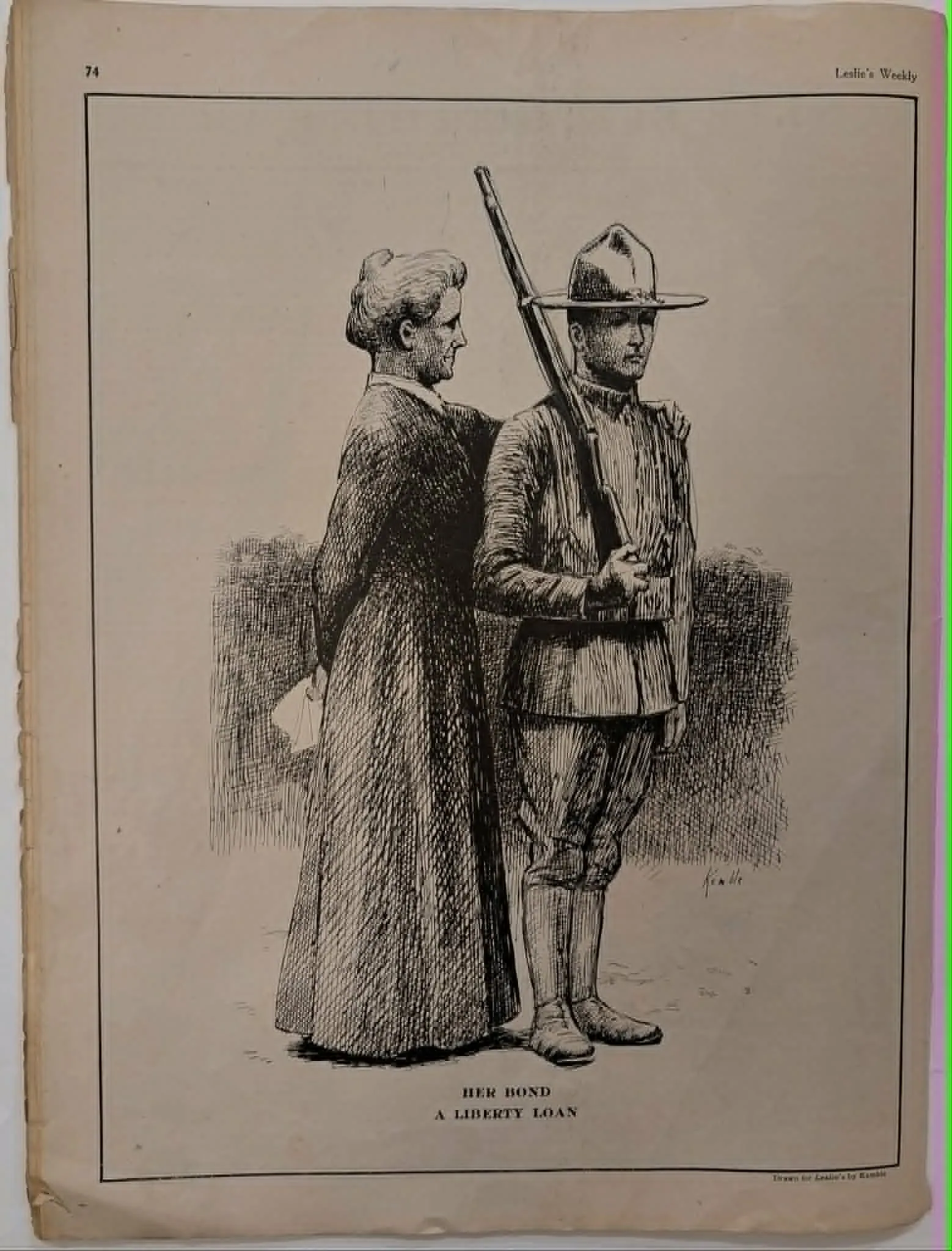
Look at the date. 1917. The global theater is locked in a mechanized stalemate. Before this precise epoch, the financial architecture of war was an institutional burden. Monarchies and treasuries funded standing armies through distant taxation and foreign debt. The civilian was a spectator to the economics of slaughter. They offered their sons, but their wallets remained largely insulated from the immediate, daily cost of artillery shells. This artifact marks the absolute death of that financial separation. It introduces a calculating, absolute new reality: the democratization of war debt. The battlefield is no longer just the muddy trenches of the Western Front. The battlefield has expanded into the American parlor. The emotional bond between a mother and her child is equated to a government promissory note. This is not merely a patriotic cartoon. It is the psychological reprogramming of a nation's wealth. It is the exact moment the state apparatus realized that to fund an industrialized war, it must weaponize domestic love, transforming private grief into public capital.
Category: Other
The History
The Economics of Industrial Slaughter To comprehend the profound weight of this artifact, one must first dissect the financial fracture of the world in 1917. For three years, Europe had been caught in a thermodynamic meat grinder. The concept of localized, maneuver-based warfare had been entirely obliterated by the invention of the machine gun, the high-explosive artillery shell, and the war of attrition. When the United States abandoned its desperate isolationism and entered the fray in April 1917, it faced a logistical and economic nightmare. The nation was fundamentally unprepared for the sheer mathematical cost of total war. The Treasury was inadequate to fund a rapid, massive mobilization alongside the billions required to prop up the failing British and French economies. The state required an unprecedented influx of immediate liquid capital. Taxation alone could not bear the weight of the war machine; it was too slow, too unpopular, and fundamentally insufficient for the scale of the conflict. The American government, spearheaded by Treasury Secretary William Gibbs McAdoo, engineered a solution that would forever alter the relationship between the citizen and the state: The Liberty Loan. However, creating a bond is merely a financial mechanism. Selling that bond to a largely rural, disconnected, and economically cautious populace required an aggressive campaign of psychological manipulation. The government had to convince ordinary citizens that parting with their savings was not an investment, but a moral imperative. The Lexicon of the Bond and the Commodification of Sacrifice How does a government convince a mother in Ohio to fund a war in Flanders? Through the careful, deliberate propaganda of parity and guilt. The title of this illustration by Kemble is a masterstroke of psychological manipulation. "HER BOND". The text operates on a devastating double entendre. In the financial sector, a bond is a debt security, a promise by the state to repay borrowed money with interest. In the human sector, a bond is the absolute, biological, and emotional tie between a mother and the son she birthed and raised. By placing these two words together beneath this specific image, the publication deliberately conflates the two definitions. The state is setting an exchange rate. The mother in the illustration has given her ultimate bond—her flesh and blood, a boy now dressed in the uniform of the state, holding a rifle, preparing to march into an industrial slaughterhouse. The viewer, sitting comfortably in their home, is therefore presented with an inescapable psychological trap. If this woman can surrender the life of her child to the state, how can the viewer refuse to surrender a mere fifty dollars? The artifact weaponizes civilian guilt. It turns the very concept of maternal sacrifice into a commodity, leveraging the deepest of human grief to underwrite the national debt. The mother is transformed into the ultimate underwriter of the conflict. The Erasure of Civilian Autonomy Examine the posture of the subjects. Pre-war depictions of motherhood in American art were heavily steeped in Victorian sentimentalism—soft, nurturing, protective, and domestic. This illustration violently severs that tradition. The mother here is stripped of softness. She stands rigid, her features sharp and heavily crosshatched with shadows of anxiety, her hand resting heavily on her son's shoulder. It is not an embrace; it is a physical transfer of ownership. She is formally handing him over to the machinery of the government. The young soldier does not look back at her. His face is stoic, blank, and pointedly directed forward, outside the frame, toward an unseen front line. He has already ceased to belong to her. He is no longer a son; he is an asset. The artifact records the exact historical shift where civilian autonomy was willingly surrendered to the state. The individual is eradicated, replaced entirely by their utility to the war effort. You are either the body that fights, the mother who surrenders the body, or the citizen who pays for the rifle the body carries. There are no other permissible identities in 1917. The Tactical Vector of the Printing Press In the early twentieth century, the media landscape was an entirely different biome. There was no television, and commercial radio was years away from mass adoption. Print media was the absolute, undisputed monarch of public perception. Weekly illustrated magazines like Leslie's did not merely report the news; they actively constructed the psychological reality of the nation. They functioned as the central nervous system of American public opinion. Images within these publications were designed for immediate, unfiltered emotional impact. They bypassed the critical, analytical centers of the brain and struck directly at the primitive core. This drawing by Kemble was deployed as a tactical vector. It was a visual weapon designed to align the internal psychology of the American working and middle classes with the cold, macroeconomic goals of the federal government. The pen and ink crosshatching, a necessity of the printing technology of the time, adds a harsh, gritty realism to the scene. It forces the viewer to confront the stark, unromantic reality of the transaction taking place. The illustration serves as a historical anchor point, documenting the moment the American media fully synchronized with the military-industrial complex, creating a blueprint for public relations and state propaganda that remains largely unchanged in its fundamental mechanics today.
The Paper
To handle this artifact is to interface with ephemeral architecture. It was explicitly designed for temporary consumption, not archival permanence. The substrate is a mass-produced, highly acidic wood pulp, likely resting between 50 and 65 GSM. In 1917, the priority was volume and speed of distribution. Over a century of existence, we observe the inevitable chemical degradation. The lignin within the wood fibers has oxidized violently upon prolonged exposure to ultraviolet light and atmospheric changes, resulting in the distinct, brittle browning creeping in from the frayed edges. Yet, this authentic aged paper texture provides a profound historical canvas. The original flat illustration style, meticulously preserved within Kemble’s dense pen-and-ink crosshatching, offers a precise schematic for modern preservation. Should this be transposed into a living 2D artwork, the stark, high-contrast black ink against the decaying paper provides perfect anchor points. The medium itself visually records the anxiety and the rapid, disposable nature of wartime information, transforming a temporary psychological weapon into a permanent anchor point of human history.
The Rarity
Classification: Class B This artifact is not classified in the higher tiers like SSS or Omega, as Leslie's Weekly was a mass-produced publication with hundreds of thousands of copies in circulation during the war. However, its rarity is derived entirely from its immense contextual value. Surviving copies from the exact months of the Liberty Loan drives are increasingly scarce due to the self-destructing nature of the acidic paper. Its true value lies not in a speculative auction house hammer price, but in its absolute purity as an unedited, real-time primary source document of state-sponsored psychological manipulation.
Cite this article
- MLA
- Naodhinsuk, Ronin. “The Time Traveller's Dossier : Leslie's 1917 - The Weaponization of Maternal Grief.” The Record Institute, 27 June 2026, https://therecord.institute/journal/the-time-travellers-dossier-leslies-1917-the-weaponization-of-maternal-grief.
- APA
- Naodhinsuk, R. (2026, June 27). The Time Traveller's Dossier : Leslie's 1917 - The Weaponization of Maternal Grief. The Record Institute. https://therecord.institute/journal/the-time-travellers-dossier-leslies-1917-the-weaponization-of-maternal-grief
- CHICAGO
- Naodhinsuk, Ronin. 2026. “The Time Traveller's Dossier : Leslie's 1917 - The Weaponization of Maternal Grief.” The Record Institute, June 27, 2026. https://therecord.institute/journal/the-time-travellers-dossier-leslies-1917-the-weaponization-of-maternal-grief.