The Time Traveller's Dossier : Leslie's 1917 - Total War Shift
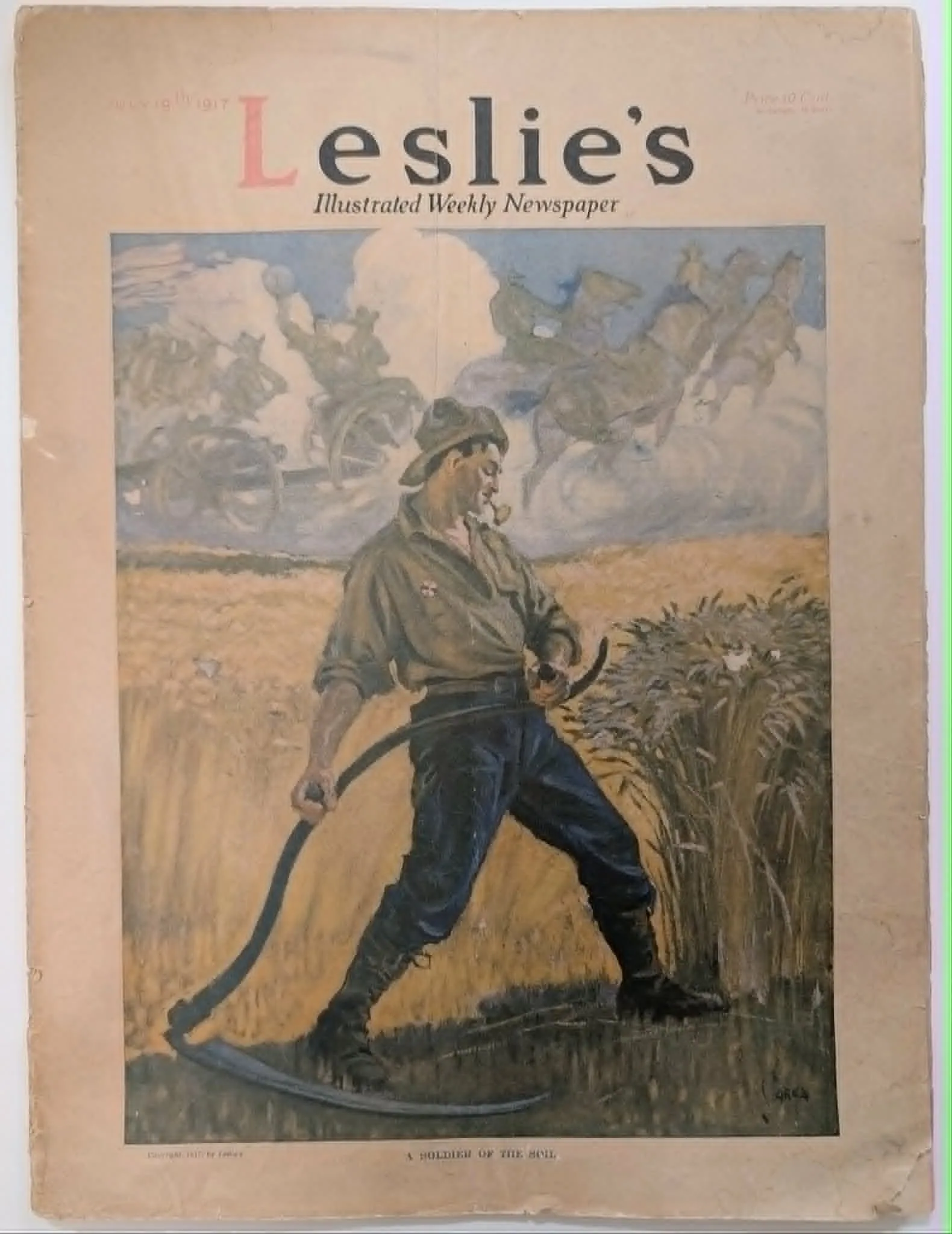
Look at the date. July 19, 1917. The world is burning. Before this precise epoch, conflicts were largely contained events. Wars were fought by standing armies on distant, designated fields. The civilian watched. The civilian waited. The civilian was a spectator to the machinations of empires. This artifact marks the death of the spectator. It introduces a terrifying, magnificent, and absolute new reality: Total War. The battlefield is no longer confined to the muddy trenches of the Western Front. The battlefield has expanded to the American wheat field. The scythe is equated to the bayonet. The harvest becomes a vital tactical offensive. This is not merely a magazine cover. It is a psychological reprogramming of a nation. It is the exact moment the state apparatus realized that to win an industrialized war, it must weaponize the civilian.
Category: Other
The History
The Global Fracture and the Death of Isolationism To understand this artifact, one must first understand the fracture of the world in the summer of 1917. For three years, Europe had been caught in a mechanized meat grinder. The concept of honorable, cavalry-driven warfare had been obliterated by the machine gun, the artillery shell, and poison gas. The United States, protected by the vast moat of the Atlantic Ocean, had clung to a desperate isolationism. That isolationism shattered in April 1917. The United States entered the fray. However, declaring war and waging war are entirely different logistical realities. The American public, largely rural and geographically isolated from the realities of European slaughter, required immediate psychological mobilization. The shift from a peacetime populace to a wartime machine was not organic; it had to be engineered. The state needed a mechanism to connect the dirt of the American Midwest to the mud of Flanders. They found that mechanism in the printing press. The Economics of Caloric Warfare Conflict is, at its absolute core, a matter of thermodynamics. A soldier is an engine of violence. An engine requires fuel. By mid-1917, the Allied engines were running catastrophically empty. The agrarian fields of France and Belgium were scarred by high-explosive craters, rendered toxic by chemical payloads, and emptied of the civilian hands required to till them. Simultaneously, the German U-boat campaigns in the Atlantic were systematically starving the British Isles, sinking merchant vessels and cutting off vital supply lines. The mathematics of the conflict shifted abruptly. The burden of caloric production moved entirely across the Atlantic Ocean. The American farmer was suddenly stripped of his localized, commercial identity. He was no longer simply growing crops for market profit. He became the primary, irreplaceable node in a global, industrialized supply chain of military survival. Without his wheat, the Allied lines would collapse from starvation before a single enemy bullet found its mark. The shift was absolute. The agricultural sector was immediately integrated into the military-industrial complex. The Propaganda of Parity How does a government convince a man thousands of miles from danger that his daily, mundane labor is an act of international heroism? Through the careful, deliberate propaganda of parity. The title of this illustration is a masterstroke of psychological manipulation: "A SOLDIER OF THE SOIL". It is an anointing. It bestows military honor upon civilian labor. It looks at the farmer—a man perhaps too old to draft, or deferred due to his critical occupation—and validates his existence within the wartime narrative. It tells the man who cannot hold a rifle that his scythe is just as lethal, just as necessary, and just as heroic. This erased the psychological boundary between the home front and the front line. Every act of labor, every crop harvested, every loaf of bread conserved became a direct act of aggression against the enemy. The civilian was eradicated, replaced by the non-uniformed combatant. The Magazine as a Tactical Vector In 1917, the media landscape was vastly different. There was no internet. There was no television. Commercial radio was in its infancy. Print was the absolute, undisputed monarch of public opinion. Magazines like Leslie's Illustrated Weekly Newspaper were not simply reporting the news; they were actively constructing the national reality. While competitors like Collier's or The Saturday Evening Post utilized a mix of text and imagery, Leslie's leaned aggressively into visual storytelling. It functioned as the cinematic universe of its era. At a price of 10 Cents (15 Cents in Canada), it was accessible mass media. It was designed to sit on parlor tables, in barbershops, and in train stations. The images were meant to be consumed instantly, bypassing the critical, analytical centers of the brain and striking directly at the emotional core. This illustration by Garcia was deployed as a tactical vector. It was a visual weapon designed to align the psychology of the agrarian working class with the geopolitical goals of the federal government. The Paradox of the Primitive There is a profound philosophical tension embedded within the history of this image. The year 1917 was defined by industrial horror—tanks, airplanes, and mechanized artillery. Yet, the hero of this cover is wielding a manual scythe. He is utilizing an ancient, primitive tool of human agriculture. This is a calculated choice. The scythe connects the modern war effort to deep, historical traditions of agrarian human survival. It presents the war not as a terrifying leap into a mechanized future, but as a defense of traditional, grounded human values. The paradox is striking: the primitive tool is being utilized to feed and fuel the most highly mechanized war machine in human history. The farmer cuts the wheat by hand, so the factory can build the shell, so the soldier can fire the gun. It is a continuous loop of energy transfer, beginning with the sun, the soil, and the scythe. The Draft and Societal Realignment July 1917 is a highly specific and critical timestamp. The Selective Service Act had just been passed in May, and the first draft lottery occurred in July of this exact year. Young men were being systematically pulled from the fields and factories. The men left behind had to bear an exponentially increased physical burden. They had to produce more food with less labor. The "Soldier of the Soil" narrative was therefore not just patriotic encouragement; it was an absolute operational necessity. It was an antidote to domestic guilt for those who did not go overseas, channeling potential shame into furious, productive agrarian energy.
The Paper
To hold this artifact is to interface with ephemeral architecture. It was never designed for permanence. The substrate is a low-grade, mass-produced wood pulp, likely resting between 50 to 70 GSM. In 1917, the priority was volume and distribution speed, not archival stability. The paper is highly acidic, a byproduct of the cheap manufacturing processes of the era. Over a century, we witness the inevitable chemical degradation. The lignin within the wood fibers has oxidized upon prolonged exposure to air and ultraviolet light, resulting in the distinct, brittle browning—the "foxing" that creeps in from the frayed edges. The printing utilizes early 20th-century rotary presses and rudimentary halftones. The ink sits heavily on the rough, fibrous texture of the page. There is a profound philosophical weight to this physical reality. This object was meant to exist for exactly seven days before being replaced by the next issue. It was disposable. Yet, through mere survival, this fragile arrangement of oxidized pulp and faded ink has mutated from temporary journalism into a permanent anchor point of human history. It records time not just in its text, but in its very decay.
The Rarity
Classification: Class A This artifact is not classified as SSS or Omega, as Leslie's was a mass-produced publication with hundreds of thousands of copies in circulation during its peak. However, its rarity is derived entirely from its contextual value. Surviving copies from the exact mobilization months of mid-1917 are increasingly scarce, primarily due to the acidic nature of the paper which ensures self-destruction over time. Its true value lies not in an auction house hammer price, but in its absolute purity as a primary source document. It is an unedited, real-time snapshot of a nation fundamentally altering its own societal structure.
Cite this article
- MLA
- Naodhinsuk, Ronin. “The Time Traveller's Dossier : Leslie's 1917 - Total War Shift.” The Record Institute, 27 June 2026, https://therecord.institute/journal/the-time-travellers-dossier-leslies-1917-total-war-shift.
- APA
- Naodhinsuk, R. (2026, June 27). The Time Traveller's Dossier : Leslie's 1917 - Total War Shift. The Record Institute. https://therecord.institute/journal/the-time-travellers-dossier-leslies-1917-total-war-shift
- CHICAGO
- Naodhinsuk, Ronin. 2026. “The Time Traveller's Dossier : Leslie's 1917 - Total War Shift.” The Record Institute, June 27, 2026. https://therecord.institute/journal/the-time-travellers-dossier-leslies-1917-total-war-shift.