The Time Traveller's Dossier : Leslie's 1918 - WWI Media Propaganda Shift
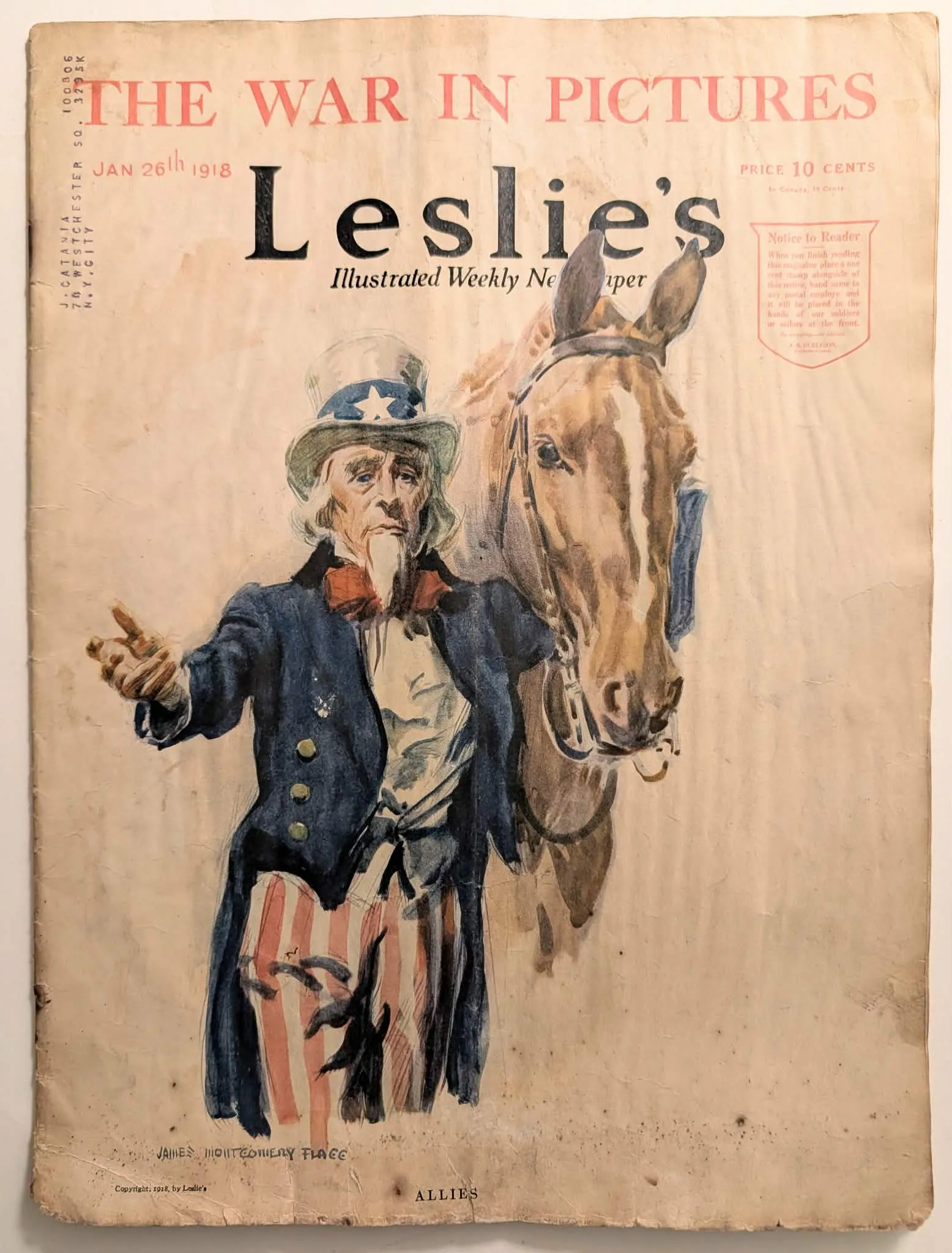
Information was once physical. It had weight. It had a trajectory. Before the immediate transmission of digital data, public morale was constructed through paper, ink, and logistics. This edition of Leslie’s Illustrated Weekly Newspaper, dated January 26, 1918, represents a critical intersection of journalism and state apparatus. It is not merely a magazine. It is a civilian weapon. The shift here is structural. A nation realizing that warfare requires more than ammunition. It requires a mobilized home front. It requires a decentralized system of psychological support. Through a simple red shield printed on its cover, this artifact transforms the passive reader into an active participant in global conflict. This is the architecture of wartime empathy. A record of when mass media became a supply line.
Category: Other
The History
The Architecture of a Global Winter The year is 1918. The month is January. The world is paralyzed in a state of mechanized slaughter. Trenches cut across the European continent like deep, unhealing scars. The conflict, once thought to be a brief geopolitical correction, has become an endless grinder of human and industrial resources. The United States has been officially involved in the First World War for less than a year. The initial wave of patriotic fervor is settling into a grim reality. Winter has halted major offensives. Both sides are digging in. The war is no longer just about territory. It is about attrition. It is about which society will collapse first. In this environment, information is a vital resource. The home front must remain committed. The soldiers on the front lines must remain connected to the society they are bleeding for. The physical distance between a trench in France and an apartment in New York City is vast. The psychological distance is even greater. The state needed a bridge. They built it out of paper. The Burleson Doctrine and Decentralized Logistics Examine the upper right corner of the artifact. A red shield. The typography is sharp, directive. "Notice to Reader." This small block of text represents a profound shift in national logistics. Authorized by A.S. Burleson, Postmaster-General, it instructs the reader to place a one-cent stamp on the magazine and hand it to any postal employee. No wrapping. No address. It will be delivered directly to soldiers or sailors at the front. This is a masterpiece of infrastructural engineering. Before the internet, before global radio broadcasts, maintaining morale required physical mass. Millions of men were isolated in mud and terror. The government could not single-handedly manufacture and distribute enough reading material to keep them anchored to their humanity. The solution was crowdsourced logistics. The state leveraged the private publishing industry. By establishing this protocol, the post office turned every civilian into a quartermaster of morale. The citizen buys the magazine. The citizen reads the news. The citizen pays the one-cent transit fee. The state handles the routing. This transformed a disposable weekly newspaper into a vital piece of military equipment. It bypassed complex sorting hubs. A single stamp converted civilian leisure into military support. This specific copy, however, never made that journey. The Upside-Down Anchor Look at the ink stamp on the left edge. J. CATANIA. 70 WESTCHESTER SQ., N.Y. CITY. The stamp is applied upside down. A careless, hurried motion by a local distributor or postmaster. This name and address ground the artifact in absolute reality. J. Catania was a specific human being living in the Bronx. They paid 10 cents for this issue. In 1918, a loaf of bread cost 9 cents. This magazine was a premium purchase. It was not a trivial acquisition. J. Catania read this issue. They saw the red shield. They read the directive from Burleson. And they chose to keep it. Or they forgot. Because they did not place that one-cent stamp, because they did not surrender it to the postal stream, this object survived. Had it fulfilled its intended destiny, it would have been shipped across the Atlantic. It would have been read in a trench. It would have been destroyed by mud, rain, fire, or time. Its failure to complete its state-mandated mission is the only reason it exists today. It is a survivor of intentional omission. James Montgomery Flagg and the Somber Uncle The visual anchor of the cover is the illustration by James Montgomery Flagg. Flagg was not just an artist. He was a psychological engineer. He is universally known for the 1917 recruitment poster: Uncle Sam pointing a harsh, demanding finger at the viewer. "I Want YOU for U.S. Army." That image was aggressive. It was an extraction of manpower. But this cover, printed only months later, represents a distinct shift in messaging. The title is simply: "ALLIES". Uncle Sam is no longer pointing. His posture is relaxed, yet weary. His eyes carry the heavy bags of an elder statesman burdened by the arithmetic of war. He is not demanding. He is presenting. His hand gestures outward, palm open, introducing his companion. This is not a call for recruitment. This is a call for endurance. Flagg understood that the public was tiring. The visual rhetoric had to evolve from aggression to partnership. The state was no longer just asking for men; it was asking for patience. The artwork reflects a nation settling into the long, dark middle of a horrific endeavor. Blood and Mud: The Equine Infrastructure The companion presented by Uncle Sam is a horse. This is a critical, often overlooked historical reality of World War I. We remember the Great War as the dawn of mechanized conflict. The birth of the tank. The introduction of aerial combat. The industrialization of the machine gun. It is categorized as a war of metal. This is an illusion. The war was fundamentally biological. It ran on muscle. Railways could only bring supplies to the edge of the battle zone. Beyond the railheads, the terrain was a nightmare of craters, mud, and shattered forests. Trucks and early tractors sank and failed. Only the horse and the mule could navigate the final, deadly miles to the front lines. They moved the artillery. They transported the wounded. They carried the ammunition. Without the horse, the mechanized war would have ground to a halt within days. Over eight million horses and mules died in World War I. They drowned in mud. They were shredded by shrapnel. They succumbed to exhaustion and starvation. The logistics of feeding the animals often superseded the logistics of feeding the soldiers. Flagg’s illustration elevates the beast of burden to the status of a sovereign ally. The horse stands tall, its eye locking directly with the viewer. It is a portrait of quiet dignity. The state is formally recognizing the silent, suffering backbone of its military infrastructure. The machine age had arrived, but it was still entirely dependent on blood and bone. Visualizing the Unthinkable (Leslie's Dominance) At the top, the masthead declares: "THE WAR IN PICTURES". This was Leslie’s core value proposition. In 1918, the public's understanding of global events was primarily textual. News was transmitted via telegraph and printed in dense columns of gray type. It was abstract. Leslie’s Illustrated Weekly Newspaper provided visual data. Photography from the front lines existed, but early cameras were bulky and required long exposures. They captured the static aftermath of battles, not the kinetic reality of them. Furthermore, the printing technology of daily newspapers rendered photos as blurry, high-contrast smudges. Leslie’s bridged this gap through a hybrid approach. They utilized high-quality rotogravure printing for internal photographs, and commissioned elite illustrators like Flagg for the covers. They provided the American public with a highly curated, visually striking interpretation of a reality they could not otherwise comprehend. The magazine did not just report the war. It shaped the visual memory of it. It taught the public how the war was supposed to look. This 10-cent purchase was the primary lens through which civilians visualized the geopolitical collapse of Europe.
The Paper
This document is printed on early 20th-century mass-market stock. It was engineered for extreme temporary utility. The paper contains a high percentage of wood pulp, retaining significant lignin. This chemical composition is inherently self-destructive. As the lignin oxidizes over a century, it shifts the paper from white to a deep, brittle sepia. The printing process reflects industrial scale. The black ink of the typography is deeply pressed, leaving a micro-embossment on the fibers. The cover utilizes an early form of commercial spot color. Notice the aging divergence. The red ink used for the masthead, the price, and the Burleson shield has maintained a stark, aggressive saturation. The watercolor tones of Flagg's illustration—the blues of the coat, the browns of the horse—have faded gracefully, integrating with the yellowing paper. The red, however, was formulated differently. It remains a harsh, unyielding alert on a decaying surface. It feels fragile to the touch. The edges are micro-frayed. It is a paradox: an object of immense historical weight, constructed from the most ephemeral materials available.
The Rarity
Class A This classification relies entirely on contextual survival. Millions of these issues were printed. It was a mass-market commodity. However, its intended lifecycle was incredibly short. The Burleson directive meant that a vast percentage of the print run was voluntarily shipped overseas, where the copies were subsequently destroyed in combat zones. The remaining domestic copies were heavily targeted during World War II paper drives, where millions of tons of old magazines were pulped for the new war effort. Finding an intact cover, free from severe water damage, retaining its vibrant red ink, and featuring the original, localized subscriber stamp (J. Catania), elevates its status. It is not an anomaly of production. It is an anomaly of preservation.
Cite this article
- MLA
- Naodhinsuk, Ronin. “The Time Traveller's Dossier : Leslie's 1918 - WWI Media Propaganda Shift.” The Record Institute, 24 June 2026, https://therecord.institute/journal/the-time-travellers-dossier-leslies-1918-wwi-media-propaganda-shift.
- APA
- Naodhinsuk, R. (2026, June 24). The Time Traveller's Dossier : Leslie's 1918 - WWI Media Propaganda Shift. The Record Institute. https://therecord.institute/journal/the-time-travellers-dossier-leslies-1918-wwi-media-propaganda-shift
- CHICAGO
- Naodhinsuk, Ronin. 2026. “The Time Traveller's Dossier : Leslie's 1918 - WWI Media Propaganda Shift.” The Record Institute, June 24, 2026. https://therecord.institute/journal/the-time-travellers-dossier-leslies-1918-wwi-media-propaganda-shift.