The Time Traveller's Dossier : LIFE 1965 - The Geometry of War
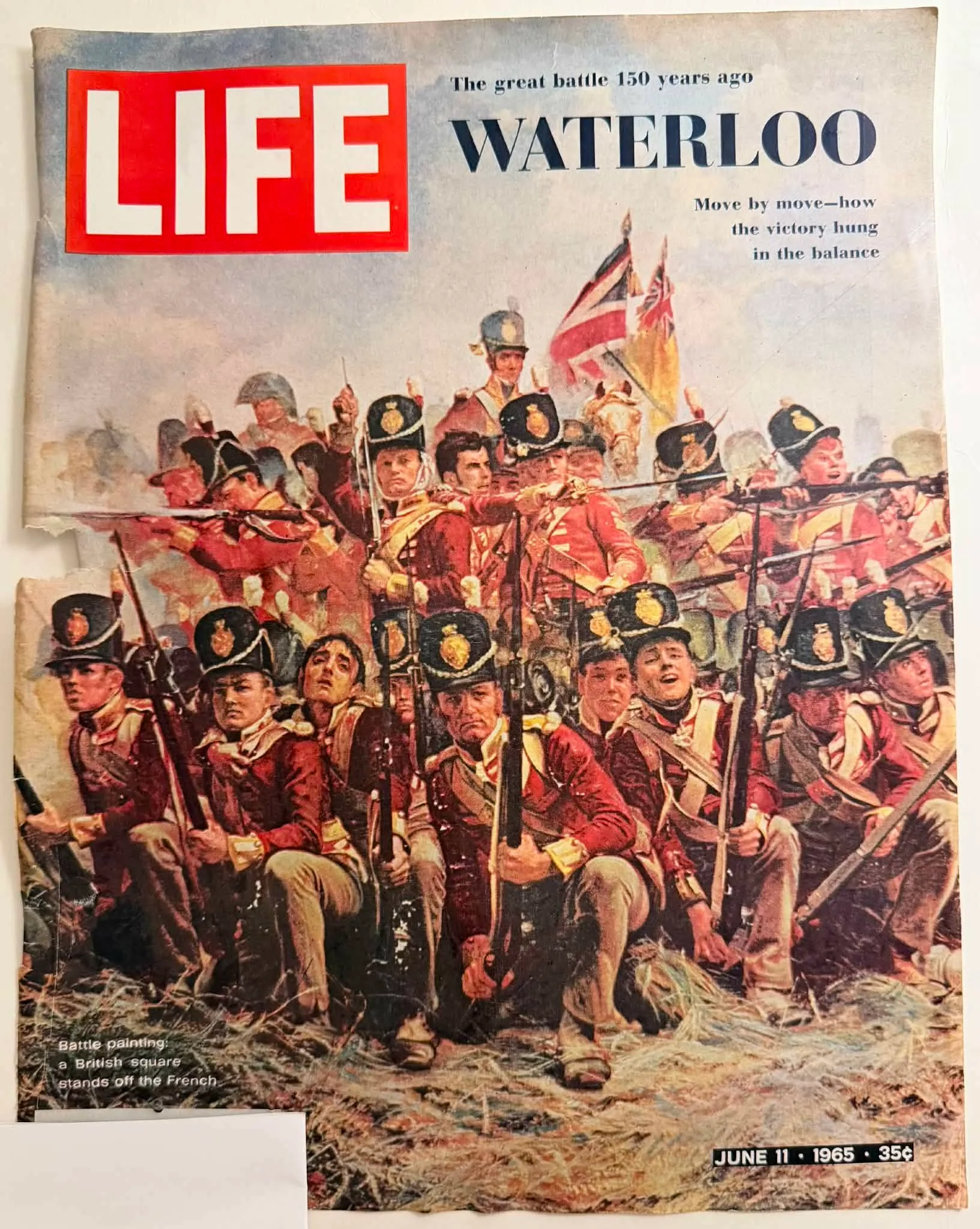
June 11, 1965. The world was hurtling toward an ambiguous future. Television was beaming the messy, borderless reality of the Vietnam War directly into American living rooms. The atomic age had rendered traditional combat obsolete. Geopolitics was a shadow play of proxy wars and unseen threats. And how did LIFE—the dominant visual organ of the American century—respond? By looking backward. By retreating exactly one hundred and fifty years. They abandoned the photograph. They embraced the brushstroke. They presented the Battle of Waterloo. This artifact is not merely a magazine cover. It is a psychological anchor. It represents a desperate cultural yearning for the "geometry of war"—a time when enemies stood in predictable squares, when victory hung in the balance of a single afternoon, and when the lines between victory and defeat were drawn distinctly in the mud. Here is the record of a society seeking clarity in the past because the present had become too complex to photograph.
Category: Other
The History
The Architecture of 1965 To understand this document, you must first understand the room in which it was opened. The year 1965 was a crucible. The post-war optimism of the 1950s had entirely fractured. In March of that year, the United States deployed its first official combat troops to Da Nang, Vietnam. The Cold War was a permanent, vibrating frequency of dread. The space race was accelerating, pushing humanity toward the cold vacuum of the cosmos. Everywhere the modern citizen looked, the world was expanding, dissolving, and becoming terrifyingly abstract. The nature of conflict itself had shifted. There were no longer grand cavalry charges. There was only the quiet terror of mutually assured destruction and the guerilla warfare of the jungle. In this environment of severe modern anxiety, media had to adapt. LIFE magazine was the undisputed titan of photojournalism. For decades, its mandate was to show the world to the world. But by the mid-1960s, a new apex predator stalked the media landscape: television. The evening news was beginning to broadcast moving images of global events. The static photograph, printed on a weekly delay, was losing its monopoly on the truth. The Editorial Retreat to Certainty LIFE was locked in a brutal war of attrition with competitors like Look and The Saturday Evening Post. Advertising revenues were slowly hemorrhaging to broadcast networks. To survive, LIFE needed to offer something television could not: scale, permanence, and deep, curated context. This cover marks a profound shift in editorial strategy. Rather than competing with the instantaneous, chaotic footage of contemporary conflicts, the editors chose to curate history. They commissioned or reproduced a painting. This is a critical technological and philosophical inversion. A magazine built on the revolutionary speed of the camera shutter chose to halt time entirely, utilizing the slow, deliberate medium of the painter's canvas. Why Waterloo? The 150th anniversary provided the hook, but the psychological subtext was the true driver. The Battle of Waterloo, fought on June 18, 1815, is the ultimate symbol of a definitive conclusion. It was the absolute end of the Napoleonic Wars. It was a conflict decided in a single, brutal day. For an American public staring down the barrel of an unwinnable, unending quagmire in Southeast Asia, the story of Waterloo was a comforting myth. It offered a narrative where the "good guys" formed an unbreakable square, held their ground against a tyrant, and emerged unequivocally victorious. The Geometry of the British Square The image chosen is highly specific. It depicts a British infantry square. This was a defensive tactical formation designed to repel cavalry. Men stood shoulder-to-shoulder, a bristling fortress of bayonets and muskets. It is a triumph of geometry over chaos. It is order violently asserting itself against disorder. In 1815, this was the pinnacle of military technology and discipline. By 1965, it was a romantic anachronism. Yet, the visual power of the square remains undeniable. The men in the painting are looking outward, surrounded by an unseen threat. This mirrored the paranoia of the Cold War era perfectly. The West felt itself surrounded, forming a metaphorical square against the encroaching ideologies of the East. The Translation of Medium This artifact also documents a fascinating shift in visual reproduction. We are looking at a mid-20th-century mass-market reproduction of a 19th-century aesthetic. The magazine's lithographic presses had to translate oil paint into four-color ink. This mechanical process inadvertently created a distinct visual language. The rich, deep oils were flattened. The complex lighting was reduced to halftone dots. What emerged on the printed page was a remarkably flat illustration style, characterized by a specific, muted period color palette. The stark reds of the British uniforms, the oxidized blues of the sky, the muddy browns of the earth—these colors became codified through the limitations of the printing press. This process captured the hand-drawn stroke quality of the original art but bound it to the rigid structure of mass media. It is a hybrid artifact: part fine art, part industrial output. It is a physical manifestation of a society trying to mechanically reproduce the aura of history, seeking comfort in the hand-painted lines of the past while operating the massive, impersonal machines of the present.
The Paper
This document is a physical clock, quietly recording the passage of time. The substrate is a standard mid-century machine-coated magazine stock, likely weighing around 65 to 70 GSM. It was designed for immediate consumption, not archiving. It was engineered to be inexpensive, lightweight, and highly receptive to ink. Under magnification, the surface reveals the mechanical truth of its creation. The image is constructed entirely of CMYK halftone rosettes. Millions of cyan, magenta, yellow, and black dots overlap to trick the human eye into perceiving a solid image. But the paper is failing, exactly as it was designed to do. The edges reveal the harsh truth of lignin oxidation. The paper has shifted from a bright, manufactured white to a deep, organic yellow. This aging process is not a flaw; it is a feature of the artifact's current existence. The aged paper texture—brittle, slightly fibrous, smelling faintly of decaying wood pulp and oxidized ink—provides a tactile grounding. It is this exact texture, this precise manifestation of decay, that gives the artifact its weight. It is the undeniable physical proof that this object has survived the relentless forward march of decades.
The Rarity
In terms of pure numerical scarcity, this artifact is not rare. LIFE magazine boasted a circulation in the millions during 1965. Countless copies of this specific issue were printed, shipped, read, and subsequently discarded. It is a product of ultimate mass manufacturing. However, its rarity is not defined by its physical scarcity, but by its contextual survival. Finding a copy that has not succumbed to moisture, fire, or the landfill is a statistical anomaly. Its value lies entirely in its historical significance. It is a perfectly preserved cross-section of mid-century American anxiety, masquerading as a history lesson. It is a Class B artifact—common in origin, but profoundly rare in its ability to communicate the psychological shift of an entire era.
Cite this article
- MLA
- Naodhinsuk, Ronin. “The Time Traveller's Dossier : LIFE 1965 - The Geometry of War.” The Record Institute, 8 August 2026, https://therecord.institute/journal/the-time-travellers-dossier-life-1965-the-geometry-of-war.
- APA
- Naodhinsuk, R. (2026, August 8). The Time Traveller's Dossier : LIFE 1965 - The Geometry of War. The Record Institute. https://therecord.institute/journal/the-time-travellers-dossier-life-1965-the-geometry-of-war
- CHICAGO
- Naodhinsuk, Ronin. 2026. “The Time Traveller's Dossier : LIFE 1965 - The Geometry of War.” The Record Institute, August 8, 2026. https://therecord.institute/journal/the-time-travellers-dossier-life-1965-the-geometry-of-war.