The Time Traveller's Dossier : Lipchitz - Death of Archives
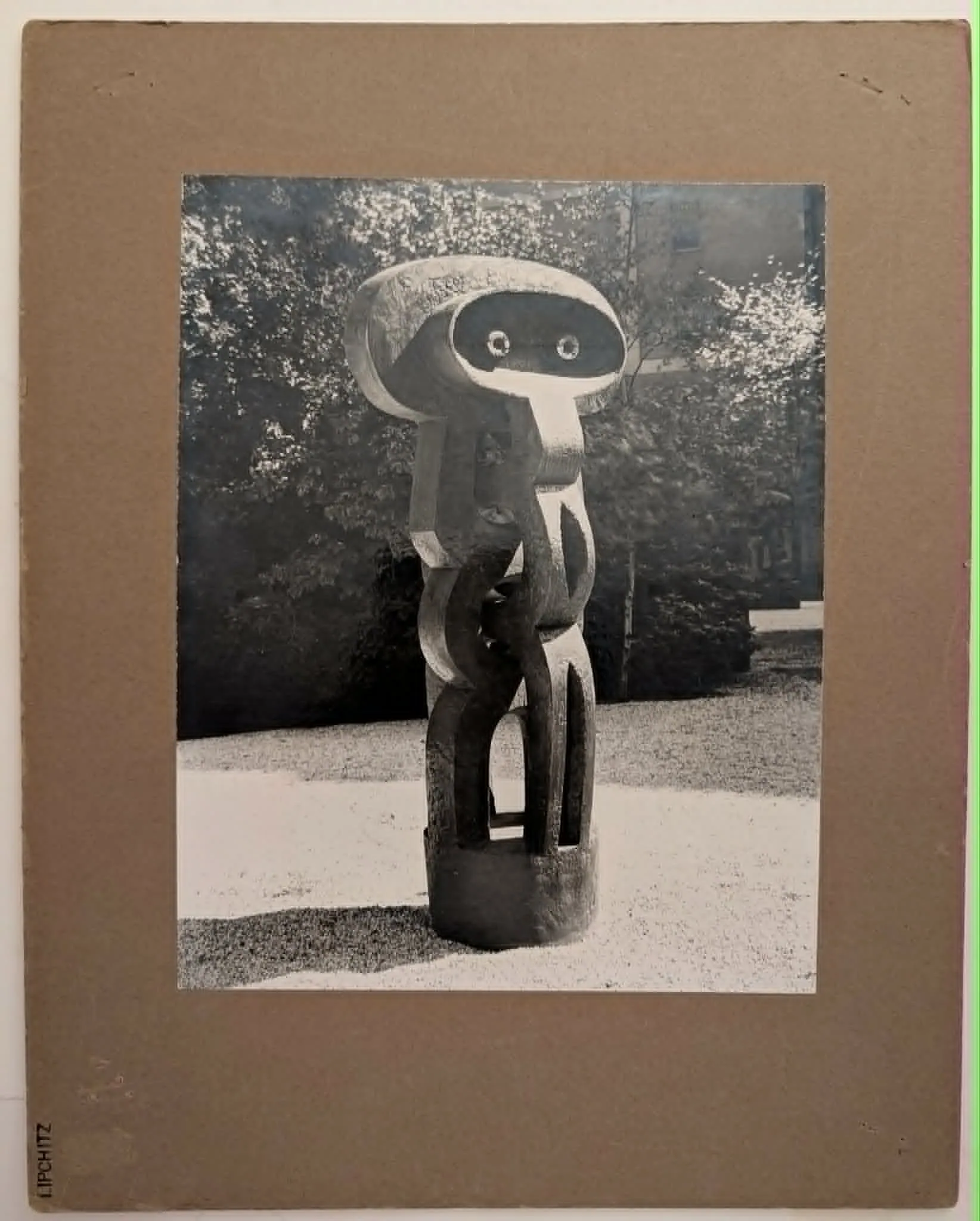
An artifact is rarely a single, static entity. It is a layered compression of human intent, institutional pride, and, ultimately, societal entropy. In the mid-twentieth century, knowledge possessed physical weight. If a citizen sought to understand the trajectory of modern European sculpture, they did not query a void; they walked into a civic temple, pulled a heavy wooden drawer, and retrieved a tangible asset. This mounted photograph was a prized bridge between the high-art echelon of New York's Museum of Modern Art and the democratic public sphere of Seattle. It was curated. It was protected. It was fiercely claimed as institutional property. Then came the great paradigm shift of the digital dawn. The physical archive, once the beating heart of human retention, was suddenly deemed a spatial liability. This artifact is no longer a photograph of a bronze sculpture. It is a casualty of the digital revolution. Marked with the brutal ink of deaccession, it represents the exact moment our society traded the tactile, deeply contextual weight of physical memory for the sterile, frictionless, and utterly amnesic convenience of the cloud.
Category: Other
The History
The Forging of the Totem in an Anxious Age To truly comprehend the gravity of this surviving artifact, we must first dissect the subject it so coldly catalogs. The photograph captures Jacques Lipchitz’s "Figure," a towering bronze cast between 1926 and 1930. During this volatile interwar period, Lipchitz, alongside the global consciousness, was undergoing a radical metamorphosis. The strict, analytical, and highly mathematical geometry of his early Cubist phase felt suddenly insufficient to capture the psychological dread and organic complexity of a world that had just torn itself apart and was preparing to do so again. He began to explore what art historians term his "transparent" phase, moving eventually into these monumental, totemic structures. This specific bronze figure is a monolithic exploration of the primitive through the razor-sharp lens of modernism. It is dense, vertical, and commanding—an imposing intersection of organic curves and brutalist voids. It feels less like a representation of a human and more like a mythic guardian forged from the very atmosphere of twentieth-century anxiety. When the Museum of Modern Art in New York acquired and displayed this piece, they were codifying it as a masterpiece of the modernist canon. It was a three-dimensional triumph of spatial philosophy. Yet, the artifact we hold today is not the bronze. It is the institutional ghost of that bronze, flattened, packaged, and shipped across a continent. The Architecture of the Decentralized Museum How does the atmospheric dread of Parisian modernism end up in a cardboard file in the Pacific Northwest? The answer lies in the profound mid-century phenomenon of the American public library as a decentralized museum. Following the economic explosion of the post-WWII era, the United States invested unprecedented capital into public infrastructure, specifically targeting visual and cultural literacy. Before the advent of the internet, the transmission of visual culture relied entirely on the mass production of physical proxies. Libraries developed exhaustive "picture files." These were heavily curated collections of visual data designed to democratize high art. If an art student, an architect, or a curious citizen in Seattle wished to study Lipchitz, they physically interacted with this exact board. This artifact was engineered to be handled by thousands of hands over decades. It was a highly sophisticated piece of analog information architecture. The photograph provided the visual data, while the meticulously typed label provided the metadata: Creator, Title, Material, Date, Dimensions, and Provenance. It reduced a seven-foot-tall, multi-ton bronze colossus into a perfectly manageable, reproducible data point that could be filed under "S" for Sculpture. The Custodians of Ephemera and the War on Entropy The physical nature of this board reveals a fierce, almost tragic war against entropy. Observe the militant instructions stamped onto the reverse of the heavy cardstock: "Use no thumb tacks gummed tape or mark in any way." This is the voice of the mid-century custodian. In a world where visual media was finite, expensive, and fragile, the librarian acted as a sovereign protector. They understood that human touch was the enemy of preservation. Every time this board was checked out, it risked destruction. The institution was obsessively possessive, stamping "Property of Seattle Public Library Art Dept." multiple times across its surface. This repetition of ownership is deeply psychological; it asserts that the knowledge contained on the board belongs to the collective, but is governed by the state. The library demanded that the object remain pristine, a perfect transmission of information from one generation to the next. The custodians fought valiantly to protect the artifact from the physical degradation of the public, entirely unaware that the true threat to its existence would not be a careless thumbtack, but the obsolescence brought forth by the speed of light. The Execution Order of the Digital Age The most historically significant element of this artifact is not the sculpture it depicts, nor the original ownership stamps. The paramount feature is the heavy, black, capitalized ink that reads: "DISCARDED THIS IS NO LONGER PROPERTY OF THE SEATTLE PUBLIC LIBRARY." This stamp is an act of institutional violence. It is an execution order. During the late 1990s and early 2000s, humanity underwent the most aggressive shift in information storage since the burning of the Library of Alexandria, though this destruction was voluntary and celebrated under the guise of "digitization." As internet access proliferated and digital scanning became ubiquitous, physical picture files transformed overnight from invaluable civic assets to massive spatial liabilities. They took up too much square footage. They required too much manual labor to index, retrieve, and refile. When the institution struck this board with the "DISCARDED" stamp, they were not just throwing away a piece of cardboard; they were officially severing their relationship with a specific mode of learning. It marks the exact terminal point where the utility of a physical photograph dropped to zero in the eyes of the state. The artifact was stripped of its aristocratic provenance, stripped of its civic duty, and banished to the void. The Phantom Limbs of Institutional Memory Today, we suffer from the phantom limbs of this lost institutional memory. If a student today wishes to view Lipchitz's 1926 figure, they type a query into a search engine and are instantly rewarded with a frictionless, high-resolution JPEG, floating in a white, contextless digital void. It takes half a second. But what is lost in this transaction? We have traded the weight of the archive for the weightlessness of the data point. When a citizen handled this specific artifact, they were engaging with a lineage. They felt the weight of the high-GSM board. They saw the faded typewriter ribbon that typed "LIPCHITZ, Jacques". They saw the catalog number "19043" written in bold, confident graphite by an anonymous archivist long dead. They saw the wear on the corners, indicating that hundreds of others in their city had sought out this exact same image before them. This artifact is saturated with human time. A digital image is eternal, but it is sterile; it has no patina, no history of being possessed, protected, and ultimately abandoned. This surviving board forces us to confront the reality that when we discarded the physical archive, we gained infinite convenience, but we permanently lost the intimacy, the serendipity, and the tactile humanity of the search.
The Paper
The structural reality of this artifact is an exercise in mid-century industrial endurance. It is fundamentally composed of two distinct materials bound together to survive the hostile environment of public circulation. The image itself is a classic gelatin silver print. This photographic process relies on a suspension of silver salts in gelatin. Over time, as we see in the subtle degradation of the image's deeper shadows, the silver begins to oxidize, subtly shifting the tonal range and causing a faint, metallic mirroring effect in the blacks. However, it is the mounting board that tells the true story of its institutional life. This is a heavy, acid-neutral binder’s board, likely pushing 800 to 1000 GSM. It is fiercely rigid, designed to remain perfectly flat despite decades of handling and atmospheric humidity changes. The texture is porous and fibrous, deliberately engineered to create friction so it would not slip within massive wooden filing cabinets. The various ink stamps reveal a brutalist mechanical application; the ink has been driven deeply into the cellulose fibers, bleeding slightly along the grain. The aging process here—the embrittlement of the edges, the slight yellowing of the typed label, and the fading of the typewriter ribbon—serves as an inescapable, physical clock. The artifact is literally recording the passage of time through its own cellular decay.
The Rarity
Classification: Class B (Contextual Relic). The raw photographic print of Lipchitz's "Figure" is not inherently rare; museums distributed thousands of promotional images of their collections. However, the exact configuration of this object elevates its rarity immensely. It is a "survivor" of a systemic, nationwide purge. When libraries digitized, these boards were thrown into dumpsters by the tens of thousands. This specific artifact, complete with its conflicting stamps of aggressive ownership ("Property of...") and ultimate rejection ("DISCARDED"), is a profound historical document. Its value does not lie in a speculative art market, but in its unparalleled contextual density. It is a fossil of twentieth-century information architecture.
Cite this article
- MLA
- Naodhinsuk, Ronin. “The Time Traveller's Dossier : Lipchitz - Death of Archives.” The Record Institute, 30 June 2026, https://therecord.institute/journal/the-time-travellers-dossier-lipchitz-death-of-archives.
- APA
- Naodhinsuk, R. (2026, June 30). The Time Traveller's Dossier : Lipchitz - Death of Archives. The Record Institute. https://therecord.institute/journal/the-time-travellers-dossier-lipchitz-death-of-archives
- CHICAGO
- Naodhinsuk, Ronin. 2026. “The Time Traveller's Dossier : Lipchitz - Death of Archives.” The Record Institute, June 30, 2026. https://therecord.institute/journal/the-time-travellers-dossier-lipchitz-death-of-archives.