The Time Traveller's Dossier : Lotus 72 - The Dawn of Aerodynamic Commerce
Before this distinct historical marker, racing machines were sculpted like artillery shells. They were engineered to pierce through the atmosphere with minimal resistance, cloaked in the solemn, traditional colors of their respective nations. Racing was a mechanical pursuit, funded by wealthy industrialists and driven by gentleman gladiators. After this marker, the paradigm violently fractured. Racing vehicles became inverted wings. They were designed not to slip through the air, but to aggressively weaponize the atmosphere, manipulating fluid dynamics to crush the tires into the asphalt. Simultaneously, the vehicles were stripped of their national identities, repainted in the hyper-calculated, vibrant liveries of global tobacco conglomerates. The problem of the late 1960s was a physical one: mechanical grip had reached its absolute terrestrial limit. The solution was aerodynamic downforce, a pursuit that required infinite corporate capital to sustain in the wind tunnel. This archived document does not merely commemorate a singular race. It physically records the exact mutation of a sport into a global commercial complex.
Category: Automotive
The History
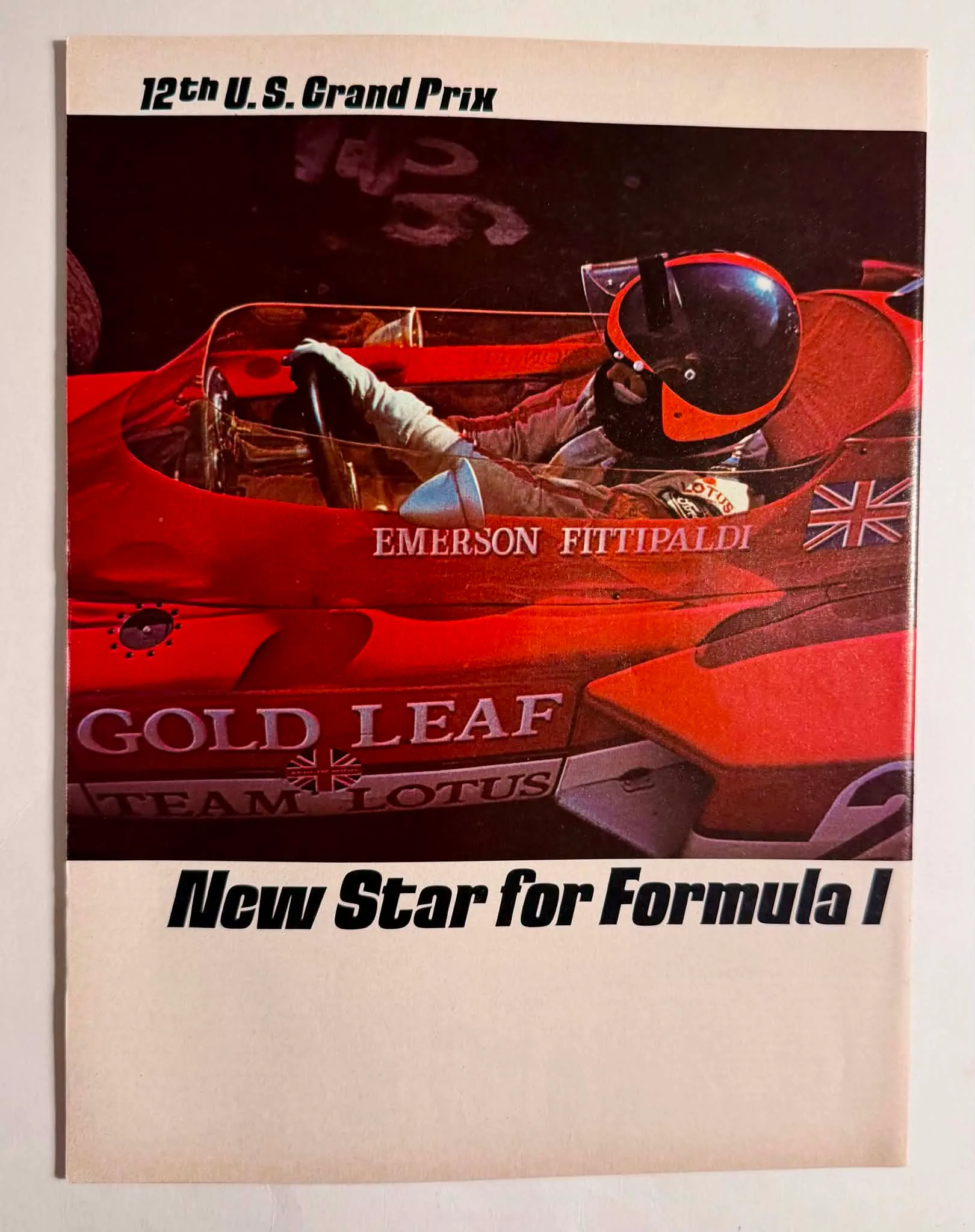
To comprehend the sheer gravity of this artifact, one must first understand the architectural stagnation of the era that preceded it. Throughout the 1950s and the majority of the 1960s, the predominant philosophy of automotive racing design was dictated by the cylinder. Engineers believed that the most efficient way to travel rapidly across a static plane was to present the smallest possible frontal area to the wind. Cars were shaped like cigars. The driver sat exposed at the center, the engine was mounted behind, and the radiator was positioned at the very tip of the nose. This configuration necessitated a large opening at the front to gulp ambient air, which would then travel through the radiator matrix and exit haphazardly around the driver or over the chassis. This methodology created an inescapable aerodynamic wall. The air entering the nose created massive drag, and as speeds increased, the air flowing over the cylindrical body created aerodynamic lift. The faster the cars traveled, the lighter they became, fundamentally disconnecting the rubber from the asphalt. The artifact before us represents the violent rejection of that philosophy. The machine depicted is the Lotus 72, conceived by Colin Chapman and Maurice Philippe. It is arguably the most significant vehicle in the history of motorsport, primarily because it ceased treating the atmosphere as an empty void to be pierced, and instead treated it as a heavy fluid to be manipulated. Chapman realized that to increase cornering speeds, the car needed to be pushed into the earth. The Lotus 72 achieved this by entirely discarding the front-mounted radiator. Instead, the cooling matrices were split in half and relocated to the sides of the driver, housed within distinct aerodynamic pods. This singular engineering decision allowed the nose of the car to be flattened into a sharp chisel. The wedge shape was born. The chassis itself became an aerodynamic device, deflecting oncoming air upward, thereby pressing the front tires down into the track surface. Beneath the fiberglass skin, the mechanical architecture was equally revolutionary. To complement the aerodynamic grip, Chapman needed to optimize the mechanical grip by reducing unsprung mass—the weight of the components not supported by the car's suspension. He moved the heavy brake discs from inside the wheels to an inboard position on the chassis itself. Furthermore, the traditional coiled springs were entirely discarded in favor of compact, internal torsion bars. This allowed the suspension geometry to be aggressively tuned to handle the immense new aerodynamic loads without the car collapsing under the invisible weight of the wind. The vehicle captured in this document is not a car; it is a low-flying aircraft engineered to stay tethered to the ground. However, the technological shift is only half the narrative etched into this artifact. The other half is purely economic, and it is arguably more impactful. For decades, international racing adhered to strict, unwritten codes of national identity. Italian cars were Rosso Corsa. French cars were Bleu de France. German cars were silver. British cars, including the ancestral lineage of Lotus, were painted in the deep, aristocratic hue of British Racing Green. It was a romantic, nationalistic visual language. But Chapman recognized that the era of aerodynamic warfare required a scale of financial investment that independent constructors simply did not possess. Wind tunnels, advanced composites, and continuous iteration demanded limitless capital. The solution was the total commodification of velocity. In a move that shocked the traditionalist racing establishment, Chapman stripped his cars of their British Racing Green. He struck a highly lucrative partnership with Imperial Tobacco and repainted his revolutionary wedge in the stark red, gold, and white of their Gold Leaf brand. The rolling billboard was born. As evidenced in the document, the text "GOLD LEAF TEAM LOTUS" dominates the lower flank of the chassis, rendered in bold, serif typography. The proud national identity has been reduced to a minuscule Union Jack decal, relegated to a supporting role beneath the corporate sponsor and next to the driver's name. This artifact documents the exact moment the soul of the sport was monetized. Formula 1 became the ultimate vector for unregulated, high-speed corporate advertising. The historical context of the specific event recorded here elevates the artifact from a mere advertisement to a profound historical document. The year 1970 was a season shrouded in deep tragedy. Team Lotus was led by the brilliant, charismatic Austrian driver Jochen Rindt. Driving the revolutionary Lotus 72, Rindt dominated the summer, amassing a massive championship lead. However, during practice for the Italian Grand Prix at Monza, Rindt suffered a catastrophic mechanical failure and was killed instantly. The racing world was paralyzed. Rindt had accumulated enough points that he could potentially win the World Championship posthumously, an unprecedented and macabre scenario. But the Ferrari team, led by Jacky Ickx, was rapidly closing the point gap. In a state of profound grief and immense pressure, Team Lotus arrived at Watkins Glen for the penultimate race of the season. As boldly printed at the top of the document, this was the "12th U.S. Grand Prix". With their star driver dead, Chapman thrust the responsibility onto the shoulders of a 23-year-old Brazilian rookie who had only started three Formula 1 races in his life. His name, clearly stenciled on the side of the cockpit, was Emerson Fittipaldi. The psychological burden on Fittipaldi was unimaginable. He was driving the same model of car that had just killed his mentor, tasked with defeating the surging Ferraris to protect Rindt's legacy. Against all logical probability, Fittipaldi drove a masterful race at Watkins Glen. He secured his maiden victory, clinching the Constructor's Championship for Team Lotus and officially securing the posthumous World Driver's Championship for the ghost of Jochen Rindt. The bold, italicized declaration anchored at the bottom of the artifact—"New Star for Formula I"—is therefore stripped of any marketing hyperbole. It is a stark, accurate historical record of a torch being passed under the most traumatic circumstances imaginable. Fittipaldi would indeed become a dominant force in the decade, validating the prophecy printed on this very page.
The Paper
The physical composition of the document serves as an analog chronometer, measuring the decay of the era it depicts. The substrate is a standard, un-coated mechanical pulp paper, likely weighing between 90 and 110 GSM, typical of mid-century periodical printing. Over the decades, the lignin within the wood pulp has oxidized, resulting in a subtle, uneven yellowing across the negative space, clearly visible behind the black typography. The image itself is rendered through four-color offset lithography. A close examination of the crimson bodywork reveals a dense matrix of cyan, magenta, yellow, and key (black) halftone dots. In this analog process, the microscopic misalignment of the printing plates during a high-speed press run creates a distinct, slightly softened texture that cannot be replicated by digital pixels. The ink has sunk deep into the porous fibers of the paper, trapping the violent energy of a 400-horsepower machine into a completely static, fragile matrix. The slight bleed of the heavy black ink in the "12th U.S. Grand Prix" text speaks to the heavy pressure of the period's rotary presses.
The Rarity
Archival Classification: Class S. While millions of magazines were printed in 1970, the survival rate of this specific advertisement, preserved without devastating tears or severe moisture damage, is exceptionally low. Its classification, however, is driven entirely by contextual value rather than mere scarcity. This is not a generic race promotion. It is a memorial document intersecting the pinnacle of Colin Chapman's engineering, the tragic death of Jochen Rindt, the explosive arrival of Emerson Fittipaldi, and the irrevocable dawn of corporate sports sponsorship. It holds immense historical gravity.
Cite this article
- MLA
- Naodhinsuk, Ronin. “The Time Traveller's Dossier : Lotus 72 - The Dawn of Aerodynamic Commerce.” The Record Institute, 28 August 2026, https://therecord.institute/journal/the-time-travellers-dossier-lotus-72-the-dawn-of-aerodynamic-commerce.
- APA
- Naodhinsuk, R. (2026, August 28). The Time Traveller's Dossier : Lotus 72 - The Dawn of Aerodynamic Commerce. The Record Institute. https://therecord.institute/journal/the-time-travellers-dossier-lotus-72-the-dawn-of-aerodynamic-commerce
- CHICAGO
- Naodhinsuk, Ronin. 2026. “The Time Traveller's Dossier : Lotus 72 - The Dawn of Aerodynamic Commerce.” The Record Institute, August 28, 2026. https://therecord.institute/journal/the-time-travellers-dossier-lotus-72-the-dawn-of-aerodynamic-commerce.