The Time Traveller's Dossier : Lufthansa - Uniting the Nations
Before the commercial turbine, geography was an absolute prison. Oceans were measured in weeks. Mountains were impassable walls. Borders were rigid, physical realities. Then came the jet age. The aircraft became the ultimate instrument of physical connection. This artifact is not a mere advertisement for an airline. It is a profound geopolitical statement disguised as corporate marketing. It represents a pivotal moment in the twentieth century. A moment when a nation, physically and ideologically severed in two, claimed to be the architect of global unity. The problem was distance, both literal and diplomatic. The solution was thrust, aluminum, and a calculated projection of national identity.
Category: Travel
The History
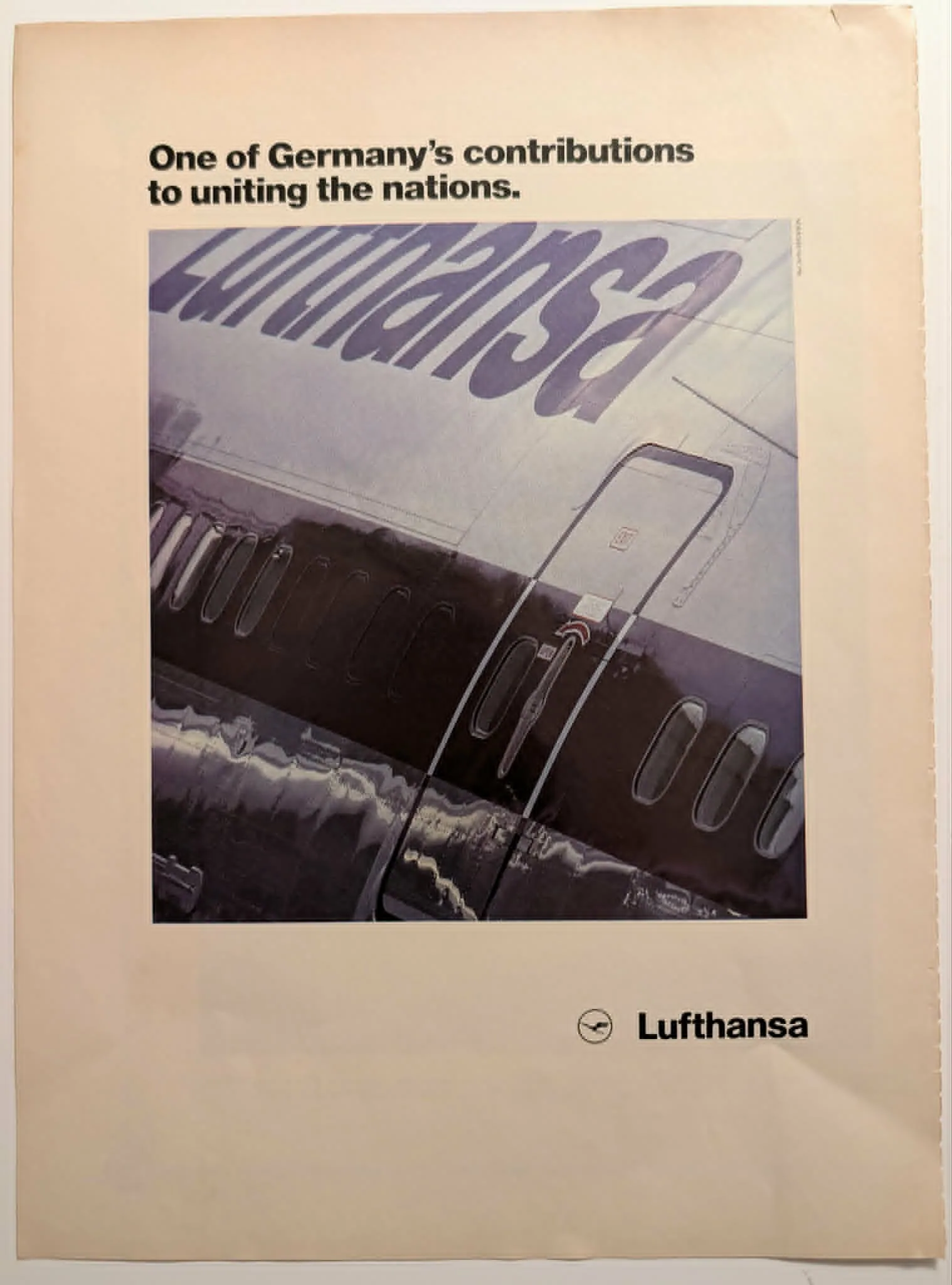
The Geopolitical Irony of a Divided Nation To understand the gravity of this document, one must anchor it in its exact historical context. We are looking at an artifact from the mid-to-late Cold War era. The world was bisected by ideology. The epicenter of this global fracture was Germany. A nation split by an iron curtain. A physical wall ran through its historical capital. West Germany—the Federal Republic—existed as a frontline state, highly industrialized, yet geopolitically confined. In this environment of absolute division, this advertisement emerges. "One of Germany's contributions to uniting the nations." The psychological weight of this headline is immense. A country that was forcibly divided is positioning its flag carrier as a mechanism for global unification. It is a masterclass in soft power. West Germany could not unite itself. Therefore, it projected its desire for unity outward, upon the rest of the globe. Lufthansa was not just an airline. It was the airborne proxy of the Wirtschaftswunder. The West German economic miracle. Through aviation, the nation reclaimed its narrative on the world stage. It shifted its identity from the instigator of global conflict to the facilitator of international connection. The Metallurgy of a Global Mirror Look closely at the image dominating the page. It is not a sweeping vista of a plane in flight. It is an extreme, almost suffocating close-up of the fuselage. The skin of the aircraft is unpainted. It is bare, highly polished aluminum. Technically, this is likely an Alclad alloy. A high-strength duralumin core coated with layers of high-purity aluminum to resist corrosion. In the mid-twentieth century, polishing an aircraft to a mirror finish was a deliberate engineering choice. It saved the weight of hundreds of gallons of paint. It incrementally reduced fuel consumption. But philosophically, the polished fuselage served a far deeper purpose. It turned the machine into a literal mirror. Notice the reflection captured in the metal. You see the tarmac. You see the terminal building. The aircraft absorbs its environment. It reflects the destination it connects. By choosing not to paint the lower half of the fuselage, Lufthansa turned the aircraft into a canvas that carried the image of the world it traversed. The metal is cold, exact, and mathematically perfect. Yet, the reflection is distorted, bent by the aerodynamic curvature of the pressure vessel. It is a visual metaphor for travel itself. The destination is familiar, but the journey alters our perception of it. The Mechanics of the Threshold The focal point of the visual composition is the aircraft door. This is not an accident. The door is the literal threshold of connection. It is the exact physical mechanism that unites the nations. Analyze the engineering of this portal. This is a plug door. A masterpiece of mid-century aerospace engineering. To open it, it must first be pulled inward before it can swing outward. At cruising altitude, the pressurized atmosphere inside the cabin pushes the door violently against its frame. The higher the altitude, the tighter the seal. The physical laws of pressure ensure the safety of the occupants. The red arrow painted on the exterior. The flush-mounted handle. These are brutalist, functional details. There is no romance in a plug door. There is only survival and utility. By focusing the camera on this specific piece of hardware, the advertisement strips away the glamour of flight. It presents aviation as a mechanical certainty. A robust, infallible system of moving human beings across hostile environments. The McCann-Erickson Strategy and Competitor Contrast The agency responsible for this artifact is McCann-Erickson. Their strategic approach here is fascinating when contrasted against the prevailing aviation advertising of the era. Consider the competitors. Pan American World Airways sold the destination. They sold beaches, exoticism, and American global dominance. Air France sold romance, gastronomy, and the supersonic dream of the Concorde. British Airways leaned heavily on imperial heritage and the comfort of the Commonwealth. McCann-Erickson took a radically different path for Lufthansa. They sold objective reality. They sold the instrument. There are no smiling flight attendants here. There is no champagne. There is no azure sky. There is only heavy typography and the cold reality of industrial aluminum. It is a distinctively Germanic approach to marketing. Efficiency over emotion. Contribution over luxury. The wording is precise: "One of Germany's contributions..." It frames the existence of the airline as a duty to the global community. It is an act of service, manufactured in a factory, and deployed on the runway. The Historical Shift This advertisement documents a critical shift in the human timeline. It marks the era when international travel transitioned from an exclusive luxury to a systemic expectation. The commercial jetliner became the physical internet. It routed human data across nodes. It standardized global time. It accelerated international trade, diplomacy, and cultural exchange. This piece of paper captures the exact moment society accepted that the sky was no longer a barrier. The sky was simply infrastructure. And this infrastructure was built on the back of rigorous engineering and complex geopolitical motivations.
The Paper
We examine the physical substrate. This is a standard mid-century magazine stock. Its weight is likely between 70 and 90 GSM (Grams per Square Meter). The paper is highly acidic, derived from untreated wood pulp. This chemical reality is evident in the heavy oxidation present across the page. The margins have transitioned from white to a deep, nicotine-stained yellow. The lignin within the paper fibers has reacted with decades of ultraviolet light and oxygen. Examine the extreme close-up of the crop. The printing method is traditional offset lithography. The CMYK halftone dot patterns are clearly visible upon magnification. The cyan and magenta dots cluster tightly to create the metallic blues and purples of the fuselage reflection. The black ink (Key) anchors the heavy shadows and the typography. The texture of the paper is matte, absorbing the ink rather than sitting on top of it. This physical degradation is a vital aspect of the artifact. The message speaks of timeless unity, but the medium is strictly bound to the decay of time. It is a chemical clock, ticking slowly in an archive.
The Rarity
Classification: Class A (High Contextual Significance) Millions of these advertisements were printed in international magazines, business journals, and newspapers. In terms of raw scarcity, it is not a unicorn. However, its true rarity lies in its contextual value. The survival rate of ephemeral magazine pages is statistically minute. To find one intact, free of critical tearing, preserving this specific intersection of Cold War anxiety and West German industrial pride, elevates its status. Its value is not monetary. Its value is anthropological. It is a pristine record of mid-century corporate diplomacy.
Cite this article
- MLA
- Naodhinsuk, Ronin. “The Time Traveller's Dossier : Lufthansa - Uniting the Nations.” The Record Institute, 20 June 2026, https://therecord.institute/journal/the-time-travellers-dossier-lufthansa-uniting-the-nations.
- APA
- Naodhinsuk, R. (2026, June 20). The Time Traveller's Dossier : Lufthansa - Uniting the Nations. The Record Institute. https://therecord.institute/journal/the-time-travellers-dossier-lufthansa-uniting-the-nations
- CHICAGO
- Naodhinsuk, Ronin. 2026. “The Time Traveller's Dossier : Lufthansa - Uniting the Nations.” The Record Institute, June 20, 2026. https://therecord.institute/journal/the-time-travellers-dossier-lufthansa-uniting-the-nations.