The Time Traveller's Dossier : Lummus - Subterranean Jet Age
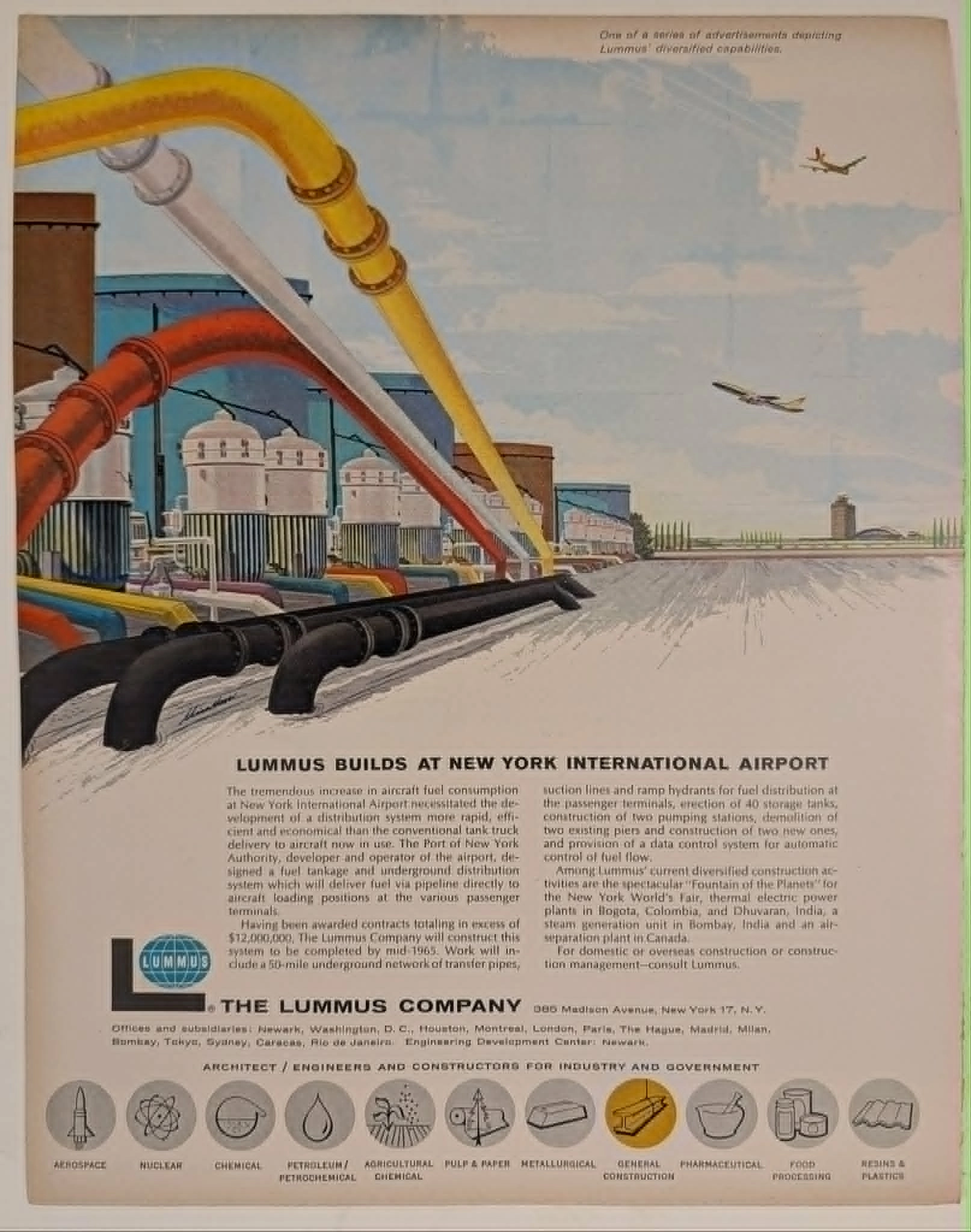
Then, aviation logistics was a surface-level friction. Fuel was transported via fleets of cumbersome tank trucks. The tarmac was a congested, dangerous theatre of slow-moving vehicles attempting to sate the growing thirst of early commercial airliners. Progress was visible, but highly inefficient. Now, we observe the burial of the mechanism. The transition from visible labor to invisible, automated infrastructure. A fifty-mile subterranean vascular system of steel pipes. This artifact documents a critical inflection point in the architecture of global transit. It captures the precise moment when the Jet Age outgrew its terrestrial limitations. The Lummus Company advertisement is not merely a record of an engineering contract at New York International Airport. It is a philosophical declaration of mid-century industrial hegemony. It represents the era when human progress required the mechanics of survival to be driven underground. By dissecting this document, we witness the birth of the modern, high-volume logistical artery, a system designed to operate silently beneath the feet of millions, powering the spectacle of global flight while remaining entirely unseen.
Category: Technology
Brand: Lummus Company
The History
The Thirst of the Turbofan Era To understand the profound significance of this artifact, one must first understand the sheer mechanical gluttony of the early 1960s. The commercial aviation industry was undergoing a violent paradigm shift. The piston-engine airliners of the 1950s were being rapidly replaced by the Boeing 707 and the Douglas DC-8. These new machines were miracles of velocity, but they required kerosene in volumes that the existing infrastructure simply could not comprehend. A single intercontinental jet airliner required tens of thousands of gallons of Jet-A fuel to cross the Atlantic. Under the old logistical doctrine, this fuel was delivered to the aircraft loading positions by conventional tank trucks. As air traffic at New York International Airport (soon to be rechristened John F. Kennedy International Airport) surged, the tarmac became a chaotic, hazardous environment. Dozens of trucks crawled around multi-million-dollar aircraft, creating a bottleneck of terrestrial traffic that threatened to strangle the efficiency of the jet aircraft themselves. The surface was saturated. The only direction for infrastructure to expand was downward. The Twelve-Million-Dollar Vascular System The Port of New York Authority recognized that surface delivery was obsolete. The solution required a complete reimagining of airport architecture. They contracted The Lummus Company to construct an underground distribution system, an engineering feat detailed meticulously in this document. Awarded contracts totaling in excess of twelve million dollars—a staggering capital expenditure for the mid-1960s—Lummus was tasked with building a fifty-mile subterranean network of transfer pipes, suction lines, and ramp hydrants. This was not merely pipe-laying; it was the construction of an industrial vascular system. The project necessitated the erection of forty massive storage tanks and two new pumping stations, effectively placing a high-capacity petroleum distribution facility directly beneath one of the busiest passenger terminals on earth. The artifact specifically notes the inclusion of a "data control system for automatic control of fuel flow." This single sentence marks the dawn of algorithmic logistics. Human operators were no longer sufficient to manage the fluid dynamics of a modern airport. Early computing networks were drafted to govern the subterranean pressure, anticipating the thirst of the jets waiting on the concrete above. The Destruction of the Old Paradigm Progress inherently requires violence against the past. The text calmly notes the "demolition of two existing piers" to make way for the new construction. The mid-century American engineering ethos was unsentimental. If an existing structure impeded the flow of capital and kerosene, it was eradicated. The Lummus Company was acting as the architect of erasure and renewal. They were systematically overwriting the piston age to accommodate the jet age, ensuring that by the projected completion date of mid-1965, the airport would operate with a rapid, economical, and entirely invisible efficiency. The Hegemony of The Lummus Company Beyond the specific logistics of New York International Airport, the document serves as a broader thesis on corporate omnipotence. Lummus positions itself as the invisible hand shaping the modern world. The text seamlessly pivots from aviation fuel pipelines to their other concurrent projects: the spectacular "Fountain of the Planets" for the 1964 New York World's Fair, thermal electric power plants in Colombia and India, and a steam generation unit in Bombay. The New York World's Fair reference firmly anchors this artifact in 1964, a year defined by technological utopianism. While they were building the hidden, dirty infrastructure of airports, they were simultaneously constructing the highly visible, aquatic spectacles of the future. The iconography lining the bottom of the page is perhaps the most revealing element of the artifact. It displays a twelve-point spectrum of diversified capabilities: Aerospace, Nuclear, Chemical, Petroleum/Petrochemical, Agricultural Chemical, Pulp & Paper, Metallurgical, General Construction, Pharmaceutical, Food Processing, Resins & Plastics. This is not just a list of services; it is a periodic table of mid-century capitalism. Lummus was communicating that there was no facet of human consumption, from the food we eat to the nuclear fission we harness, that they could not engineer. They were the masters of matter, offering total industrial synthesis to both industry and government. The Philosophical Shift in Infrastructure This advertisement captures the moment when infrastructure became a ghost. Before this era, industry was loud, visible, and deeply human. Trains spewed black smoke; dockworkers manually unloaded cargo; fuel trucks dominated the runways. But as the scale of consumption grew, the aesthetics of progress demanded cleanliness. The mechanics of the modern world had to be hidden from the consumer. By driving fifty miles of pipe underground, Lummus was participating in the grand illusion of the late twentieth century: the idea that power, fuel, and data arrive effortlessly. The passengers boarding their flights in 1965 would never see the forty storage tanks, the pumping stations, or the data control systems. They would only experience the seamless miracle of flight. This artifact records the systematic burying of human labor and industrial friction, replacing it with silent, automated flow.
The Paper
The physical medium of this archival document is a lightweight, coated magazine stock, likely weighing between 70 and 80 GSM (Grams per Square Meter). Typical of mid-1960s trade publications, the paper is engineered to hold ink efficiently without the high-gloss clay coating utilized in modern luxury print. The printing relies on four-color rotary offset lithography. Under magnification, the CMYK halftone rosette patterns are clearly visible, particularly in the subtle gradients of the sky and the sharp industrial yellow of the primary piping. Time has exerted its inevitable toll upon the organic material. The edges of the page display mild foxing and oxidation—a slow, chemical burning of the lignin within the wood pulp. The paper has lost its original crisp white hue, settling into a warmer, slightly fragile archival tone. This physical degradation is vital. The artifact is not a pristine digital file; it is a tangible object that has survived the very passage of time its imagery attempts to conquer.
The Rarity
Classification: Class B - Contextual Artifact. From a purely physical standpoint, this object does not possess extreme material scarcity. Trade magazines of the 1960s were printed by the thousands and distributed to engineering firms, governmental bodies, and corporate executives worldwide. It is highly likely that multiple copies of this specific advertisement exist in forgotten archives or bound periodicals. However, its true rarity is contextual and historical. It is an unadulterated snapshot of peak American industrial confidence. It documents a specific, multi-million-dollar infrastructural pivot at one of the world's most vital transit hubs. The value of this artifact lies not in auction house bidding wars, but in its profound utility to historians of technology, urban planning, and corporate aesthetics. It is a vital primary source for understanding the subterranean scaling of the Jet Age.
Cite this article
- MLA
- Naodhinsuk, Ronin. “The Time Traveller's Dossier : Lummus - Subterranean Jet Age.” The Record Institute, 31 May 2026, https://therecord.institute/journal/the-time-travellers-dossier-lummus-subterranean-jet-age.
- APA
- Naodhinsuk, R. (2026, May 31). The Time Traveller's Dossier : Lummus - Subterranean Jet Age. The Record Institute. https://therecord.institute/journal/the-time-travellers-dossier-lummus-subterranean-jet-age
- CHICAGO
- Naodhinsuk, Ronin. 2026. “The Time Traveller's Dossier : Lummus - Subterranean Jet Age.” The Record Institute, May 31, 2026. https://therecord.institute/journal/the-time-travellers-dossier-lummus-subterranean-jet-age.