The Time Traveller's Dossier : Mid-Century DuPont Paint - The Chemistry of the Suburbs
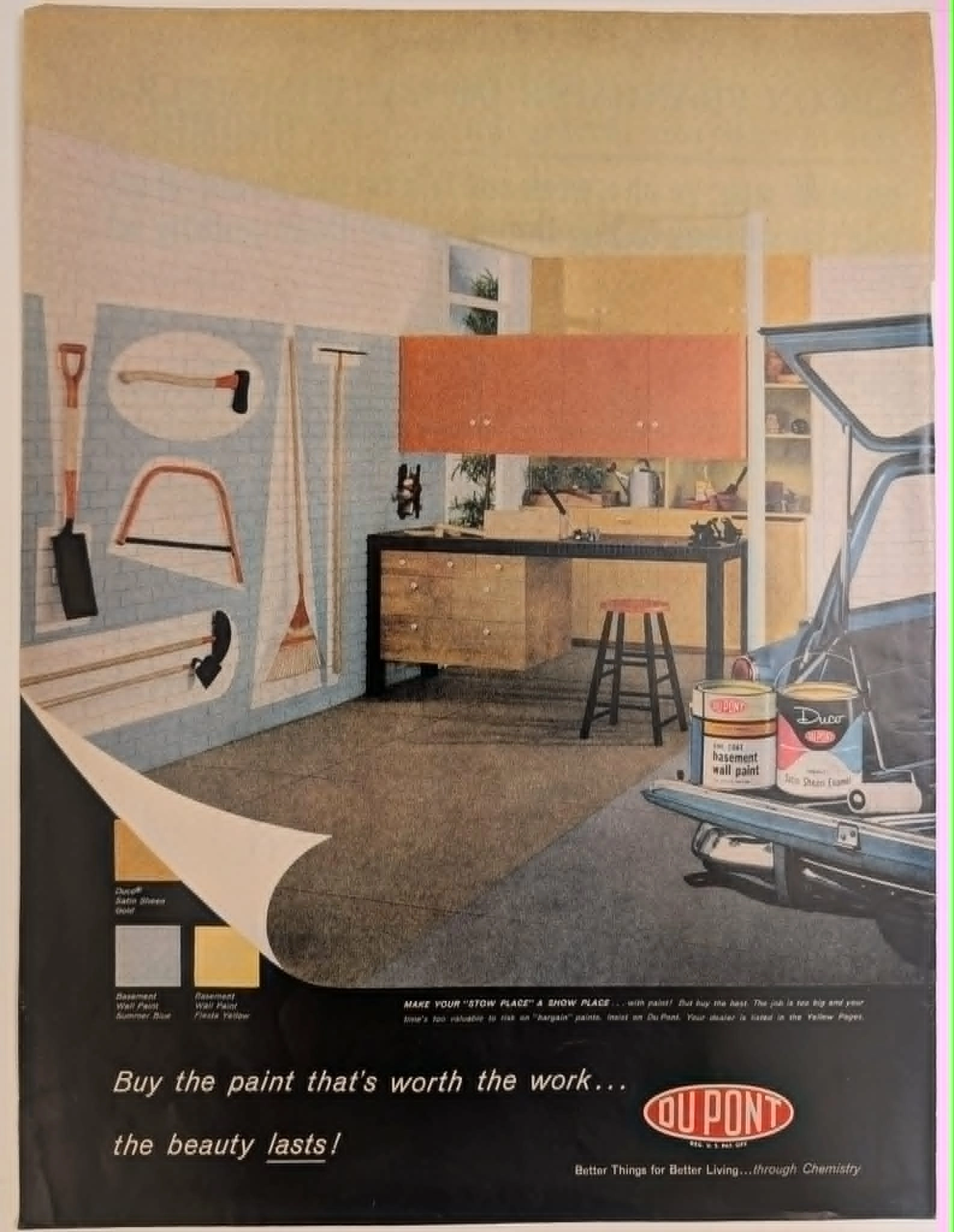
The era is the mid-twentieth century. The American domicile is undergoing a radical expansion. The automobile has mandated a new architectural appendage: the garage. The home is no longer solely a realm of domesticity. It is a site of personal industry and curated leisure. Then: The basement and the garage were subterranean dungeons. They were purely utilitarian voids. Repositories for coal, dust, and discarded artifacts. To paint these spaces was a desperate act of preservation, not an act of design. Labor in these zones was grueling, hidden, and devoid of aesthetic pride. Now: The dark corners are brought into the light. DuPont introduces a chemical revelation to the suburban frontiersman. The "Stow Place" is aggressively transformed into the "Show Place". The tools of labor are no longer hidden; they are displayed as modern art. Through the alchemy of synthetic polymers, a single coat of paint alters reality. The homeowner is elevated from a laborer to a curator of his own domain.
Category: Other
The History
The Frontier of the Carport and the Cellar To deconstruct this DuPont advertisement, one must first map the shifting topography of the post-war American home. The GI Bill and the subsequent suburban explosion birthed millions of new homes. These homes came with spaces that lacked historical precedent in the working-class psyche. The attached garage. The sprawling, unfinished basement. Initially, these were architectural afterthoughts. They were the "stow places"—liminal zones where the messiness of life was banished. However, as the economic boom solidified, a psychological shift occurred. The middle class, flush with unprecedented disposable income and newly acquired leisure time, began to look at these empty spaces not as voids, but as blank canvases. The home was no longer just a shelter to survive within; it was a kingdom to be optimized. This advertisement captures the exact moment the garage ceased to be a mere shelter for the automobile and became an active, aestheticized extension of the living room. The presence of the blue station wagon, its tailgate casually lowered, serves as a threshold. It connects the mobility of the outside world directly to the ordered sanctuary of the interior. It suggests a seamless lifestyle where the transition from driving to creating is fluid. The Alchemy of Peacetime At the bottom right corner lies a phrase that defined an era: "Better Things for Better Living... through Chemistry". This was not just a corporate slogan. It was the foundational theology of the 1950s and 60s. DuPont, a company with deep roots in explosives and wartime manufacturing, had to pivot its massive industrial apparatus toward peacetime consumerism. The same chemical engineering that produced nylon for parachutes and synthetic rubber for jeep tires was now directed at the domestic sphere. Before this chemical revolution, paint was a difficult, temperamental medium. It required mixing, it separated, it took days to dry, and it offered poor coverage. DuPont’s "One Coat basement wall paint" and "Duco Satin Sheen Enamel" represented a technological triumph over nature. The promise of "One Coat" is the promise of engineered efficiency. It is the democratization of professional results. The homeowner no longer needed to be an apprentice painter. The chemistry did the heavy lifting. The complex formulation of pigments, binders, and synthetic solvents was neatly packaged in a tin can, waiting to be unleashed by the amateur hand. The Psychology of "Sweat Equity" Perhaps the most brilliant element of this artifact is its psychological manipulation of labor. "Buy the paint that's worth the work..." This is a profound acknowledgment of the Do-It-Yourself (DIY) movement. DIY in the 1930s was born of poverty and desperation. You fixed it yourself because you could not afford to pay someone else. By the mid-century, DIY had been successfully rebranded as a noble, fulfilling leisure activity. The "weekend warrior" was born. DuPont astutely recognizes that painting a basement is arduous, physical labor. They do not pretend it is effortless. Instead, they validate the effort. They position their product not as a shortcut to avoid work, but as a premium insurance policy to protect the value of the homeowner's sweat. "The job is too big and your time's too valuable to risk on 'bargain' paints." This copy flatters the consumer. It elevates their weekend chore into a high-stakes investment. If you are going to invest your valuable time, you must honor that time with superior chemistry. It is a masterful conflation of the Protestant work ethic with consumerist upgrading. Shadow Boarding: The Illusion of Absolute Control Observe the left side of the composition. The tools—a shovel, an axe, a saw, a rake, a hoe—are not merely hung on the wall. They are suspended over precise, white-painted silhouettes of themselves. This technique is known as "shadow boarding". It originated in industrial factories, aviation mechanic shops, and military armories to ensure no tool was left inside an engine or a weapon system. It is a system of absolute, uncompromising visual order. To bring this hyper-industrial organizational method into a suburban basement is a fascinating sociological tell. The Cold War era was fraught with invisible anxieties: nuclear annihilation, ideological subversion, economic instability. The suburban garage became a micro-domain where the American male could exercise total control. The shadow board represents a world where everything has an exact, permanent place. It is a physical manifestation of the desire for a predictable, ordered universe. DuPont paint is positioned as the medium through which this order is achieved. The "Fiesta Yellow" and "Summer Blue" do not just cover the concrete; they define the boundaries of control. The Domestication of the Workshop Historically, the workshop was a distinctly masculine, grimy domain. It was characterized by sawdust, grease, and raw, unfinished wood. This advertisement completely subverts that archetype. The aesthetic of the interior house—traditionally the female domain—has breached the walls of the garage. Look at the color palette. "Duco Satin Sheen Gold", "Summer Blue", "Fiesta Yellow". These are not the colors of a mechanic's pit. These are the colors of a mid-century modern living room or a high-end kitchen. The workbench is immaculate. The cabinets above it are a sleek, atomic-age orange. There are potted plants visible in the background. This is the sterilization and gentrification of the workspace. It suggests that the garage must now be presentable to the neighbors. It must be a "Show Place". The husband's workshop is no longer an exile from the home's decor; it must conform to the overall aesthetic standard of the property. DuPont provided the exact chemical hues necessary to facilitate this suburban assimilation. The Duality of the Tin Can Finally, let us analyze the physical cans resting on the tailgate. They represent the dual nature of the chemical product. The can on the left, "basement wall paint", features blocky, utilitarian typography. It screams functionality. It is designed to tackle raw masonry. The can on the right, "Duco Satin Sheen Enamel", features an elegant, sweeping script for the word "Duco". It implies a smooth, luxurious finish. Together, they sit on the threshold of the automobile, ready to transform the raw, masculine concrete of the "stow place" into the refined, aestheticized "show place". They are miniature reactors of synthetic beauty, waiting for the weekend to begin.
The Paper
The artifact is preserved on a high-grade, coated magazine stock typical of premium mid-century periodicals (likely Life or The Saturday Evening Post). Estimated at 80 to 90 GSM. The printing process is a highly saturated commercial offset lithography. Close inspection reveals a tight, precise CMYK halftone dot structure, necessary to render the subtle gradients of the blue station wagon and the distinct color swatches at the bottom left. The paper exhibits signs of acidic aging, with noticeable yellowing radiating from the edges inward, a natural consequence of lignin breakdown. The ink remains remarkably vibrant, a testament to the heavy pigmentation used in mid-century print advertising to convey the bright optimism of the era's consumer goods.
The Rarity
Classification: Class B. While the physical page itself was mass-produced in the millions and remains relatively common in archival circuits, its contextual value is exceptional. It is a pristine sociological snapshot. It perfectly encapsulates the intersection of the post-war housing boom, the rise of DIY leisure culture, the psychological shift of suburban masculinity, and the golden age of chemical optimism. Its value lies in its power as a visual thesis on the gentrification of the American garage. It is a vital document for historians of mid-century domestic architecture and consumer psychology.
Cite this article
- MLA
- Naodhinsuk, Ronin. “The Time Traveller's Dossier : Mid-Century DuPont Paint - The Chemistry of the Suburbs.” The Record Institute, 16 May 2026, https://therecord.institute/journal/the-time-travellers-dossier-mid-century-dupont-paint-the-chemistry-of-the-suburbs.
- APA
- Naodhinsuk, R. (2026, May 16). The Time Traveller's Dossier : Mid-Century DuPont Paint - The Chemistry of the Suburbs. The Record Institute. https://therecord.institute/journal/the-time-travellers-dossier-mid-century-dupont-paint-the-chemistry-of-the-suburbs
- CHICAGO
- Naodhinsuk, Ronin. 2026. “The Time Traveller's Dossier : Mid-Century DuPont Paint - The Chemistry of the Suburbs.” The Record Institute, May 16, 2026. https://therecord.institute/journal/the-time-travellers-dossier-mid-century-dupont-paint-the-chemistry-of-the-suburbs.