The Time Traveller's Dossier : Monsanto 1942 - The Sulfa Paradigm Shift
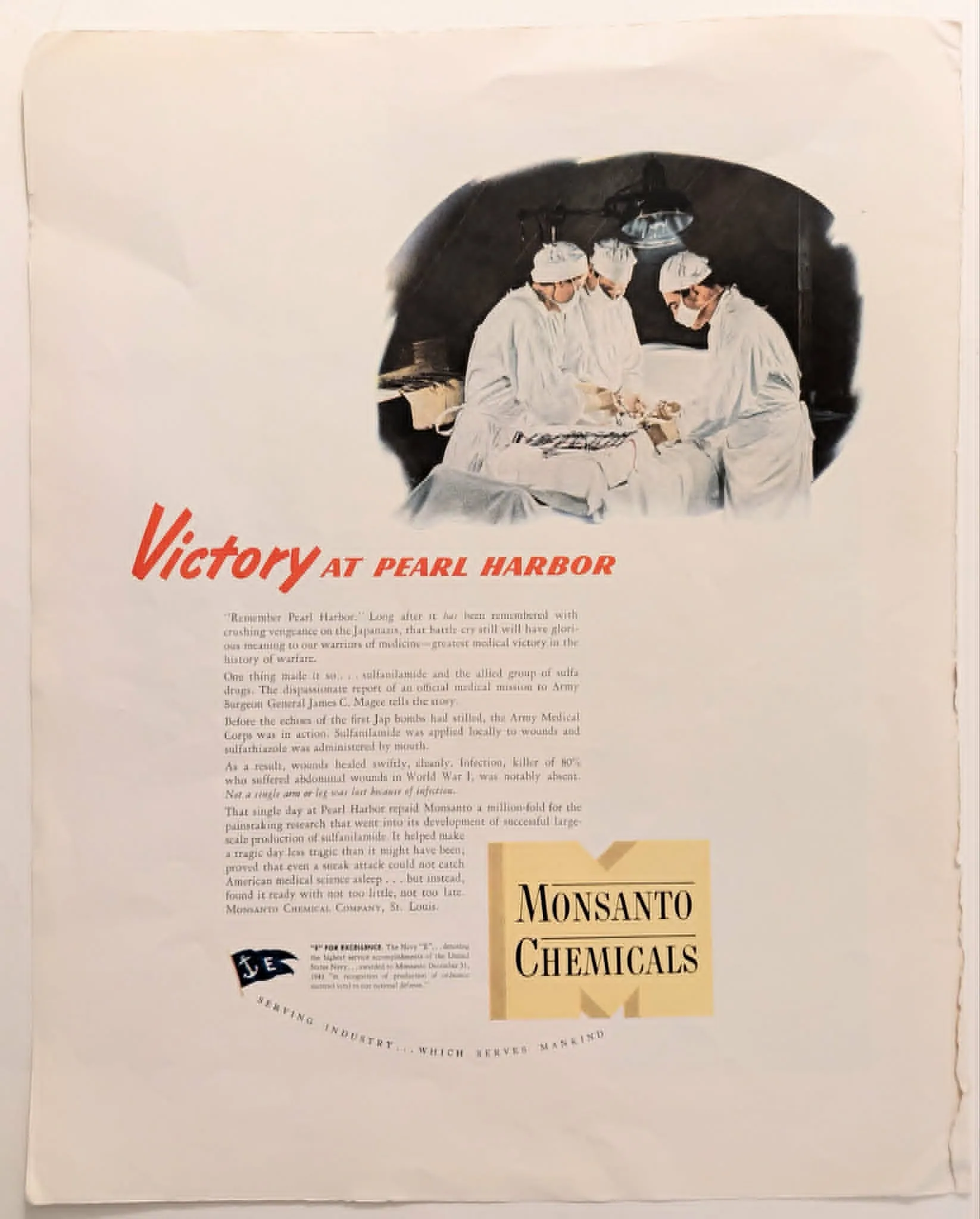
War is a brutal accelerator of human ingenuity. It strips away the theoretical. It demands the immediate. Before 1941, the battlefield was governed by a microscopic tyrant. Infection. The bullet merely opened the door. The bacteria finalized the transaction. The surgeon was often a mechanic of despair, amputating to outpace the rot. Then came the white powder. This 1942 Monsanto Chemicals advertisement is not merely corporate propaganda. It is a birth certificate for modern combat trauma care. It captures the exact temporal coordinate where humanity learned to weaponize chemistry against biological decay. It documents the transition from passive wound management to active, systemic sterilization. The shift was absolute. The armaments of war destroyed flesh. The armaments of the laboratory preserved it. Here, frozen on fading pulp paper, is the moment the medical corps declared a victory that transcended geopolitics. A victory over the invisible.
Category: Technology
The History
The Microscopic Theater of War To understand the profound shift this artifact represents, one must first confront the helpless terror of the era preceding it. Look back to the trenches of the First World War. The artillery was modern. The medicine was medieval. A soldier wounded in the abdomen faced a functional death sentence. The mortality rate for such penetrating wounds hovered near eighty percent. The soil of Europe was saturated with anaerobic bacteria. A shrapnel wound introduced this hostile flora deep into human tissue, sealing it away from oxygen. Gangrene flourished. Sepsis was the standard conclusion. The only definitive countermeasure was the saw. Amputation was the crude mathematics of survival. Subtract the limb to save the core. Surgeons operated in a state of perpetual retreat. The era's primary antiseptic, the Carrel-Dakin solution, was a caustic, unstable hypochlorite compound requiring constant, agonizing wound irrigation. It could not hunt infection systemically. The pre-1941 paradigm was defined by this fundamental biological vulnerability. The human body was structurally unprepared for the industrialized tearing of flesh. The Irony of Origin: Bayer and Prontosil The historical irony of the sulfa paradigm shift is profound. The genesis of this life-saving chemical occurred within the borders of the very nation America was mobilizing to destroy. In 1932, a German pathologist named Gerhard Domagk, working for Bayer, discovered that a synthetic red dye called Prontosil protected mice from lethal streptococcus. The active agent was sulfanilamide. By the late 1930s, this chemical secret had crossed the Atlantic. But its introduction to the American public was catastrophic. The American Catalyst: The 1937 Elixir Tragedy In 1937, an American pharmaceutical company mass-produced a liquid version called Elixir Sulfanilamide. To dissolve the powder, they used diethylene glycol as a solvent. It was, essentially, antifreeze. Over one hundred people died in a horrific mass poisoning. This mass poisoning directly triggered the 1938 Food, Drug, and Cosmetic Act. By the time war arrived, sulfanilamide was no longer an experimental compound; it was a heavily regulated chemical requiring massive, sterile, and exact industrial production. This is where chemical titans like Monsanto entered the historical frame. They were tasked with producing a life-saving agent under the most rigorous safety standards ever devised, at a scale previously unimaginable. The Synthesis of Salvation: Bacteriostatic Mechanics The shift provided by sulfa was a revolution in biological mechanics. Researchers discovered that sulfonamide compounds possessed a miraculous, targeted property. They were not bactericidal. They did not outright kill the bacteria. Rapidly killing large bacterial populations often caused toxic shock. Instead, they were bacteriostatic. They mimicked para-aminobenzoic acid, a nutrient bacteria require to synthesize folic acid. The bacteria absorbed the sulfa drug instead of the nutrient. Their internal reproduction mechanism jammed. They were frozen in place. This allowed the human immune system, specifically the white blood cells, the critical time required to mobilize, surround, and eradicate the invaders. Medicine transitioned from reactive surgery to proactive chemical defense. However, altering a global war required monumental industrial scale. The Crucible of Pearl Harbor December 7, 1941. The day of infamy. The American Pacific Fleet was systematically dismantled in a matter of hours. The human cost was staggering. Thousands were burned, shattered, and torn by high explosives and shrapnel in a massive, chaotic mass-casualty event. Yet, amidst the smoke and the catastrophic loss of steel, a silent medical milestone occurred. The text of the artifact lays the claim bare. Not a single arm or leg was lost because of infection. This defied all historical combat statistics. The advertisement details the protocol implemented by the Army Medical Corps under Surgeon General James C. Magee. It was a two-pronged assault. Sulfanilamide powder was applied directly, locally, into the raw, gaping wounds. Concurrently, sulfathiazole was administered by mouth. They saturated the biological battlefield. They created a chemical perimeter within the flesh of the wounded. The medical corps had anticipated the need. They were stocked. They were ready. The artifact framing this as a dispassionate report is a brilliant rhetorical device. It grounds a seemingly impossible survival rate in the cold, hard authority of official military reporting. It transforms a tragedy into a triumph of preparedness. It proved that systemic medicine could function in the chaos of a combat zone. The Machinery of Monsanto and the Industrial Front We must analyze the source of the message. The Monsanto Chemical Company. Today, the name carries a vastly different, highly complex ecological and corporate legacy. But in 1942, in the crucible of a two-front global war, Monsanto was an engine of national defense operating out of St. Louis. The artifact highlights this pivot, emphasizing painstaking research and large-scale production. American mobilization wasn't just about building bombers; it was about scaling organic chemistry. Monsanto accelerated the production of sulfanilamide a million-fold. This metric represents the sheer force of American industrial capacity repurposed for biological survival. Unlike competitors focused primarily on synthetic rubber and munitions, Monsanto scaled pharmaceutical precursors alongside ordnance work. The chemical plant became as vital to the war effort as the shipyard. They were manufacturing time. Time for the wounded to heal. Time for the surgeons to operate without the looming specter of immediate sepsis. The Pennant of Excellence The Navy "E" pennant, awarded December 31, 1941, serves as the psychological anchor of this document. Consider the compressed timeline. Barely three weeks after the devastation of Pearl Harbor, the United States Navy paused to officially recognize a chemical manufacturer. The award was for the production of ordnance materiel vital to national defense. This reveals the profound duality of the industrial war machine. The same vats and pipelines used to create high explosives were simultaneously harnessed to produce the crystalline powder that preserved human life. The flag was a powerful instrument of morale architecture. It unified the home front with the battlefront. It explicitly told the factory worker in the Midwest that their labor was actively, directly saving the lives of the boys bleeding in the Pacific theater. The Ephemeral Window of Glory From an archival perspective, this artifact is locked in a specific, fleeting moment in time. The era of the sulfa drugs was revolutionary, but it was incredibly brief. Even as this advertisement went to press, scientists across the Atlantic, accelerated by the same wartime pressures, were working to scale a far superior biological weapon. Penicillin. By war's end, penicillin usurped sulfa. Sulfa drugs had severe limitations, causing kidney toxicity and allergic reactions, while bacteria rapidly evolved resistance. Therefore, this artifact documents the absolute peak of a specific technology. It is a snapshot taken right before the paradigm shifted yet again. It forces us to contemplate the nature of scientific progress. The miracles of today are the obsolete footnotes of tomorrow. Yet, without the sulfa bridge, the chasm of World War II casualties would have been unimaginably deeper. The Philosophy of the Redacted Tragedy The copywriter penned a hauntingly pragmatic line: it helped make a tragic day less tragic. This is the ultimate philosophy of trauma medicine. It does not undo the violence. It does not erase the attack. It merely manages the arithmetic of death. The advertisement claims a crushing vengeance not through superior firepower, but through the defiance of survival. To keep a soldier alive when the enemy intended him to die is a fundamental act of warfare. This piece of paper is a testament to that defiance. It is a record of humanity deciding that if we must engage in the systematic destruction of one another, we will simultaneously engineer the chemical means to mitigate the rot. It is a dark, brilliant, and fundamentally human contradiction.
The Paper
The physical reality of this artifact tells a parallel story of its era. This is mid-century magazine stock, likely hovering around 60 to 70 GSM. It was born in an era of strict wartime rationing, where resource allocation prioritized the military over the publisher. The paper is inherently acidic. The lignin within the wood pulp is actively oxidizing, resulting in the distinct amber-yellowing visible along the margins. It is a slow-motion chemical fire consuming the document from within. The printing utilizes a standard four-color CMYK offset lithography process. Upon close inspection, one can observe the slight misregistration inherent to 1940s high-speed web presses. The tactile sensation of this page is coarse and fragile. It is uniquely redolent of the urgency of the 1940s. It was produced quickly, distributed widely, and never intended to survive into the next century.
The Rarity
Class A : Culturally Imperative. While millions of these magazines were printed, the survival rate of this specific advertisement in pristine, untorn condition is remarkably low. However, its true rarity is not derived from market scarcity, but from its immense contextual gravity. It is an artifact that intersects three massive historical vectors. The exact timeline of the Pearl Harbor attack. The fundamental paradigm shift in pharmaceutical military application. The early corporate wartime identity of Monsanto, a company whose modern narrative is entirely divorced from this heroic savior archetype. It is a vital historical contradiction.
Cite this article
- MLA
- Naodhinsuk, Ronin. “The Time Traveller's Dossier : Monsanto 1942 - The Sulfa Paradigm Shift.” The Record Institute, 22 June 2026, https://therecord.institute/journal/the-time-travellers-dossier-monsanto-1942-the-sulfa-paradigm-shift.
- APA
- Naodhinsuk, R. (2026, June 22). The Time Traveller's Dossier : Monsanto 1942 - The Sulfa Paradigm Shift. The Record Institute. https://therecord.institute/journal/the-time-travellers-dossier-monsanto-1942-the-sulfa-paradigm-shift
- CHICAGO
- Naodhinsuk, Ronin. 2026. “The Time Traveller's Dossier : Monsanto 1942 - The Sulfa Paradigm Shift.” The Record Institute, June 22, 2026. https://therecord.institute/journal/the-time-travellers-dossier-monsanto-1942-the-sulfa-paradigm-shift.