The Time Traveller's Dossier : Murakami & LV - The Corporate Flattening of Fine Art
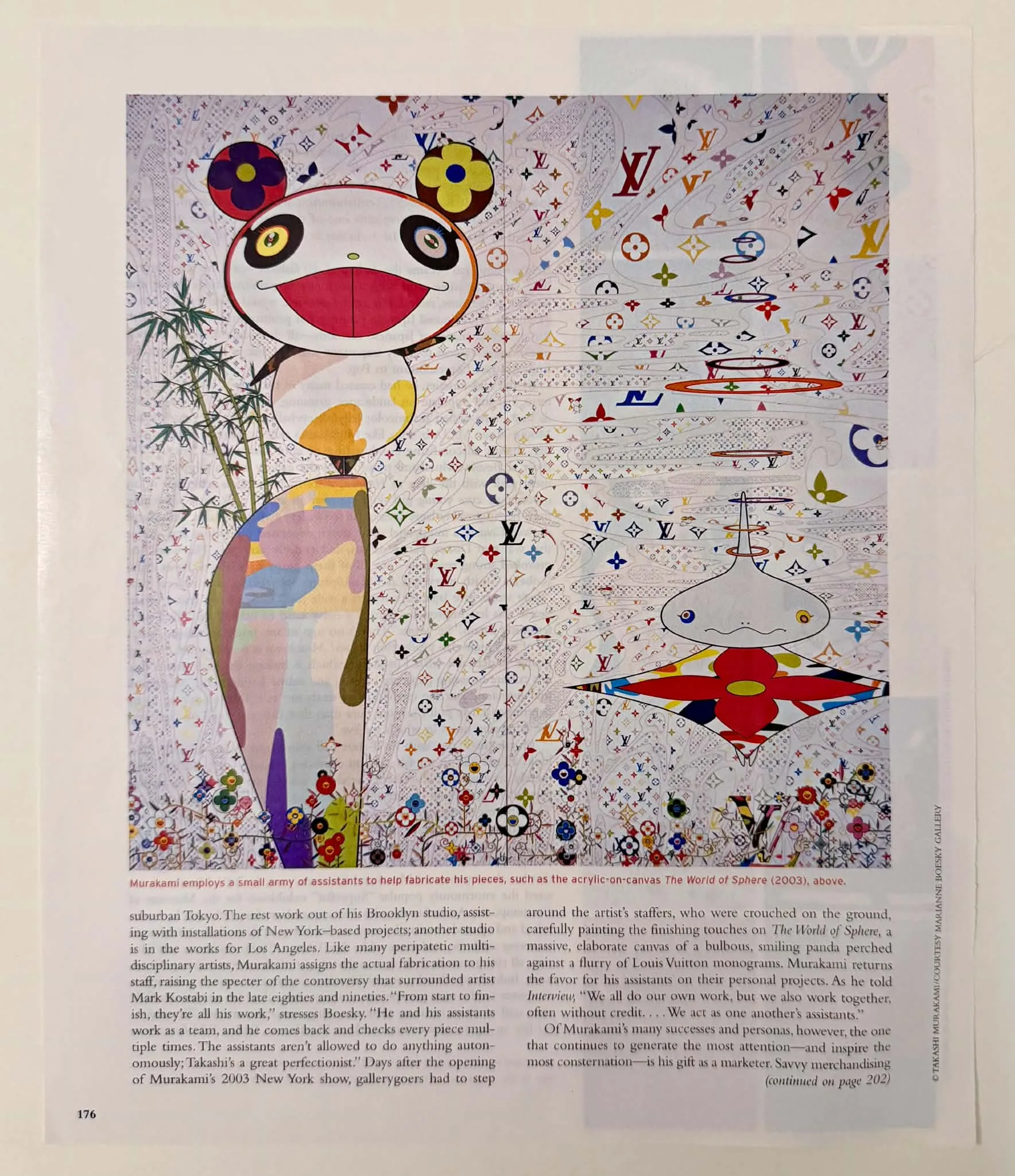
Before this artifact, the canvas was a sacred, isolated space. It was a realm guarded fiercely against the intrusion of commercial branding. Art was meant to critique capital from a safe distance, not wear its logos as a second skin. After this artifact, the boundary dissolved entirely. The canvas became a billboard. The billboard became the canvas. Captured on this magazine page is a profound structural shift in how art is fabricated, valued, and consumed. It documents Takashi Murakami’s The World of Sphere (2003), a piece that did not just feature the Louis Vuitton monogram, but structurally integrated it into the DNA of high art. Furthermore, the accompanying text shatters the myth of the solitary artistic genius, detailing a corporate, factory-like production line that forever altered the mechanics of the twenty-first-century art market.
Category: Fashion
The History
The Myth of the Solitary Creator For centuries, the Western art historical canon has been anchored by a highly romanticized, deeply entrenched myth: the solitary genius. We are conditioned to imagine the artist alone in a dimly lit studio, agonizing over every brushstroke, channeling divine inspiration directly onto the canvas. Authenticity, in this framework, is inextricably linked to the physical touch of the master's hand. If the artist did not paint it, it is not truly theirs. This artifact, a printed page from an art publication circa the early 2000s, aggressively dismantles that paradigm. The text visible on the page explicitly states: "Murakami employs a small army of assistants to help fabricate his pieces, such as the acrylic-on-canvas The World of Sphere (2003), above." This was not a secret. It was a publicized methodology. The text goes on to detail operations running out of a Brooklyn studio, with another planned for Los Angeles. It compares this multi-disciplinary, highly staffed approach to the controversial practices of Mark Kostabi in the late eighties. By the time this article was published, Murakami had formalized his production under the corporate banner of Kaikai Kiki Co., Ltd. He was not merely a painter; he was a CEO. He was an art director managing a global supply chain of aesthetic fabrication. This shift was jarring to Western sensibilities, yet it was deeply rooted in the traditional Japanese kōbō (workshop) system, historically used to produce Ukiyo-e woodblock prints. The individual ego was subsumed by the collective output of the studio. This artifact documents the exact moment when the Western art establishment was forced to accept industrial corporate management as a valid form of high artistic creation. The Convergence of Canvas and Commerce To understand the gravity of The World of Sphere (2003), one must examine the economic and cultural landscape of the early 2000s. The global economy was recovering from the dot-com crash. A new era of hyper-consumerism was taking hold, driven by the democratization of luxury. Luxury fashion houses were no longer content with selling heritage; they needed to sell cultural relevance. In 2003, Marc Jacobs, then the creative director of Louis Vuitton, initiated a collaboration with Takashi Murakami. Prior collaborations, such as with Stephen Sprouse, had treated the bag as a canvas. Murakami inverted the formula. He treated his canvas as a handbag. He took the sacred, fiercely protected Louis Vuitton monogram—a symbol of elite European heritage dating back to 1896—and subjected it to his "Superflat" philosophy. The traditional LV monogram, usually rendered in austere brown and gold, was violently mutated into thirty-three vibrant colors. This became the Multicolore monogram. But Murakami did not stop at designing leather goods. As seen in the artwork on this page, he integrated the corporate logo directly into his fine art paintings. The logos float in the background, a permanent atmospheric condition of the world his characters inhabit. The brand identity of a multinational conglomerate was elevated to the status of a fine art motif, equal in visual hierarchy to the painted figures. This was a profound philosophical flattening. Art and commerce were no longer in dialogue; they had successfully assimilated one another. Anatomy of an Assimilation: The World of Sphere The artwork reproduced on this page, The World of Sphere (2003), is a masterclass in calculated aesthetic collision. It operates on multiple semiotic levels simultaneously. At the center stands a bulbous, massive panda character. The panda is rendered in the distinct, hyper-glossy style of Japanese anime and manga. Its face features oversized eyes and an unnaturally wide, red-tongued smile. It is aggressively cute, yet completely hollow. Below it, a sleek, alien-like figure with a halo hovers above a stylized, multi-colored flower that mirrors the geometry of the LV blossoms. To the left, traditional Japanese bamboo stalks rise vertically, painted with precise, historical reverence. And behind all of this, the sky is not blue. The sky is Louis Vuitton. The Multicolore monograms are scattered across swirling, cloud-like formations. This composition is not an accident; it is an ideological statement. Murakami is forcing traditional Japanese nature motifs (the bamboo), contemporary Japanese otaku culture (the cartoon panda), and Western hyper-capitalism (the LV logos) onto a single, compressed plane. There is no depth of field. There is no background or foreground. Everything exists on the same flat surface. This is the ultimate realization of his Superflat theory. It suggests that in the modern, globalized world, all culture—whether it is a sacred heritage brand, a cheap plastic toy, or a venerated historical painting technique—has been flattened into an interchangeable visual commodity. The Mechanics of Controversy The text accompanying the image provides crucial context regarding the reception of this method. It notes that gallery-goers at Murakami's 2003 New York show had to literally step around his staff, who were crouched on the ground painting the finishing touches on canvases. Marianne Boesky, his gallerist at the time, is quoted stressing that despite the assistants, the works are entirely Murakami's vision: "He and his assistants work as a team, and he comes back and checks every piece multiple times. The assistants aren't allowed to do anything autonomously; Takashi's a great perfectionist." This defensive posture highlights the friction of the era. The market was struggling to reconcile the astronomical prices of these artworks with the fact that the named artist barely touched the canvas. The artifact captures a transitional anxiety. The art world was grappling with the reality that the most important skill of a twenty-first-century artist was not the mastery of a brush, but the mastery of logistics, branding, and delegation. The article concludes with a telling observation about Murakami's true genius: "Of Murakami's many successes and personas, however, the one that continues to generate the most attention—and inspire the most consternation—is his gift as a marketer." This sentence alone defines the historical shift. The artist had successfully transitioned from a creator of objects to a manager of a brand. The artwork itself became a secondary byproduct of the overarching marketing strategy. The Legacy of 2003 The year 2003, captured in this printed document, was the absolute apex of this cultural crossover. The Murakami x Louis Vuitton collaboration generated hundreds of millions of dollars in revenue. It sparked a decade-long trend of luxury houses partnering with contemporary artists, a model that is now standard industry practice. However, The World of Sphere remains unique because it captures the infiltration flowing in both directions. The fashion house absorbed the artist's aesthetic to sell bags, and the artist absorbed the fashion house's trademark to sell paintings. This artifact is a fossil of the moment capitalism entirely swallowed the avant-garde. It proves that the ultimate rebellion in the modern art world was not to reject consumerism, but to become its most efficient, unapologetic manufacturer. The canvas was stripped of its romantic immunity. It was rebuilt as a localized node in a global corporate network, rendering the boundary between a gallery wall and a retail storefront permanently indistinguishable.
The Paper
This artifact is a physical page excised from a glossy, high-production commercial publication, likely an art magazine or a retrospective exhibition catalog from the mid-2000s. The substrate is a medium-to-heavyweight coated paper, estimated at 115 to 130 GSM. The gloss coating was applied to maximize color fidelity and saturation, a crucial requirement when reproducing the hyper-vibrant, synthetic palette of Murakami's Superflat universe. However, the passage of two decades has begun to subtlely alter its physical state. The coating shows microscopic signs of dulling, and the edges likely exhibit a faint, warm oxidation—a chemical yellowing that contradicts the timeless, plastic perfection of the artwork printed upon it. The printing relies on an advanced CMYK offset lithography process. Upon extreme magnification, the pristine, flat colors of the acrylic-on-canvas original are revealed to be optical illusions, constructed from thousands of intersecting halftone rosettes. This mechanical translation adds an unintentional layer of irony to the artifact. Murakami’s assistants painted the original canvas by hand to look perfectly flat and mechanical, mimicking computer graphics. This magazine page then used actual mechanical printing to reproduce that handmade mechanical look. The typography is clean and utilitarian, deliberately subordinated to the overwhelming visual noise of the artwork above it.
The Rarity
The intrinsic value of this artifact does not lie in its material scarcity. Millions of similar pages were printed, bound, and distributed. Its true rarity is contextual and historical. It holds a Class B classification because it serves as a primary source document capturing a highly specific, highly volatile moment in art history. It is a contemporaneous record of the friction generated by Murakami's corporate methodology. It captures the exact language used by critics and gallerists in 2003 to justify and explain the industrialization of the artist's studio. While the original acrylic canvas of The World of Sphere trades for millions in private auctions, this mass-produced page is arguably more valuable to the sociologist or the historian. It preserves not just the image, but the discourse, the controversy, and the mechanics of the era’s shifting paradigms in real-time.
Cite this article
- MLA
- Naodhinsuk, Ronin. “The Time Traveller's Dossier : Murakami & LV - The Corporate Flattening of Fine Art.” The Record Institute, 13 September 2026, https://therecord.institute/journal/the-time-travellers-dossier-murakami-lv-the-corporate-flattening-of-fine-art.
- APA
- Naodhinsuk, R. (2026, September 13). The Time Traveller's Dossier : Murakami & LV - The Corporate Flattening of Fine Art. The Record Institute. https://therecord.institute/journal/the-time-travellers-dossier-murakami-lv-the-corporate-flattening-of-fine-art
- CHICAGO
- Naodhinsuk, Ronin. 2026. “The Time Traveller's Dossier : Murakami & LV - The Corporate Flattening of Fine Art.” The Record Institute, September 13, 2026. https://therecord.institute/journal/the-time-travellers-dossier-murakami-lv-the-corporate-flattening-of-fine-art.