The Time Traveller's Dossier : Murakami - The Superflat Shift
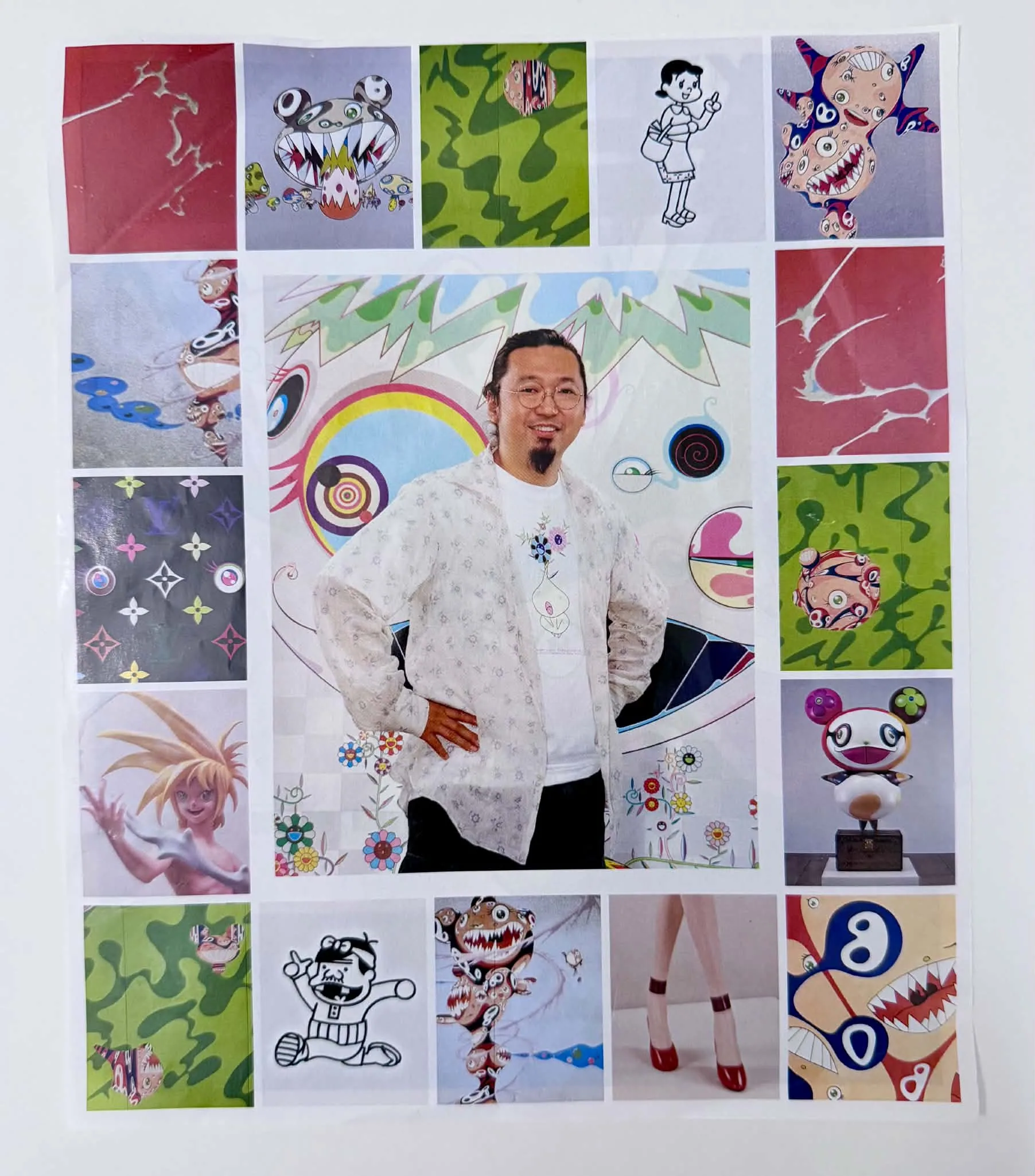
There was a wall. For centuries, the boundary between fine art and commercial product was heavily fortified. On one side stood the gallery: sterile, quiet, demanding reverence. On the other side stood the marketplace: loud, transactional, ephemeral. This artifact records the exact moment that wall was demolished. It did not fall to a siege. It was painted over in thirty-three vibrant colors. We are observing a primary archival document—a collage sheet that serves as a visual manifesto for a rapidly changing world. It captures the mutation of post-war trauma into aggressive cuteness, the elevation of otaku subculture to high art, and the unprecedented infiltration of a luxury European fashion house by a Japanese contemporary artist. Before this paradigm shift, luxury was defined by heritage and strict, unyielding tradition. After this shift, luxury became a canvas. The images presented here are not merely illustrations; they are the blueprints of modern cultural consumption. They represent the architecture of a flattened reality.
Category: Other
The History
The Architecture of a Flattened Reality History is rarely defined by seamless transitions. It is defined by fractures, collisions, and the synthesis of opposing forces. To understand the artifact presented—a composite record of Takashi Murakami’s visual language—one must first understand the psychological landscape of post-war Japan. The dropping of the atomic bombs did more than level cities; it leveled the societal hierarchies that had governed Japan for centuries. The rigid structures of the past were vaporized. In the vacuum that followed, a new culture emerged, built on the rapid consumption of Western media, the rise of electronics, and the comforting, escapist realms of anime and manga. This new reality was inherently two-dimensional. It existed on television screens, on the pages of comic books, and eventually, on computer monitors. There was no depth, both literally and metaphorically. The distinction between "high" culture (traditional tea ceremonies, classical painting) and "low" culture (comic books, plastic toys) ceased to exist for the new generation. Everything existed on a single, flattened plane of consumption. In the year 2000, this societal observation was formalized into a radical aesthetic theory. It was called "Superflat." It argued that the visual flatness of traditional Japanese art—from the Edo period ukiyo-e woodblock prints to the screen paintings of the Kano school—had simply evolved into the cel animation of modern anime. The lack of three-dimensional perspective was not a technical deficiency; it was a cultural signature. The Mascot of the Void Look closely at the recurring entity within this archival sheet. The creature with the rounded ears, the wide, unblinking eyes, and the razor-sharp teeth. This is Mr. DOB. At first glance, he is a recognizable derivation, a genetic splice of Mickey Mouse and Sonic the Hedgehog. However, Mr. DOB is not a celebration of Western pop culture; he is a critique of it, and a reflection of the Japanese psyche. He is the ultimate empty vessel. The letters D, O, and B are inscribed on his face, derived from a meaningless Japanese slang phrase, "Dobojite, dobojite" (Why, why?). Mr. DOB is a shapeshifter. In the close-up fragments captured in this document, he is seen in states of mutation. Sometimes he is smiling, projecting the highly exportable Japanese concept of "kawaii" (cuteness). In other frames, his form melts, his eyes multiply into a grotesque cluster, and his smile reveals jagged, predatory teeth. This duality is intentional. The cuteness is a shield, a coping mechanism for a society that experienced unparalleled trauma. The teeth represent the suppressed anxiety, the lingering radiation, and the monstrous nature of unchecked consumerism. He is a self-portrait of an artist, and a portrait of a generation that grew up consuming mass media to avoid confronting reality. The Parisian Collision The most pivotal element documented in this collage is the presence of the Monogram Multicolore. Prior to 2003, the Louis Vuitton monogram was an untouchable monolith. It was rendered in a strict, two-tone palette of chestnut brown and gold. It communicated heritage, stability, and exclusion. When Marc Jacobs, then the creative director of the house, invited a contemporary artist to reinterpret this sacred geometry, he initiated a seismic shift in the global luxury market. The artist did not just tweak the design; he dismantled its solemnity. The traditional canvas was replaced with stark white or pitch black, upon which the classic LV initials and quatrefoils were silkscreened in thirty-three distinct, vivid colors. Furthermore, the monogram was occasionally interrupted by blinking, cartoonish eyes. This was not merely a collaboration; it was a hostile takeover masked as a playful intervention. The European luxury establishment had allowed the Japanese "low" culture of anime and kawaii to overwrite its most recognizable asset. The Collapse of Hierarchies The resulting 2003 collection was a commercial phenomenon that altered the trajectory of fashion and art. The handbags ceased to be mere accessories; they became highly coveted, mobile pieces of contemporary art. Waiting lists stretched into the thousands. The secondary market exploded. More significantly, this moment legitimized the crossover. It proved that a high-end luxury brand could leverage the energy of contemporary art without diluting its prestige. Simultaneously, it proved that a fine artist could mass-produce their vision on commercial products without losing their critical credibility. The Superflat theory had been proven in the marketplace. The wall between the gallery and the boutique was entirely dismantled. The economic ecosystem of art fundamentally changed. Artists were no longer solitary figures in studios; they were brands, operating factories akin to Andy Warhol’s model, but updated with the rigorous efficiency of a Japanese corporation. The Legacy of the Shift This artifact serves as a critical junction point. The inclusion of the artist standing proudly before his canvas, surrounded by his creations—from the hyper-sexualized otaku figurine of Miss Ko2 to the mutating forms of Mr. DOB—acts as a thesis statement. It documents the transition from a localized subculture to global dominance. The aesthetic choices that seem commonplace today—the blending of streetwear with luxury, the integration of cartoon mascots into high fashion, the complete disregard for traditional artistic boundaries—all trace their lineage back to the precise historical moment captured in these halftones. It is a record of an era where depth was intentionally sacrificed for surface, where history was compressed into a single, vibrant layer, and where the anxieties of the past were repackaged and sold as objects of desire.
The Paper
The physical artifact presents as a contemporary archival print, likely a retrospective editorial spread or gallery exhibition index. An analysis of the surface reveals it is printed on a heavy, coated stock, approximately 130 to 150 GSM. The coating allows for maximum ink holdout, essential for the dense saturation required by the Superflat aesthetic. Close examination of the macro images reveals distinct offset lithographic halftone patterns. The precision of the rosette structures in the CMYK printing is critical here; the exactness of the mechanical reproduction mirrors the artist's own philosophy of factory-style art production. Slight tonal shifts and micro-abrasions along the edges suggest the early stages of paper aging, a subtle irony for an artwork predicated on defying time and depth. The gloss finish inherently resists the deep, fibrous texture of traditional vintage paper, opting instead for a slick, impermeable barrier that reflects light, further emphasizing the concept of absolute, impenetrable surface.
The Rarity
Classification: Class A This specific composite artifact is not a one-of-a-kind original painting, which dictates its classification. It is a reproductive document. However, its value is entirely contextual. It acts as an encyclopedic index of a pivotal cultural shift. While mass-produced gallery guides or editorial features hold low intrinsic market value, their archival worth increases exponentially as they become the primary physical evidence of how an aesthetic movement was communicated to the masses during its inception. It is a map of a revolution, capturing the exact coordinates where art met global commerce.
Cite this article
- MLA
- Naodhinsuk, Ronin. “The Time Traveller's Dossier : Murakami - The Superflat Shift.” The Record Institute, 14 September 2026, https://therecord.institute/journal/the-time-travellers-dossier-murakami-the-superflat-shift.
- APA
- Naodhinsuk, R. (2026, September 14). The Time Traveller's Dossier : Murakami - The Superflat Shift. The Record Institute. https://therecord.institute/journal/the-time-travellers-dossier-murakami-the-superflat-shift
- CHICAGO
- Naodhinsuk, Ronin. 2026. “The Time Traveller's Dossier : Murakami - The Superflat Shift.” The Record Institute, September 14, 2026. https://therecord.institute/journal/the-time-travellers-dossier-murakami-the-superflat-shift.