The Time Traveller's Dossier : Murakami's DOB - The Superflat Mutation
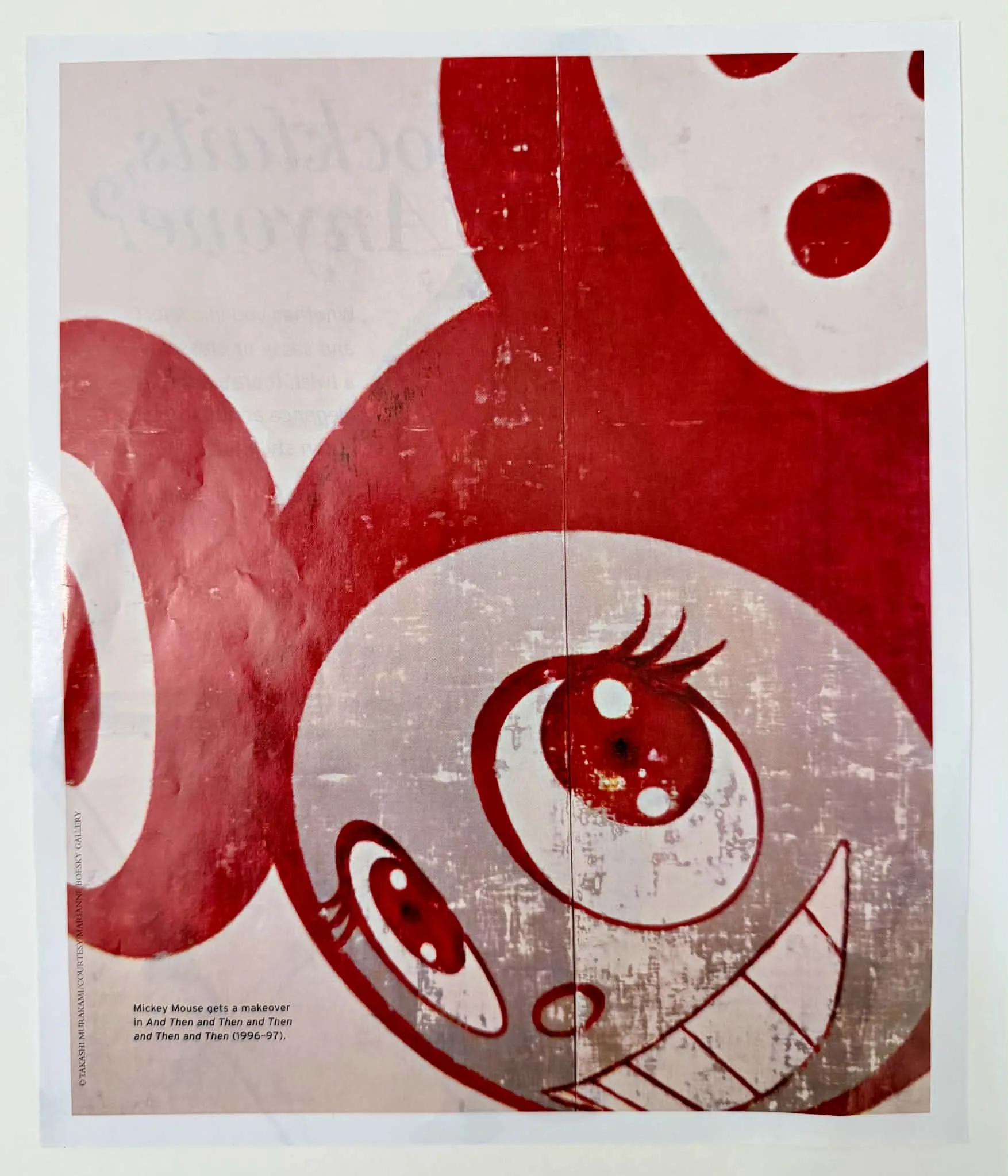
Before this artifact, pop art was an act of observation. After this artifact, pop art became an act of aggressive integration. This is not merely a printed image. It is a cultural autopsy. Captured on this aging paper is the exact moment when Western iconography—specifically the global dominance of Disney’s Mickey Mouse—was consumed, digested, and weaponized by post-war Japanese otaku culture. The image features Takashi Murakami’s Mr. DOB. It represents a fundamental shift in the global art market's center of gravity. It is the visual manifestation of a society rejecting the depth of Western historical narratives in favor of a profound, intentional shallowness. The hierarchy between "high art" and "mass consumerism" did not just blur here. It was flattened entirely.
Category: Other
The History
The Context of the Void: Japan’s Lost Decade To understand the gravity of this printed artifact, one must first look at the soil from which it grew. The mid-to-late 1990s in Japan was an era defined by an invisible weight. The economic bubble of the 1980s had violently burst, plunging the nation into what economists would later term the "Lost Decade." The relentless optimism of post-war reconstruction had evaporated. In its place, a profound cultural stagnation took hold. The generation coming of age during this period found themselves inheriting an empire of consumer electronics, towering concrete skylines, and absolute economic uncertainty. They retreated. The youth turned inward, burying themselves in manga, anime, video games, and isolated subcultures. This was the true stabilization of the otaku—a demographic characterized by obsessive, indoor consumption of two-dimensional media. Traditional Japanese society viewed this retreat as a societal failure. The Western art world viewed it as utterly irrelevant. Takashi Murakami viewed it as an engine. He recognized that the future of Japanese identity was not going to be found in the serene landscapes of traditional Ukiyo-e, nor in mimicking European abstract expressionism. The future was buried in the plastic, disposable, aggressively colorful world of the otaku. This artifact is a direct transmission from that ideological pivot. The Western Invader: Mickey Mouse as Cultural Imperialism The caption printed on this page is explicitly clear: "Mickey Mouse gets a makeover..." But to call this a mere "makeover" is a philosophical understatement. Mickey Mouse was not just a cartoon character; he was the smiling ambassador of American cultural imperialism. Following World War II, the United States fundamentally reshaped the Japanese constitution, economy, and media landscape. With this occupation came the influx of American pop culture. Disney was the spearhead. The recognizable silhouette of those two round ears became a symbol of a triumphant, inescapable Western hegemony. Pop artists like Andy Warhol had previously taken American icons—Marilyn Monroe, Campbell’s Soup—and reproduced them to comment on mass production. But Warhol was an American reflecting his own culture. Murakami, standing on the other side of the Pacific, was dealing with an imported icon. Mr. DOB is a response to that invasion. The character’s name derives from the Japanese slang phrase “Dobojite, dobojite?” meaning “Why, why?” It is a question directed at a void. By taking the universally recognized architecture of Mickey Mouse and mutating it, Murakami was not paying homage. He was stripping the icon of its American invincibility, absorbing its power, and rendering it foreign, slightly monstrous, and entirely Japanese. The Genesis of Mr. DOB: A Deliberate Mutation Look closely at the anatomical structure of the figure captured on this page. The rounded ears are present, but they are hollowed out, bearing the letters 'D' and 'B'. The face is a circular 'O'. The eyes are massive, reflecting the standard visual language of Japanese anime, yet they possess a frantic, almost unhinged intensity. The smile is wide, filled with jagged, menacing teeth. This is not a creature designed to comfort children. Mr. DOB was engineered in 1993, but this specific iteration, And Then and Then and Then and Then and Then (1996-97), represents the character's most confident stabilization. Murakami designed DOB to be a universally recognizable mascot that stood for nothing. He studied the survival mechanics of characters like Sonic the Hedgehog and Doraemon, analyzing what made a silhouette instantly memorable. He then weaponized those mechanics. DOB is a Frankenstein’s monster of consumer appeal. It is cute, but it is dangerous. It is deeply familiar, yet entirely alien. This duality forces the viewer to confront their own conditioning. Why are we drawn to this shape? Why do we trust it, even when it bears its teeth? The Superflat Philosophy: Erasing the Depth of History This printed excerpt is a physical manifestation of a theory that would alter the trajectory of contemporary art: Superflat. Coined by Murakami, Superflat theory posits that there is a fundamental lack of three-dimensional depth in traditional Japanese art—from the woodblock prints of the Edo period to modern anime cels. But Superflat is not merely an aesthetic observation about perspective; it is a sociological diagnosis. Murakami argued that post-war Japanese society itself had become "flat." The distinction between high culture and low culture had been eradicated. In the West, a hierarchy persisted: an oil painting hung in a gallery was inherently "superior" to a comic book sold at a newsstand. In Japan, devastated by war and rebuilt by extreme capitalism, that hierarchy collapsed. Anime, plastic figurines, and manga held as much cultural weight as fine art. By painting Mr. DOB using traditional Japanese techniques but adopting the visual language of cheap animation, Murakami dragged the otaku aesthetic kicking and screaming into the hallowed halls of fine art. He forced the global elite to pay millions for the very imagery that Japanese society had previously dismissed as childish trash. The Title as an Echo: "And Then..." The title documented in this artifact, And Then and Then and Then and Then and Then (1996-97), is crucial to its historical decoding. It is not descriptive. It is rhythmic and exhausting. It mimics the relentless, never-ending cycle of consumerism. In a capitalist society, there is no final conclusion. There is only the next product, the next episode, the next iteration. You buy a thing, and then you need another thing, and then another. The title reflects the endless, hollow scrolling of modern existence before the smartphone era even truly began. It is the sound of a television left on in an empty room. By repeating the phrase until it loses all meaning, Murakami strips away the narrative arc of the artwork, leaving the viewer trapped in a continuous, meaningless present. This mirrors the exact psychological state of the Japanese youth during the economic stagnation of the 1990s. There was no future to look forward to, only an endless series of "and thens." The Gallery Validation: Marianne Boesky and the Western Gaze At the bottom of the page, a quiet but highly significant text anchors the piece: © TAKASHI MURAKAMI/COURTESY MARIANNE BOESKY GALLERY. This single line of copyright establishes the geopolitical shift this artifact represents. Marianne Boesky opened her gallery in New York in 1996, the exact timeline of this piece. She was instrumental in introducing Murakami’s radically foreign vision to a deeply traditional, Eurocentric American art market. The inclusion of this credit line proves that the infiltration was successful. Mr. DOB had breached the gates. The otaku subculture had bypassed local Japanese disapproval and secured validation from the capital of the Western art world. This copyright line is not just a legal protection; it is a timestamp of conquest. It signifies the moment a Japanese artist stopped trying to speak the language of Western art, and instead forced the West to learn his. The Permanent Shift: From Observation to Integration The historical weight of this artifact lies in its legacy. Before Murakami, artists critiqued commercialism from a safe, ironic distance. After Murakami, that distance evaporated. He proved that an artist could simultaneously be a critic of consumerism and its most enthusiastic participant. Murakami went on to mass-produce Mr. DOB as plush toys, keychains, and Louis Vuitton handbags. He did not just paint the mascot; he became the corporation. This 1996-97 iteration of DOB is the blueprint for that empire. It is the exact prototype of the modern art world we inhabit today—a world where the lines between a museum masterpiece, a hypebeast sneaker drop, and a luxury brand collaboration no longer exist. This printed page is the schematic for the flattened reality we currently occupy.
The Paper
This artifact is not a pristine canvas; it is a survivor of mechanical reproduction. It appears to be an excerpt from a gallery catalog, an art periodical, or a retrospective book. The paper itself reveals the passage of time. It is a standard mid-weight commercial stock, likely between 100 to 115 GSM, originally featuring a semi-gloss coating. However, time has begun to strip away this protective layer, replacing the factory sheen with a muted, chalky texture. A severe, deliberate vertical crease bisects the image. This confirms its placement as a two-page spread, a centerfold meant to dominate the viewer’s peripheral vision when the publication was opened flat. The physical damage along this fold line—the micro-tears in the ink exposing the raw paper fibers beneath—serves as a brutal reminder of its physical reality. Technically, the printing utilizes a standard CMYK offset lithography process. Under close inspection, the aggressive red ink is not solid; it is constructed from a microscopic cosmos of halftone rosettes. The slight misalignment in these dot patterns—a minor registration error—adds a raw, analog imperfection to an image that is fundamentally about plastic, digital perfection. The paper exhibits subtle edge yellowing, a chemical oxidation process that grounds this futuristic, timeless character firmly in the late 1990s.
The Rarity
Class A While the original painting of And Then and Then... holds immense financial value in the blue-chip art market, this specific printed artifact derives its value from its archival context. It is a mass-produced fragment, yet it operates as a crucial historical document. Its rarity is not defined by scarcity of material, but by the specificity of the era it captures. It is a primary source document showing exactly how Murakami was presented to the Western public at the very genesis of his international breakout. As physical print media from the 1990s continues to degrade and disappear into landfills, intact references featuring the Marianne Boesky Gallery attribution become critical, irreplaceable markers of art history.
Cite this article
- MLA
- Naodhinsuk, Ronin. “The Time Traveller's Dossier : Murakami's DOB - The Superflat Mutation.” The Record Institute, 13 September 2026, https://therecord.institute/journal/the-time-travellers-dossier-murakamis-dob-the-superflat-mutation.
- APA
- Naodhinsuk, R. (2026, September 13). The Time Traveller's Dossier : Murakami's DOB - The Superflat Mutation. The Record Institute. https://therecord.institute/journal/the-time-travellers-dossier-murakamis-dob-the-superflat-mutation
- CHICAGO
- Naodhinsuk, Ronin. 2026. “The Time Traveller's Dossier : Murakami's DOB - The Superflat Mutation.” The Record Institute, September 13, 2026. https://therecord.institute/journal/the-time-travellers-dossier-murakamis-dob-the-superflat-mutation.