The Time Traveller's Dossier : Murakami's Inflatables - The Spatial Invasion of Superflat
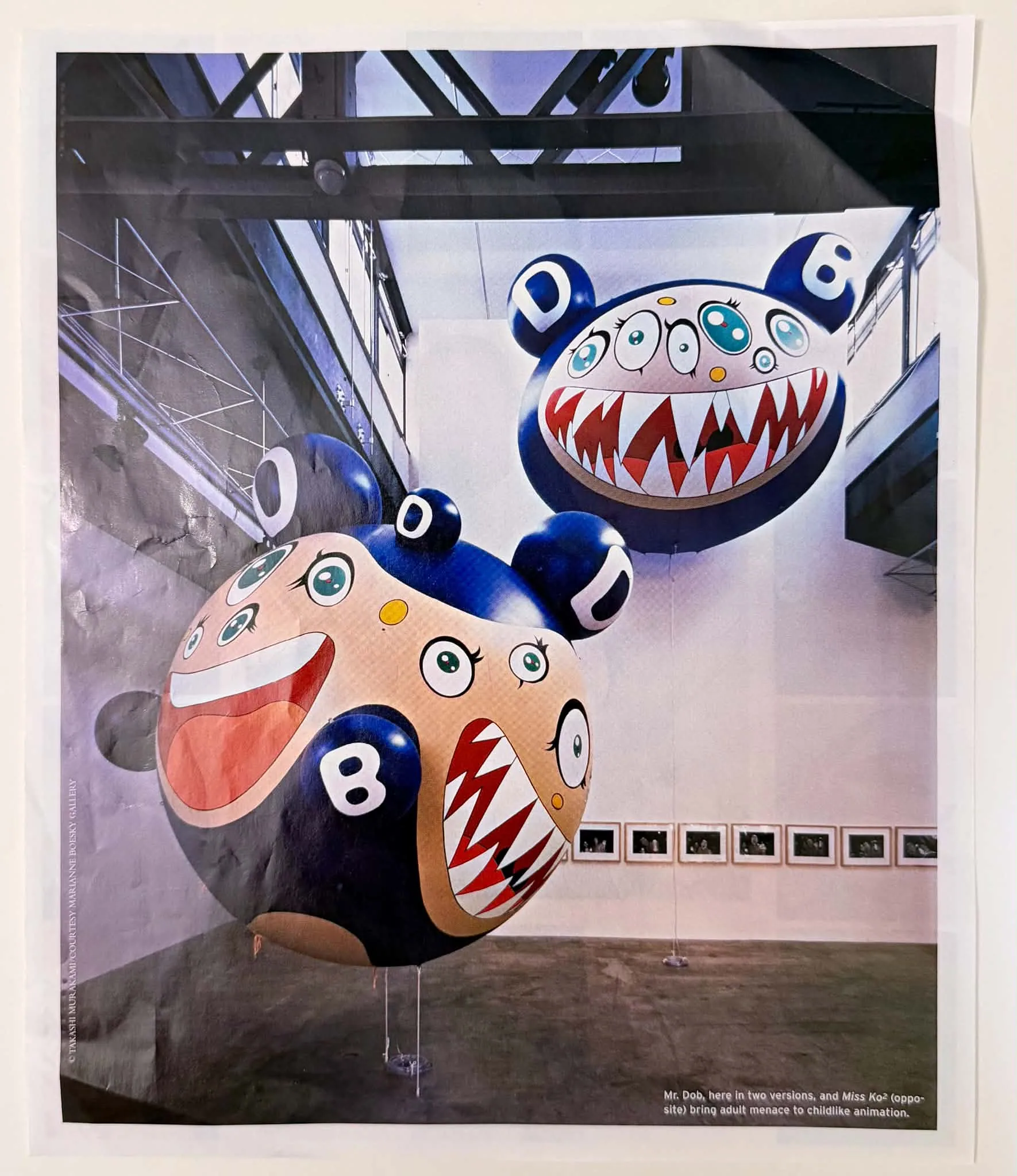
Before this artifact, the philosophy of "Superflat" was strictly confined to two dimensions. It existed on canvas. It existed on paper. It existed on screens. It was a critique of a society lacking depth, delivered through a medium that literally possessed none. After this artifact, the flat universe inhaled. It inflated. It breached the physical dimension. Captured across these magazine pages is the documentation of a profound structural shift in contemporary art. Takashi Murakami did not just build sculptures. He deployed architectural parasites. These massive inflatable iterations of Mr. DOB transformed the cute, consumable mascot into an oppressive, spatial threat. The boundary between the pristine white cube of the gallery and the hyper-synthetic nightmare of post-war Japanese otaku culture was irrevocably shattered. The culture of the flat had learned how to occupy volume.
Category: Fashion
The History
The Dimensional Paradox: Inflating the Flat To understand the historical gravity of the installations documented in this artifact, one must first grasp the foundational paradox of the artwork itself. Takashi Murakami’s entire conceptual framework, known as "Superflat," was a sociological diagnosis masquerading as an aesthetic movement. He argued that post-war Japanese society, having been leveled by atomic destruction and subsequently rebuilt by extreme American capitalism, had lost its cultural and historical depth. The hierarchy between high art and low culture had been flattened entirely. Thus, his early paintings were meticulously rendered to eliminate any illusion of three-dimensional space, mimicking the flat, glossy cels of cheap commercial animation. They were pristine, flat surfaces reflecting a flat society. However, the printed artifact before us records the exact moment that flat ideology became a spatial weapon. By transitioning Mr. DOB from a flat acrylic canvas to a massive, three-dimensional inflatable structure, Murakami engineered a deliberate and brilliant paradox. He took a character defined entirely by its lack of depth and forced it into physical volume. But the volume is a trick. An inflatable sculpture is not carved from solid marble. It is not cast in heavy bronze. It is merely a thin membrane of synthetic, petroleum-based material stretched tightly over empty air. It occupies massive physical space, yet it remains fundamentally hollow. This structural hollowness is the ultimate, devastating metaphor for the era into which it was born. The late 1990s and early 2000s in Japan were defined by the traumatic aftermath of the "Bubble Economy"—a period of massive, artificially inflated economic growth that eventually and violently burst, leaving a void of societal stagnation known as the Lost Decade. Murakami’s inflatables are the literal, physical manifestation of that economic bubble. They are imposing. They are colorful. They are utterly dominant in the room. Yet, they require constant, loud mechanical life support from electric air blowers to survive. If punctured by a single pin, they collapse into a puddle of meaningless vinyl. They are monuments to a society running on artificial inflation. The Anatomy of Menace: Biological Mutation and the Kawaii Defense The caption printed on this archival page provides a clinical, precise observation of this cultural shift: "Mr. Dob, here in two versions, and Miss Ko2 (opposite) bring adult menace to childlike animation." This specific phrase, "adult menace," is the critical cipher required to decode the artifact. In its earliest iterations on canvas, Mr. DOB was a relatively benign, if slightly confusing, amalgamation of Mickey Mouse and Sonic the Hedgehog. He was a mascot engineered for mass consumption, utilizing the visual mechanics of kawaii (cuteness). Cuteness, in post-war Japanese culture, is not merely an aesthetic preference; it is a vital psychological defense mechanism. It is a way for a traumatized, defeated society to regress, to seek comfort in the harmless, the soft, the infantile, and the apolitical. The massive inflatables documented here represent the exact moment that psychological defense mechanism failed. The repressed trauma mutated and breached the surface. This iteration of Mr. DOB is a biological nightmare. The character’s face is asymmetrical, bloated, and distorted. The mouth is stretched into a terrifying rictus grin, exposing rows of massive, jagged, shark-like teeth. This is not the welcoming smile of a corporate character designed to comfort children at a theme park. It is the gaping maw of an apex predator designed to consume them. It is the visual representation of late-stage capitalism devouring the mindless consumer. Furthermore, the eyes present a profound psychological disturbance. In traditional commercial animation, large, singular eyes signify innocence, vulnerability, and emotional permeability. Here, the eyes have multiplied like cancer cells. They vary wildly in size, pupil dilation, and directional focus. Some are wide with manic, unblinking energy; others are heavy-lidded, displaying a quiet, psychotic detachment. This multiplication of the optical organs speaks directly to biological mutation—a recurring, inescapable motif in post-war Japanese art that constantly echoes the persistent generational anxiety of nuclear fallout. Additionally, in the context of the approaching digital age of the early 2000s, these multiple, erratic eyes simulate the paranoia of panoptic surveillance. The mascot is no longer a passive object for the viewer to look at. The mascot is surveilling the room with schizophrenic intensity. The Architectural Parasite and the Gallery Host The full spatial context of the installation, captured in these documentary photographs, offers a stark, jarring contrast that heightens the ideological impact of the work. The gallery space is explicitly industrial. Concrete floors, exposed steel roof trusses, and bare white walls create a cold, utilitarian environment. Against this stark, serious architectural reality, the synthetic, hyper-pigmented balloons appear almost hallucinatory, as if a digital virus has infected physical reality. This juxtaposition is a calculated act of aggression. The gallery space represents the established, institutionalized reality of the Western art world—a space historically reserved for serious, heavy, permanent objects of deep contemplation. Murakami invades this sacred space with objects that are playful, weightless, and inherently temporary. He turns the quiet sanctuary of the gallery into a chaotic carnival tent. He transforms a place of quiet reflection into a zone of sensory overload. The sheer scale of the balloons forces the viewer into a position of absolute physical inferiority. The scale dictates a specific somatic response. It forces the human body into a posture of submission. To engage with the artwork, the viewer must physically tilt their head backward. They must expose their throat. They must adopt the physical stance of a small child staring up at an imposing adult, or a primitive worshipper staring up at a monolithic, wrathful deity. The space is no longer neutral; it is hierarchically dominated by the synthetic presence of the mascot. The inflatable does not just sit in the room; it aggressively displaces the air. It alters the acoustics of the gallery, introducing the constant, humming drone of the air compressors required to keep the illusion alive. It obstructs the physical navigation of the space, forcing the elite art collectors to physically dodge and weave around its bloated form. It is an architectural parasite that entirely takes over the host body of the gallery. Koons vs. Murakami: The Philosophy of the Balloon To truly understand the historical shift, one must compare this artifact to the work of Jeff Koons, who was dominating the Western art market with balloon imagery during the same era. Koons made balloon dogs out of high-chromium stainless steel. He created heavy, permanent, indestructible objects that merely masqueraded as fragile, temporary balloons. His work was about monumentalizing the fleeting. Murakami did the exact, philosophical opposite. He made actual, fragile, temporary balloons that masqueraded as permanent cultural monuments. While Koons solidified air into steel, Murakami inflated the solid institution of art with empty air. Koons created objects meant to outlast civilization; Murakami created objects that could be destroyed by a stray fingernail, perfectly mirroring the precarious, fragile nature of the modern global economy. The Western Gaze and Institutional Assimilation The copyright text anchored subtly in the artifact reads: "© TAKASHI MURAKAMI/COURTESY MARIANNE BOESKY GALLERY". This single line of metadata is a crucial historical timestamp. Marianne Boesky was instrumental in launching Murakami’s career in the United States in the late 1990s and early 2000s, serving as the bridge between Tokyo otaku culture and the Manhattan elite. This credit line documents the exact era when the Western art market began to aggressively assimilate globalized, hyper-commodified Asian pop art. Western collectors and institutions were utterly fascinated by Murakami’s ability to package foreign psychological trauma into brightly colored, highly polished, commercially viable objects. The presence of this copyright text on a printed magazine page signifies the successful completion of Murakami’s infiltration. His localized Japanese critique had been effectively translated, packaged, and distributed for Western consumption. The fact that this installation is being analyzed through the medium of a printed magazine page further cements its status as a pivotal artifact. The inflatable, inherently temporary and prone to deflation, relies entirely on mechanical reproduction—photography and print—for its historical permanence. The physical object itself may lose air, be folded up, and packed away into a dark wooden crate, but the image of the object, captured on this glossy page, enters the permanent, unalterable archive of art history.
The Paper
This artifact is a physical page excised from a commercial art publication, likely a high-end magazine or an exhibition retrospective catalog. It is not a digital apparition; it is a tangible piece of history. The substrate is a standard commercial coated stock, estimated to be between 100 and 115 GSM in weight. The glossy finish was chemically engineered to hold the ink precisely on the surface rather than letting it bleed into the paper fibers. This ensures maximum color saturation and razor-sharp line definition—a vital, non-negotiable requirement for reproducing the hyper-synthetic, plastic aesthetic of Murakami’s inflatables. However, the passage of time is written directly into the paper's physical topography. Across the full-page spread, distinctive stress wrinkles and light crescent creases are visible. These physical deformations remind the archivist that this is a fragile physical object that has been handled, turned, and subjected to environmental humidity and pressure over decades. The printing process relies on standard CMYK offset lithography. When examining the tightest visual crops, the smooth, airbrushed illusion of the balloon's vinyl surface breaks down completely into thousands of microscopic halftone rosettes. This mechanical translation adds a profound layer of irony to the artifact: an image of a three-dimensional physical object, deliberately designed to look like a two-dimensional cartoon, is ultimately rendered back into a two-dimensional mechanical dot pattern on a printed page.
The Rarity
The intrinsic value of this artifact does not lie in its material scarcity or raw physical components. As a page torn from a commercially distributed publication, thousands of identical copies were printed and circulated globally. Its true rarity is entirely contextual, informational, and historical. It earns a Class B classification because it operates as a primary source document capturing a highly specific, volatile moment in the evolution of contemporary art. It records the precise visual language, the stark gallery setting, and the critical vocabulary (such as the term "adult menace") used by critics to interpret Murakami's transition into massive spatial installations during the Marianne Boesky era. While the original physical inflatables represent millions of dollars in institutional asset value, this mass-produced page serves as the critical fossil record. It preserves not just the visual appearance of the art, but the contemporary discourse, the shock, and the environmental context surrounding its initial impact on the world.
Cite this article
- MLA
- Naodhinsuk, Ronin. “The Time Traveller's Dossier : Murakami's Inflatables - The Spatial Invasion of Superflat.” The Record Institute, 13 September 2026, https://therecord.institute/journal/the-time-travellers-dossier-murakamis-inflatables-the-spatial-invasion-of-superflat.
- APA
- Naodhinsuk, R. (2026, September 13). The Time Traveller's Dossier : Murakami's Inflatables - The Spatial Invasion of Superflat. The Record Institute. https://therecord.institute/journal/the-time-travellers-dossier-murakamis-inflatables-the-spatial-invasion-of-superflat
- CHICAGO
- Naodhinsuk, Ronin. 2026. “The Time Traveller's Dossier : Murakami's Inflatables - The Spatial Invasion of Superflat.” The Record Institute, September 13, 2026. https://therecord.institute/journal/the-time-travellers-dossier-murakamis-inflatables-the-spatial-invasion-of-superflat.