The Time Traveller's Dossier : Nash-Kelvinator 1943 - The Stratospheric Paradigm
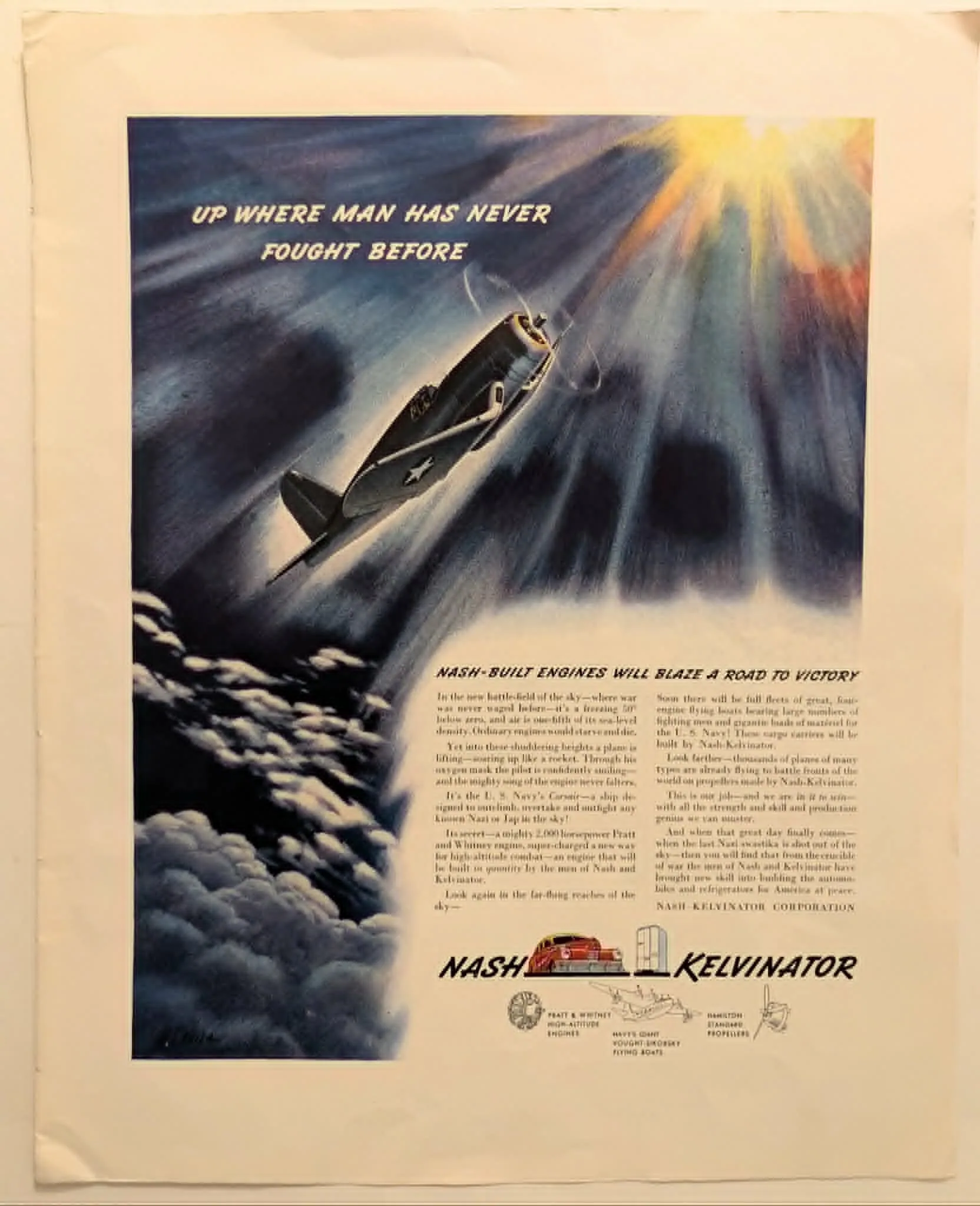
War accelerates human engineering with a brutal, unforgiving absolute. Before the global conflict, the horizon of industrial ambition was domestic comfort. The factory floor was a temple dedicated to the preservation of perishables and the convenience of personal transit. Then, the sky was weaponized. This World War II-era Nash-Kelvinator advertisement is not merely a corporate proclamation. It is a defining artifact of the great industrial pivot. It captures the precise temporal coordinate where the manufacturers of household refrigerators and passenger automobiles were forced into the stratosphere. It documents a structural shift in societal function: the immediate redirection of civilian manufacturing infrastructure toward the production of high-altitude lethality. The transition was absolute. The mechanisms of domestic cooling were abandoned. The thermodynamics of supercharged aviation took their place. Frozen on this deteriorating pulp paper is the moment an entire nation realized that survival required them to build machines capable of breathing where human lungs could not. A domestic workforce, weaponized for the troposphere.
Category: Technology
The History
The Domestic Prelude and the Economy of Comfort To understand the profound structural shift represented by this artifact, one must examine the economic and societal landscape of the late 1930s. The United States was slowly climbing out of the Great Depression. The industrial metrics of success were defined by domestic utility. Nash had built a reputation on the reliable, horizontal motion of the passenger automobile. Kelvinator had mastered the quiet, localized thermodynamics of the household refrigerator. Their merger created a conglomerate dedicated exclusively to the American standard of living. The factory floors in Wisconsin and Michigan were calibrated for civilian predictability. They engineered comfort. They manufactured convenience. This era was characterized by an inward-looking industrial philosophy. The machines built by Nash-Kelvinator were designed to isolate the consumer from the elements—keeping the heat out of the icebox, and keeping the rain off the driver. The engineering tolerances, while precise for their time, were dictated by the forgiving environments of kitchens and paved highways. The Altitude Imperative and the Axis Threat The outbreak of global war shattered this domestic equilibrium. The European and Pacific theaters introduced a new, vertical dimension to geopolitical dominance. It became immediately apparent that whoever controlled the upper atmosphere controlled the war. Enemy aircraft had set terrifying new benchmarks in maneuverability and altitude. The stratosphere transformed from a scientific curiosity into a vital, freezing battlefield. The advertisement's copy captures this realization with chilling clarity: "Up where man has never fought before". The text explicitly details the hostility of this new domain, noting a temperature of "a freezing 50° below zero" and an atmosphere where "air is one-fifth of its sea-level density". Under these extreme conditions, the internal combustion engines that powered terrestrial vehicles would simply suffocate. "Ordinary engines would starve and die," the artifact bluntly states. The problem was no longer just aerodynamic drag or payload capacity; the problem was respiration. The human pilot required an oxygen mask to survive, but the aircraft required a mechanical lung. The Mechanical Lung and the Arsenal of Democracy By federal decree in early 1942, civilian automobile production was halted. The assembly lines were torn out. The great industrial pivot had begun. Nash-Kelvinator, a company fundamentally rooted in the management of temperature and domestic transport, was conscripted into the aerospace industry. The engineering leap required was staggering. They were tasked with manufacturing the beating heart of the American aerial offensive: a "mighty 2,000 horsepower Pratt and Whitney engine". This is the core technological shift documented by the artifact. Building a 2,000 horsepower radial engine required metallurgical precision and machining tolerances that far exceeded anything required for a refrigerator compressor. To solve the problem of thin air, these engines were "super-charged in a new way for high-altitude combat". The supercharger acted as the mechanical lung, violently compressing the sparse stratospheric air and forcing it into the cylinders, ensuring the "mighty song of the engine never falters". There is a profound philosophical irony here. Kelvinator’s pre-war expertise lay in extracting heat to create cold. Their wartime mandate required them to manage the immense, explosive heat of a 2,000 horsepower engine operating in an environment of fifty degrees below zero. They had transitioned from preserving the peace of the American kitchen to preserving the structural integrity of a war machine operating at the limits of physics. The Corsair and the Ecosystem of Dominance The artifact centers its visual narrative on the U.S. Navy's Corsair. This aircraft, with its distinct inverted gull-wing design, was a brutalist piece of engineering. It was built around the massive Pratt & Whitney engine that Nash-Kelvinator was tasked with supplying in quantity. The copy is unapologetically aggressive, declaring the Corsair a ship "designed to outclimb, overtake and outfight any known Nazi or Jap in the sky!". It is a statement of mechanical supremacy. But the artifact also reveals the vast, interconnected ecosystem of the wartime supply chain. Nash-Kelvinator was not operating in a vacuum. The corporate base of the advertisement showcases their other critical sub-contracts. They were manufacturing "Hamilton Standard Propellers", the complex, variable-pitch blades required to translate 2,000 horsepower into thrust. Furthermore, the text mentions "fleets of great, four-engine flying boats" bearing massive logistical loads for the Navy, explicitly identifying them as "Navy's Giant Vought-Sikorsky Flying Boats". This demonstrates a societal shift from isolated corporate competition to a synchronized industrial monolith. The former makers of domestic appliances were now the foundational pillars of a global logistical and combat network. The Crucible of Reconversion Perhaps the most philosophically revealing aspect of this artifact is its conclusion. Wartime propaganda often relied on fear, but this piece relies on the promise of the future. The text speaks of the "crucible of war". It acknowledges the violence but frames it as a temporary, transformative fire. The advertisement promises that when the "last Nazi swastika is shot out of the sky," the men of Nash and Kelvinator will return to their domestic origins. However, they will not return as they were. The text guarantees that the extreme demands of building high-altitude aircraft engines will have "brought new skill into building the automobiles and refrigerators for America at peace". This is the ultimate justification for the industrial interruption. It asserts that the brutal necessity of war will yield a technological dividend for peacetime. The visual representation of this promise sits at the very bottom of the page: a bright red passenger automobile juxtaposed against a pristine white household refrigerator. They sit below the bold Nash-Kelvinator typography, surrounded by the line-art schematics of radial engines and propellers. It is a visual contract with the American public: endure this violent detour into the stratosphere, and we will return to the ground with machines of unprecedented quality.
The Paper
The physical reality of this artifact provides a parallel narrative of its era. This is a mid-century, mass-produced magazine stock, likely falling within the 60 to 70 GSM range. It was birthed during a period of strict federal rationing, where the highest-grade wood pulp was redirected from civilian publishing toward critical wartime logistics. The paper is inherently acidic. The unrefined lignin within the matrix is actively oxidizing, resulting in the distinct, amber-hued yellowing visible along the outer margins. This is a slow, relentless chemical fire consuming the document from the inside out. The printing process utilizes standard four-color CMYK offset lithography. Upon macro inspection of the red automobile graphic, the distinct halftone rosette patterns are visible, a hallmark of 1940s high-speed web presses operating under wartime constraints. The tactile sensation of the page is coarse and highly fragile. It is a highly ephemeral medium, printed quickly to boost morale, yet it now carries the heavy, enduring weight of total industrial war.
The Rarity
Class A : Culturally Imperative. While these mass-market magazines were printed by the millions, the survival rate of this specific advertisement in pristine, untorn condition is exceptionally low. However, its true rarity is completely detached from antique market valuations. Its rarity stems from its immense contextual gravity. It is a flawless primary source documenting the "Great Reconversion." It intersects the history of domestic consumerism with the extreme engineering of stratospheric combat. It captures a fleeting moment where a refrigerator company was forced to build the heart of a fighter plane, making it a vital historical contradiction.
Cite this article
- MLA
- Naodhinsuk, Ronin. “The Time Traveller's Dossier : Nash-Kelvinator 1943 - The Stratospheric Paradigm.” The Record Institute, 22 June 2026, https://therecord.institute/journal/the-time-travellers-dossier-nash-kelvinator-1943-the-stratospheric-paradigm.
- APA
- Naodhinsuk, R. (2026, June 22). The Time Traveller's Dossier : Nash-Kelvinator 1943 - The Stratospheric Paradigm. The Record Institute. https://therecord.institute/journal/the-time-travellers-dossier-nash-kelvinator-1943-the-stratospheric-paradigm
- CHICAGO
- Naodhinsuk, Ronin. 2026. “The Time Traveller's Dossier : Nash-Kelvinator 1943 - The Stratospheric Paradigm.” The Record Institute, June 22, 2026. https://therecord.institute/journal/the-time-travellers-dossier-nash-kelvinator-1943-the-stratospheric-paradigm.