The Time Traveller's Dossier : Nash-Kelvinator - Weapons Above the Battlefield and a Blood-Stained Promise
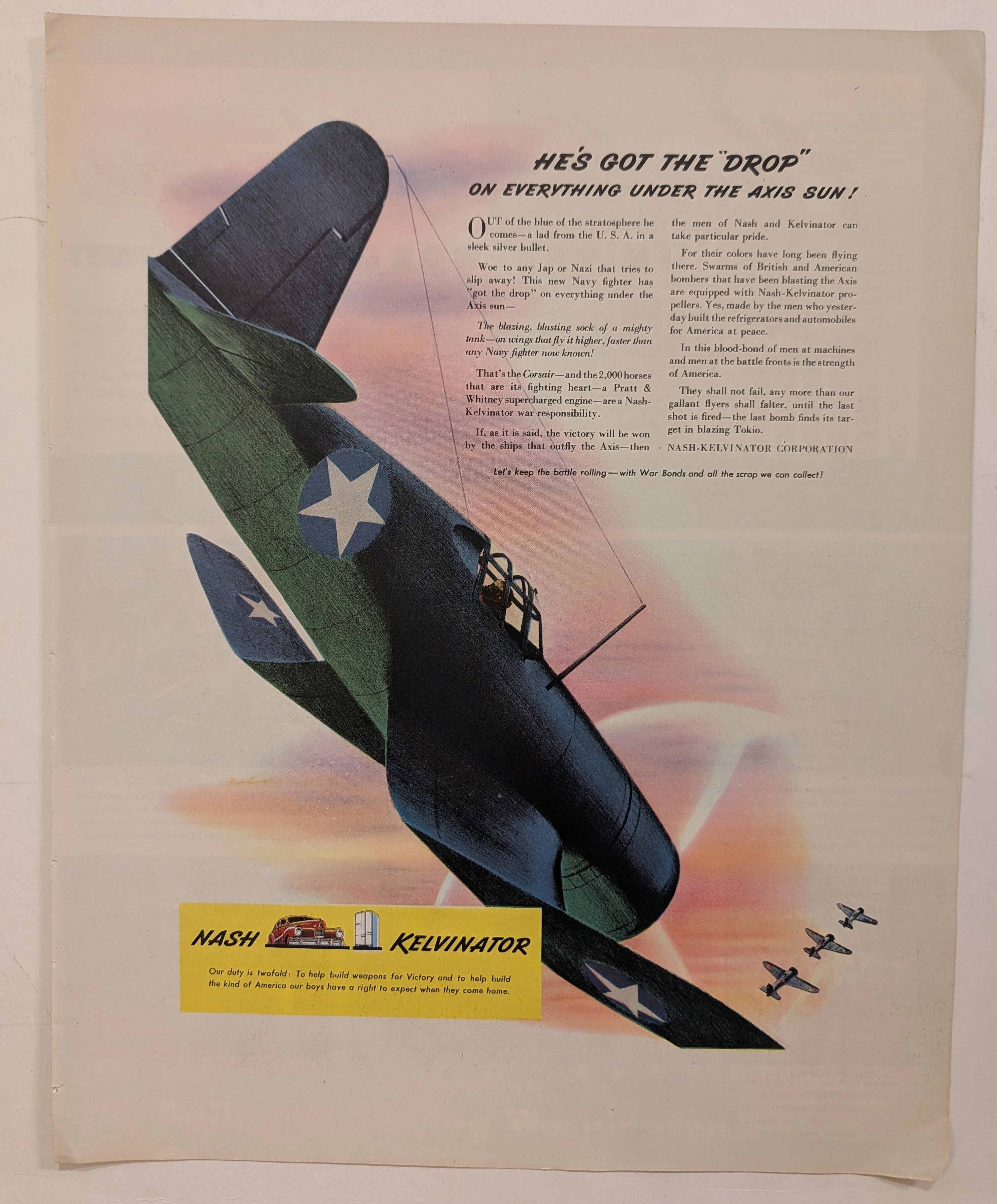
Before this specific artifact was pulled from the printing press. The American assembly line was the ultimate, undisputed symbol of domestic prosperity and peacetime innovation. Vast, sprawling factories across the United States produced gleaming automobiles for family road trips and humming refrigerators to preserve food in the modern, electrified kitchen. But then, the devastating attack on Pearl Harbor and the subsequent, all-consuming inferno of the Second World War brought that domestic utopia to a violently abrupt halt. The assembly lines for civilian goods were completely, unconditionally suspended by federal mandate. Then, the greatest, most rapid industrial metamorphosis in human history occurred. America transitioned almost overnight into the "Arsenal of Democracy." The Nash-Kelvinator Corporation, a massive industrial conglomerate renowned for producing top-tier automobiles and household refrigerators, was forced to entirely abandon its consumer goods. Instead, they pivoted their massive manufacturing capabilities to produce the raw, beating hearts of aerial behemoths: the 2,000-horsepower Pratt & Whitney supercharged engines destined for the legendary Vought F4U Corsair fighter plane. This advertisement was not printed to "sell" a product to the reader, because the company literally had no products left for the civilian market to buy. Rather, it was meticulously engineered to sell an "ideology," a "justification," and a profound "hope." It is the stark, jarring integration of the brutal, unvarnished violence of aerial combat against the Axis powers, intricately woven into the idealized, suburban dream of a brand-new car and a pristine refrigerator. This is a promise forged in blood: We will build the terrifying weapons necessary to secure victory today, so that we may return to building the prosperous, consumer-driven America you deserve... on the glorious day our brave boys finally come home.
Category: Automotive
Brand: Nash
The History
The Arsenal of Democracy and the Great Industrial Pivot To successfully decode the immense historical and sociological gravity of this advertisement—printed during the absolute boiling point of the Second World War, circa 1943 to 1944—one must first thoroughly understand the unprecedented industrial landscape of the United States during this era. Following the nation's entry into the global conflict, the United States government, under the direction of the War Production Board, issued a sweeping mandate that completely halted the manufacture of all civilian automobiles and domestic electrical appliances. Every single factory, foundry, and assembly line was ruthlessly drafted into the sprawling machinery of the global war effort. The Nash-Kelvinator Corporation, which had been formed in 1937 through a highly strategic merger between a prominent automobile manufacturer (Nash Motors) and a leading high-end appliance maker (Kelvinator), was certainly no exception to this federal decree. They were forced to execute a monumental pivot. They transitioned their sophisticated production lines from assembling quiet, insulated refrigerators and comfortable passenger sedans to manufacturing complex, high-stress military equipment, most notably Hamilton Standard aircraft propellers and incredibly complex aviation engines. This specific advertisement is a flawless, textbook example of what the industry termed "Institutional Advertising" during the wartime years. Because these massive corporations had absolutely no physical goods available for the American public to purchase, they faced the very real, existential threat of brand amnesia. If they stayed silent for the duration of the war, consumers might forget them by the time peace returned. Therefore, the only viable method to maintain their hard-won market position and public goodwill was to actively boast about how their factories were directly contributing to the slaughter of the nation's enemies. The Broken-Winged Behemoth: The Vought F4U Corsair The primary visual anchor of the advertisement, depicted in a terrifying, high-speed dive from the stratosphere, is the Vought F4U Corsair. This distinctive, inverted gull-wing aircraft was one of the most powerful, feared, and recognizable fighter planes utilized by the United States Navy and Marine Corps in the brutal Pacific Theater. The advertising copy proudly, almost aggressively, declares that this specific aircraft possesses a "fighting heart—a Pratt & Whitney supercharged engine—are a Nash-Kelvinator war responsibility." This represents a highly calculated and brilliant psychological association. While Nash-Kelvinator did not design or build the airframe of the Corsair itself, they were a major licensee contracted to build the incredibly complex radial engines that allowed the aircraft to perform. They built the "heart" that allowed this machine to fly higher, dive faster, and strike harder than almost any other naval fighter in existence at the time. The advertisement leverages the awe-inspiring, lethal reputation of the Corsair as undeniable, empirical proof of Nash-Kelvinator's absolute engineering precision. If their machines are reliable enough to keep a pilot alive in a dogfight over the Pacific, they are certainly reliable enough to keep your milk cold or drive your family to church. The Rhetoric of Violence and Unvarnished Nationalism The language utilized in this specific copy reflects the intense hatred, the racial animosity, and the bloodthirsty spirit of the wartime era with startling clarity. The text proclaims: "Woe to any Jap or Nazi that tries to slip away!" The casual, prominent use of a racial slur ("Jap") was entirely standard, officially sanctioned practice in American wartime propaganda and commercial advertising of the 1940s. The advertisement offers absolutely no apologies and makes no attempt at diplomatic compromise. It speaks bluntly and aggressively of bombs finding their targets in "blazing Tokio." This raw, visceral anger is systematically justified and sanctified through what the advertisement poetically terms a "blood-bond." It speaks of the sacred connection between the men operating the heavy machinery in the safe, domestic factories of America, and the men operating the lethal machinery of war on the chaotic, bloody battlefronts. It was a concerted, highly effective psychological effort to make the civilian worker feel as though they were directly pulling the trigger on the enemy. It was the total, uncompromising mobilization of the American psyche. The Promise of Peacetime Consumerism The true, underlying psychological brilliance of this archival artifact is quietly hidden in the bright, cheerful yellow box situated in the lower-left corner. Here, a stylized, idealized illustration of a sleek red automobile and a pristine, gleaming white refrigerator is presented against a stark contrast to the dark machinery of war. The text reads: "Our duty is twofold: To help build weapons for Victory and to help build the kind of America our boys have a right to expect when they come home." This is the fundamental core of the advertisement. It is the explicit forging of a social contract with the American consumer: Endure the current rations, tolerate the shortages, buy your War Bonds, and allow us to build the machines of death for now. But, when the dust of the global conflict finally settles, the exact same unparalleled engineering expertise that we used to build a 2,000-horsepower engine to destroy our enemies will be seamlessly redirected. It will be used to build you the most beautiful car and the most advanced refrigerator you have ever seen, elevating your domestic life to unprecedented heights. It was the planting of the psychological seeds that would ultimately bloom into the massive, unstoppable American consumer boom of the 1950s.
The Paper
When examined closely through a macro lens, the physical substrate of this artifact reveals itself to be standard, mid-grade magazine stock typical of the 1940s. It vividly demonstrates the four-color (CMYK) offset lithography printing technology prevalent during the era. In the macro enlargement of the yellow box, one can clearly observe the distinct halftone dot matrix—often referred to as the "rosette pattern"—that intricately combines to create the illusion of the red automobile and the white refrigerator. The mechanical overlapping of cyan, magenta, yellow, and black dots to manufacture shadows, gradients, and depth on a relatively coarse paper surface is highly indicative of the technical constraints of wartime printing. During World War II, paper was subject to strict national rationing, often resulting in thinner, lower-quality stocks that absorbed ink less cleanly than pre-war materials. In the macro detail of the enemy aircraft (the Japanese Mitsubishi A6M Zeros), we can see the precise application of bright magenta/red ink used to stamp the "Hinomaru" (the rising sun roundel) on the wings. The paper itself exhibits distinct signs of natural degradation. There is noticeable foxing—small, brown, localized spots caused by the oxidation of iron or copper impurities within the wood pulp—and a general, uniform yellowing across the negative space. This acidification is the undeniable, organic evidence of a fragile document that has survived for over eight decades, slowly interacting with ambient light and atmospheric oxygen.
The Rarity
As a piece of institutional advertising and domestic wartime propaganda, this specific ad was printed in massive, astronomical quantities. It was deliberately placed in high-circulation, mainstream national magazines such as Life, The Saturday Evening Post, and Collier's to ensure the message reached the absolute maximum number of American households. Consequently, physical copies of the magazines containing this page are relatively common and easily acquirable within the vintage paper and ephemera markets. However, its Contextual and Historical Value is profound and monumental. It serves as a perfect, unblemished representation of the exact moment when American society was forced to violently weld "Consumerism" directly to the "Military-Industrial Complex." The jarring visual juxtaposition of an aggressive fighter plane engaged in a lethal dive, placed immediately alongside cheerful, domestic appliances like a refrigerator and a family sedan, serves as a uniquely powerful historical testament to the bizarre, necessary psychological transitions of the World War II home front.
Cite this article
- MLA
- Naodhinsuk, Ronin. “The Time Traveller's Dossier : Nash-Kelvinator - Weapons Above the Battlefield and a Blood-Stained Promise.” The Record Institute, 9 May 2026, https://therecord.institute/journal/the-time-travellers-dossier-nash-kelvinator-weapons-above-the-battlefield-and-a-blood-stained-promise.
- APA
- Naodhinsuk, R. (2026, May 9). The Time Traveller's Dossier : Nash-Kelvinator - Weapons Above the Battlefield and a Blood-Stained Promise. The Record Institute. https://therecord.institute/journal/the-time-travellers-dossier-nash-kelvinator-weapons-above-the-battlefield-and-a-blood-stained-promise
- CHICAGO
- Naodhinsuk, Ronin. 2026. “The Time Traveller's Dossier : Nash-Kelvinator - Weapons Above the Battlefield and a Blood-Stained Promise.” The Record Institute, May 9, 2026. https://therecord.institute/journal/the-time-travellers-dossier-nash-kelvinator-weapons-above-the-battlefield-and-a-blood-stained-promise.