The Time Traveller's Dossier : Nassa Shell Pectoral - Currency and Status
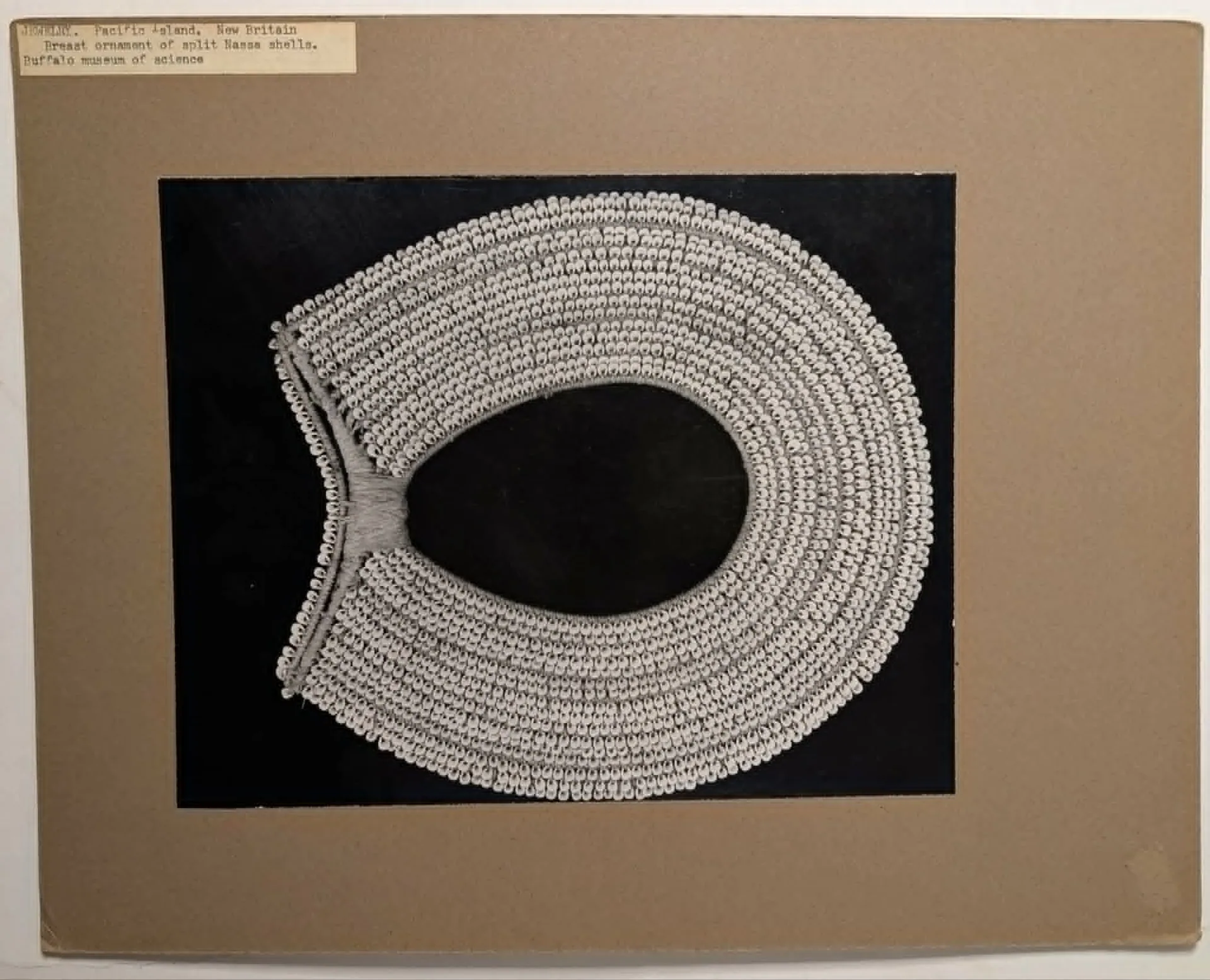
Before this, wealth was an abstract concept. In the West, capital was hidden in ledgers, locked in vaults, or buried in gold reserves. It was unseen. It was a theoretical agreement of power. In the Pacific Islands of New Britain, capital was tactile. It was worn on the chest. It was a heavy, physical manifestation of labor, time, and societal structure. This artifact is not merely a necklace. It is an accounting ledger. It is a wearable bank. The photograph before us documents a profound historical shift. It captures the exact moment an indigenous financial instrument was downgraded by Western taxonomy. It was stripped of its economic power. It was relabeled as "Primitive Art." Then it was relabeled as "Jewelry." Finally, as captured by the brutal ink stamp on its mount, it was simply "DISCARDED." This is a record of how cultures record, misunderstand, and ultimately erase one another.
Category: Fashion
The History
The Architecture of Indigenous Capital To understand this artifact, one must first dismantle the Western definition of currency. In the late 19th and early 20th centuries, the Tolai people and surrounding cultures of New Britain (in present-day Papua New Guinea) operated on a highly sophisticated economic system. Their currency was not paper fiat. It was tambu or diwarra—shell money. The fundamental unit of this economy was the Nassa shell (Nassarius). These small, hump-backed sea snails were abundant in the ocean, but their value was not derived from rarity. Their value was derived strictly from the labor required to process them. This is the labor theory of value made undeniably physical. The breast ornament captured in this photograph is constructed from thousands of these split shells. It is a concentration of immense human effort. It represents a localized economy operating at peak efficiency, entirely independent of the global gold standard. The Mechanics of Extraction and Processing The creation of this object required an industrial level of biological processing. The Nassa shells had to be harvested from coastal waters. The biological matter within had to be removed through burial or boiling. Then came the critical phase: the fracturing. The apex, or the back of every single shell, had to be meticulously cracked off to create a hollow channel. This was done by hand, using rudimentary stone or wooden tools. One mistake, and the shell shattered, rendering it worthless. Once split, the shells were threaded onto tightly woven strips of rattan, cane, or fiber cordage. Look closely at the magnified detail in the photographic record. Notice the alarming consistency. The spacing is mathematically precise. The shells are nested against each other like the scales of a serpent or the rings of chainmail. This is not casual craftsmanship. This is minting currency. The weaver was, in essence, a central banker assembling capital block by block. The Pectoral as a Statement of Liquidity When a piece of this scale was constructed, it transcended basic exchange. A breast ornament of this size was reserved for individuals of high status—a chief, a "big man," or a prominent elder. Wearing this was a strategic display of ultimate liquidity. It was an aggressive projection of economic dominance. In ceremonies, marriages, or dispute settlements, this pectoral could be disassembled. The individual strips of shell money could be unraveled and distributed to settle debts or purchase alliances. To wear this artifact was to wear one's entire treasury on one's chest. It signaled to the community and to rival factions that the wearer possessed the resources to outlast any conflict or fund any communal feast. It was a physical deterrent made of calcium carbonate and woven vine. The Taxonomy of Western Misunderstanding The labels attached to the photographic mount tell a secondary, far more cynical history. The original physical object was removed from its economic ecosystem in New Britain and absorbed into the Buffalo Museum of Science. At this point, the artifact experienced a violent ontological shift. It ceased being money and became a specimen. The typewriter labels are a masterclass in Western taxonomic bias. Observe the progression of the text. One label reads "PRIMITIVE ARTS." The word "Primitive" implies a lower evolutionary stage of human creation. It dismisses the complex financial mathematics required to assemble the piece. Another label reads "JEWELRY." This is a fundamental misclassification. Calling this breastplate "jewelry" is akin to calling a briefcase full of hundred-dollar bills an "accessory." The Western archival system failed to comprehend that it was looking at a foreign banking system. The typewriter ink locked the object into an inaccurate historical narrative, reducing a powerful economic instrument to mere exotic adornment. The Bureaucracy of Forgetting The final historical shift recorded here is the lifecycle of institutional memory. The photograph itself became an artifact of the Seattle Public Library Art Department. For decades, it served as visual data. It was cataloged under the number 17468. It was protected by stern rules stamped on the reverse: "Use no thumb tacks gummed tape or mark in any way." The institution demanded its pristine preservation. Yet, the same institution eventually deemed it obsolete. The massive, bleeding ink stamp spelling "DISCARDED" dominates the mount. This stamp represents the ultimate devaluation. The physical object lost its power when it was taken from New Britain. The photographic representation lost its power when the library modernized. The "DISCARDED" stamp is a brutal, administrative execution of memory. It reveals how quickly a society will throw away the documentation of human history once it no longer fits the current filing system. It is a chilling reminder that archiving is not permanent; it is merely a temporary stay of execution against forgetting.
The Paper
The artifact is a multi-layered composite of materials, each degrading at its own distinct chronological pace. The primary substrate is a rigid, heavy-stock cardboard mount. It is highly acidic, exhibiting the deep, oxidized grey-brown hue typical of mid-20th-century institutional filing materials. The surface has a rough, fibrous texture, designed for durability in a card catalog system rather than aesthetic presentation. The photograph itself is a gelatin silver print. The emulsion layer sits flatly on the paper base, exhibiting a low-gloss, matte finish. This finish was intentional, designed to eliminate glare under the harsh fluorescent lights of a library reading room. The contrast is severely pushed. The blacks are deep and crushing, entirely consuming the background to force the white of the Nassa shells into sharp, aggressive relief. The most compelling physical aspects are the ink applications. The instructional text on the reverse ("Use no thumb tacks...") is applied with a highly structured, commercial rubber stamp, its edges crisp and authoritarian. Conversely, the "DISCARDED" stamp is violent. The ink is over-saturated, bleeding slightly into the porous cardboard fibers, applied with a heavy, dismissive human hand. The typed labels utilize a physical ribbon mechanism, the mechanical keys biting deep into the fragile, aged paper tape, leaving a permanent topographical depression in the material. It is a physical collision of preservation and destruction.
The Rarity
Classification: Class A. The original breast ornament safely resides within the climate-controlled vaults of a museum. However, this specific photographic mount possesses a unique and irreplaceable contextual rarity. Its value does not stem from the object it depicts, but from the institutional scars it bears. It is a primary document of archival failure. The combination of the inaccurate taxonomic labels ("Jewelry," "Primitive Arts") paired directly with the brutal "DISCARDED" stamp elevates this from a mere reference photo to a powerful piece of meta-history. It forces us to confront how institutions curate, mislabel, and ultimately throw away the world's cultural heritage.
Cite this article
- MLA
- Naodhinsuk, Ronin. “The Time Traveller's Dossier : Nassa Shell Pectoral - Currency and Status.” The Record Institute, 30 June 2026, https://therecord.institute/journal/the-time-travellers-dossier-nassa-shell-pectoral-currency-and-status.
- APA
- Naodhinsuk, R. (2026, June 30). The Time Traveller's Dossier : Nassa Shell Pectoral - Currency and Status. The Record Institute. https://therecord.institute/journal/the-time-travellers-dossier-nassa-shell-pectoral-currency-and-status
- CHICAGO
- Naodhinsuk, Ronin. 2026. “The Time Traveller's Dossier : Nassa Shell Pectoral - Currency and Status.” The Record Institute, June 30, 2026. https://therecord.institute/journal/the-time-travellers-dossier-nassa-shell-pectoral-currency-and-status.