The Time Traveller's Dossier : New York Central - The Geometry of Wartime Logistics
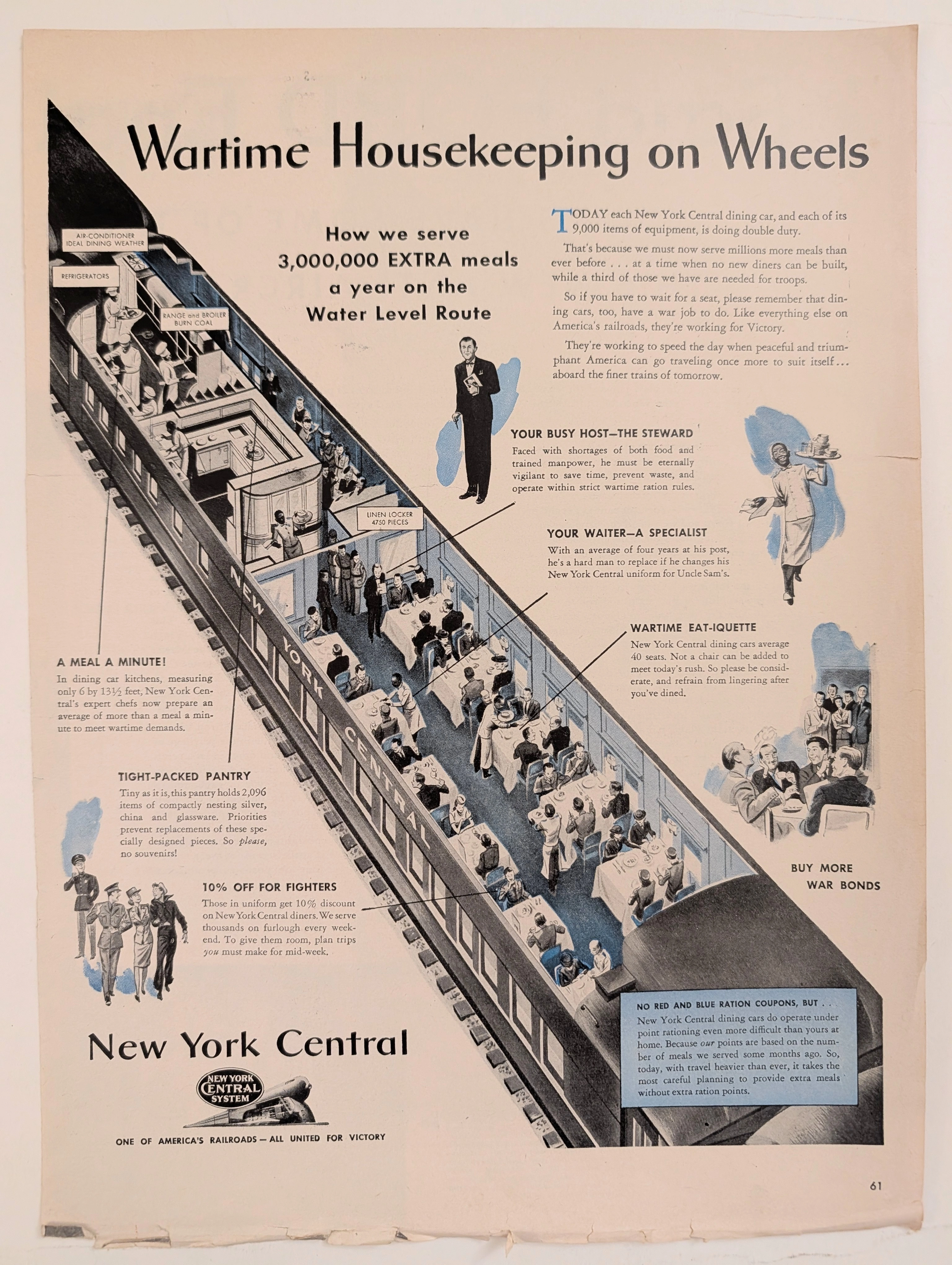
Travel was once a performance of leisure. It was an escape. It was the ultimate luxury of time and space. Before 1941, the American railroad dining car was a rolling palace. It was a five-star restaurant hurtling across the continent at sixty miles per hour. The New York Central Railroad, famously operating the 20th Century Limited along the "Water Level Route," sold the illusion of infinite abundance. Then, the world caught fire. The illusion shattered. The palace became a machine. The artifact before us—a highly detailed, cross-sectional print advertisement for the New York Central System—captures a total inversion of purpose. It is a blueprint of survival. It is the moment the dining car stopped being a theatre of luxury and became an industrial feeding mechanism. The messaging is brutally efficient. It does not apologize for the crowding. It celebrates the mathematics of survival. It asks the civilian to eat quickly, to not steal the silverware, and to surrender their comfort for the soldier. This is not a travel advertisement. It is a masterclass in managing public expectations through the sheer, unyielding force of logistical transparency. It is the architecture of necessity.
Category: Travel
Brand: New York Central
The History
The Death of the Leisure Class To comprehend the shock of this advertisement, one must first understand the zenith from which American passenger rail had fallen. In the 1920s and 1930s, the battle between the New York Central Railroad and its bitter rival, the Pennsylvania Railroad, was fought with crystal, mahogany, and white linen. The dining car was a loss leader. Railroads bled money on their culinary services purely to attract wealthy patrons to their flagship lines. Space was entirely subservient to comfort. A passenger was expected to linger over a cigar, to sip brandy as the Hudson River blurred past the window. December 7, 1941, erased this paradigm overnight. The United States entered the Second World War, and the domestic transportation grid was instantly nationalized in spirit, if not in absolute legal fact. The military required the movement of millions of conscripted men. Troop trains claimed absolute priority. Suddenly, the civilian traveler was no longer a revered guest. They were an obstruction. They were a secondary priority permitted to travel only out of absolute necessity. The New York Central had to pivot from selling luxury to selling endurance. The Mathematics of the Rolling Kitchen The heart of this artifact is its astonishing spatial transparency. The advertisement proudly exposes the terrifying, claustrophobic geometry of the dining car kitchen. Consider the dimensions explicitly stated: "measuring only 6 by 13 ½ feet." Within this microscopic footprint—barely the size of a modern walk-in closet—human beings were subjected to extreme heat, relentless motion, and unimaginable pressure. They were required to stand beside a "Range and Broiler Burn Coal" hurtling along steel rails. In this 81-square-foot furnace, they manufactured miracles. The copy notes the preparation of "an average of more than a meal a minute to meet wartime demands." This is no longer culinary art. This is an assembly line. It is Henry Ford’s logic applied to roasted chicken and potatoes. The New York Central proudly states they serve "3,000,000 EXTRA meals a year." This was a staggering logistical triumph, achieved without expanding the physical dimensions of the train cars. The Tightly Packed Pantry and the Plea to the Public The efficiency extended beyond the cooking space. The advertisement points to a "Tight-Packed Pantry" holding "2,096 items of compactly nesting silver, china and glassware." Notice the subtle, desperate plea appended to this engineering marvel: "Priorities prevent replacements of these specially designed pieces. So please, no souvenirs!" This is a profound historical marker. The wartime economy had diverted all base metals and manufacturing capabilities toward the production of aircraft, munitions, and tanks. A stolen silver spoon was no longer a minor annoyance to the railroad; it was an irreplaceable asset. The corporate voice shifts from hospitable to mildly admonishing. The civilian is reminded that their petty theft directly harms the national infrastructure. The Human Machinery: Stewards, Waiters, and Race The artifact highlights the human element of this rolling factory. It points to "Your Busy Host—The Steward" and "Your Waiter—A Specialist." The copy notes the waiter is a "hard man to replace if he changes his New York Central uniform for Uncle Sam's." This hints at the severe domestic labor shortage. However, looking at the visual representation, we must acknowledge the unwritten historical reality of the era. The waiters and cooks depicted in the illustration are Black men. Since the era of George Pullman in the late 19th century, the grueling, highly specialized labor of sleeping car porters and dining car staff was predominantly performed by African Americans. They were the invisible backbone of American luxury travel. In 1943, these men were pushed to the absolute limits of human endurance. They navigated crowded aisles, balanced scalding trays on lurching trains, and dealt with a stressed, rationing-fatigued public. They were the frontline soldiers of domestic logistics. Wartime Eat-iquette and the Gamification of Guilt The most fascinating psychological manipulation in this artifact is the section titled "Wartime Eat-iquette." The New York Central dining cars averaged 40 seats. They bluntly state: "Not a chair can be added to meet today's rush. So please be considerate, and refrain from lingering after you've dined." The era of the leisurely post-dinner cigar was dead. The civilian was being explicitly instructed to eat and evacuate. The corporation weaponized patriotic guilt to accelerate table turnover. If you lingered, you were not just being rude to the waiter; you were delaying a soldier from eating. The advertisement reinforces this by offering "10% OFF FOR FIGHTERS." It visually centers the men in uniform. The civilian is relegated to the periphery of importance. The Paradox of Rationing Finally, we examine the text regarding the "Red and Blue Ration Coupons." During WWII, the Office of Price Administration (OPA) heavily controlled civilian access to meat, butter, sugar, and canned goods through a complex system of stamps. The advertisement boasts that travelers do not need to surrender their personal ration points to eat in the dining car. However, it clarifies that the railroad itself is strictly rationed "based on the number of meals we served some months ago." This created a bizarre paradox. The dining car was a high-pressure, overcrowded, stressful environment, yet it was also one of the few places a civilian could legally consume a steak without burning through their family’s monthly ration book. The railroad leveraged this loophole, managing public frustration by reminding them of the administrative miracle required to put food on the table at all. This advertisement is a monument to the industrialization of hospitality. It is the moment the machine of war swallowed the dining car whole.
The Paper
The physical reality of this document is a direct reflection of wartime austerity. Extracted from a mass-circulation magazine, the paper stock is a thin, machine-made wood pulp. It lacks the heavy, glossy clay coating of pre-war luxury publications. Under magnification, the mechanical limitations of the era are laid bare. We observe a two-color printing process—a stark, utilitarian black ink overlaid with a single, highly strategic cyan (blue) spot color. This duotone approach was cheaper and faster than full CMYK separation, yet brilliantly effective. The cyan is used to guide the eye. It colors the uniform of the steward, the dresses of the female passengers, and acts as a structural highlight to separate the isometric floors and walls of the train car. The halftone dot pattern is coarse, designed for high-speed rotary presses that prioritized volume over fine art fidelity. Decades of oxidation have turned the unprinted areas of the page into a warm, acidic beige. The edges show micro-tears and brittleness, the inescapable destiny of cheap, acidic wood pulp. This artifact was never meant to survive. It was ephemeral communication, designed to be read in a waiting room and discarded. Its survival is an accident, preserving the exact tactical texture of 1943.
The Rarity
Classification: Class A (High Contextual & Archival Value) As a singular magazine tear sheet, this item is not exceptionally rare in the open market. Millions of copies were printed across various national publications. However, its archival classification is elevated to Class A strictly due to its density of informational value. It is a flawless, uncorrupted primary source. It does not rely on vague patriotic slogans; it provides exact dimensions, inventory counts, and explicit social directives. For historians of logistics, industrial design, culinary history, and wartime sociology, this single page offers more concrete data than a dozen standard propaganda posters. Its value lies in its absolute transparency.
Cite this article
- MLA
- Naodhinsuk, Ronin. “The Time Traveller's Dossier : New York Central - The Geometry of Wartime Logistics.” The Record Institute, 15 April 2026, https://therecord.institute/journal/the-time-travellers-dossier-new-york-central-the-geometry-of-wartime-logistics.
- APA
- Naodhinsuk, R. (2026, April 15). The Time Traveller's Dossier : New York Central - The Geometry of Wartime Logistics. The Record Institute. https://therecord.institute/journal/the-time-travellers-dossier-new-york-central-the-geometry-of-wartime-logistics
- CHICAGO
- Naodhinsuk, Ronin. 2026. “The Time Traveller's Dossier : New York Central - The Geometry of Wartime Logistics.” The Record Institute, April 15, 2026. https://therecord.institute/journal/the-time-travellers-dossier-new-york-central-the-geometry-of-wartime-logistics.