The Time Traveller's Dossier : Niagara Carpet - The Dawn of Extreme Torture Testing Adverts
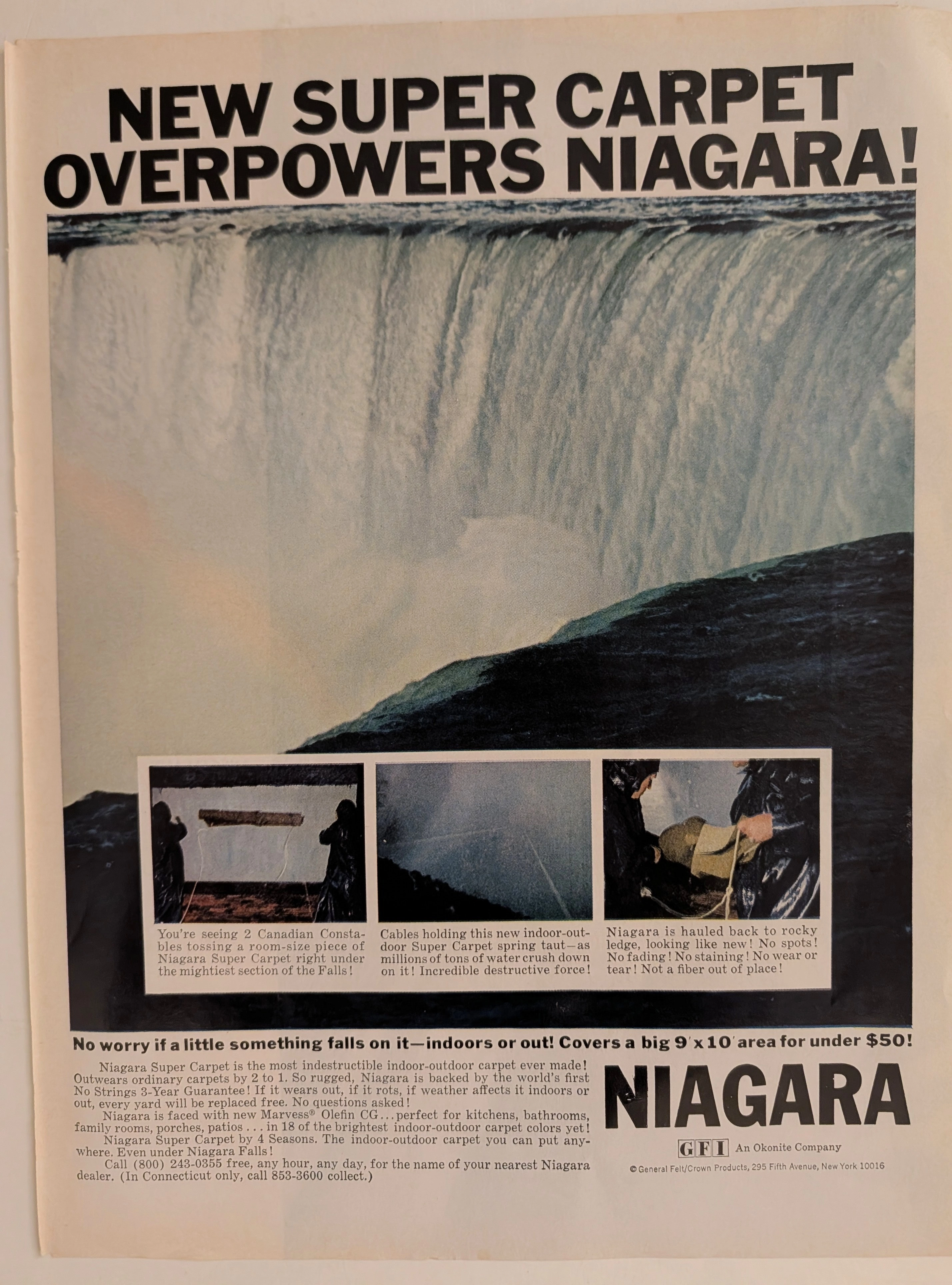
Before this artifact. Domesticity was a fragile construct. Textiles were vulnerable. Rugs were confined to parlors. They feared the rain. They feared the mud. They feared the chaotic elements of the outside world. Then came the synthetic revolution. Polymers breached the sacred threshold of the home. The industrial promise was simple. Indestructibility. But a promise on paper is weak. The proof required absolute spectacle. This advertisement documents a structural pivot in consumer communication. From merely telling the consumer. To aggressively showing the consumer. A room-sized textile. Rigged to steel cables. Tossed directly into an apocalyptic deluge. This is not mere marketing collateral. It is a historical document of material science attempting to conquer the forces of nature.
Category: Travel
Brand: ์Niagara
The History
The Threshold of Synthetic Domestication To understand this artifact, one must first understand the post-war chemical boom. The mid-twentieth century was defined by an excess of industrial capacity. During the war, chemical companies developed miraculous polymers for parachutes, tires, and insulation. When peace arrived, these massive industrial complexes needed a new target. They found it in the American suburban home. Wool and cotton were the old guard. They were organic. They absorbed moisture. They degraded. They rotted. The chemical industry introduced the synthetic alternatives. First came Nylon. Then came Polyester. Then came the subject of this document. Polypropylene. Known in the commercial textile trade as Olefin. Specifically, Marvess® Olefin CG. Olefin is not a traditional fabric. It is an extruded petrochemical. It is, at a molecular level, a highly refined plastic spun into microscopic yarns. Its defining characteristic is its absolute hydrophobia. It does not absorb water. It vehemently repels it. Because it lacks porous cellular walls, stains cannot bind to the fiber. Mold cannot feed on it. UV radiation struggles to break its carbon bonds. This was a radical shift. A carpet was no longer a delicate woven craft. It was a piece of industrial armor repurposed for the domestic living room floor. The Architecture of the Torture Test By the late nineteen-sixties, the American consumer had grown deeply cynical. Decades of exaggerated advertising claims had diluted the power of the printed word. Every product was "new." Every formula was "improved." Every item was "revolutionary." Words alone no longer moved capital. The industry needed empirical validation. This birthed the era of the "Torture Test." This was a psychological strategy designed to short-circuit consumer doubt. Timex strapped wristwatches to boat outboard motors. Samsonite hired actual apes to physically assault their luggage. General Felt Industries, armed with their new Olefin textile, looked for their own theater of proof. They bypassed laboratories. They bypassed factory stress tests. They went directly to the absolute extreme. Niagara Falls. The psychological calibration here is masterful. Niagara Falls represents the ultimate, unyielding destructive force of nature. Millions of tons of water. Crushing down with relentless kinetic energy. The logic presented to the consumer is mathematically simple but emotionally profound. If this carpet can survive the apocalyptic hydraulic crush of the falls. It will effortlessly survive a spilled martini. It will survive a muddy dog. It will survive a summer thunderstorm on an open patio. It re-calibrates the scale of domestic anxiety by introducing an unimaginable extreme. The Logistics of the Fall Observe the physical evidence provided in the three lower inset panels. The framing is deliberately grainy. Under-exposed. Chaotic. These are not polished studio photographs. They are styled as documentary evidence. The text explicitly notes the presence of "2 Canadian Constables." This is a critical psychological anchor. The inclusion of law enforcement personnel adds an aura of objective state authority to a corporate stunt. They are witnesses to the impossible. Consider the sheer engineering required for this single photographic frame. "Cables holding this new indoor-outdoor Super Carpet spring taut." Suspending a nine-by-ten-foot sheet of woven plastic directly beneath a waterfall is not a trivial undertaking. The aerodynamic and hydrodynamic drag on a surface area of ninety square feet under that volume of falling water is immense. The force would snap standard ropes. It would shred lesser textiles instantly. The fact that it held together is a testament to the tensile strength of the Olefin backing. This was not a cheap trick of the camera. It was a high-risk, high-cost logistical nightmare, executed entirely to produce a single page in a magazine. It represents the peak of mid-century advertising hubris. The Blurring of Architectural Boundaries Beyond the spectacle, this artifact records a profound shift in residential architecture. The text repeatedly hammers the phrase "indoor-outdoor." Before this era, the line between shelter and nature was absolute. You had the interior, which was controlled, soft, and carpeted. You had the exterior, which was wild, hard, and made of concrete or wood. The post-war suburban boom created transitional spaces. The patio. The lanai. The sunroom. The Florida room. The middle class wanted to push their domestic comfort out into the natural environment. Niagara Super Carpet facilitated this architectural migration. It allowed the softness of the living room floor to exist under the open sky. It dissolved the strict boundary between the inside and the outside. "Perfect for kitchens, bathrooms, family rooms, porches, patios." It unified the home into a single, indestructible, synthetic surface. Corporate Lineage and the Economics of Indestructibility Look closely at the corporate attribution at the bottom right. "GFI An Okonite Company." This lineage is historically vital. Okonite was not a lifestyle brand. They were heavy industry. They manufactured insulated wires for the transcontinental railroad. They built telegraph cables. They produced the infrastructure that electrified the nation. By placing this name on a consumer rug, General Felt Industries was transferring industrial credibility to a domestic product. It whispered a subliminal message: The people who wire factories built your patio rug. Then, the final closing argument. The price point. "Covers a big 9'x10' area for under $50!" Adjusted for inflation to the modern era, fifty dollars in the late nineteen-sixties translates to roughly four hundred dollars today. It was aggressively accessible. It did not position indestructibility as a luxury reserved for the elite. It democratized durability. Combined with the "No Strings 3-Year Guarantee," it shifted the risk entirely away from the consumer. If it wore out. If it rotted. If the weather destroyed it. "Every yard will be replaced free. No questions asked!" It moved consumer durables into a strange paradox. A product so cheap it was almost disposable, yet engineered to outlast the home itself. It is a paper monument to the era when chemistry conquered reality.
The Paper
This artifact is a classic specimen of mid-century mass-market publication printing. The physical substrate speaks volumes about the era. It is a lightweight, low-GSM wood-pulp stock. Because it was designed for a high-circulation magazine, cost-efficiency overruled archival permanence. The paper is heavily saturated with lignin, a natural polymer found in wood. Over the decades, exposure to ultraviolet light and atmospheric oxygen has caused the lignin to oxidize. This chemical reaction is what produces the distinct yellowing, or "foxing," visible around the margins. The printing method is traditional Web Offset Lithography. Under magnification, the majestic image of Niagara Falls shatters into thousands of microscopic dots. The CMYK rosette patterns—Cyan, Magenta, Yellow, and Key (Black)—are loosely registered. The inks sit flat on the porous surface, lacking the high-gloss coatings of modern periodicals. The tactile sensation of this paper is dry, fragile, and inherently impermanent. There is a beautiful irony here. The advertisement boasts of an immortal, indestructible synthetic carpet. Yet the medium carrying the message is slowly crumbling into dust under the weight of time.
The Rarity
Classification: Class B (Contextual Anomaly) In terms of sheer survival numbers, this is not a unique artifact. It was printed in mass-market periodicals, millions of copies flooding mailboxes and newsstands. However, its true rarity lies in its conceptual and contextual value. It is an unblemished record of a specific paradigm shift in advertising psychology. Most pages from these magazines were discarded, recycled, or used as kindling. To find a specimen intact, where the heavy ink saturation of the waterfall has not bled through or destroyed the structural integrity of the paper, elevates its status. It is a Class B archival piece. Valuable not for its market price, but for its perfection as an educational tool regarding mid-century material science and consumer manipulation.
Cite this article
- MLA
- Naodhinsuk, Ronin. “The Time Traveller's Dossier : Niagara Carpet - The Dawn of Extreme Torture Testing Adverts.” The Record Institute, 4 May 2026, https://therecord.institute/journal/the-time-travellers-dossier-niagara-carpet-the-dawn-of-extreme-torture-testing-adverts.
- APA
- Naodhinsuk, R. (2026, May 4). The Time Traveller's Dossier : Niagara Carpet - The Dawn of Extreme Torture Testing Adverts. The Record Institute. https://therecord.institute/journal/the-time-travellers-dossier-niagara-carpet-the-dawn-of-extreme-torture-testing-adverts
- CHICAGO
- Naodhinsuk, Ronin. 2026. “The Time Traveller's Dossier : Niagara Carpet - The Dawn of Extreme Torture Testing Adverts.” The Record Institute, May 4, 2026. https://therecord.institute/journal/the-time-travellers-dossier-niagara-carpet-the-dawn-of-extreme-torture-testing-adverts.