The Time Traveller's Dossier : Nine Flags - The Global Scent Wardrobe Shift
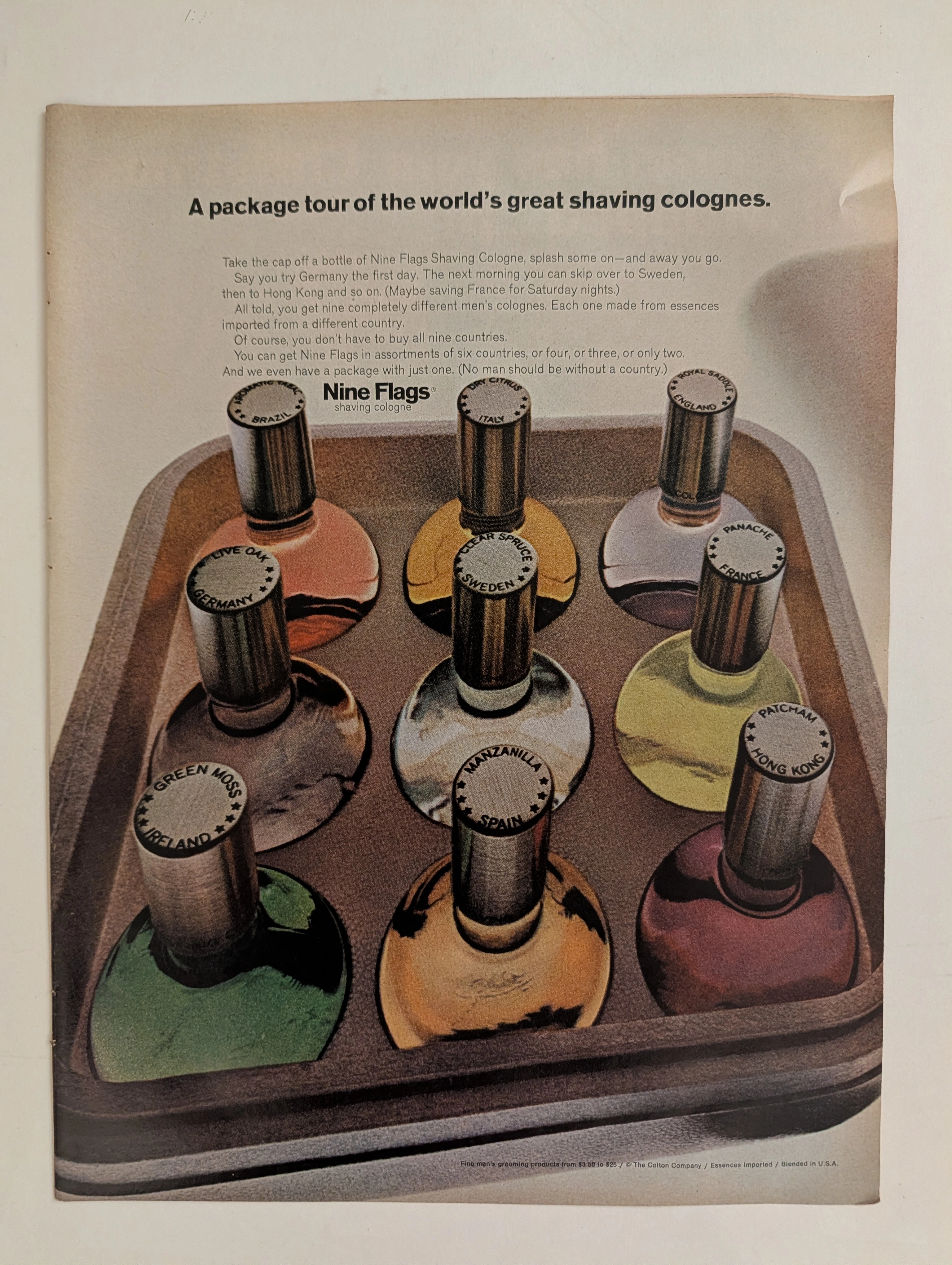
Before this artifact. A man had one scent. A singular identity. Utilitarian. Antiseptic. Bay rum or witch hazel. Function over form. Loyalty to a single, unyielding signature. Then, a shift. Nine distinct flags. Nine geographic promises. The concept of a fragmented, situational "wardrobe" of fragrances was introduced to the mid-century male psyche. Scent was no longer just hygiene. It was a vehicle for cosmopolitan identity. A package tour of the world, distilled into glass, resting quietly on a bathroom counter. It was the democratization of the jet-set lifestyle. The permission for a man to be someone different on a Tuesday than he was on a Saturday.
Category: Fashion
Brand: Nine Flags
The History
The Monolithic Male Baseline To understand the profound shift this artifact represents, we must first map the baseline of mid-twentieth-century male grooming. Prior to the mid-1960s, the grooming ritual was largely a binary construct. Clean or dirty. Shaved or unshaven. Aftershave was not a luxury; it was a punitive necessity. Formulas were highly alcoholic, designed to cauterize micro-abrasions left by carbon steel razor blades. The scent profiles were monolithic. Brands like Old Spice, Aqua Velva, and Brut dominated the landscape. A man chose his brand in his early twenties and wore it until the end of his days. Single-scent loyalty was an unspoken virtue, intertwined with the stoic, post-war archetype of unwavering masculine reliability. To own multiple fragrances was viewed with suspicion. It bordered on the frivolous. The grooming cabinet was a place of utility, not curation. The Aspirational Jet Age The historical landscape surrounding this artifact marks the zenith of the Jet Age. Commercial aviation had transitioned from a dangerous novelty to a glamorous, aspirational ideal. The Boeing 707 was connecting continents at unprecedented speeds. Globalism was emerging, not yet as an economic reality for the working class, but as an aesthetic luxury. Yet, international travel remained financially out of reach for the vast majority of the population. A gap formed in the market. A chasm between the desire for cosmopolitan experience and the economic reality of the domestic consumer. The Colton Company, a sophisticated subdivision operating under the invisible, corporate umbrella of the Gillette company, recognized this void. They did not just sell a grooming product. They engineered a simulation. They formulated a "package tour of the world." If the consumer could not fly Pan Am to the Mediterranean or the Black Forest, the essences would be flown to him. The Psychology of the Scent Wardrobe The most critical sociological shift embedded in this text is the disruption of the singular male identity. "Say you try Germany the first day. The next morning you can skip over to Sweden, then to Hong Kong and so on. (Maybe saving France for Saturday nights.)" This copy is quietly revolutionary. It suggests that a man’s identity does not have to be fixed. It grants psychological permission for modularity. A man could be stoic and grounded on Monday (Germany), crisp and efficient on Tuesday (Sweden), and sophisticated, perhaps even romantic, on the weekend (France). It introduced the concept of contextual dressing applied to olfaction. The artifact tells the consumer that variety is not inherently unmasculine; rather, it is a marker of a man of the world. It framed consumer choice as a form of global conquest. The Nine Territories and Botanical Geopolitics The selection of the nine countries and their corresponding scents is a masterclass in demographic targeting and cultural stereotyping. Every bottle is a highly calculated geopolitical signal. Brazil (Aromatic Tabac): Positioned as exotic. The dense, humid tropics combined with the rugged masculinity of tobacco. It promised warmth and untamed energy. Italy (Dry Citrus): Reflecting the sharp, tailored refinement of the Mediterranean coast. Citrus implies cleanliness, but "dry" elevates it to a state of sharp, sartorial elegance. England (Royal Saddle): An appeal to old-world wealth. The equestrian tradition. Leather, wood, and heritage. It was the scent of the establishment and unshakeable confidence. Germany (Live Oak): The Black Forest. Sturdy, grounded, and industrious. The oak symbolizes resilience. It is a deeply conservative, reliable scent profile. Sweden (Clear Spruce): Nordic efficiency. Crisp, unpolluted air. The promise of bracing, chilling freshness, appealing to the athletic or morning-focused individual. France (Panache): Explicitly reserved by the ad copy for "Saturday nights." France was the cultural shorthand for romance, nightlife, and unapologetic sensuality. Ireland (Green Moss): The rugged poet. Damp earth, fertile land, and a connection to the wild, untamed elements. Spain (Manzanilla): Arid, complex, and sun-drenched. A nod to the Iberian peninsula's intense heat and passionate culture. Hong Kong (Patcham): The gateway to the East. Utilizing patchouli, it echoed the ancient Silk Road. It provided an aura of the mystical and the deeply foreign. Logistical Alchemy and the American Engine Beneath the romance of the global tour lies the cold, brilliant reality of mid-century supply chain economics. "Each one made from essences imported from a different country. Essences Imported / Blended in U.S.A." This is the crux of the operation. To manufacture nine distinct colognes across nine different international borders would have been a logistical nightmare, destroying profit margins with tariffs and shipping costs. Instead, The Colton Company imported only the concentrated raw materials—the essences. The blending, the bottling, the packaging, and the quality control were all centralized within the United States. This ensured consistency while legally allowing the brand to leverage the powerful cachet of the word "imported." It was globalism optimized by American industrial efficiency. Modularity and the Illusion of Choice The engineering of the package itself represents a shift in retail strategy. "Of course, you don't have to buy all nine countries. You can get Nine Flags in assortments of six countries, or four, or three, or only two." The pricing structure, ranging from $3.50 to $25.00, was vast. Twenty-five dollars in the late 1960s was a premium investment in grooming. By offering modular sets, the brand achieved two things. First, it lowered the barrier to entry. A man could start with a set of three. Second, it introduced the gamification of grooming. It created an open loop. If a man owned three flags, he was inherently missing six. The design compelled completion. It transformed a consumable liquid into a collectible artifact. The tray holding the bottles is deliberately designed to look like a precision tool kit or an ammunition box. It appeals directly to a mechanical, organizing instinct. "No Man Should Be Without a Country" The final ideological hook of the artifact is its tagline. "And we even have a package with just one. (No man should be without a country.)" This is a brilliant subversion of a serious, almost nationalistic sentiment, repurposed for consumerism. It taps into a primal fear of displacement. To lack a signature scent—to lack a "flag"—is framed as being socially adrift. The artifact does not just sell scented alcohol. It sells belonging. It sells the world, neatly compartmentalized, capped, and stamped, ready for consumption.
The Paper
The physical substrate of this artifact speaks volumes about mid-century mass communication. It is printed on standard, mid-weight magazine stock, likely ranging between 60 to 70 GSM. The paper is lightly coated to allow the ink to sit upon the surface, enhancing the reflective qualities of the metallic caps in the imagery. Under macro inspection, the web offset printing process reveals itself entirely. The CMYK rosette patterns—cyan, magenta, yellow, and black halftone dots—are distinctly visible across the metallic textures of the bottle caps. This mechanical precision contrasts sharply with the organic promises of the scents inside. The edges show minor signs of atmospheric degradation, a faint yellowing or foxing caused by the oxidation of the wood pulp over decades. The tactile reality is one of controlled decay. The artifact is slowly burning itself up through the invisible friction of time and oxygen.
The Rarity
Class A. As a printed advertisement, it was mass-produced in the millions, inserted into high-circulation men's magazines of the era. Therefore, the physical paper itself is not a scarcity. However, its contextual value is extraordinarily high. Complete, intact physical sets of the Nine Flags colognes with their original molded trays are now exceedingly rare, often degraded or lost entirely. This artifact serves as the definitive historical anchor. It is the blueprint of a paradigm shift. Its rarity lies not in its physical scarcity, but in its absolute clarity as a document that permanently altered the psychology of the men's cosmetics industry.
Cite this article
- MLA
- Naodhinsuk, Ronin. “The Time Traveller's Dossier : Nine Flags - The Global Scent Wardrobe Shift.” The Record Institute, 1 May 2026, https://therecord.institute/journal/the-time-travellers-dossier-nine-flags-the-global-scent-wardrobe-shift.
- APA
- Naodhinsuk, R. (2026, May 1). The Time Traveller's Dossier : Nine Flags - The Global Scent Wardrobe Shift. The Record Institute. https://therecord.institute/journal/the-time-travellers-dossier-nine-flags-the-global-scent-wardrobe-shift
- CHICAGO
- Naodhinsuk, Ronin. 2026. “The Time Traveller's Dossier : Nine Flags - The Global Scent Wardrobe Shift.” The Record Institute, May 1, 2026. https://therecord.institute/journal/the-time-travellers-dossier-nine-flags-the-global-scent-wardrobe-shift.