The Time Traveller's Dossier : Nycar Seat Covers - The Synthetic Fashion Shift
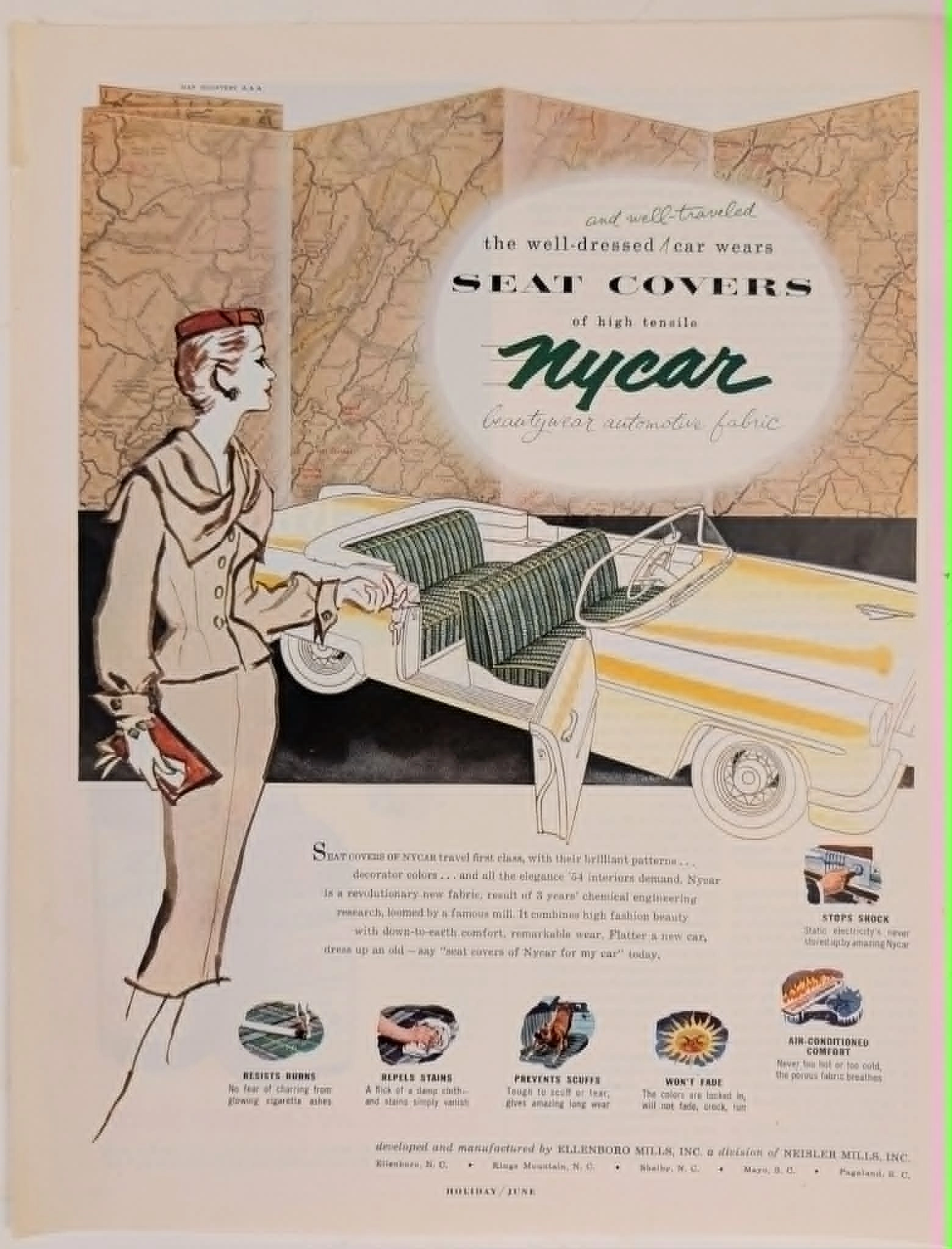
This is not merely a piece of commercial paper. It is a documentary record of the moment the automobile ceased to be a mere machine. Before this era, a car was primarily a utilitarian vessel of transport. Its interior was functional, often fragile, and entirely secondary to the mechanics of the engine. The open road was an adventure, but the cabin was a vulnerable space. This full-page spread from the mid-1950s captures the exact moment the paradigm shifted. It transformed the automotive interior from a utilitarian necessity into a highly curated, fashionable extension of the American living room. It documents a massive technological leap: the application of advanced chemical engineering to consumer textiles. The integration of synthetic fabrics into everyday mobility. It sells invulnerability masked as high fashion. It sells the democratization of luxury. It translates the cold, hard science of high-tensile synthetics into the elegant drape of "beautywear" for the modern highway.
Category: Fashion
Brand: Nycar
The History
The Cartography of Leisure To understand this artifact, one must first look at the background. The canvas upon which this entire advertisement is painted is a map. Specifically, a "Map Courtesy A.A.A." (American Automobile Association). This is not an accidental design choice. In the post-war era, the American landscape was fundamentally changing. The highway system was expanding at an unprecedented rate. Driving was no longer just about getting from point A to point B; it was becoming a primary form of national leisure. The road trip was becoming a central pillar of the American Dream. Families were traveling further, faster, and more frequently than ever before. But this new mobility presented a critical problem. More time in the car meant more wear and tear on the car's interior. The automobile was becoming a mobile living room, a dining room, and a playroom all at once. The original factory upholstery was fundamentally unequipped for this new reality. The Problem of Organic Upholstery Before the synthetic revolution, standard automotive interiors were built from organic materials. Wool broadcloth. Mohair. Cotton blends. These materials were fundamentally flawed for the rigors of mid-century family travel. They absorbed moisture. They held onto stains with stubborn permanence. They faded rapidly under the relentless magnification of automotive glass. And critically, they wore out. The constant friction of sliding in and out of the vehicle degraded organic fibers quickly. A family's expensive new investment could look ragged and impoverished within a single year of heavy use. The car's mechanical heart might beat perfectly, but its interior soul would be ruined. The Chemical Engineering Solution This artifact documents the cure. "Nycar — beautywear automotive fabric." The copy proudly boasts that this material is the "result of 3 years' chemical engineering research." This is a crucial historical marker. The post-war period was the golden age of synthetic polymers. The chemical mastery developed for wartime parachutes, tow ropes, and military webbing was being aggressively rapidly repurposed for consumer goods. Nylon and advanced synthetic blends represented a complete break from nature. They were forged in laboratories, not grown in fields. They possessed high tensile strength. They were engineered for resilience. By weaving these synthetic miracles into seat covers, Ellenboro Mills offered consumers a way to armor their vehicles without sacrificing aesthetics. The Feminization of Automotive Accessories Notice the primary subject of the composition. It is not a mechanic in overalls. It is not a rugged patriarch behind the wheel. It is a highly elegant, impeccably tailored woman standing beside a gleaming yellow convertible. This represents a profound shift in automotive marketing. By the mid-1950s, women were increasingly recognized as primary drivers and key decision-makers in household automotive purchases. The car was becoming a reflection of personal style. The headline explicitly draws this parallel: "The well-dressed car wears Seat Covers." The automobile is personified. It is dressed. It wears fabric just as the woman wears her immaculate suit. The seat cover is elevated from a protective tarp to an essential fashion accessory. It promises "first class" travel and "decorator colors." It bridges the gap between the fashion house and the garage. The Anatomy of Mid-Century Threats The brilliance of this artifact lies in its forensic breakdown of everyday destruction. The bottom third of the page is dedicated to a series of inset illustrations. These are micro-narratives of the threats facing the modern driver. First, the glowing cigarette. "Resists Burns." In an era where smoking was omnipresent, a dropped ash was a death sentence for organic upholstery. The synthetic promise is immunity to this specific, highly common carelessness. Second, the stain. "Repels Stains." A disembodied hand wipes away grime with a simple damp cloth. It speaks to the labor-saving promises of the 1950s. The emancipation from deep scrubbing and costly professional cleaning. Third, the dog. "Prevents Scuffs." A hyperactive Boxer dog scrambles across the seat. The high-tensile strength of the fabric acts as a shield against the claws of family pets and the restless feet of children. Fourth, the sun. "Won't Fade." An angry, anthropomorphized sun beams down. Synthetics promised colorfastness. The vibrant "decorator colors" would remain locked in, defying the bleaching power of ultraviolet light. Finally, the shock. "Stops Shock." A hand turns a car radio dial. Early synthetics were notoriously prone to generating massive static electricity charges. Nycar specifically markets itself as a solution to this, promising that static is never stored up. It is a technical refinement of the synthetic promise. The Democratization of Luxury Ultimately, this document is about economic preservation and social status. "Flatter a new car, dress up an old." Seat covers offered a dual utility. For the new car buyer, they protected the massive financial investment, ensuring trade-in value remained high. For the owner of an older vehicle, they provided an instant, affordable facelift. They hid the sins of the past beneath a tight, fashionable skin of modern chemistry. This advertisement is a masterclass in mid-century consumer psychology. It takes the anxiety of wear and tear, mixes it with the aspiration of high fashion, and solves it with laboratory science. It is a perfect microcosm of 1950s American optimism.
The Paper
This is a single page extracted from a high-circulation mid-century American publication (noted as Holiday / June at the bottom). The physical substrate is a standard, lightweight, machine-made magazine stock. It is calibrated strictly for the rapid velocity of mass-market rotary printing presses. The printing relies entirely on the classic CMYK halftone process. Under heavy magnification, the seamless illusion of the elegant woman and the yellow convertible completely shatters. It resolves into a precise, interlocking, mathematical constellation of magenta, cyan, and yellow rosettes. The aging is highly evident and completely authentic. The paper displays the classic, undeniable oxidation of mid-century wood-pulp. A subtle, warm yellowing migrates inward from the cut edges. The physical fibers are slightly brittle. The tactile sensation is dry. It bears the distinct, slightly dusty scent of slowly decomposing lignin. The period-accurate color palette—the specific muted greens of the seats, the soft yellow of the car, the sepia tones of the AAA map—is locked perfectly within this flat illustration style. The aged paper texture itself is a vital aesthetic record of the era.
The Rarity
Rarity: C — Very Common. This specific artifact falls squarely into the foundational tier of the Institute’s grading system. Record Score: Notable. The artifact documents a meaningful cultural shift in automotive marketing and the commercial application of synthetic textiles. It records the moment cars became fashion accessories. Rarity Score: Low. This exact advertisement was embedded in mass-market lifestyle publications like Holiday magazine. It was printed by the hundreds of thousands, likely millions. Because these lifestyle magazines were systematically saved, hoarded, and stored in attics and basements by consumers, the surviving physical population of this specific advertisement is enormous. Composite Logic: Following the Institute’s strict, unbreakable rules, the grade is heavily capped. Historical significance can lift a physically common object only as far as S. However, because this specific artifact was produced in massive quantities and survives in deep, easily accessible abundance, the Rarity axis exerts massive downward gravity on the composite score. It simply cannot transcend its mass-produced origins. It is a ubiquitous record of a fascinating shift in consumer habits. Condition: Good — The page exhibits mild edge toning and slight rippling consistent with magazine extraction. There is minor wear along the left margin where it was bound. However, it remains structurally complete with vibrant, un-faded ink retention and clear legibility of all typography.
Cite this article
- MLA
- Naodhinsuk, Ronin. “The Time Traveller's Dossier : Nycar Seat Covers - The Synthetic Fashion Shift.” The Record Institute, 3 June 2026, https://therecord.institute/journal/the-time-travellers-dossier-nycar-seat-covers-the-synthetic-fashion-shift.
- APA
- Naodhinsuk, R. (2026, June 3). The Time Traveller's Dossier : Nycar Seat Covers - The Synthetic Fashion Shift. The Record Institute. https://therecord.institute/journal/the-time-travellers-dossier-nycar-seat-covers-the-synthetic-fashion-shift
- CHICAGO
- Naodhinsuk, Ronin. 2026. “The Time Traveller's Dossier : Nycar Seat Covers - The Synthetic Fashion Shift.” The Record Institute, June 3, 2026. https://therecord.institute/journal/the-time-travellers-dossier-nycar-seat-covers-the-synthetic-fashion-shift.