The Time Traveller's Dossier : Olds F-80 - Detroit's European Pivot
Post-war American automotive supremacy was an illusion built on mass. Vehicles were designed as sprawling land yachts. Bigger equated to better. Then, the horizon violently shifted. The European influx redefined the concept of luxury from sheer size to surgical precision. This document, detailing the conceptual Oldsmobile F-80, represents a desperate, calculated pivot. It is the artifact of a domestic giant realizing that the future belonged to the compact, the efficient, and the agile. It was Detroit attempting to speak a foreign dialect. They were no longer setting the standard; they were reacting to a new world order. The question was no longer how large a car could be, but how smart it could become.
Category: Automotive
The History
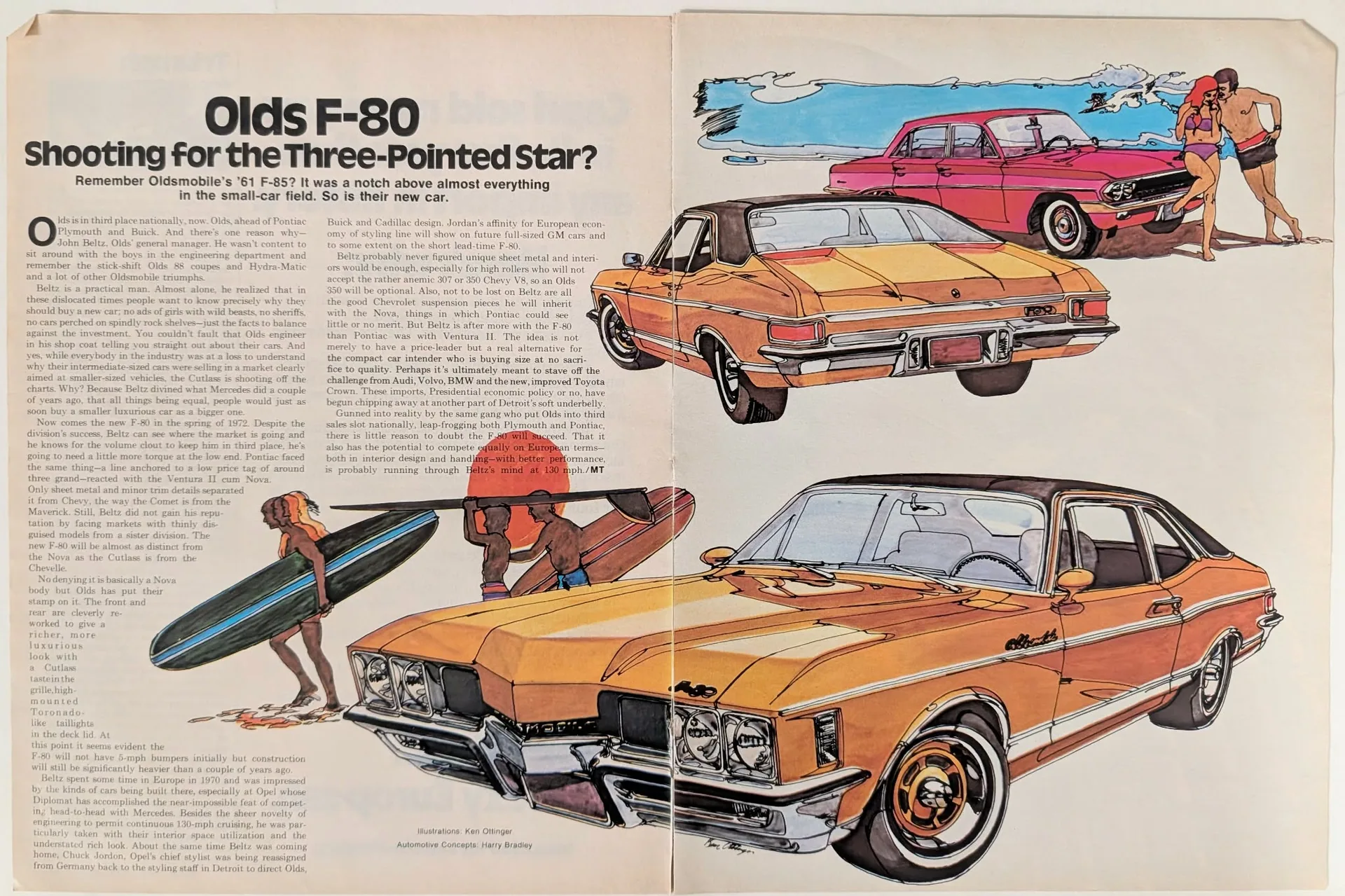
The Illusion of Infinite Displacement To understand the profound weight of this magazine spread, one must first understand the hubris of the American automotive industry at the dawn of the 1970s. For decades, Detroit operated under an undisputed, isolationist paradigm. Fuel was exceptionally cheap. Steel was abundant. The American highway system was a vast, sprawling canvas that demanded large, comfortable, and ultimately inefficient cruisers. Engineering was a matter of linear escalation. To make a car more premium, one simply lengthened the wheelbase, softened the suspension, and increased the displacement of the V8 engine. There was no substitute for cubic inches. This philosophy created a domestic market that was entirely insulated from the engineering realities of the rest of the world. Cars were isolated isolation chambers, disconnected from the road, floating on soft underbellies. The American consumer was trained to equate physical bulk with social status. A compact car was viewed merely as a necessary compromise for the economically disadvantaged, not a choice for the discerning driver. The European Infiltration However, a silent revolution was breaching the shores. European manufacturers were operating under entirely different constraints. Narrow roads, expensive fuel, and a cultural appreciation for driving dynamics birthed a different breed of automobile. Companies like Mercedes-Benz, BMW, Volvo, and Audi were not selling mass; they were selling meticulous engineering. They introduced the American market to the concept of the premium compact. These vehicles were tight, responsive, and utilized interior space with mathematical brilliance. The American consumer, particularly the affluent and educated demographic, began to notice. The article explicitly questions if Oldsmobile is "Shooting for the Three-Pointed Star?". This headline is a monumental admission of vulnerability. The "Three-Pointed Star" of Mercedes-Benz had become the undeniable benchmark for luxury and engineering competence. Detroit was suddenly forced to look over its shoulder. John Beltz and the Epiphany of 1970 The text reveals the genesis of this paradigm shift within General Motors. It centers on John Beltz, the general manager of Oldsmobile. Beltz is portrayed as a pragmatist, a man who realized that consumers were demanding a clear rationale for purchasing a new vehicle. The days of selling cars purely on emotion and exaggerated advertising were ending. The critical turning point occurred during Beltz’s time in Europe in 1970. The text notes he was deeply impressed by the vehicles being built there, particularly observing Opel. He witnessed the Opel Diplomat achieve the near-impossible feat of competing head-to-head with Mercedes-Benz. Beltz experienced an epiphany regarding interior space utilization and understated, rich design. He divined a fundamental truth: if all things were equal, the American public would just as readily purchase a smaller luxurious car as a larger one. This realization was tectonic. It shattered the core tenet of Detroit's design philosophy. The Anatomy of Compromise Translating this European epiphany into American manufacturing reality was a brutal exercise in compromise. The artifact details the forthcoming 1972 F-80. To build this new premium compact, Oldsmobile could not start from a blank sheet of paper. The economics of Detroit demanded shared architecture. The F-80 was fundamentally anchored to a lower price tag, built upon the Chevrolet Nova X-body platform. This presents the inherent conflict of the era. How does an automaker create a vehicle to challenge Mercedes-Benz using the bones of an economy car? The answer was visual and tactile differentiation. The text explicitly states that only sheet metal and minor trim details separated the F-80 from its Chevrolet sibling, similar to how the Comet was separated from the Maverick. Oldsmobile's engineers worked cleverly on the front and rear treatments to give it a richer, more luxurious aesthetic. They incorporated Cutlass taste in the grille and utilized high-mounted Toronado-like taillights in the deck lid. It was an attempt to graft a premium identity onto an economy skeleton. It was a bridge between two worlds, built under the constraints of corporate bean-counting. The Impending Grip of Legislation Beyond foreign competition, the artifact hints at another massive shift altering the automotive landscape: federal legislation. The text explicitly mentions that while the F-80 initially would not have 5-mph bumpers, the construction of the vehicle would still be significantly heavier than a couple of years prior. This seemingly minor detail is a harbinger of the dark ages of American automotive performance. The federal government was stepping in to regulate safety and, soon after, emissions. The era of the unregulated, lightweight, high-horsepower machine was closing. The added weight of structural reinforcements and mandated safety equipment would begin to suffocate the performance of domestic vehicles. Oldsmobile was designing the F-80 not just to fight European agility, but to survive an impending wave of bureaucratic weight. The engineering focus was shifting from acceleration to compliance. The Psychological Warfare The artifact explicitly states the ultimate goal of the F-80: it was meant to stave off the challenge from Audi, Volvo, BMW, Mercedes, and the new, improved Toyota Crown. This roster of competitors highlights the multi-front war Detroit was facing. The European makes were attacking from the premium high ground, while Japanese manufacturers like Toyota were beginning to erode the foundation from below with bulletproof reliability and extreme efficiency. The narrative appeals to the historical precedent of the '61 F-85, reminding readers that Oldsmobile had previously created a vehicle that was a notch above everything else in the small-car field. But the market had changed. The challenge was no longer just building a better American compact; it was competing on European terms—in interior design, handling, and better performance. The article concludes by noting the potential for the F-80 to succeed, observing that the foreign competition had begun chipping away at another part of Detroit's soft underbelly. This document is a strategic assessment of a besieged empire attempting to fortify its weakest flank.
The Paper
This artifact is a physical manifestation of a specific era in publishing economics. Printed on vintage magazine stock characteristic of the late 1960s to early 1970s, the paper possesses a relatively low GSM, prioritizing high-volume, rapid distribution over archival permanence. It was a transient medium for transient news. The printing method is high-volume web offset lithography. A close examination reveals pronounced CMYK rosette patterns, particularly visible in the gradients of the illustrations. The paper itself is heavily laden with lignin, which has reacted with decades of oxygen and ultraviolet light to produce a distinct, oxidized yellowing along the margins. The tactile texture is porous and dry. The ink does not sit atop a glossy coating; rather, it has been absorbed deep into the fibers of the paper. This physical degradation is an integral part of the artifact's identity. It acts as a chronological timestamp, proving that this speculation on the future is irrevocably trapped in the past. It is a fragile record of corporate strategy.
The Rarity
Classification: Class A (Historical Pivot) The rarity of this artifact does not stem from a high market valuation or physical scarcity, but rather from its immense contextual value. It captures a highly specific, fleeting moment of speculative journalism—likely published in Motor Trend, as implied by the "/MT" sign-off in the text. It represents a transitional phase where American automakers were actively trying to formulate a defense against European philosophy before the 1973 OPEC oil crisis forcefully accelerated the timeline. Documents that capture the exact moment a corporate giant acknowledges a paradigm shift—admitting vulnerability to the "Three-Pointed Star"—are critical historical markers. It is an unvarnished look at corporate anxiety dressed as product anticipation.
Cite this article
- MLA
- Naodhinsuk, Ronin. “The Time Traveller's Dossier : Olds F-80 - Detroit's European Pivot.” The Record Institute, 29 August 2026, https://therecord.institute/journal/the-time-travellers-dossier-olds-f-80-detroits-european-pivot.
- APA
- Naodhinsuk, R. (2026, August 29). The Time Traveller's Dossier : Olds F-80 - Detroit's European Pivot. The Record Institute. https://therecord.institute/journal/the-time-travellers-dossier-olds-f-80-detroits-european-pivot
- CHICAGO
- Naodhinsuk, Ronin. 2026. “The Time Traveller's Dossier : Olds F-80 - Detroit's European Pivot.” The Record Institute, August 29, 2026. https://therecord.institute/journal/the-time-travellers-dossier-olds-f-80-detroits-european-pivot.