The Time Traveller's Dossier : Pabst Blue Ribbon 1938 - The Democratization of Leisure
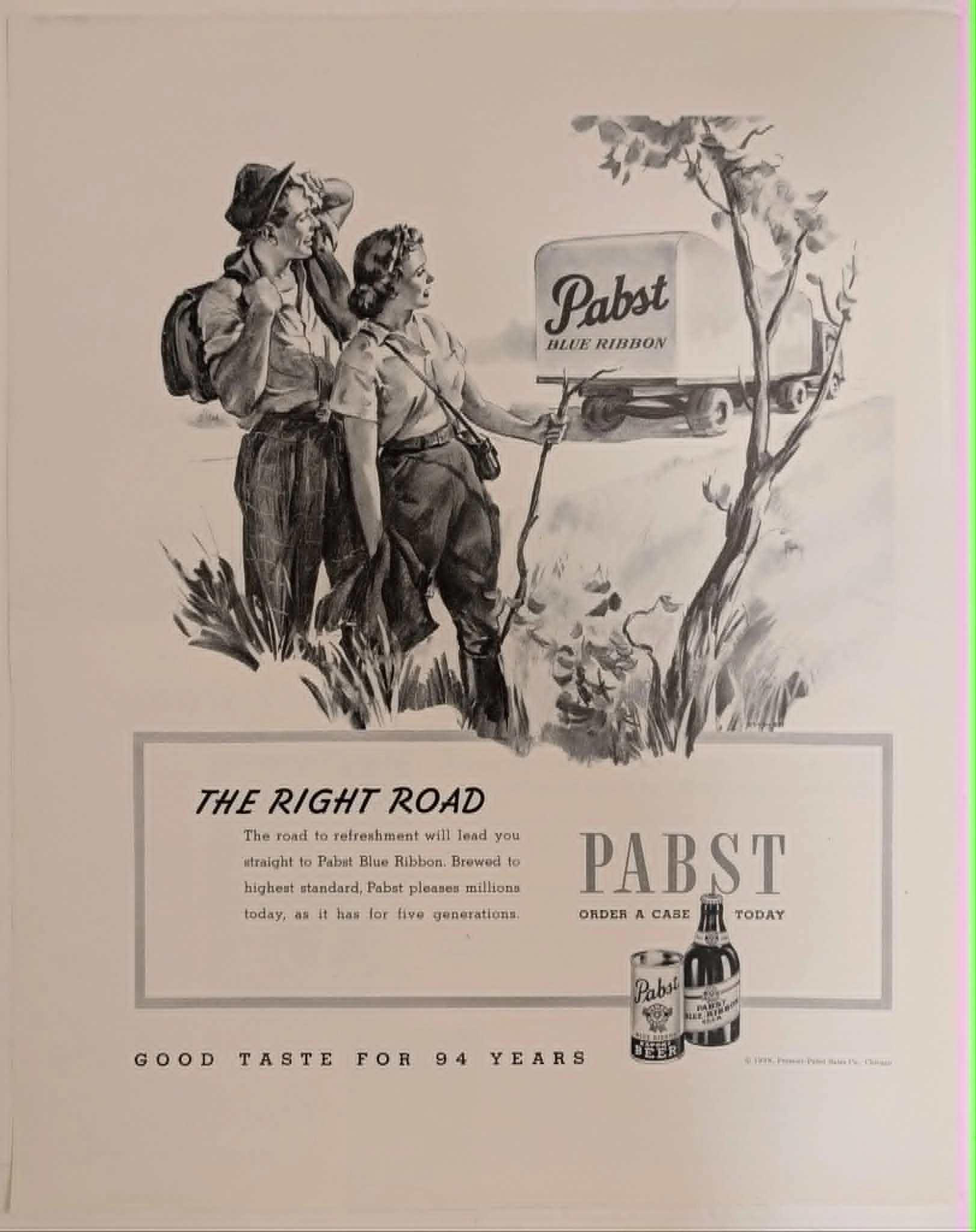
Leisure is a modern invention. Before the twentieth century, the wilderness was something to be feared, conquered, or harvested for raw materials. It was rarely a destination for pleasure. But as the heavy gears of the Industrial Revolution mechanized human labor, the exhausted human soul required a psychological escape. The concept of the "weekend" was born. This specific artifact documents a vital, foundational cultural shift. It marks the precise historical moment when mass-produced, standardized consumer goods hitched a ride on the newly paved American highway system, entering the pristine sanctuary of the great outdoors. Then: Alcohol was tethered to the dark, illicit, and dangerous spaces of the Prohibition-era speakeasy or the localized, grimy neighborhood saloon. Now: The beverage was sanitized, canned, and aggressively rebranded as wholesome "refreshment," becoming a portable staple of the sunlit, optimistic American landscape. Through the lens of this 1938 Pabst Blue Ribbon advertisement, we observe how a massive brewery engineered not just the distribution of a beverage, but the creation of a pastoral, mobile lifestyle.
Category: Travel
The History
The Shadows of 1938 and the Invention of the Outdoors To fully grasp the socio-cultural weight and the strategic brilliance of this artifact, one must first anchor it firmly in the turbulent chronological bedrock of 1938. The United States was slowly, painfully exhaling from the suffocating, decade-long grip of the Great Depression. Across the Atlantic Ocean, the geopolitical tectonic plates were violently shifting. The terrifying, rhythmic drums of a second global war were already beginning to beat in the distance. Yet, domestically, the American public was desperately hungry for stability. They craved optimism. They sought a psychological and physical escape from urban industrial anxiety and lingering economic despair. Enter the great American wilderness. Driven by the massive, unprecedented infrastructure projects of the New Deal, which saw the Civilian Conservation Corps (CCC) carve thousands of miles of hiking trails and build countless national park facilities, the outdoors was suddenly rendered accessible. It was opened to the working and middle classes. The wilderness was no longer a terrifying, untamed frontier; it was a curated, welcoming playground. Hiking, camping, and motoring rapidly became potent symbols of democratic vitality. The couple depicted in this advertisement—vigorous, healthy, clad in rugged but distinctly fashionable outdoor attire, gazing optimistically toward the horizon—are not merely walking. They are actively participating in a newly engineered national pastime. They represent the absolute democratization of leisure. The Attire of Emancipation and Vigorous Masculinity The visual coding of the figures in the illustration reveals deep sociological shifts regarding gender and class in the late 1930s. The woman is depicted wearing practical trousers or jodhpurs, paired with sturdy hiking boots. In previous decades, such attire on a woman would have been scandalous, or at least highly improper outside of specialized equestrian circles. By 1938, it symbolized a quiet emancipation. Women were no longer exclusively confined to the domestic sphere or the parlor; they were active, physical participants in outdoor leisure alongside men. The man, smoking a pipe and carrying a heavy wooden walking stick and a canvas rucksack, embodies a specific type of rugged, almost Roosevelt-esque masculinity. It is a wholesome, robust strength. It is a stark departure from the image of the pale, overworked factory laborer or the desperate, destitute figures that dominated the visual landscape of the early 1930s. They are the ideal consumers: healthy, mobile, and possessing disposable income. The Post-Prohibition Sanitization of Alcohol In 1938, the national trauma of Prohibition (which had been repealed a mere five years prior, in 1933) was still a fresh, raw memory in the American psyche. During the "dry" years, alcohol had been violently pushed into the shadows. It was legally and culturally associated with organized crime syndicates, illicit underground speakeasies, dangerous bathtub gin, and ultimate societal decay. When the 21st Amendment finally repealed Prohibition, commercial breweries faced a monumental, existential public relations challenge. They had to aggressively and immediately decouple their newly legal product from the heavy stigma of the saloon, the drunkard, and the bootlegger. This advertisement is a masterclass in psychological rebranding. The actual word "beer" is visually minimized, completely overshadowed by the massive, trusted "Pabst" typography and the prominent, overriding concept of "refreshment." The act of consumption is entirely removed from the dark, smoky interior of a bar. It is explicitly placed under the bright, wholesome, natural canopy of the great outdoors. By strategically associating Pabst Blue Ribbon with an athletic, fresh-faced couple enjoying a vigorous hike in the countryside, the Premier-Pabst Sales Company is fundamentally rewriting the sociological code of alcohol. It is no longer a dangerous intoxicant. It is a wholesome, revitalizing reward for physical exertion. It is framed as a natural, almost agricultural product—as innocent, pure, and American as the trees surrounding the hikers. The Mechanical Revolution of Packaging: The Birth of the Can However, the true, world-altering "shift" hidden within this artifact is not merely cultural; it is deeply, profoundly technological. Look closely at the product shot in the bottom right corner of the composition. Flanking the traditional, heavy glass bottle is a flat-top steel beer can. Today, the aluminum beverage can is a ubiquitous, almost invisible piece of modern disposable life. In 1938, it was a cutting-edge marvel of metallurgical and chemical engineering. For centuries, beer was a hyper-local, highly fragile commodity. It was distributed in massive, heavy wooden kegs or easily shattered glass bottles. It was prohibitively expensive to transport over long distances. It was highly vulnerable to ultraviolet light, which causes the liquid to chemically degrade and develop a "skunky" flavor profile. In 1935, just three years before this specific advertisement was printed, the very first successful pressurized beer cans hit the American consumer market. This was not a simple manufacturing tweak. It required the invention of a microscopic internal plastic lining to prevent the beer from chemically reacting with the steel enclosure. It required an exterior cylindrical structure capable of withstanding the immense, volatile internal pressure generated during the necessary pasteurization process. The introduction of the beer can revolutionized the global logistics of pleasure. Cans were incredibly lightweight. They stacked perfectly in transit. They chilled exponentially faster than thick glass. They blocked one hundred percent of damaging ultraviolet light. Most importantly, they were entirely shatterproof. This specific technological leap is the silent, mechanical engine driving the entire narrative of the advertisement. You could not easily, or safely, hike up a rugged mountain trail with a canvas backpack full of clinking, fragile, heavy glass bottles. But the steel can made "refreshment" completely and flawlessly portable. The can literally liberated the beverage from the dark confines of the neighborhood tavern. It allowed the product to travel securely wherever the modern consumer dared to walk. The Mobile Behemoth and the Mastery of the Cold Chain In the background of the illustration, commanding the crest of "The Right Road," sits a massive, streamlined Pabst delivery truck. This is not a subtle or accidental inclusion. In the 1930s, the national highway system was rapidly expanding, connecting disparate, isolated towns and systematically erasing geographical barriers. The truck is a towering monument to modern logistics. It represents the nascent mastery of the "cold chain" and the triumph of national distribution networks. Before the widespread adoption of refrigerated transport and advanced pasteurization, a massive brewery headquartered in Chicago could not reliably serve a customer hiking in the rural Pacific Northwest. The truck in the background proudly declares to the consumer that no matter how far they venture into the untamed wilderness, the vast industrial might of Pabst will ensure that a perfectly standardized, flawlessly crafted product will be waiting for them. It is a bold promise of absolute mechanical reliability wrapped in a gentle pastoral fantasy. Lineage as Currency: The "94 Years" Anchor Finally, the artifact leans heavily on the psychological concept of temporal permanence. The bold, unyielding declaration, "GOOD TASTE FOR 94 YEARS," serves as a vital anchor of consumer trust in an era defined by extreme economic instability. By tracing its corporate lineage all the way back to 1844, Pabst is signaling to the modern consumer that the brand has successfully survived the American Civil War, the Great War, the ravages of Prohibition, and the depths of the Great Depression. It subtly implies that while the outside world is chaotic, violent, and utterly unpredictable, the high quality of a Pabst Blue Ribbon is an eternal, unyielding constant. It uses vast historical longevity as a stabilizing flavor profile.
The Paper
This artifact is a surviving physical manifestation of mid-twentieth-century mass media distribution. The substrate is a standard medium-weight, machine-made magazine stock. Given the era of 1938, it is composed of highly acidic wood pulp, which accounts for the slight yellowing and embrittlement over the decades. The printing methodology utilizes a classic single-color (black ink) offset halftone process. If one closely examines the macro-photography provided, the distinct, uniform rosette patterns of the halftone dots are clearly visible. The varying sizes of these microscopic black dots are what create the optical illusion of a greyscale gradient—from the deep, solid blacks of the man's trousers to the soft, wispy grey shading of the clouds. The texture is entirely flat, lacking the tactile impressions of earlier letterpress work. It is a disposable document designed for immediate, temporary consumption by millions, yet it has stubbornly survived to record the permanence of the ideas it carried.
The Rarity
Class B (Cultural Context High, Physical Scarcity Moderate). While vintage magazine advertisements from the late 1930s are physically common in antique ephemera markets, this specific artifact possesses high contextual value. It serves as a perfect bridge between three distinct historical vectors: post-Prohibition sociological rebranding, the democratization of outdoor leisure, and the groundbreaking introduction of steel packaging technology. Its rarity lies in its crystalline articulation of a massive cultural pivot. It is a pristine example of how complex logistical advancements (the beer can and the distribution truck) were translated into a highly palatable, romanticized vision of the American weekend.
Cite this article
- MLA
- Naodhinsuk, Ronin. “The Time Traveller's Dossier : Pabst Blue Ribbon 1938 - The Democratization of Leisure.” The Record Institute, 24 May 2026, https://therecord.institute/journal/the-time-travellers-dossier-pabst-blue-ribbon-1938-the-democratization-of-leisure.
- APA
- Naodhinsuk, R. (2026, May 24). The Time Traveller's Dossier : Pabst Blue Ribbon 1938 - The Democratization of Leisure. The Record Institute. https://therecord.institute/journal/the-time-travellers-dossier-pabst-blue-ribbon-1938-the-democratization-of-leisure
- CHICAGO
- Naodhinsuk, Ronin. 2026. “The Time Traveller's Dossier : Pabst Blue Ribbon 1938 - The Democratization of Leisure.” The Record Institute, May 24, 2026. https://therecord.institute/journal/the-time-travellers-dossier-pabst-blue-ribbon-1938-the-democratization-of-leisure.