The Time Traveller's Dossier : Palladium - Engineered Luxury — The Record Institute JournalThe Time Traveller's Dossier : Palladium - Engineered Luxury — The Record Institute JournalThe Time Traveller's Dossier : Palladium - Engineered Luxury — The Record Institute JournalThe Time Traveller's Dossier : Palladium - Engineered Luxury — The Record Institute JournalThe Time Traveller's Dossier : Palladium - Engineered Luxury — The Record Institute JournalThe Time Traveller's Dossier : Palladium - Engineered Luxury — The Record Institute JournalThe Time Traveller's Dossier : Palladium - Engineered Luxury — The Record Institute Journal
1 / 7

✦ 7 Photos — Click any image to view in high resolution

April 14, 2026

The Time Traveller's Dossier : Palladium - Engineered Luxury

FashionIllustration: Robert Levering (
Archive Views: 22
Theme/SubjectLuxury
Heritage AdvertisementsLuxury

The History

The Illusion of Scarcity and the Geopolitics of Platinum
To understand the emergence of palladium as a consumer good, we must first analyze the metallurgical realities of the early 20th century. Platinum was the uncontested king of white metals. It was dense, it was rare, and it was fiercely expensive. However, platinum was also strategically vital. During the Second World War, the United States government classified platinum as a strategic metal. It was essential for the manufacturing of explosives, the production of aviation spark plugs, and various chemical catalysts required for the war machine.

Consequently, platinum was strictly prohibited from being used in non-essential industries. The jewelry market was suddenly devoid of its premium white metal. Jewelers pivoted to white gold, an alloy that requires constant rhodium plating to maintain its color. But the major mining conglomerates saw an entirely different opportunity. They saw a chance to redefine the hierarchy of the periodic table.

The Nickel Giant's Dilemma
Enter The International Nickel Company, Inc. (INCO), operating out of 67 Wall Street, New York. INCO was an industrial titan, primarily focused on extracting nickel from the massive Sudbury Basin in Ontario, Canada. Nickel was the backbone of modern industry, used in everything from stainless steel to armor plating.

But the Sudbury ore was complex. When you mine for nickel and copper, you do not just get nickel and copper. You extract trace amounts of the platinum group metals: platinum, rhodium, ruthenium, iridium, osmium, and palladium. For decades, palladium was largely an afterthought. It was an industrial byproduct. It had uses in dentistry and early telecommunications, but INCO was extracting more palladium than the industrial sector required.

They possessed a massive surplus of a metal that was technically precious, entirely white, and fundamentally useless to their core industrial buyers. The solution was simple in theory but profoundly difficult in execution: They had to convince the American middle class that this byproduct was the ultimate symbol of eternal love.

The Formation of the Platinum Metals Division
To orchestrate this psychological shift, INCO created the "Platinum Metals Division." This was not a mining department; it was a propaganda arm. Their sole directive was to manufacture prestige.

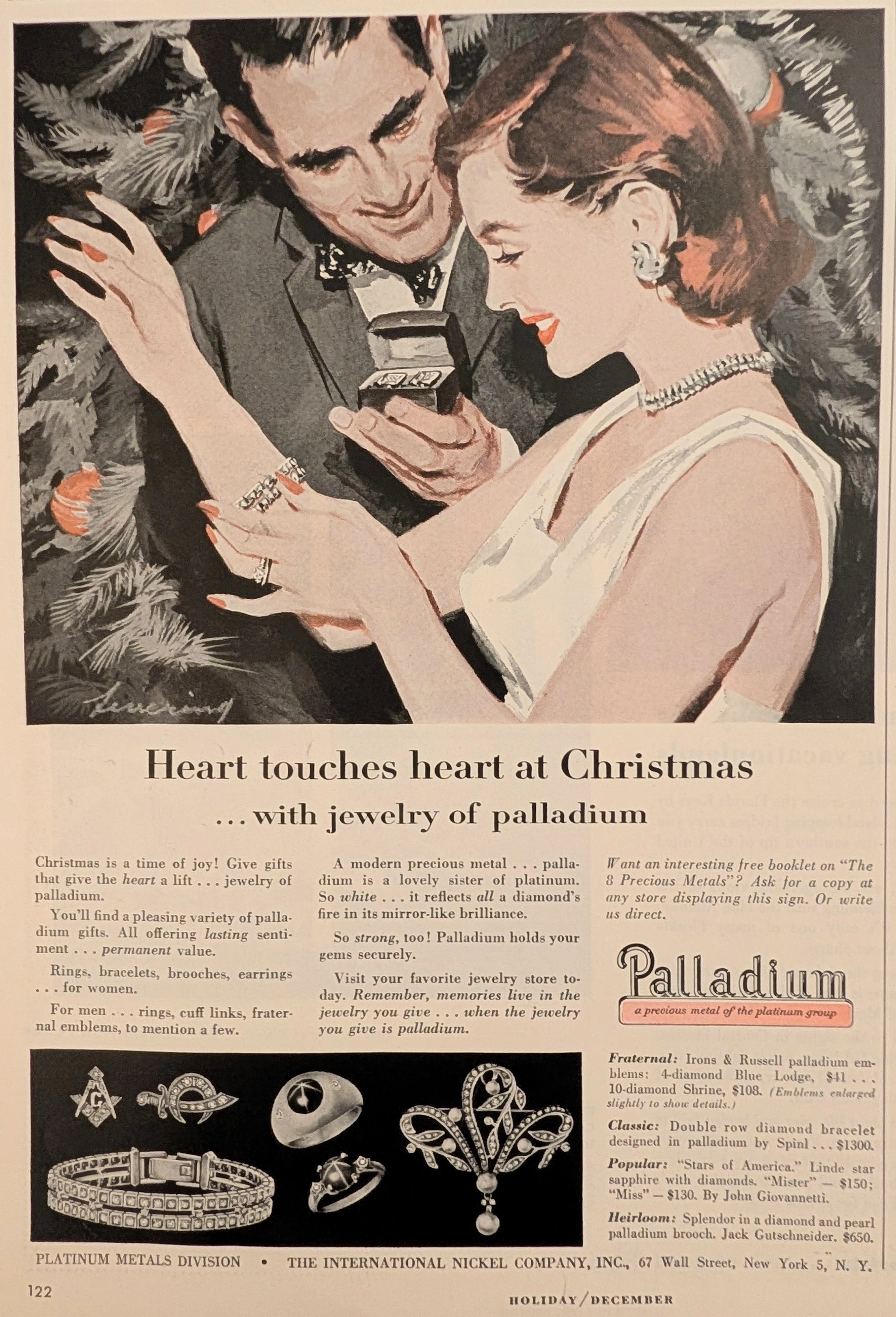
The strategy utilized in this artifact is remarkably precise. Notice the rhetorical framing. Palladium is not sold as a cheap alternative to platinum. It is sold as the "lovely sister of platinum." It rides the coattails of an established luxury item while presenting its own unique benefits. The copy emphasizes that it is "So white... it reflects all a diamond's fire." This directly attacks white gold, which tends to yellow over time. It states that palladium is "So strong, too!" attacking the perception that a lighter metal is an inferior metal.

This represents a monumental shift in the luxury paradigm. The consumer was no longer buying a metal based purely on historical scarcity. They were buying a metallurgical solution, engineered and marketed by a corporate entity to solve an inventory problem. The "permanence" of the sentiment was directly tied to the chemical stability of the element.

The Civic Market: Targeting the Fraternal Man
The demographic targeting of this artifact is exceptionally revealing. Alongside the traditional rings and bracelets designed for women, the advertisement prominently features fraternal emblems. Specifically, it showcases a Masonic Blue Lodge emblem and a Shrine scimitar and crescent.

This was a highly calculated maneuver. In the post-war era of the 1950s, the American middle class was booming, and civic organizations like the Freemasons, the Shriners, the Elks, and the Lions Club formed the absolute backbone of male socialization and networking. These men were the primary purchasers of fine jewelry. They were the husbands buying the Christmas gifts.

By manufacturing palladium fraternal pins—priced at $41 for a 4-diamond Blue Lodge emblem and $108 for a 10-diamond Shrine emblem—INCO infiltrated the male ego. They normalized the metal within the closed, highly trusted networks of the lodges. If palladium was noble enough for the sacred geometry of the Freemasons, it was noble enough for a wife’s Christmas bracelet. It was an infiltration of the luxury market through the side door of fraternal loyalty.

The Synthetic Star and the Industrialization of Romance
Perhaps the most philosophically fascinating element of this artifact is the subtle inclusion of the "Stars of America" Linde star sapphire, designed by John Giovannetti.

The Linde star sapphire was not pulled from the earth. It was grown in a laboratory. The Linde Air Products Company, a division of the industrial chemical giant Union Carbide, had perfected the Verneuil process to synthesize corundum and artificially induce the rutile needles that create the "star" effect.

Consider the layers of modern engineering captured in this single advertisement. We have a ring made of an industrial mining byproduct (palladium), setting a gemstone grown in a chemical laboratory (the Linde star sapphire), marketed by a nickel conglomerate, to be sold as the ultimate expression of timeless, organic, human emotion.

This is the ultimate triumph of the 20th-century industrial complex. They did not just manufacture the products; they manufactured the traditions. They engineered the materials, they engineered the scarcity, and through carefully crafted imagery of a man and woman by a Christmas tree, they engineered the sentiment itself.

The historical shift is absolute. The value of the object was no longer derived from nature. It was derived entirely from the narrative.

The Paper

The physical constitution of this document is a testament to the mid-century golden age of mass publication. Extracted from Holiday magazine, the paper stock is a high-grade, coated calendared paper, specifically designed to hold tight ink registration for luxury advertisers.

Under macroeconomic magnification, the mechanical violence of the CMYK halftone process becomes starkly visible. The seemingly smooth, painted illustration of the couple is revealed to be a regimented, microscopic grid of cyan, magenta, yellow, and black dots. The jewelry macro photography in the lower section utilizes a dense black halftone to create the illusion of deep velvet, allowing the stark white of the unprinted paper to simulate the brilliance of the diamonds and palladium.

The paper has aged with a slight chemical yellowing at the margins—a slow oxidation of the clay coating. The ink, however, remains resolute. It is a physical recording of a specific technological era, capturing the exact moment when high-fidelity color printing became the primary delivery mechanism for corporate ideology.

The Rarity

Classification: Class B (High Contextual & Archival Value)

As a standalone piece of ephemera, tear sheets from mid-century magazines are not exceedingly rare; millions of copies of Holiday were printed. However, the true archival value of this specific page lies in its uncorrupted demonstration of corporate supply-chain marketing.

It is a Class B artifact. Its value is not monetary, but informational. It provides a flawless, isolated data point proving how The International Nickel Company deliberately engineered a luxury market for a mining byproduct. For metallurgical historians, scholars of consumer psychology, and analysts of marketing history, this pristine fragment is an invaluable primary text.
Visual Impact

The visual language of this artifact is constructed to synthesize intimacy with authority. The upper half of the composition is intensely warm. The illustrator uses soft, impressionistic strokes, dominating the palette with Christmas greens, deep reds, and the warm flesh tones of the couple. The man looks not at the jewelry, but at the woman. The woman looks at the jewelry. The visual flow directs the viewer's eye exactly where the corporation wants it: from the emotional reaction to the physical product.

The lower half of the page is a jarring, calculated contrast. The warmth vanishes. The layout becomes an austere, high-contrast catalog of stark black and brilliant white. This is the transition from the emotional hook to the transactional reality.

The typography of the word "Palladium" acts as the bridge. It is rendered in a custom, three-dimensional serif font, sitting atop a pale pink grounding box. It is designed to look heavy, established, and permanent. It does not whisper; it declares its presence as a foundational element of the earth, masking its true nature as a corporate surplus.

Share This Archive

The Archive Continues

Continue the Exploration

The Time Traveller's Dossier: The Sartorial Armor of Terence Stamp – A Foster Grant Exhibition

The Time Traveller's Dossier: The Sartorial Armor of Terence Stamp – A Foster Grant Exhibition

The metamorphosis of sunglasses from a purely utilitarian device designed to protect the human cornea into a profound instrument of psychological transformation and sartorial armor is one of the most fascinating narratives in the history of modern fashion. The historical artifact elegantly and securely positioned upon the analytical table of The Record Institute today is a majestic, large-format print advertisement for Foster Grant Sunglasses, featuring the internationally renowned British actor Terence Stamp, originating from approximately 1968. This document completely transcends the traditional boundaries of optical equipment marketing. It operates as a highly sophisticated, multi-layered cultural mirror, reflecting the exact moment when celebrity mystique, mass-market manufacturing, and the volatile sociopolitical crosscurrents of the late 1960s converged on a single printed page. This world-class, comprehensive dossier conducts a meticulous, unyielding, and exceptionally deep examination of the artifact, operating under the absolute most rigorous parameters of historical, sociological, and material science evaluation. We will decode the brilliant advertising strategy that successfully elevated injection-molded plastics to the realm of high fashion, analyze the complex biographical and cultural significance of Terence Stamp as the chosen emissary of this campaign, and dissect the rich, era-defining semiotics embedded within the six distinct personas he portrays. Furthermore, as we venture deeply into the chemical and physical foundations of this analog printed ephemera, we will reveal the precise mechanical fingerprints of the CMYK halftone rosettes and the graceful, natural oxidation of the paper substrate. This precise intersection of visual nostalgia, mid-century commercial artistry, and the immutable chemistry of time cultivates a serene wabi-sabi aesthetic—a natural, irreversible phenomenon that serves as the primary engine driving up its market value exponentially within the elite global spheres of Vintage Fashion Ephemera and Cinematic Memorabilia collecting.

The Time Traveller's Dossier: The Ultimate Horological Supremacy – A Museum-Grade Forensic Deconstruction of the 1968 Longines Ultra-Chron

Longines · Fashion

The Time Traveller's Dossier: The Ultimate Horological Supremacy – A Museum-Grade Forensic Deconstruction of the 1968 Longines Ultra-Chron

The evolution of human timekeeping is not merely a passive record of hands rotating in concentric circles; it is a brutal, centuries-long engineering war waged against the absolute, unforgiving laws of physics—specifically gravity, temperature fluctuation, and physical friction. The historical artifact placed upon The Record Institute’s forensic examination table today is a monumental full-page print advertisement for the 1968 Longines Ultra-Chron, extracted from a mid-twentieth-century publication. Released precisely on the precipice of the "Quartz Crisis"—a technological tsunami that would soon decimate the traditional Swiss watch industry—this document represents the absolute pinnacle, the zenith, and the glorious final, defiant stand of analog mechanical engineering. This exhaustive, world-class academic archival dossier will ruthlessly dissect the artifact with microscopic precision, operating under the most rigorous parameters of historical and physical evaluation. We will decode the arrogant yet mathematically backed copywriting that boldly claims "A Minute A Month" accuracy, the profound mechanical significance of the 36,000 vibrations per hour (vph) high-beat movement, and the five specific medallions of honor that permanently anchor the brand’s bloodline to legendary aviation pioneers such as Charles Lindbergh and Howard Hughes. Furthermore, we will subject the heavy, dark-field offset lithography to a rigorous material science analysis, exposing the mechanical fingerprints of the analog halftone rosettes and the inevitable, profoundly beautiful wabi-sabi oxidation of the paper substrate. It is this exact intersection of horological mastery and chemical degradation that acts as the primary engine driving the artifact's market value exponentially upward among serious global collectors.

Vintage Chivas Regal x Charles Saxon Ad: The Vanishing Playboy Art | The Record

Vintage Chivas Regal x Charles Saxon Ad: The Vanishing Playboy Art | The Record

An in-depth look at the Chivas Regal ad from Playboy magazine, illustrated by legendary artist Charles Saxon. A magazine-sized piece of authentic analog art on degrading vintage paper, driving up its value as an alternative asset.

Published by

The Record Institute

Taxonomy Match

Related Articles

Ahead of Its Time: The 1978 Heuer Chronosplit Manhattan GMT — related article
Read Article

Ahead of Its Time: The 1978 Heuer Chronosplit Manhattan GMT

Rediscover the ultimate analog-digital hybrid timepiece through a rare 1978 vintage magazine advertisement, meticulously preserved as a single sheet cut-out.

Rolex "Perpetually Yours" — related article
Read Article

Rolex "Perpetually Yours"

This rare mid-century Rolex "Perpetually Yours" advertisement captures the genesis of the modern Rolex empire. Featuring the legendary Oyster Perpetual, it celebrates the historic union of the world's first waterproof 'Oyster' case (1926) and the revolutionary self-winding 'Perpetual' rotor (1931). A true museum-grade horological archive, this piece represents the ultimate mechanical blueprint that defined Rolex's eternal supremacy.

THE TIME TRAVELER'S DOSSIER: THE KOREAN WAR ANCHOR AND THE SCARCITY OF LUXURY — related article
Read Article

THE TIME TRAVELER'S DOSSIER: THE KOREAN WAR ANCHOR AND THE SCARCITY OF LUXURY

The artifact under our uncompromising, unprecedented museum-grade analysis is a profoundly preserved Historical Relic excavated from the golden age of post-WWII American opulence. This Primary Art Document is a monumental magazine advertisement for the Imperial by Chrysler, dating to the pivotal 1951-1952 era. This document is a "Forensic Blueprint of American Aristocracy and Geopolitical Crisis." It masterfully weaponizes regal European iconography to elevate Chrysler's flagship model above mere transportation, explicitly targeting "those who can afford any motor car in the world". Yet, its most significant historical anchor is hidden in the microscopic fine print: "WHITE SIDEWALLS WHEN AVAILABLE". This single sentence instantly transforms the advertisement into a wartime relic, reflecting the severe rubber shortages imposed during the Korean War. Grounded by the iconic jeweled emblem and its breathtaking wabi-sabi chemical degradation—highlighted by its violently torn binding edge—this artifact commands an irreplaceable status, cementing its Rarity Class A designation.

THE TIME TRAVELER'S DOSSIER: THE AUTOMOTIVE ARISTOCRACY AND THE AESTHETICS OF RUIN — related article
Read Article

THE TIME TRAVELER'S DOSSIER: THE AUTOMOTIVE ARISTOCRACY AND THE AESTHETICS OF RUIN

The artifact under rigorous, museum-grade analysis is an exceptionally preserved Historical Relic originating from the golden age of American automotive supremacy. Sourced from a vintage issue of The Saturday Evening Post, this Primary Art Document features a commanding, full-page advertisement for Packard, one of the most prestigious luxury automobile manufacturers in world history. Visually dominated by a striking, head-on illustration of a New Series Packard, the piece explicitly highlights the legendary corporate slogan: "Ask the man who owns one". Published during the turbulent economic landscape of the early 1930s Great Depression, this advertisement is a profound sociological marker. It boldly markets uncompromising luxury—boasting features like a four-speed synchro-mesh transmission and "Ride Control" shock absorbers—to an elite aristocracy largely insulated from the era's financial collapse. Physically, this pre-2000s analog artifact is a breathtaking embodiment of wabi-sabi. It exhibits a violently torn left binding edge, significant moisture blooming along the bottom margin, and deep amber lignin oxidation. This natural chemical and environmental degradation transforms a mass-produced commercial print into an irreplaceable, ready-to-frame Primary Art Document, forever capturing the magnificent mortality of the analog age.

"The Bloodline of Champions: Ferry Porsche's Ultimate Test" — related article
Read Article

"The Bloodline of Champions: Ferry Porsche's Ultimate Test"

Uncovering the historical lineage of Porsche's motorsport dominance, from the 1922 Sascha to the legendary 917, and how track technology forged the 911.

The Time Traveller's Dossier: The Architecture of Aristocracy – Chivas Regal "Prince of Whiskies" Advertisement (Circa Mid-1950s) — related article
Read Article

The Time Traveller's Dossier: The Architecture of Aristocracy – Chivas Regal "Prince of Whiskies" Advertisement (Circa Mid-1950s)

analysis is a meticulously preserved, single magazine tear sheet representing a pinnacle era of mid-20th-century commercial illustration and brand positioning. Far removed from the realm of disposable consumer advertising, this artifact operates as a sophisticated sociological document. It captures a precise historical epoch where the global spirits industry—specifically the Scotch whisky sector—transitioned from marketing regional agricultural products to curating internationally recognized symbols of aristocratic heritage and refined lineage. ​Operating with absolute curatorial precision, this dossier deconstructs a circa mid-1950s advertisement for Chivas Regal 12-Year-Old Blended Scotch Whisky. By analyzing the intersection of classical illustration, the strategic deployment of British royal iconography, and the meticulous visual forensics of the analog printing process, this document illuminates the foundational strategies of modern heritage branding. It demonstrates how a brand gracefully orchestrated a narrative of ancient nobility and warmth to captivate the post-war American consumer, establishing an enduring standard for the premium spirits market that remains profoundly influential today.