The Time Traveller's Dossier : Pitney Bowes - The Mechanized Mailroom
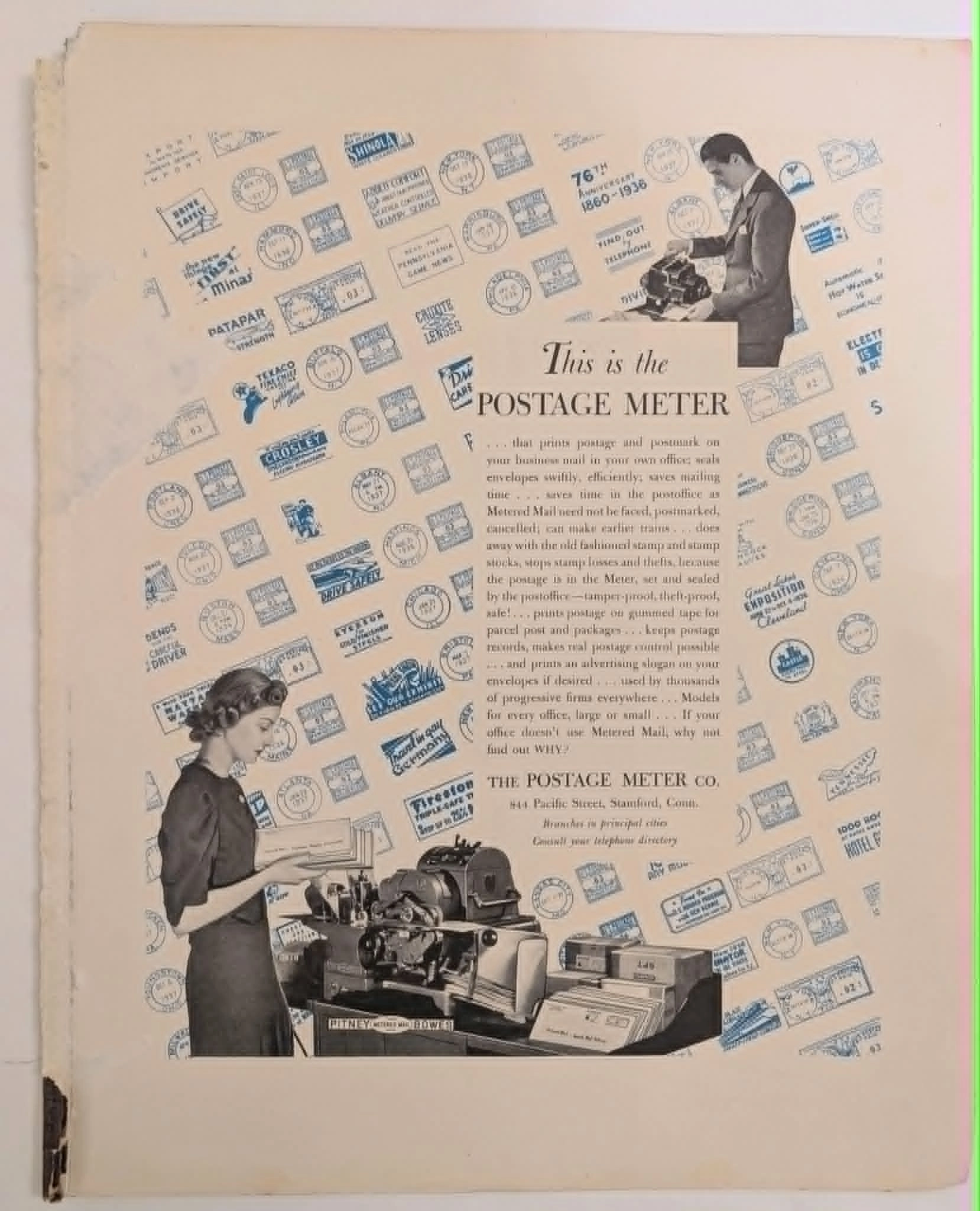
Then, it was a revelation of corporate autonomy. Now, it is the genesis fossil of automated data routing. Before this machine, communication was entirely physical, biological, and fraught with human error. The adhesive postage stamp, once a miracle of the nineteenth century, had become a massive liability for the twentieth-century corporation. Stamps were tiny, untraceable forms of fiat currency. They were easily stolen, painfully licked, and laboriously accounted for by armies of clerks. The problem of the era was administrative friction; the solution, presented on this page, was the absolute mechanization of the mailroom. We do not just see an advertisement for a machine here. We are witnessing the precise moment a private corporation was granted the sovereign power of the state. The Pitney Bowes Postage Meter allowed a business to print its own valid United States postage. This artifact documents the critical shift from analog, messy human labor to secure, mechanized corporate infrastructure.
Category: Other
The History
The End of the Adhesive Era and the Corporate Postmaster The Architecture of Bureaucratic Friction The year is circa 1938. The American corporate landscape is expanding, despite the lingering, suffocating grip of the Great Depression. As companies grew, their reach extended across states and oceans. The primary artery of this commerce was the United States Postal Service. However, a severe bottleneck existed at the very origin point of this communication: the corporate mailroom. To understand the profound shift this advertisement represents, one must first understand the excruciating inefficiency of the pre-metered era. Every single invoice, every contract, every piece of direct mail required a physical postage stamp. These stamps were purchased in massive sheets. They had to be manually separated. They had to be counted. Their adhesive backs had to be moistened—often by the tongues of low-wage clerks, or with damp sponges that grew foul over time. They were then manually pressed onto envelopes. Finally, these letters were hauled to the post office, where government workers had to face them, sort them, and manually run them through cancellation machines to prevent stamp reuse. It was a slow, biological, and incredibly inefficient system. The physical nature of the stamp was suffocating the speed of business. The Economics of Pilferage Beyond the sheer loss of time, the physical stamp presented a massive accounting nightmare. In the 1930s, a three-cent stamp possessed real, liquid value. To a clerk struggling to feed a family during the Depression, a sheet of stamps was equivalent to a pocketful of cash. Stamps were entirely untraceable. They could be slipped into a pocket, taken home, and used for personal mail or traded. This phenomenon, known as "pilferage," cost large corporations thousands of dollars annually—a staggering sum at the time. Accounting for postage was a game of guesswork. The ledger never matched the inventory. The Pitney Bowes Postage Meter eliminated this problem instantly. The machine was, essentially, a miniature bank vault combined with a printing press. As the ad boldly declares: "tamper-proof, theft-proof, safe!" The postage was no longer a physical piece of paper lying in a desk drawer. The postage was trapped securely as a mathematical value inside a locked, cast-iron meter. The post office set the meter, sealed it with a lead seal, and the company paid for the value loaded inside. The physical currency was transformed into secure, mechanical data. Engineering the Sovereign Machine This transition required more than just clever mechanical engineering; it required an act of Congress. Arthur Pitney, the inventor, and Walter Bowes, an industrialist, had to convince the United States government to relinquish its monopoly on the printing of valid postage. This was an unprecedented surrender of sovereign power. The government was allowing private entities to print what was essentially money on their own envelopes, inside their own offices. The mechanism had to be flawless. It required intricate, die-cast gears, descending registers to track the remaining balance, and ascending registers to track total expenditure. It was a proto-computer. The machine depicted in the advertisement—a heavy, industrial piece of equipment sitting solidly on a desk—represents the successful fusion of government authority and corporate efficiency. By adopting this machine, a business effectively bypassed the postal clerk. The ad states it clearly: "saves time in the postoffice as Metered Mail need not be faced, postmarked, cancelled; can make earlier trains." The corporation had become its own postmaster. The Genesis of the Networked Billboard There is a secondary, equally profound shift hidden in plain sight across this advertisement. Floating in the background is a sea of blue metered postmarks. Look closely at the contents of these marks. We see Patapar. We see Crosley Electric Refrigerators. We see Texaco Fire-Chief Gasoline. Before the postage meter, an envelope was simply a container. It carried a return address and a destination. Pitney Bowes realized that because their machine was already printing the postmark, it could simultaneously print a small, customizable graphic next to it. This was the birth of the envelope as a strategic marketing medium. The machine allowed companies to broadcast their slogans across the country, riding on the authority of the U.S. Mail. "It will pay you to see the CROSLEY SHELVADOR before you buy any ELECTRIC REFRIGERATOR." This was printed on thousands of utility bills, invoices, and letters. The postage meter transformed the corporate mailroom into an autonomous advertising agency. It converted the cost of postage into an opportunity for brand impressions. A Sociological Snapshot of the 1930s Office Finally, we must analyze the human element within the frame. The advertisement presents a stark, highly structured view of 1930s office sociology. In the upper right, a sharply dressed man in a tailored suit operates a smaller meter model. He is focused, authoritative, perhaps a manager or a small business owner. In the foreground, a woman in a modest, dark dress operates the larger, industrial-grade mailing machine. This composition reflects the gendered division of labor during the era. The heavy, repetitive, high-volume clerical work—the actual processing of the mail—was predominantly assigned to women, who were entering the corporate workforce in record numbers. The machine is marketed as a tool of liberation from the drudgery of licking stamps, yet it also tethered the operator to the rhythm of the machine itself. She is feeding envelopes into the heavy iron mechanism, becoming a biological extension of the automation process. This single page of paper captures a society locked in a transition. It is moving away from the physical, the manual, and the slow, and accelerating blindly into the era of data tracking, corporate automation, and mass-market broadcasting.
The Paper
The Canvas of Corporate Administration This artifact is a physical manifestation of commercial publishing in the late 1930s. It is printed on an uncoated, medium-GSM magazine stock. Printing Method: The advertisement relies on a sophisticated two-color web offset or letterpress process. The black ink provides the structural foundation—the text, the machinery, the human figures. The second pass of ink is a highly specific, standardized "postal blue." This is deliberate. By rendering the background stamps entirely in this distinct blue, the publisher mimics the exact visual experience of receiving a piece of metered mail. The Halftone Process: Upon close inspection, the photographic elements—the man, the woman, the machines—are composed of visible halftone dots. This translation of a continuous-tone photograph into a matrix of tiny ink dots was the standard method for mass reproduction, binding the image to the mechanical reality of its creation. Chemical Aging: The paper has oxidized over the decades, shifting from a likely bright white to a warm, mottled cream. This oxidation creates a striking, unintended contrast with the blue ink, which has maintained its chemical stability surprisingly well. The artifact feels dry and brittle at the edges, a fragile survivor of the pre-digital age.
The Rarity
Class A (Contextual Benchmark) Vintage advertisements are generally common, but this specific artifact possesses a Class A rarity due to its pristine two-color registration and its immense historical weight. Its value does not lie in an auction house bidding war. Its value is entirely contextual. It is a flawless blueprint of early corporate bureaucracy. Finding a piece that so clearly articulates the exact moment physical stamps were replaced by mechanical data tracking is rare. It is a benchmark artifact for historians studying the automation of the American workforce and the origins of direct mail marketing.
Cite this article
- MLA
- Naodhinsuk, Ronin. “The Time Traveller's Dossier : Pitney Bowes - The Mechanized Mailroom.” The Record Institute, 22 May 2026, https://therecord.institute/journal/the-time-travellers-dossier-pitney-bowes-the-mechanized-mailroom.
- APA
- Naodhinsuk, R. (2026, May 22). The Time Traveller's Dossier : Pitney Bowes - The Mechanized Mailroom. The Record Institute. https://therecord.institute/journal/the-time-travellers-dossier-pitney-bowes-the-mechanized-mailroom
- CHICAGO
- Naodhinsuk, Ronin. 2026. “The Time Traveller's Dossier : Pitney Bowes - The Mechanized Mailroom.” The Record Institute, May 22, 2026. https://therecord.institute/journal/the-time-travellers-dossier-pitney-bowes-the-mechanized-mailroom.