The Time Traveller's Dossier : Plaskon - The Synthetic Jungle Shift
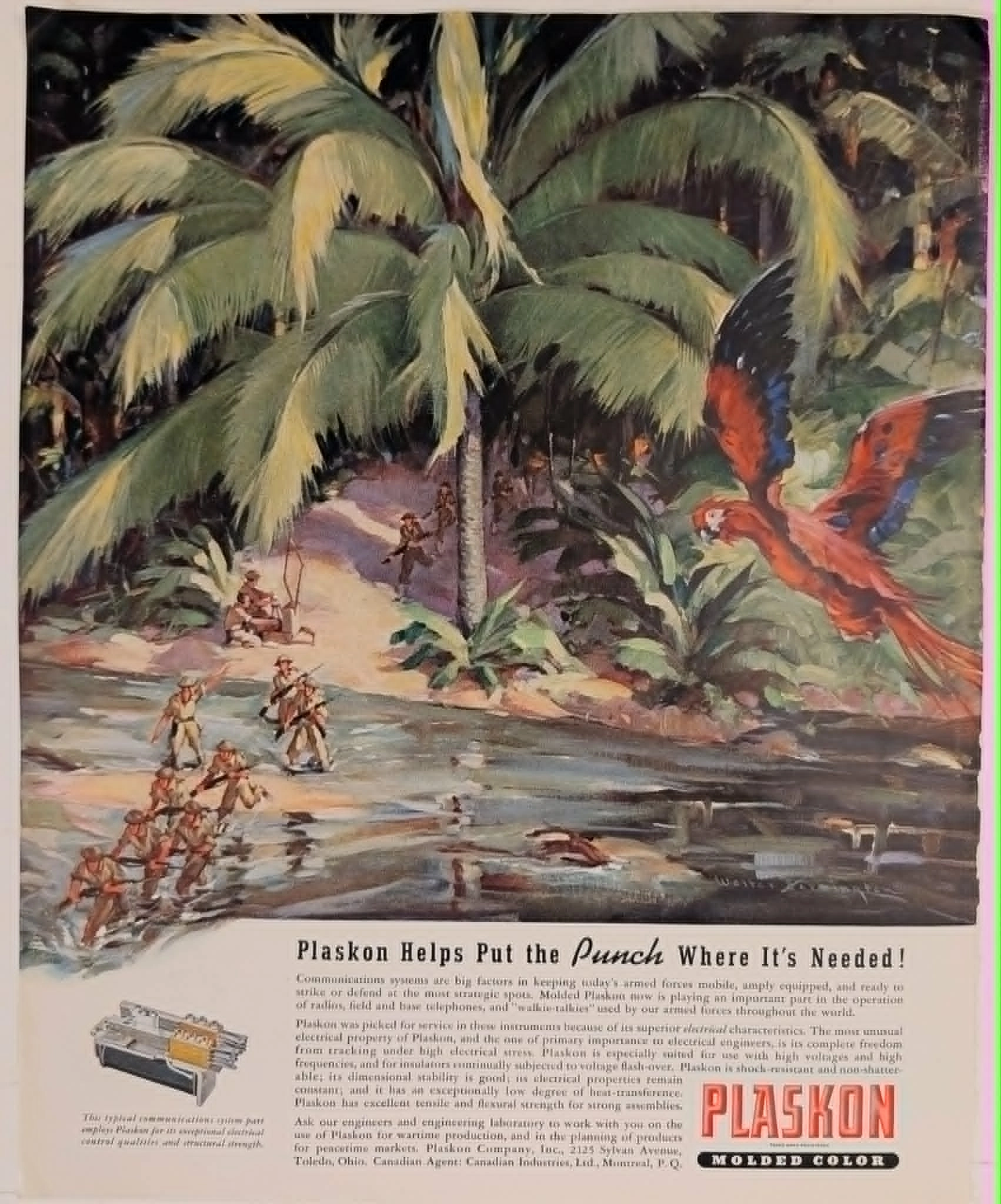
Then, the materials of war were harvested from the earth. Wood. Rubber. Glass. Canvas. These natural elements were resilient in temperate zones, but they possessed a fatal flaw. They decayed. When introduced to the suffocating heat and perpetual moisture of the equatorial jungle, nature reclaimed them. Now, survival demands an unnatural intervention. The problem is elemental. How does a military apparatus maintain high-voltage communication networks in a rainforest actively trying to dissolve them? The solution is molecular. You engineer a polymer that the jungle cannot digest. This artifact documents the profound pivot from natural reliance to synthetic dominance. It captures the exact moment when the primary commodity of a plastics manufacturer shifted from aesthetic color to invisible electrical resistance. The advertisement does not sell a shape. It sells the mathematical certainty of synthetic chemistry.
Category: Technology
Brand: Plaskon
The History
The Hostile Theater and the Communications Crisis The artifact transports us instantly to a generalized Pacific or Southeast Asian theater of World War II. The visual narrative is dominated by soldiers wading waist-deep through a winding river, dwarfed by towering palm fronds and the oppressive, chaotic density of the jungle. This environment was not merely a backdrop; it was a primary antagonist. For military engineers of the era, the jungle was an unrelenting nightmare. Early communications equipment relied heavily on traditional, naturally derived insulators. Engineers utilized rubber, shellac, waxed paper, and early, brittle phenolic plastics to house sensitive electrical components. In the dry laboratories of the American Midwest, these materials performed flawlessly. In the torrential rains and ninety percent humidity of the Pacific islands, they failed catastrophically. Moisture seeped into microscopic cracks. Fungus consumed organic bindings. The jungle systematically dismantled the hardware of the Allied forces. The most critical failure occurred at the microscopic level of electrical current. When high voltages pulsed through damp, compromised equipment, the moisture facilitated sudden electrical arcing. The electric arc would burn a carbonized, conductive path across the surface of the insulator—a destructive phenomenon known to electrical engineers as "tracking." Once a carbon track formed, the insulator fundamentally transformed into a conductor. The radio short-circuited. The transmission sparked out. The line went dead. A dead radio in the deep jungle meant a severed command chain. It meant a squad cut off from artillery support. It meant isolation, and isolation inevitably meant death. The military desperately required a material evolution. As the artifact declares, "Communications systems are big factors in keeping today's armed forces mobile, amply equipped, and ready to strike or defend at the most strategic spots". To maintain that mobility, the materials housing those systems had to become impervious to nature. The Anatomy of Plaskon and Molecular Warfare Enter Plaskon. Originally developed as a urea-formaldehyde thermosetting resin, Plaskon was widely marketed throughout the 1930s for a completely different purpose: its ability to hold vibrant, pastel hues. This was the origin of its proud trademark, "MOLDED COLOR". Before the war, it was the preferred material for sleek Art Deco radio dials, stylish clock cases, and consumer buttons. But global conflict stripped away the aesthetic veneer of industrial production. The war exposed the raw, tactical utility of Plaskon's underlying chemistry. The resin was drafted into the armed forces. The advertisement explicitly outlines this newfound, invisible utility: "Plaskon was picked for service in these instruments because of its superior electrical characteristics". The most critical of these characteristics was its absolute resistance to the deadly carbon tracking that plagued early phenolics. The copy reads with the precision of a technical manual: "The most unusual electrical property of Plaskon, and the one of primary importance to electrical engineers, is its complete freedom from tracking under high electrical stress". When a high-voltage flashover occurred across a Plaskon component, the resin did not combust into a conductive ash trail. It maintained its molecular integrity. It remained a stubborn, unyielding insulator. This singular chemical trait allowed it to be "especially suited for use with high voltages and high frequencies, and for insulators continually subjected to voltage flash-over". The Tactical Advantage of Synthetic Durability Observe the lower left corner of the artifact. We see an inset illustration of a complex, multi-layered switch or relay block. The caption identifies it: "This typical communications system part employs Plaskon for its exceptional electrical control qualities and structural strength". This tiny, unassuming component represents the absolute bleeding edge of wartime materials science. In the chaotic theater of jungle warfare, heat and moisture constantly force materials to warp, expand, contract, or shatter. A warped relay means a jammed signal. The artifact assures the military procurement officer that Plaskon is "shock-resistant and non-shatterable". It promises that "its dimensional stability is good; its electrical properties remain constant; and it has an exceptionally low degree of heat-transference". Furthermore, the text guarantees "excellent tensile and flexural strength for strong assemblies". These are not merely engineering specifications printed in a trade magazine; they are survival guarantees. This synthetic resin is actively "playing an important part in the operation of radios, field and base telephones, and 'walkie-talkies' used by our armed forces throughout the world". The introduction of the portable "walkie-talkie"—such as the heavy backpack SCR-300 or the handheld SCR-536—fundamentally altered the doctrine of infantry tactics. It allowed real-time, dynamic coordination at the individual squad level. But that battlefield coordination relied entirely on the microscopic stability of synthetic resins holding the fragile circuitry together under immense physical and electrical stress. The Competitor Landscape: Bakelite vs. Amino Plastics To truly grasp the magnitude of this historical shift, we must contextualize Plaskon against its primary competitors. Bakelite, a phenol-formaldehyde resin, was the undisputed granddaddy of commercial plastics. It was phenomenally tough, highly heat-resistant, and cheap to produce. However, Bakelite possessed a fatal flaw in high-voltage, high-humidity applications: it tracked violently. When subjected to a high-frequency electric arc, the phenolic resin burned deeply, leaving a conductive carbon residue. Furthermore, Bakelite was chemically restricted to dark, opaque colors—primarily browns and blacks. Plaskon, an amino plastic, completely resisted this carbon tracking. This singular, invisible chemical distinction gave the Plaskon Company a dominant monopoly in highly specific, high-frequency military applications. While Bakelite was utilized to build the heavy, durable outer casings of field equipment, Plaskon was entrusted to build the highly sensitive internal organs of the communication network. This dynamic represents a secondary, crucial historical shift: the intense specialization of synthetic materials. Plastics were no longer viewed as a cheap, monolithic substitute for wood or metal. They had evolved into highly specialized, precision-engineered chemical tools, tailored explicitly for specific, extreme combat stresses. The Corporate Horizon: From War to Peace The Plaskon Company, Inc., headquartered at "2125 Sylvan Avenue, Toledo, Ohio," alongside its "Canadian Agent: Canadian Industries, Ltd., Montreal, P.Q.," was engaged in a dual strategy. They were not merely fighting a global war; they were actively laying the aggressive groundwork for the postwar consumer boom. This artifact is, at its core, a Business-to-Business (B2B) advertisement masquerading as a patriotic tableau. It serves as an open, strategic invitation to industrial manufacturers. The text explicitly states: "Ask our engineers and engineering laboratory to work with you on the use of Plaskon for wartime production, and in the planning of products for peacetime markets". This single sentence encapsulates the overarching philosophical shift of the 1940s industrial complex. The radical technologies tempered in the brutal crucible of war—the non-tracking resins, the ultra-durable polymers, the weather-proof insulators—were destined to aggressively infiltrate the domestic sphere. The synthetic material that kept a radio functioning during a monsoon in the Solomon Islands would soon become the very same material housing the radio sitting on a postwar suburban kitchen counter. The corporate machinery utilized the Pacific theater as a vast, unforgiving proving ground for the architecture of the modern, fully synthetic world.
The Paper
This is a physical manifestation of wartime industrial printing. The substrate is a medium-weight, coated magazine stock typical of 1940s trade publications. The GSM (Grams per Square Meter) hovers between 70 and 90, providing enough density to support rich ink saturation without excessive bulk. A macroscopic examination reveals the standard rotary letterpress CMYK halftone dot matrix. Look closely at the vibrant red and blue plumage of the parrot. The colors do not blend organically; they are an optical illusion created by overlapping geometric grids of cyan, magenta, yellow, and black ink. The paper exhibits signs of acidic degradation, common in wood-pulp mixtures of the era. A subtle, yellow-brown oxidation is baking into the margins, a slow, unstoppable burning of time. It is a fragile, aging canvas carrying the permanent record of a synthetic revolution.
The Rarity
Classification: Class B (High Contextual Significance). In terms of pure physical scarcity, this piece is not exceptionally rare. Thousands of copies were circulated within technical, engineering, and business periodicals of the 1940s. However, its true value is intensely contextual. It serves as a critical bridge document. It captures a highly specific transitional moment where a consumer plastics company, famous for aesthetic color, had to completely rebrand its product based on invisible, highly technical electrical properties to secure government contracts. Its rarity lies in its profound narrative utility for historians of technology and chemistry.
Cite this article
- MLA
- Naodhinsuk, Ronin. “The Time Traveller's Dossier : Plaskon - The Synthetic Jungle Shift.” The Record Institute, 30 May 2026, https://therecord.institute/journal/the-time-travellers-dossier-plaskon-the-synthetic-jungle-shift.
- APA
- Naodhinsuk, R. (2026, May 30). The Time Traveller's Dossier : Plaskon - The Synthetic Jungle Shift. The Record Institute. https://therecord.institute/journal/the-time-travellers-dossier-plaskon-the-synthetic-jungle-shift
- CHICAGO
- Naodhinsuk, Ronin. 2026. “The Time Traveller's Dossier : Plaskon - The Synthetic Jungle Shift.” The Record Institute, May 30, 2026. https://therecord.institute/journal/the-time-travellers-dossier-plaskon-the-synthetic-jungle-shift.