The Time Traveller's Dossier : Pontiac WWII - The Mechanical Shift
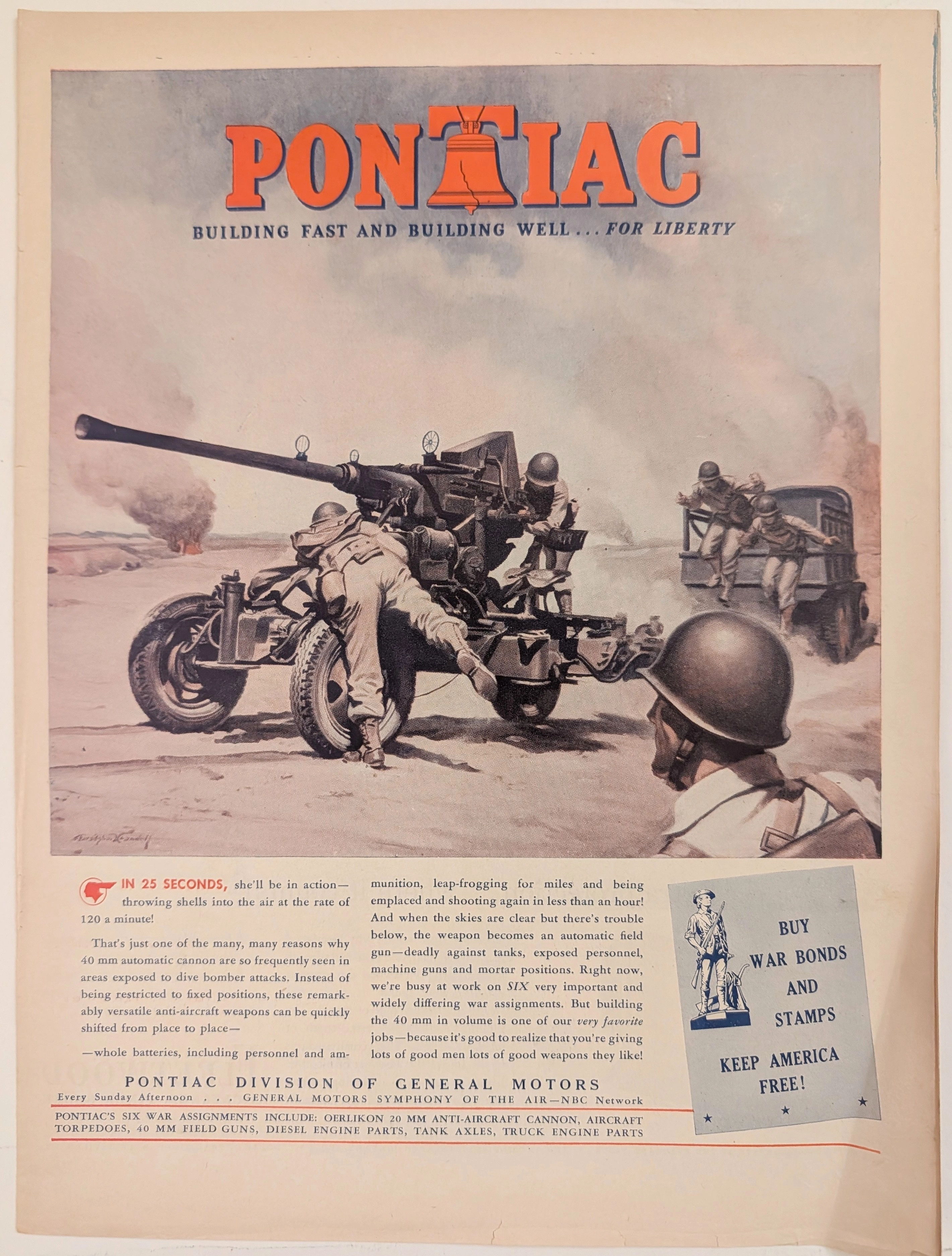
Then, the American automotive industry sold the illusion of the open road. Now, it sold the mathematics of ballistic trajectory. The problem in early 1942 was not the pursuit of aerodynamic design or the quiet hum of a civilian engine. It was the absolute, existential threat posed by the mechanized war machines of the Axis powers. The skies over Europe and the Pacific were dominated by hostile dive bombers, and the Allied forces desperately lacked the mobile firepower to protect their exposed infantry and armored columns. The solution, as brutally and efficiently documented by the Pontiac Division of General Motors in this artifact, was the total repurposing of the American assembly line. This artifact is a portal. It transports us to the precise historical moment when the Detroit manufacturing colossus ceased the production of consumer luxury and pivoted entirely to the architecture of industrialized warfare. It is an advertisement, yes. But deeper than that, it is a psychological instrument. It was meticulously designed to condition a bewildered civilian populace, teaching them to equate the familiar corporate logo of their family automobile with the violent, necessary output of heavy artillery and anti-aircraft munitions.
Category: Other
The History
The Death of the Civilian Assembly Line and the Birth of the Arsenal To fully comprehend the gravity of this document, one must understand the unprecedented economic shockwave that struck the United States in the winter of 1941-1942. Following the attack on Pearl Harbor, the federal government instituted a mandate that altered the fabric of American capitalism overnight. In February 1942, the production of civilian automobiles was entirely halted by the War Production Board. The massive, sprawling factories of Detroit, which had spent decades perfecting the mass production of personal vehicles, went dark. When the machinery roared back to life, the stamping presses that had once shaped the elegant, sloping fenders of the Pontiac Streamliner were now tasked with forging the brutal, unforgiving geometries of heavy ordnance. The artifact before us is a primary source record of this violent industrial pivot. Pontiac, a brand traditionally positioned within the General Motors hierarchy as a reliable, mid-tier symbol of American prosperity, was suddenly assigned six critical war assignments. As proudly listed at the bottom of the page, these included the Oerlikon 20mm anti-aircraft cannon, aircraft torpedoes, tank axles, diesel engine parts, and the centerpiece of this visual narrative: the 40mm automatic field gun. The corporation was no longer selling a comfortable ride; it was selling the concept of mechanical lethality as a patriotic duty. The Engineering of Ballistic Tolerances The claim "Building Fast and Building Well... For Liberty" is not mere advertising hyperbole; it represents one of the greatest engineering feats in human history. The 40mm automatic cannon depicted in the illustration—widely recognized as a derivative of the famous Swedish Bofors design—was a notoriously complex weapon. In Europe, these guns were traditionally manufactured using the meticulous, time-consuming methods of master craftsmen, who hand-filed and custom-fitted individual breechblocks and gears. This artisanal approach was entirely inadequate for a global war requiring tens of thousands of anti-aircraft batteries. General Motors and Chrysler engineers had to completely dissect the weapon and reverse-engineer it for the American assembly line. This required the translation of European metric blueprints into imperial measurements and the creation of entirely new, massive machine tools. The tolerances required for an automotive transmission were strict, but the tolerances required for a cannon firing two-pound high-explosive shells at a rate of 120 rounds per minute were absolute. A single microscopic flaw in the machining process could result in a catastrophic jam, leaving an entire infantry battalion exposed to a Stuka dive bomber. Pontiac successfully mechanized the production of these weapons, ensuring that every single part was universally interchangeable on a muddy battlefield in Italy or a humid jungle in the South Pacific. This advertisement subtly communicates that engineering triumph to the public. The Kinetic Reality of Maneuver Warfare The copy of the advertisement provides a stark, educational window into the evolving tactical doctrines of the Second World War. "IN 25 SECONDS, she'll be in action—throwing shells into the air at the rate of 120 a minute!" The emphasis here is entirely on speed, mobility, and sheer volume of fire. The text actively educates the civilian reader on the concept of maneuver warfare. It explicitly notes that "Instead of being restricted to fixed positions, these remarkably versatile anti-aircraft weapons can be quickly shifted from place to place." This was a direct response to the static, trench-bound trauma of the First World War. The Blitzkrieg tactics employed by the Axis powers relied on rapid, mechanized movement supported by close air support. To counter this, Allied weaponry had to be equally fluid. The illustration perfectly captures this kinetic energy. The artillery crew is not dug into a permanent concrete bunker; they are exposed on a dusty, barren plain, frantically operating a weapon mounted on pneumatic rubber tires—a direct nod to the automotive heritage of its manufacturer. The text further elaborates that when the skies are clear, the weapon becomes "an automatic field gun—deadly against tanks, exposed personnel, machine guns and mortar positions." Pontiac was selling the terrifying versatility of their newly assigned product line. The Corporate Patriot and the Economy of Deferred Gratification Beneath the imagery of the artillery crew lies a profound socio-economic reality. By 1943, the American economy was operating at maximum capacity, with near-universal employment. Civilians had disposable income, but due to severe wartime rationing, there were virtually no consumer goods to purchase. You could not buy a new Pontiac, no matter how much money you had. To prevent massive inflation and fund the astronomical costs of the military-industrial complex, the government and corporate America colluded to create an economy of deferred gratification. The inset box featuring the Minute Man statue and the bold command to "BUY WAR BONDS AND STAMPS" is a crucial element of this strategy. Pontiac was utilizing its corporate advertising budget not to sell a physical product, but to sell government debt. By associating the purchase of a war bond with the direct supply of a 40mm cannon to the troops, the advertisement weaponized civilian guilt and patriotism. It transformed the passive act of saving money into an active, aggressive contribution to the war effort. The Continuum of Conflict and the Masterpiece of Industrial Propaganda The inclusion of the Concord Minute Man—the iconic symbol of the American Revolutionary War—is a highly calculated piece of visual psychology. By placing the 18th-century militiaman alongside the 20th-century mechanized artillery crew, the advertisement creates a moral continuum of conflict. It suggests to the reader that the sprawling, industrialized slaughter of the Second World War is spiritually identical to the agrarian, localized rebellion of 1776. It legitimizes the global scale of the violence by anchoring it in the foundational mythos of American liberty. This artifact is a masterpiece of institutional advertising. It achieved three vital objectives simultaneously. First, it kept the Pontiac brand name relevant and heroic in the minds of consumers who could not actually purchase their products, ensuring brand loyalty for the eventual post-war boom. Second, it boosted the morale of the thousands of autoworkers on the factory floor, elevating them from mere mechanics to essential soldiers of the production line. Third, it provided a comforting, mathematical certainty to the families of deployed soldiers: the terrifying chaos of the battlefield was being met with the cold, reliable, and overwhelming industrial precision of Detroit. It is a paper monument to the exact moment the automobile industry became the undeniable engine of global warfare.
The Paper
This document is a tactile survivor of a severely restricted era. The physical substrate is a lightweight, low-grade magazine stock, likely weighing no more than 60 GSM. The severe rationing of chemical bleaching agents and high-quality wood fibers during the war effort resulted in paper with an exceptionally high lignin content. This chemical composition is the direct cause of the heavy, localized oxidation and the brittle, yellowed nature of the margins—a process archivists identify as acid degradation. The printing methodology is a high-speed, web-fed offset lithography. Upon close inspection under magnification, the image resolves into the distinct, overlapping CMYK halftone rosette patterns characteristic of mid-century mass publication. The registration of the inks is remarkably precise for the era, particularly evident in the sharp, urgent red of the Pontiac lettering against the dusty, desaturated earth tones of the battlefield illustration. The tactile fragility of the page, combined with the faint, arid scent of decaying cellulose, serves as a sensory recording of the material sacrifices required by the home front during the apex of global conflict.
The Rarity
Classification: Class A (Archival Significance - High Macro-Historical Value) While general wartime advertisements were printed by the millions, discovering an intact, legible, and structurally sound example that so perfectly encapsulates the specific pivot of the Detroit automotive industry is increasingly rare. This artifact ascends to Class A status not because of a prohibitive auction price, but due to its immense, irreplaceable contextual utility. It is an unsanitized primary source document that captures the exact intersection of consumer brand identity and military-industrial propaganda. The pristine survival of the specific copy detailing the "120 a minute" firing rate and the "Six War Assignments" elevates its status among serious historians of military logistics and corporate communication.
Cite this article
- MLA
- Naodhinsuk, Ronin. “The Time Traveller's Dossier : Pontiac WWII - The Mechanical Shift.” The Record Institute, 18 April 2026, https://therecord.institute/journal/the-time-travellers-dossier-pontiac-wwii-the-mechanical-shift.
- APA
- Naodhinsuk, R. (2026, April 18). The Time Traveller's Dossier : Pontiac WWII - The Mechanical Shift. The Record Institute. https://therecord.institute/journal/the-time-travellers-dossier-pontiac-wwii-the-mechanical-shift
- CHICAGO
- Naodhinsuk, Ronin. 2026. “The Time Traveller's Dossier : Pontiac WWII - The Mechanical Shift.” The Record Institute, April 18, 2026. https://therecord.institute/journal/the-time-travellers-dossier-pontiac-wwii-the-mechanical-shift.