The Time Traveller's Dossier : Renault's Turbo Gamble - Anatomy of a Revolution
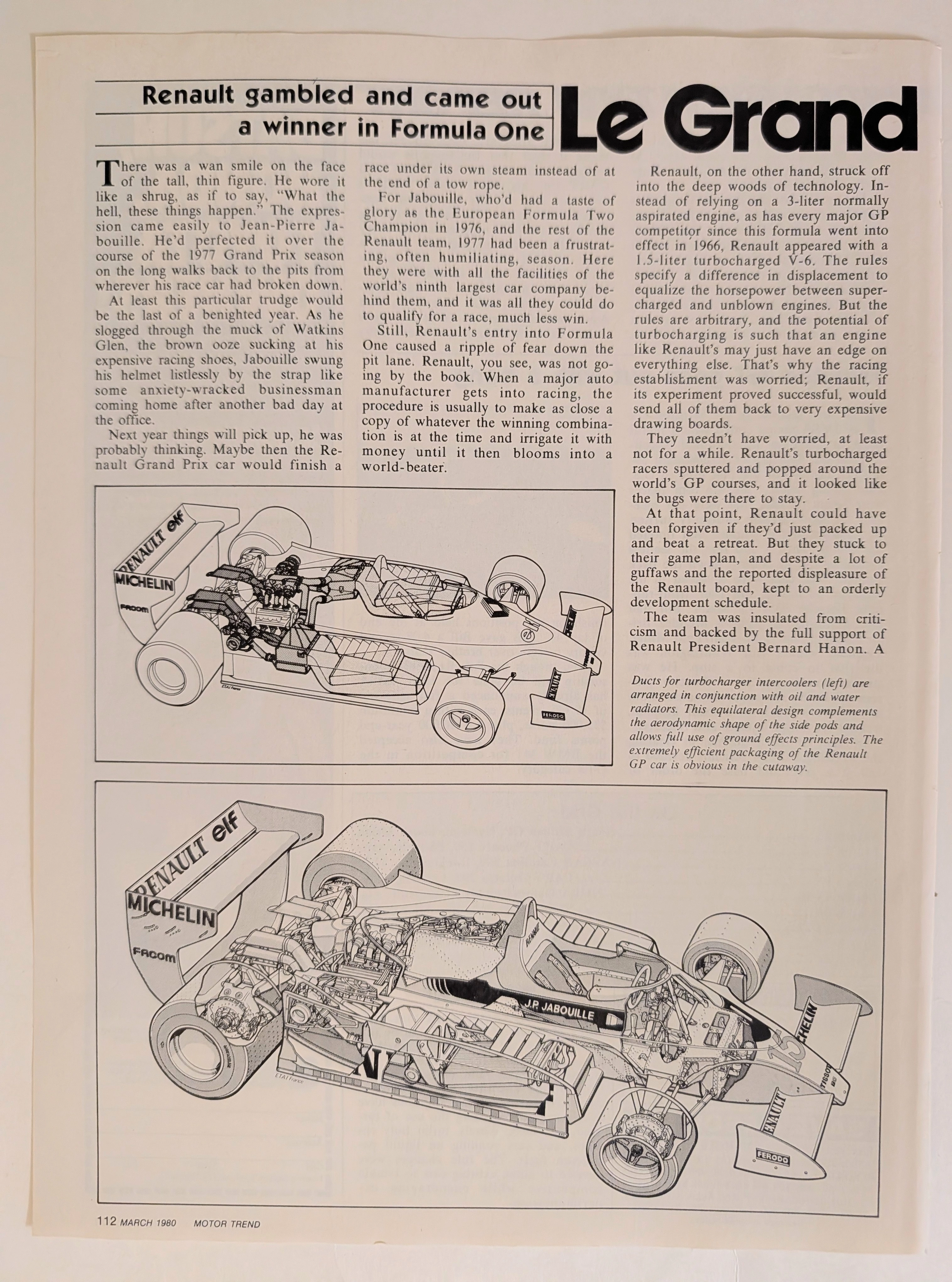
In the annals of motorsport, true revolutions are rarely born from immediate success. They are usually forged in the fires of public humiliation, mechanical failure, and stubborn, visionary persistence. Before the modern era of ultra-efficient hybrid power units, Formula One was dominated by a single, reliable philosophy: the 3.0-liter naturally aspirated engine (most notably the ubiquitous Ford Cosworth DFV). Then came Renault. In 1977, the French manufacturer did not enter F1 to conform; they entered to disrupt. They chose a loophole in the rulebook that allowed for 1.5-liter forced-induction engines—a path so complex and fraught with reliability issues that the established British teams dismissed it entirely. The artifact before us—a page from the March 1980 issue of Motor Trend magazine—captures the precise historical moment when the laughter stopped. It documents the vindication of the turbocharged V6. This magnificent technical cutaway illustrates not just a car, but the blueprint of a paradigm shift that would permanently alter the trajectory of global motorsport.
Category: Automotive
Brand: Renault
The History
The Yellow Teapot and the Woods of Technology To appreciate the gravity of this article, one must understand the agony of Renault's early F1 years. When Jean-Pierre Jabouille first piloted the turbocharged Renault RS01 in 1977, it was a spectacular, smoking disaster. It broke down so frequently, often in clouds of white steam and oil smoke, that rival teams mockingly dubbed it the "Yellow Teapot." The article's text explicitly references this painful genesis, noting how Jabouille "slogged through the muck of Watkins Glen" and how the team endured an "often humiliating season." Yet, as the copy states, Renault "struck off into the deep woods of technology." They believed that forced induction was the future of the automobile, and F1 was their laboratory. The Shield of Bernard Hanon Innovation requires political cover as much as engineering genius. The text reveals a crucial behind-the-scenes reality of corporate racing: "despite a lot of guffaws and the reported displeasure of the Renault board," the racing program survived. Why? Because the team was "insulated from criticism and backed by the full support of Renault President Bernard Hanon." This is a testament to top-down corporate vision. Hanon protected his engineers from the impatient bean-counters, buying them the time necessary to cure the turbo lag, solve the overheating, and irrigate the project "with money until it then blooms into a world-beater." By 1979, Jabouille had won the French Grand Prix at Dijon—the first-ever victory for a turbocharged car in F1. The gamble had paid off. The Architecture of Ground Effects and Turbocharging The visual centerpiece of this document is the breathtaking cutaway illustration of the Renault RS10. This car represented the ultimate marriage of two revolutionary late-70s technologies: turbocharging and ground-effect aerodynamics. The caption notes the "extremely efficient packaging of the Renault GP car." To make a turbo engine survive, it required massive intercoolers, oil radiators, and water radiators. The illustration reveals how these components were masterfully crammed into the sidepods ("arranged in conjunction... complements the aerodynamic shape"). This packaging allowed the bottom of the sidepods to be shaped like inverted airplane wings, sucking the car to the track using ground effects. It was a masterpiece of thermal and aerodynamic engineering.
The Paper
Under the scrutiny of a macro lens, the mechanical realities of mid-century automotive publishing are exposed. Printed on standard, uncoated magazine stock, the page has aged to a warm, off-white hue. The true marvel, however, is the technical illustration credited to "ETAI France." Long before CAD (Computer-Aided Design) and 3D rendering, technical artists created these cutaways entirely by hand. The varying weights of the ink lines, the precise stippling used to convey the texture of the massive rear slick tires, and the intricate mechanical shading of the V6 engine block demonstrate a staggering level of draftsmanship. It is an industrial blueprint elevated to commercial art.
The Rarity
Classification: Class B (High Technical & Contextual Value) While mass-produced automotive magazines from 1980 are not inherently rare, the contextual perfection of this specific page elevates its archival status. It is a Class B artifact. It provides an untainted, contemporary explanation of one of the most significant technological transitions in automotive history, published just as the turbo era was beginning to dominate the sport. For historians of motorsport engineering, or students of corporate innovation and risk management, this page is an invaluable primary source.
Cite this article
- MLA
- Naodhinsuk, Ronin. “The Time Traveller's Dossier : Renault's Turbo Gamble - Anatomy of a Revolution.” The Record Institute, 23 April 2026, https://therecord.institute/journal/the-time-travellers-dossier-renaults-turbo-gamble-anatomy-of-a-revolution.
- APA
- Naodhinsuk, R. (2026, April 23). The Time Traveller's Dossier : Renault's Turbo Gamble - Anatomy of a Revolution. The Record Institute. https://therecord.institute/journal/the-time-travellers-dossier-renaults-turbo-gamble-anatomy-of-a-revolution
- CHICAGO
- Naodhinsuk, Ronin. 2026. “The Time Traveller's Dossier : Renault's Turbo Gamble - Anatomy of a Revolution.” The Record Institute, April 23, 2026. https://therecord.institute/journal/the-time-travellers-dossier-renaults-turbo-gamble-anatomy-of-a-revolution.