The Time Traveller's Dossier : Rolex Ref 1002 - The Handcrafted Era
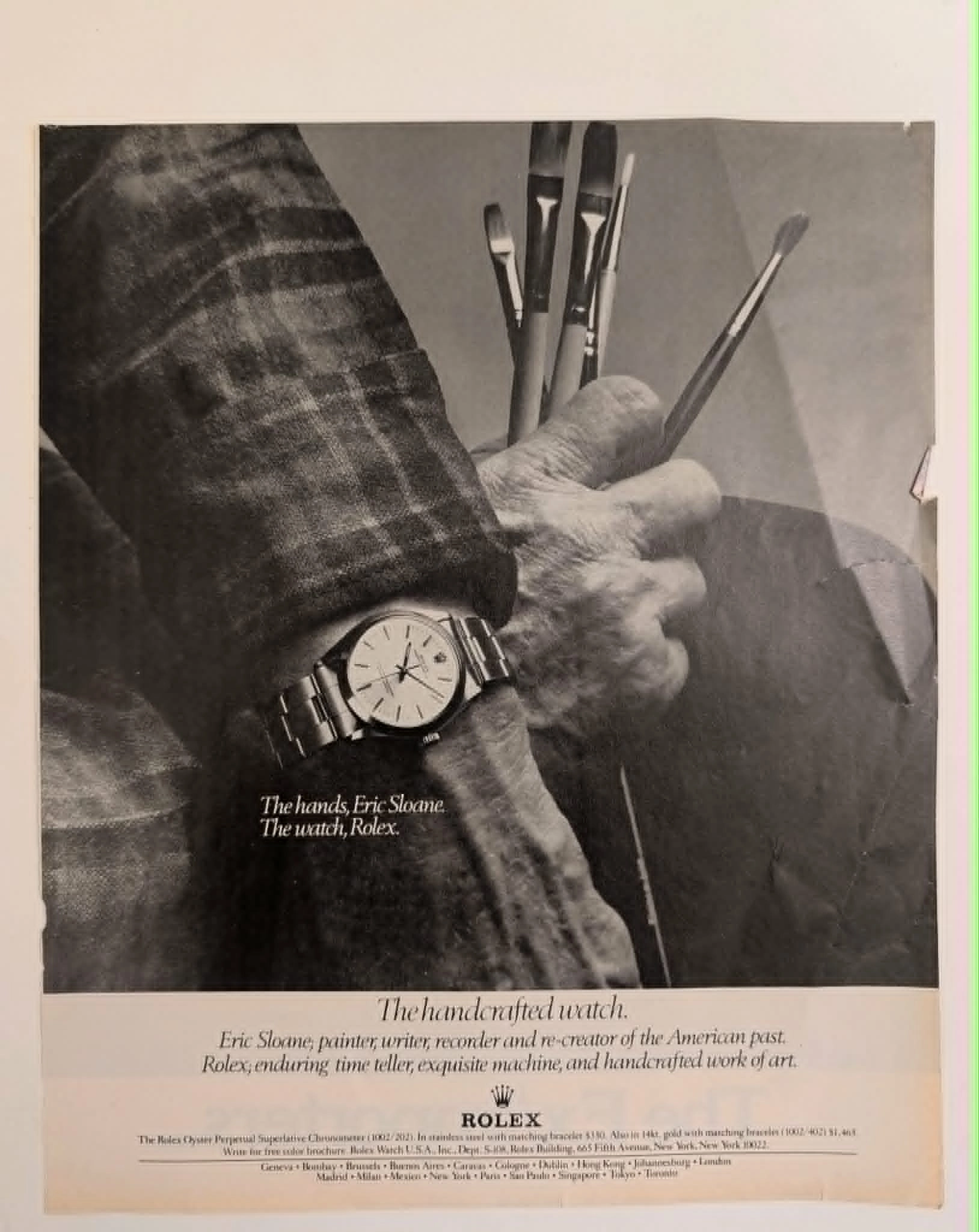
Time was once measured by the sun. Then, it was measured by the machine. Finally, it was measured by the artisan. This archival document represents a fundamental pivot in the human relationship with horology. Before this era, a watch was a necessary instrument for navigation, synchronization, and survival. After this era, a watch became a declaration of permanence. The advertisement features Eric Sloane, a man who documented the fading analog skills of early America. He is paired with the Rolex Oyster Perpetual Reference 1002. It is a deliberate juxtaposition. The hands that preserve history are wrapped in the machine that preserves time. It is the exact moment horology stopped selling mere utility, and began selling legacy.
Category: Fashion
Brand: Rolex
The History
The Epoch of Mechanical Tension To understand this artifact, we must analyze the temporal landscape in which it was forged. The price listed for the stainless steel Reference 1002 is $350. The 14-karat gold iteration stands at
,465. Adjusted for inflation, this places the document squarely in the late 1960s or very early 1970s. This was not a quiet era. It was a period of profound technological and philosophical friction. The Space Race had concluded with a victory for extreme engineering. Humanity was looking upward, toward satellites and integrated circuits. The digital revolution was in its embryonic stage. Mass production had reached a level of unprecedented efficiency. Goods were becoming cheaper, faster to produce, and entirely disposable. In the realm of horology, a storm was gathering. The tuning fork movement had already proven that electronic regulation could surpass the accuracy of a traditional mainspring. The impending Quartz Crisis—a technological shift that would nearly annihilate the Swiss mechanical watch industry—was looming on the horizon. Accuracy was no longer a luxury; it was about to become a cheap, mass-produced commodity. Faced with the reality that a battery-powered circuit could soon out-perform a hundred hand-assembled gears, Rolex faced an existential dilemma. How does a company sell mechanical engineering when electronic engineering is inherently more accurate? The answer is etched into this very document. They stopped selling the machine as a tool. They began selling the machine as "a handcrafted work of art." The Artisan as the Anchor Rolex did not choose a pilot, a deep-sea diver, or a race car driver for this specific campaign. For decades, the Oyster case was marketed purely on its rugged utility—surviving the English Channel, scaling Mount Everest. Here, they chose Eric Sloane. Sloane was an author, an artist, and a cultural historian. His life’s work was the meticulous documentation of early American craftsmanship. He painted covered bridges, studied meteorology, and wrote exhaustively about the traditional hand tools used to build the physical foundation of the United States. He was a man obsessed with the analog, the tactile, and the enduring. He represented the antithesis of the disposable, plastic culture that was rapidly enveloping the late twentieth century. By placing a Rolex on Sloane’s wrist, surrounded by the worn wooden handles of his paintbrushes, the strategic message was engineered with surgical precision. Rolex aligned the creation of a mechanical watch with the creation of fine art. The watch is presented not as a product of a factory, but as the inevitable evolution of traditional human craftsmanship. Sloane preserved the American past with his hands; Rolex preserved the concept of permanent, enduring mechanics. It was a brilliant, necessary shift in psychological positioning. If watches were destined to become obsolete as tools, they had to be reborn as totems. The Mechanical Truth of Reference 1002 Beneath the philosophical marketing lies a foundation of rigorous engineering. The watch featured is the Rolex Oyster Perpetual Reference 1002. It is, by all definitions, the purest distillation of the brand's core design language. There is no date function. There is no rotating bezel. There are no chronograph pushers. It is a three-hand timepiece dedicated to a single variable: the current moment. Inside the 34mm stainless steel case resides the Caliber 1560 or 1570—movements that form the absolute bedrock of Rolex's reputation for reliability. Beating at 19,800 vibrations per hour, the mechanism relies on a free-sprung balance and a Breguet overcoil. It is an architecture designed for stability over decades, not mere years. The dial proudly bears the text: "Superlative Chronometer Officially Certified." In this era, this was not merely a marketing slogan. It was a rigorous, scientifically verified metric. To achieve this certification, the movement had to undergo fifteen days of brutal testing across five different positions and three different temperatures at the Swiss testing institutes. Only the movements that proved exceptionally resistant to gravitational variance and thermal expansion were granted the title. The case itself is the legendary Oyster architecture. Machined from a solid block of steel, with a screw-down case back and the patented Twinlock winding crown, it isolated the delicate micro-mechanics from water, dust, and pressure. It was an impermeable vault for a fragile, beating heart. The Economic Valuation of Time We must examine the economics detailed in the lower quadrant of the artifact. A stainless steel watch for $350 in 1970 represented a significant, yet attainable, capital expenditure for the middle-to-upper working class. It was an investment. It was roughly equivalent to three weeks of average wages in the United States at the time. The gap between the steel version ($350) and the gold version (
,465) is highly indicative of the metallurgical economy of the era. The internal mechanics were identical. The buyer of the gold watch was paying a nearly 400% premium entirely for the material housing. This vast chasm in pricing highlights the dual nature of horology: it is simultaneously an instrument of precision and an instrument of social stratification. By listing both prices, the advertisement democratizes the engineering while stratifying the luxury. It states, implicitly, that the "handcrafted work of art" is available to the professional, while the precious metal variant is reserved for the elite. Yet, the timekeeping—the fundamental truth of the object—remains identical for both. The Historical Shift This specific advertisement represents the exact fulcrum on which modern horology balances today. Rolex foresaw the commoditization of time. They realized that selling a watch based solely on its ability to tell time was a fatal strategy. Therefore, they pivoted to philosophy. They began selling the idea of time. They sold the romance of gears turning against each other in the dark. They sold the concept of human hands polishing steel until it mirrored the soul of the craftsman. This document is the blueprint for the entire modern luxury watch industry. Every brand that survived the Quartz Crisis did so by adopting the narrative laid out in this text. They stopped being toolmakers. They became myth-makers. The Reference 1002, strapped to the wrist of a painter of barns, was the vanguard of this revolution.
The Paper
The physical medium of this document serves as a poignant counterpoint to its subject matter. Printed on standard, mass-market magazine stock, the paper possesses a low Grams per Square Meter (GSM) rating, likely hovering around 60 to 70 GSM. The printing methodology is standard industrial halftone lithography. Upon close inspection of the magnified archives, the distinct rosette patterns of the ink application are visible. It relies on a subtractive color model, though presented here heavily weighted in black and grayscale tones to evoke a sense of archival gravity. The paper itself is actively succumbing to the entropy of time. The acidic nature of the wood pulp used in mid-century periodicals causes a slow, inevitable yellowing—a process known as lignin oxidation. The edges are frayed; the fibers are degrading. There is a profound irony in this physical decay. The paper, a temporary vehicle meant to be discarded at the end of the month, carries an advertisement for a machine engineered to outlast the human wearing it. The medium is dying; the message is permanence.
The Rarity
Classification: Class S (Contextual Pivot) While vintage Rolex advertisements are relatively common in the broader antiquarian market, this specific artifact commands a Class S rating due to its profound historical weight. Its value does not lie in extreme scarcity, but in its function as a definitive "Contextual Pivot." It marks the precise transition from the era of the tool watch to the era of the art watch. It is a textbook artifact for horological scholars studying the survival strategies of Swiss manufacturers prior to the Quartz Crisis. Finding it intact, with the price matrix legible and the tonal contrasts sharp, elevates its status significantly within corporate archival studies.
Cite this article
MLA
Naodhinsuk, Ronin. “The Time Traveller's Dossier : Rolex Ref 1002 - The Handcrafted Era.” The Record Institute, 23 May 2026, https://therecord.institute/journal/the-time-travellers-dossier-rolex-ref-1002-the-handcrafted-era.
APA
Naodhinsuk, R. (2026, May 23). The Time Traveller's Dossier : Rolex Ref 1002 - The Handcrafted Era. The Record Institute. https://therecord.institute/journal/the-time-travellers-dossier-rolex-ref-1002-the-handcrafted-era
CHICAGO
Naodhinsuk, Ronin. 2026. “The Time Traveller's Dossier : Rolex Ref 1002 - The Handcrafted Era.” The Record Institute, May 23, 2026. https://therecord.institute/journal/the-time-travellers-dossier-rolex-ref-1002-the-handcrafted-era.