The Time Traveller's Dossier : Royal 76 - The Pump Shift
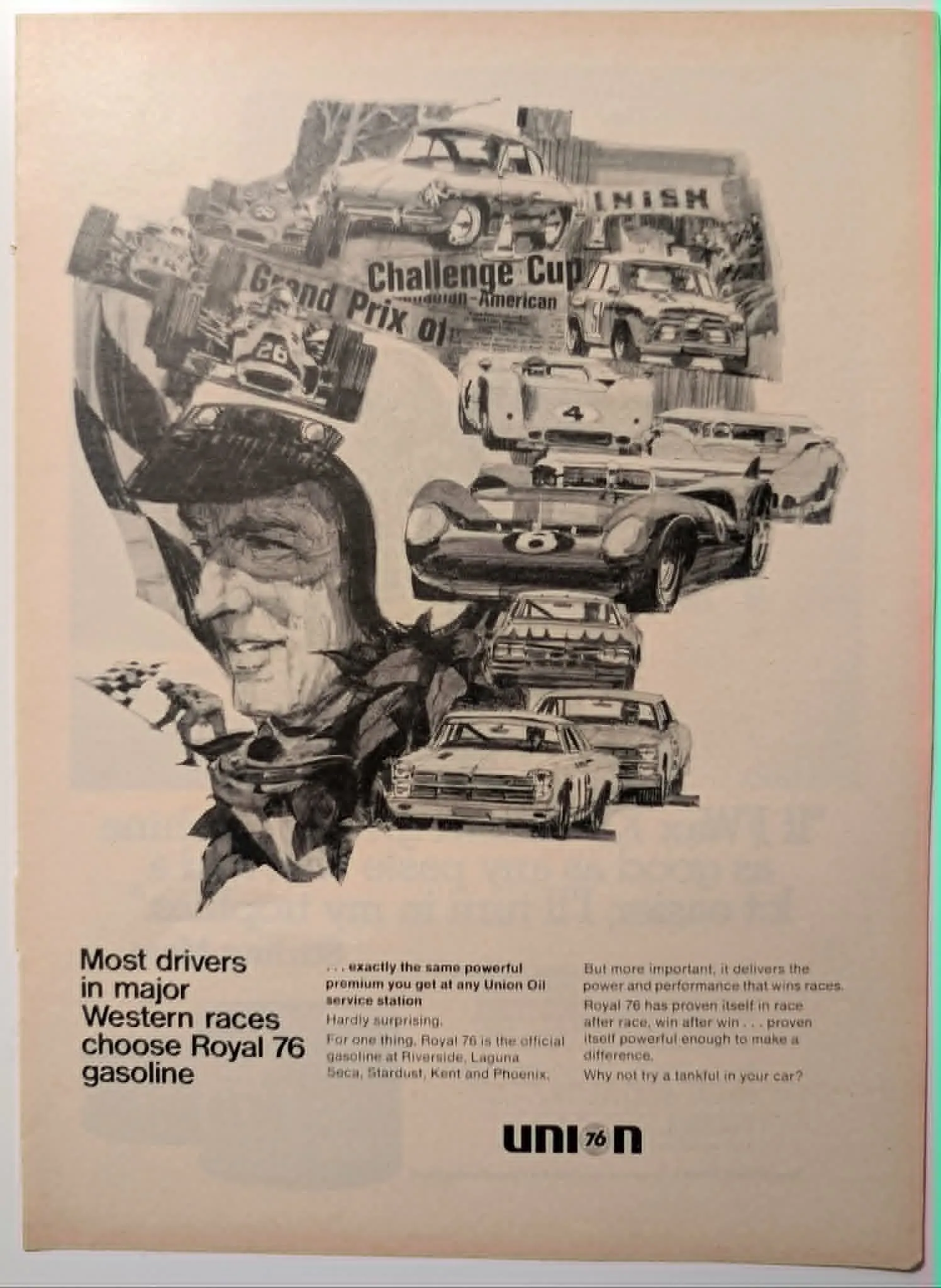
We look at a piece of paper. We see a mosaic of speed. Before this era, racing was a distant spectacle. It belonged to the aristocrats. It belonged to the engineers in closed paddocks. Then, the post-war industrial machine pivoted. The focus shifted from military superiority to consumer seduction. The problem was distance. The psychological distance between the man driving a mundane sedan to a corporate office, and the gladiator risking immolation on a weekend race track. The solution was the pump. This advertisement is the exact moment that bridge was built. It sold the illusion of proximity. It told the commuter that for a few cents more per gallon, they could pour the adrenaline of the Grand Prix directly into their daily lives. The shift was complete. Performance was no longer something you only watched. It was something you purchased.
Category: Technology
The History
The Architecture of the Post-War Mind To understand this artifact, we must analyze the vacuum it was designed to fill. The late 1960s in America was an era defined by mechanical optimism. The interstate highway system was unfurling across the continent, laying down thousands of miles of fresh concrete. Mobility was synonymous with freedom. But freedom, once obtained, quickly becomes routine. The commute became a reality. The automobile transitioned from a symbol of ultimate liberty to a necessary appliance for economic survival. The petroleum industry recognized this psychological stagnation. They needed a mechanism to re-inject romance into the act of burning fossil fuels. They found it on the race track. The Western Coliseums The artifact explicitly names its proving grounds: Riverside, Laguna Seca, Stardust, Kent, and Phoenix. These were not merely locations. They were the defining arenas of the golden age of American road racing. Riverside International Raceway, in the dusty heat of Southern California, was brutal. It consumed brakes, tires, and men. Winning there meant your machinery possessed undeniable endurance. Laguna Seca offered the Corkscrew, a terrifying drop in elevation that tested the absolute limits of chassis dynamics and fluid delivery under extreme G-forces. Stardust International Raceway in Las Vegas was a temporary phenomenon, operating only from 1965 to 1968. Its inclusion firmly carbon-dates this artifact. It was a flat, fast circuit funded by casino money, bringing the glamour of high-stakes gambling into the paddock. Kent, known as Pacific Raceways, nestled in the dense, damp forests of Washington state, tested traction and driver nerve in unpredictable microclimates. Phoenix provided the relentless, unforgiving desert heat, pushing engine cooling systems and fuel vaporization limits to the brink. By listing these exact circuits, Union Oil was not just listing events. They were establishing a geographic dominance. They were mapping the entire Western seaboard and desert interior, laying claim to every extreme condition a vehicle could face. The Chemical Equation What was Royal 76? It was an equation. It was a chemical composition of hydrocarbons heavily doped with tetraethyllead (TEL). In the era before environmental regulation, octane was achieved through lead. Lead prevented engine knock. It allowed engineers to increase compression ratios. Higher compression meant more violent explosions inside the cylinder, yielding greater horsepower. The copy claims: "...exactly the same powerful premium you get at any Union Oil service station." This was the pivotal shift in industrial marketing. Historically, racing fuel was an exotic blend. It was a volatile mixture of alcohols, benzene, and aviation-grade compounds. It was highly toxic, unstable, and entirely unsuited for a street car. But series like the SCCA Trans-Am and the early days of NASCAR began mandating "pump gas." They required vehicles to run on commercially available fuel. This regulation birthed a marketing goldmine. Union 76 engineered Royal 76 to be just stable enough for the commuter, but volatile enough to sustain a high-compression race engine at wide-open throttle for 500 miles. It was a masterclass in supply chain dual-purposing. The Illusion of the Symmetrical Experience The genius of this artifact lies in its psychological engineering. When a consumer read "Most drivers in major Western races choose Royal 76 gasoline," a very specific mental substitution occurred. The consumer is not a race car driver. The consumer drives a heavy, steel-bodied station wagon. But at the moment of purchase, at the physical interface of the fuel pump, the consumer engages in the exact same physical action as the pit crew. They lift the nozzle. They dispense the fluid. The advertisement validates this action. It suggests a chemical symmetry. If the fluid in the tank is the same, then the potential of the machine is the same. The only difference is the bravery of the operator. It is a profound commercial deception, executed flawlessly. It monetized the ego. The Competitor Landscape Union 76 was not alone in this war. Standard Oil (Chevron) pushed their Custom Supreme. Shell had their Super Shell with Platformate. Gulf dominated the endurance racing visuals with their iconic blue and orange livery. To survive this brutal market, Union 76 had to pivot from purely logical arguments (engine cleanliness, mileage) to deeply emotional ones. The orange sphere of the 76 logo became omnipresent at tracks. It was mounted on towering poles, visible from the grandstands and the television cameras. This printed artifact is the localized, intimate version of that towering orange sphere. It is the trackside billboard compressed into a magazine page, delivered directly to the suburban living room. It marks the era when petroleum companies stopped selling fuel, and started selling the mythology of speed.
The Paper
We examine the physical evidence. The substrate is thin. It is likely a 70 to 80 GSM uncoated stock, typical of mid-century newsprint or a low-cost, mass-circulation periodical. It was not designed for permanence. It was engineered for ephemeral consumption. The printing method is a rotary letterpress or early offset lithography. When we observe the extreme close-up of the driver's face, the truth of the medium is revealed. We see the halftone pattern. The halftone process is an optical illusion. It translates continuous shades of gray into a matrix of solid black dots of varying sizes. The human eye, from a distance, blends these dots into a smooth gradient. This specific artifact shows heavy dot gain. The ink has spread into the porous fibers of the cheap paper, softening the sharp edges of the original illustration. The paper has aged. It has oxidized. The lignin within the wood pulp has reacted with light and air, turning the once-white margins into a warm, uniform beige. This yellowing is not damage. It is the physical recording of time. The paper itself is a clock, slowly burning its own chemical reserves over six decades.
The Rarity
Classification: Class B (Contextual Survivor) This is not a unique artifact. When it was printed, hundreds of thousands, perhaps millions, of identical copies were pushed through the rotary presses. They were read on trains. They were left in waiting rooms. They were ultimately discarded, lining birdcages or fueling incinerators. Its rarity is not found in its initial scarcity, but in its survival rate. Ephemera is designed to die. Therefore, any surviving piece graduates from 'trash' to 'document'. Its value is strictly contextual. It holds little to no aggressive financial premium on the auction block. Its true worth belongs to the sociologist, the automotive historian, and the archivist. It is a perfect, unedited snapshot of corporate rhetoric during the peak of the internal combustion era.
Cite this article
- MLA
- Naodhinsuk, Ronin. “The Time Traveller's Dossier : Royal 76 - The Pump Shift.” The Record Institute, 12 June 2026, https://therecord.institute/journal/the-time-travellers-dossier-royal-76-the-pump-shift.
- APA
- Naodhinsuk, R. (2026, June 12). The Time Traveller's Dossier : Royal 76 - The Pump Shift. The Record Institute. https://therecord.institute/journal/the-time-travellers-dossier-royal-76-the-pump-shift
- CHICAGO
- Naodhinsuk, Ronin. 2026. “The Time Traveller's Dossier : Royal 76 - The Pump Shift.” The Record Institute, June 12, 2026. https://therecord.institute/journal/the-time-travellers-dossier-royal-76-the-pump-shift.