The Time Traveller's Dossier : Russian Retreat - The Empire's Collapse
Then, the Russian Imperial Army was a mythological behemoth, a terrifying monolith of inexhaustible manpower destined to steamroll across the European continent. Wars were expected to be won by sheer arithmetic and the unquestioning loyalty of millions. Now, in the mechanical meat grinder of the Eastern Front, the paradigm fractures entirely. The battlefield has mutated into a theater of systemic dissolution. This artifact documents that exact tectonic pivot. It captures the precise, harrowing moment when an empire ceased to function, when soldiers transformed into revolutionaries, and when military discipline dissolved into absolute, chaotic flight. It is the blueprint of a civilization's collapse and the violent birth of a new ideological era.
Category: Other
The History
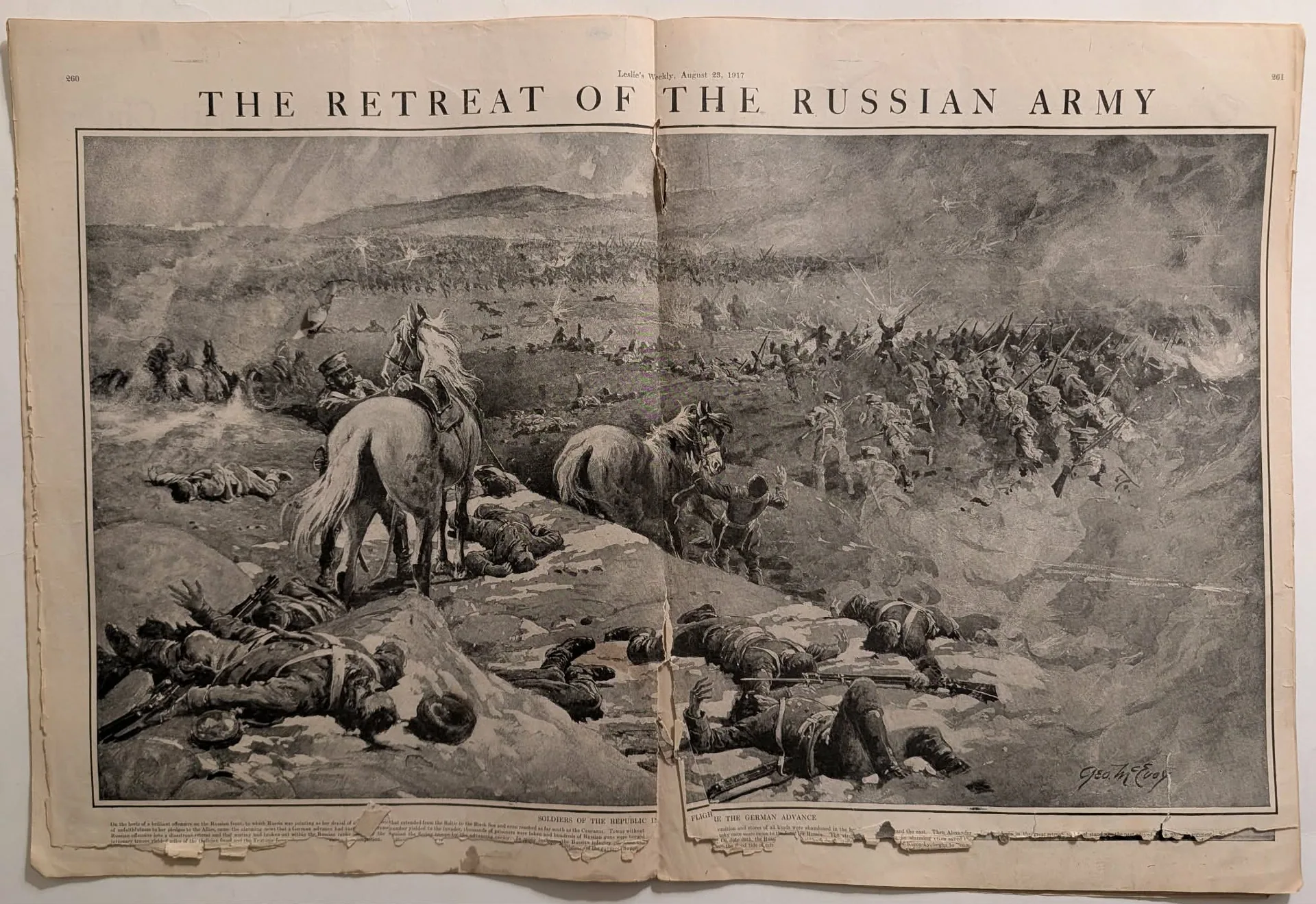
The Illusion of the Monolith History is rarely altered by a single tactical error; it is dismantled by the slow rot of systemic failure. Prior to 1914, the European continent held a collective, almost superstitious fear of the "Russian Steamroller." The assumption was mathematical: the sheer demographic weight of the Russian Empire, capable of fielding millions of men, would inevitably overwhelm any industrial advantage held by the Central Powers. But mass, devoid of logistical infrastructure, is merely a larger target. By 1917, the myth of the steamroller had been comprehensively shattered by the relentless, mechanized efficiency of the German war machine. The Russian soldier was brave, but courage cannot deflect artillery shells, nor can it fill empty stomachs or replace missing boots. The war had ceased to be a contest of strategy and had devolved into a gruesome equation of attrition, one that the Russian logistical apparatus was fundamentally incapable of solving. The empire was bleeding out, not just on the front lines, but in the breadlines of Petrograd and the frozen rail yards of the interior. The Kerensky Gamble and the Summer of Disillusionment To understand the sheer kinetic panic depicted in this artifact, published on August 23, 1917, one must understand the political vacuum of that fateful summer. In March 1917, the Romanov dynasty collapsed under the weight of its own obsolescence. The Tsar abdicated, replaced by a fragile Provisional Government that operated in an uneasy, paralytic duality with the Petrograd Soviet. The nation was desperate for peace, yet the Provisional Government, heavily pressured by its Western Allies and led by Alexander Kerensky, made a fatal geopolitical miscalculation. They chose to honor imperial commitments and ordered a massive, final push: the July Offensive. Initially, shock battalions made localized gains, buoyed by a fleeting, manufactured enthusiasm. But the rot was too deep. Within days, the German and Austro-Hungarian forces counterattacked. The Russian line did not just break; it evaporated. The scene captured in this centerfold is not merely a tactical withdrawal; it is the Tarnopol retreat, a catastrophic event where entire divisions simply refused to fight, turned their backs on the enemy, and began a chaotic, violent march back toward the motherland. The Anatomy of a Rout What this illustration masterfully conveys is the psychological shatter point of an army. Order Number 1, issued earlier by the Petrograd Soviet, had already stripped officers of their traditional authority, democratizing the military to the point of paralysis. Soldiers formed committees; they debated orders before executing them. When the German counter-offensive struck, the fragile bonds of military cohesion disintegrated completely. In the artwork, the retreat is not an organized retrograde movement. It is a desperate, surging tide of humanity fleeing a mechanized slaughter. The men running toward the horizon are no longer soldiers of the Tsar, nor are they the loyal defenders of the Provisional Government; they are a transient, desperate mob. The lack of standardized equipment, the desperate clinging to horses, and the absolute abandonment of the dead in the foreground highlight a logistical and moral total system failure. The Russian army was literally walking away from the First World War, taking their rifles and their rage back to the cities, providing the very kindling that the Bolsheviks would ignite three months later in the October Revolution. The American Perspective and the Media Landscape The publication of this double-page spread in Leslie's Weekly is highly significant. In April 1917, the United States formally entered the Great War. The American public was anxious, newly committed to a European bloodbath they barely understood. Leslie's Weekly, a massive illustrated news magazine, served as a primary visual conduit for the American populace. Displaying "The Retreat of the Russian Army" was both a news report and a terrifying warning. It conveyed a stark geopolitical reality to the American reader: the Eastern Front was collapsing. The millions of Russian soldiers who had been tying down German divisions were now vanishing into the steppes. This meant that the full, undivided fury of the German Empire would soon be pivoted westward, aimed directly at the fresh, untested American Expeditionary Forces arriving in France. The artwork is therefore not just a depiction of Russian tragedy; it is an instrument of American psychological preparation. It is propaganda through realism, illustrating the sheer scale of the conflict and the catastrophic consequences of military disintegration. The Shift: From Imperial War to Ideological Warfare The historical shift represented by this artifact is absolute. It marks the death of the 19th-century imperial warfare model, where conscripts fought mindlessly for monarchs. The men fleeing across this page represent the birth of the ideological soldier. They are running away from an imperial war they did not choose, heading toward a civil war that would reshape the 20th century. When the dust of this retreat finally settled, the Russian Imperial Army was gone forever, eventually replaced by the Red Army—a force built on radically different political, social, and structural foundations. This single piece of paper captures the precise, messy, and violent transition between two global epochs.
The Paper
This artifact is printed on early 20th-century mass-market newsprint, an inherently ephemeral medium designed for immediate consumption and rapid disposal. It possesses a remarkably low Grams per Square Meter (GSM), rendering the stock fragile and highly susceptible to environmental degradation. The heavy presence of lignin-rich wood pulp has initiated profound oxidation over the past century, causing the paper to polymerize and adopt a brittle, distinct yellow-brown patina. Upon microscopic inspection, the coarse halftone printing technique is heavily exposed. The chaotic scene is not a continuous tone but a rigid, mathematical matrix of thousands of varied black ink dots. The physical centerfold crease, punctuated by minor tears and edge fraying, acts as a temporal watermark, actively recording its own decay. Yet, within this decaying matrix lies a profound potential. For the modern archivist dedicated to animating vintage print advertisements and historical illustrations into living 2D artwork, this artifact serves as an immaculate canvas. The static, frozen panic captured in these halftone dots holds a latent, frantic kinetic energy. By meticulously applying digital motion techniques while strictly preserving the coarse, historical illustration styles inherent to 1917 newsprint, one can resurrect the horrific urgency of this retreat. The rearing horses and the fleeing infantry demand to be released from their temporal freeze, bridging the gap between a static historical record and visceral, living memory.
The Rarity
Classification: Class S. While Leslie's Weekly was a mass-produced publication, the survival of an intact, double-page centerfold depicting one of the most critical geopolitical turning points of the 20th century is exceptionally rare. Its rarity is not defined by exorbitant auction house valuations, but by its immense contextual density. It is a primary source document that visually chronicles the collapse of the Russian Empire and the shifting burden of the First World War just as America entered the fray. It is a foundational text for researchers of military psychology, propaganda, and the precursors to the Russian Revolution.
Cite this article
- MLA
- Naodhinsuk, Ronin. “The Time Traveller's Dossier : Russian Retreat - The Empire's Collapse.” The Record Institute, 26 July 2026, https://therecord.institute/journal/the-time-travellers-dossier-russian-retreat-the-empires-collapse.
- APA
- Naodhinsuk, R. (2026, July 26). The Time Traveller's Dossier : Russian Retreat - The Empire's Collapse. The Record Institute. https://therecord.institute/journal/the-time-travellers-dossier-russian-retreat-the-empires-collapse
- CHICAGO
- Naodhinsuk, Ronin. 2026. “The Time Traveller's Dossier : Russian Retreat - The Empire's Collapse.” The Record Institute, July 26, 2026. https://therecord.institute/journal/the-time-travellers-dossier-russian-retreat-the-empires-collapse.