The Time Traveller's Dossier : Santopour - Viscosity Wars
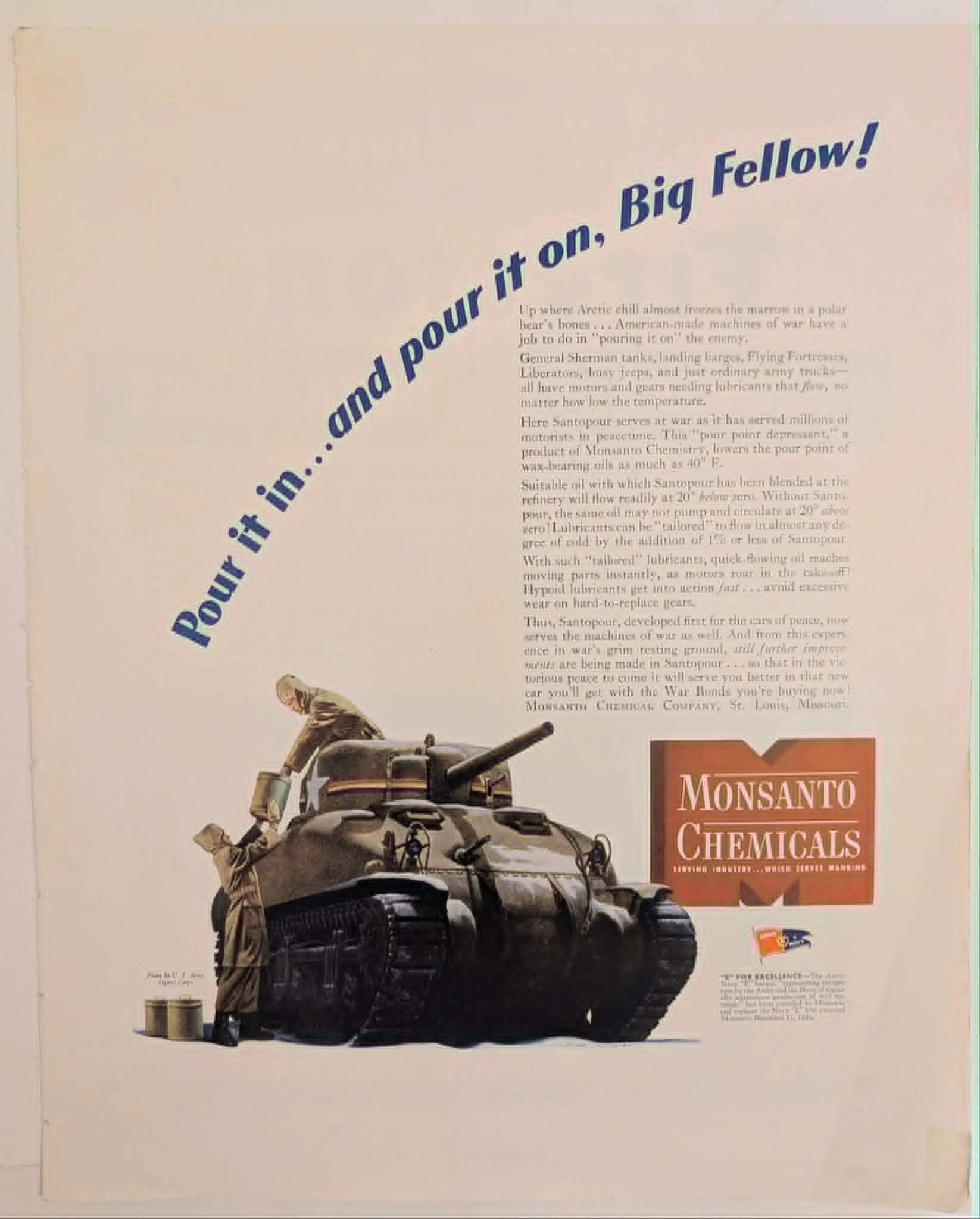
War is inherently an act of motion. When motion ceases, armies perish. Before the widespread deployment of advanced chemical additives, mechanized warfare was hopelessly bound by the rigid, unforgiving laws of thermodynamics. As the ambient temperature plummeted, petroleum congealed. Vital engines starved. Steel ground violently against steel. The most advanced machines of human conflict were routinely transformed into useless monuments of iron, trapped within the ice. This single sheet of paper documents a fundamental evolutionary shift. It marks the exact transition from mechanical desperation to chemical supremacy. Then: The brutal realities of cold weather dictated the absolute limits of human conflict and logistics. Now: Microscopic chemistry rewrote the boundaries of the global battlefield. Through the lens of this Monsanto Santopour advertisement, we observe the precise historical moment when the molecular manipulation of oil viscosity became a definitive, civilization-altering weapon of total war.
Category: Technology
The History
The Friction of Warfare and the Immobilized Vanguard To truly comprehend the weight of this artifact, one must first dissect the brutal, unforgiving mathematics of the Second World War. It was a global conflict defined not merely by the explosive yield of munitions, but by the relentless efficiency of logistics. The Allied forces relied on an unprecedented, staggeringly massive mechanized vanguard. General Sherman tanks. Flying Fortresses. Liberators. Endless fleets of busy Jeeps and landing barges. These incredibly complex machines required immense, continuous, and violent combustion to function. But combustion is entirely dependent upon lubrication. At standard room temperature, conventional petroleum-based lubricants functioned adequately. However, the sprawling theaters of this specific war were rarely temperate. The Arctic convoys delivering desperate supplies to Murmansk faced maritime temperatures that could shatter exposed steel. High-altitude strategic bombers operated in the unforgiving troposphere, where the ambient air temperature routinely plunged to sixty degrees below zero. In these extreme, lethal environments, conventional lubricating oil ceased to be a fluid. It became an active liability. Crude oil, the foundational element of these lubricants, naturally contains high concentrations of paraffin waxes. As temperatures drop, these wax molecules begin a physical transformation. They crystallize. They reach out and interlock. They rapidly form rigid, microscopic lattice structures that trap the remaining liquid oil, transforming the vital fluid into a thick, semi-solid, impenetrable gel. In the field of tribology, this is known as the "pour point"—the absolute lowest temperature at which an oil will continue to flow under the force of gravity. When the oil reaches its pour point inside the frozen block of a tank engine, the internal oil pump cannot circulate it. Crankshaft bearings run completely dry. Pistons fuse permanently to cylinder walls in a shower of sparks. The engine aggressively destroys itself from the inside out within a matter of minutes. The physical environment, long before the enemy fired a single shot, was quietly winning the war of attrition. The Microscopic Battlefield: A Chemical Shift in Strategy Before the advent of advanced pour point depressants, militaries around the world attempted rudimentary, often desperate physical solutions to this thermodynamic nightmare. They actively diluted their vital oil supplies with kerosene. While this crude method lowered the freezing point, it drastically reduced the oil's ability to actually lubricate, vastly increasing the wear and tear on complex, hard-to-replace components like hypoid gears. Soldiers were routinely forced to build open fires directly beneath the engine blocks of their tanks hours before dawn—a highly dangerous, time-consuming practice that immediately revealed their tactical positions to enemy artillery. The shift represented in this specific document is incredibly profound. It is the definitive pivot from engineering clumsy mechanical workarounds to altering the fundamental molecular chemistry of the fluid itself. Monsanto Chemical Company, previously recognized as a peacetime manufacturer of standard industrial and consumer chemicals, aggressively pivoted its vast intellectual and material resources toward the war effort. The development of "Santopour" represents a silent, invisible victory on the microscopic battlefield. Santopour is scientifically categorized as a pour point depressant. Its core function is not to physically remove the problematic wax from the oil—a refinement process that was economically and physically impossible on a massive, wartime scale—but rather to manage it at the molecular level. When added to lubricating oil in seemingly insignificant quantities (the advertisement specifically notes "1% or less"), the active polymers within Santopour interact directly with the wax crystals the exact moment they begin to form in the extreme cold. The additive molecules strategically coat the growing edges of the wax crystals. They act as microscopic saboteurs. They physically inhibit the crystals from locking together to form the dreaded gel lattice. The wax still technically precipitates out of the solution, but it remains suspended in tiny, isolated, microscopic structures. The oil matrix remains broken. The fluid continues to flow. This was not a minor mechanical convenience. It was a massive strategic imperative. The advertisement proudly and aggressively declares that a suitable base oil blended with Santopour will flow readily at a staggering "20° below zero," whereas that exact same oil without the chemical intervention might not pump and circulate at "20° above zero." This represents a forty-degree Fahrenheit paradigm shift in operational capacity. This specific chemical intervention meant that an Allied Sherman tank could start its engine instantly, without warning, in the frozen, blood-soaked Ardennes forest. It meant a Liberator bomber could violently dive through the frigid upper atmosphere without its critical hydraulic or lubrication systems seizing in mid-air. It meant that forward momentum—the lifeblood of any invading army—was permanently preserved against the elements. The Arsenal of Democracy and Industrial Symbiosis Beyond the immediate chemical engineering triumph, the artifact serves as a pristine, undeniable testament to the socio-economic structure of the United States during the early 1940s. The concept of the military-industrial complex was not yet a term of political derision; it was a deeply celebrated, publicly documented symbiosis. The advertisement deliberately and effectively bridges the psychological gap between the violent frontline and the domestic home front. It explicitly utilizes a photograph credited to the "U.S. Army Signal Corps," instantly connecting a civilian, profit-driven corporation to the official, heavily sanitized military apparatus of the state. The imagery of two anonymous, heavily cloaked soldiers laboring over a monolithic tank in the snow is presented not as a distant, lamentable tragedy, but as a shared, necessary industrial endeavor. Furthermore, the artifact features the highly prominent, colorful display of the Army-Navy "E" Award burgee. This specific pennant, representing official government recognition for "especially meritorious production of war materials," was an incredibly potent, highly coveted symbol of the era. As the text notes, it was awarded to Monsanto on December 31, 1941—a mere twenty-four days after the devastating attack on Pearl Harbor. This award was not merely a corporate pat on the back; it was a psychological weapon aimed at the domestic workforce. It was awarded to physical factories and their exhausted workers, explicitly linking their daily, grinding labor to the survival of the nation. Displaying the "E" in a glossy national advertising campaign was a calculated method of establishing absolute corporate legitimacy and unassailable patriotic virtue. It clearly signaled to the American public that Monsanto was doing its part to aggressively crush the Axis powers. The narrative seamlessly blends patriotic duty with advanced chemical prowess. The massive machine of war, the "Big Fellow," requires to be "poured on" the enemy, and Monsanto loyally provides the chemical means to pour it in. The Capitalist Loop: A Promise of Peacetime Application Perhaps the most philosophically significant and sociologically revealing element of this artifact is its forward-looking, highly calculated conclusion. In the very midst of a devastating total war, the corporate copywriter strategically anchors the present, undeniable violence to a promised, prosperous, and highly consumerist future. "Thus, Santopour, developed first for the cars of peace, now serves the machines of war as well. And from this experience in war's grim testing ground, still further improvements are being made... so that in the victorious peace to come it will serve you better in that new car you'll get with the War Bonds you're buying now!" This specific paragraph is the ultimate, perfected articulation of the capitalist shift. Total, mechanized war is casually framed as a massive, government-funded research and development phase. The horrific, blood-soaked battlefield is drastically reduced to a mere "grim testing ground" for product iteration. The extreme, lethal conditions that were currently freezing young men to death are neatly sanitized into actionable data points for future consumer product improvement. The advertisement effectively promises the civilian reader a direct, material reward for their current financial and emotional sacrifice. The purchase of government War Bonds funds the military. The military subsequently funds the private chemical companies. The chemical companies perfect the industrial additives under the duress of combat. Those very same additives will eventually make the civilian consumer's post-war, suburban automobile run more efficiently. It is a perfect, flawless, closed-loop ideology. It psychologically validates the unthinkable horrors of the present by guaranteeing the material comforts of the future. This single, fragile sheet of paper perfectly encapsulates the rapid transition of American industry: from the depths of the Great Depression, directly through the burning crucible of a global war, and perfectly positioned for the unparalleled, explosive economic boom of the 1950s.
The Paper
This artifact is a surviving physical manifestation of mid-century mass media distribution. The substrate is a medium-weight, machine-made magazine stock. Given the wartime rationing of the 1940s, it is likely a highly acidic wood pulp mixture, though the current digitized image shows only minimal extreme yellowing, suggesting it was carefully preserved in a climate-controlled, dark environment. The printing methodology utilizes a standard four-color CMYK offset halftone process, highly indicative of high-circulation national periodicals of the era (such as LIFE or The Saturday Evening Post). The color registration is remarkably tight and disciplined for the period. If one were to examine the artifact closely under a macro loupe, the distinct rosette patterns of the halftone dots would clearly reveal the mechanical, purely mathematical translation of the original U.S. Army Signal Corps photograph into distinct layers of cyan, magenta, yellow, and black ink. The texture is entirely flat, completely lacking the tactile, physical impressions of earlier letterpress work. This marks the widespread industrial shift toward offset lithography for rapid mass advertising. It is, fundamentally, a disposable document designed for immediate, temporary consumption. Yet, by the sheer defiance of probability, it has survived the decades to record the absolute permanence of the monumental ideas it originally carried.
The Rarity
Class S (Historical Context & Informational Density). While vintage magazine advertisements from the World War II era are physically common in antique markets, this specific artifact possesses incredibly high contextual value. It serves as a perfect, unbroken bridge between three distinct historical vectors: military mechanized logistics, advanced polymer chemical engineering, and socio-economic wartime propaganda. Its true rarity lies not in its physical scarcity—millions of these exact pages were aggressively printed and distributed—but in its crystalline, unfiltered articulation of the military-industrial complex at the exact moment of its birth. It is a pristine, untouched example of how complex scientific advancement was directly and seamlessly translated into palatable, patriotic marketing. It is a vital historical document cleverly disguised as everyday commerce.
Cite this article
- MLA
- Naodhinsuk, Ronin. “The Time Traveller's Dossier : Santopour - Viscosity Wars.” The Record Institute, 24 May 2026, https://therecord.institute/journal/the-time-travellers-dossier-santopour-viscosity-wars.
- APA
- Naodhinsuk, R. (2026, May 24). The Time Traveller's Dossier : Santopour - Viscosity Wars. The Record Institute. https://therecord.institute/journal/the-time-travellers-dossier-santopour-viscosity-wars
- CHICAGO
- Naodhinsuk, Ronin. 2026. “The Time Traveller's Dossier : Santopour - Viscosity Wars.” The Record Institute, May 24, 2026. https://therecord.institute/journal/the-time-travellers-dossier-santopour-viscosity-wars.