The Time Traveller's Dossier : Siphnian Frieze - Institutional Memory
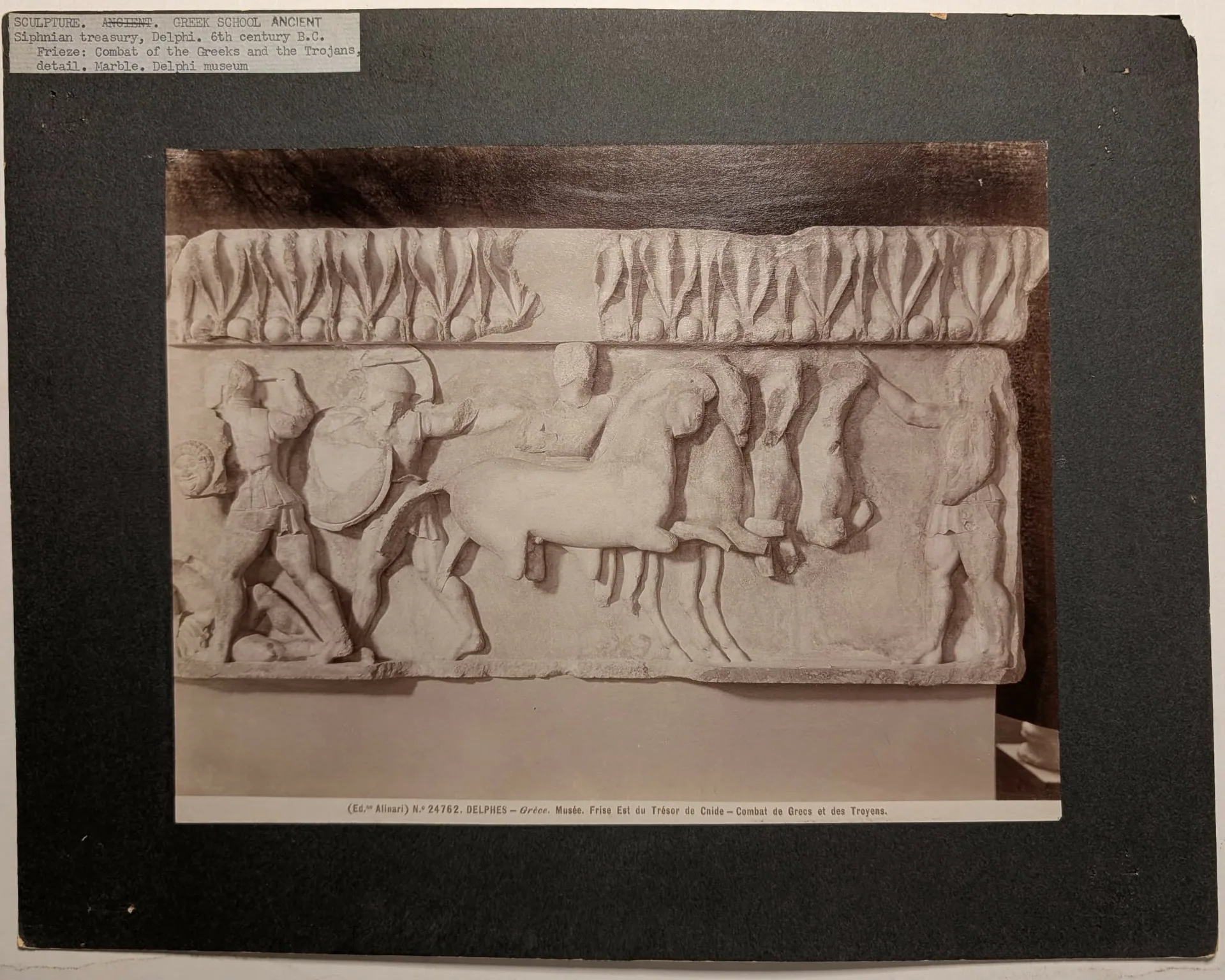
An artifact is rarely a single thing. It is a layered compression of time. What began as a sacred marble carving in the 6th century BC was mechanically flattened into a two-dimensional photograph by Italian technicians in the late 19th century. Decades later, it was weaponized as an educational tool by an American public institution. Finally, it was rendered obsolete by the digital age. This is not simply a photograph of a Greek frieze. It is a chronicle of how human beings consume, categorize, and eventually discard their own cultural foundations. The shift represented here is profound: the transition from eternal monument, to mass-produced institutional resource, to bureaucratic waste. It solves the ancient problem of geographic isolation, only to fall victim to the modern problem of physical impermanence.
Category: Other
The History
The Bronze Age Encoded in Stone To understand the baseline of this artifact, one must first look at the image it captures. As evidenced in the file 2dd1d89c-ab45-4598-8ae6-ddf57adb7110.jpg, the photograph displays a relief sculpture. Specifically, it represents the East Frieze of the Siphnian Treasury at Delphi, carved around 525 BC. The subject is the combat of the Greeks and the Trojans over the body of a fallen warrior. In its original context, this marble was not meant to be heavily scrutinized under artificial light. It was an architectural flex. The island of Siphnos had discovered immense wealth through silver and gold mines, and they chose to convert that capital into a permanent monument at the center of the ancient Greek world. The marble was a ledger of power. The warriors depicted were not just myths; they were synchronized representations of civic duty. The physical artifact we are examining, however, strips the marble of its three-dimensional sovereignty and its geographic anchor. The Alinari Translation and the Photographic Shift The first major technological shift this object represents is the democratization of visual history. The text printed directly beneath the photographic image, visible in 7b902e94-dba3-4a7c-87e6-7f79a8a1d318.jpg, reads: "(Ed.ne Alinari) N.o 24762. DELPHES - Grèce. Musée. Frise Est du Trésor de Cnide - Combat de Grecs et des Troyens." The Fratelli Alinari, founded in Florence in 1852, were pioneers in the mass reproduction of classical art. Before their operation, a student in America had to cross an ocean to see the Siphnian Treasury. Alinari solved the problem of access. They engineered a methodical process to capture static monuments on glass plate negatives, translating volumetric stone into a high-contrast, flat plane. This was a monumental shift in human expectation. Art was no longer a location; it was a commodity that could be shipped in a flat cardboard envelope. The file bce0b4a1-6721-4094-948a-7cf696806c65.jpg shows the detail of this translation, where the stark shadows of the marble are frozen permanently by the chemical reaction of the photographic emulsion. The Typographical Archaeology and Institutional Friction A close examination of the artifact reveals a fascinating historical contradiction—a conflict of academic consensus recorded in ink and graphite. The printed Alinari border (7b902e94-dba3-4a7c-87e6-7f79a8a1d318.jpg) attributes the sculpture to the "Trésor de Cnide" (Treasury of the Cnidians). However, the manual typewriter label adhered to the front of the mounting board, shown in b642fc95-abc8-4d4e-b23c-c4a538843a48.jpg, forcefully reassigns it. It reads: "SCULPTURE. ANCIENT. GREEK SCHOOL ANCIENT Siphnian treasury, Delphi." Furthermore, a handwritten note on the back of the board, captured in 3b7268c2-e660-4a99-ac90-30280281c89b.jpg, doubles down on this correction: "Treasury of the Siphnians. East frieze - Combat of the Greeks and Trojans". This typographic friction represents a shift in archaeological knowledge. When Alinari captured the image, early scholarship likely attributed the fragmented ruins to Cnidus. By the time this photograph was mounted and catalogued by American librarians in the mid-20th century, the academic consensus had shifted to Siphnos. The artifact physically documents a real-time correction of human history. The Civic Cathedral of Seattle The secondary life of this object—and arguably its most culturally significant era—occurred within the bureaucratic machinery of the United States public library system. As seen in 4a617f18-15ea-4223-8bff-0d16e698a037.jpg, the back of the board bears the stark, authoritative stamp: "PROPERTY OF SEATTLE PUBLIC LIBRARY Art Dept." During the mid-20th century, following the economic stabilization of the post-war era, American public libraries heavily invested in visual education. This mounted photograph was part of a circulating collection. It was handled, debated, and presented. The institution’s need to preserve its asset is aggressively communicated in the stamp found in 24458f36-a24c-4bc6-b0d2-fd070bed8aa4.jpg: "Use no thumb tacks gummed tape or mark in any way". This instruction is an attempt to halt the natural degradation of time. The library demanded that the artifact remain pristine, a perfect transmission of knowledge, entirely ignoring the irony that the object it depicted was a broken, weathered ruin. The Kinetic Potential of the Static Frame To observe this artifact today is to recognize a latent kinetic energy locked within a very specific temporal context. The framing of the photograph deliberately demands a completely static camera angle; any mechanical panning or zooming by the Alinari photographer would have destroyed the carefully preserved original flat illustration style of the bas-relief. Today, this physical object exists as a perfect blueprint for a living 2D artwork. Looking at the intertwined limbs of the horses and warriors, one can easily map the synchronized character motion of the hoplites, locked in an eternal, rhythmic loop of thrust and parry. Yet, the sensory environment this object truly evokes does not belong to the ancient clash of bronze in Delphi. Its authentic temporal anchor is the mid-century institutional era. The acoustic shadow cast by this heavy cardboard mount is defined by the instructional drone of a crackling radio in a 1950s classroom, or the ambient, muffled noise of a bustling 1950s street bleeding through the heavy glass windows of the Seattle Public Library. To digitally reawaken or preserve this piece today means maintaining its specific period color palette and its highly degraded, aged paper texture. It is a vintage print asset that commands respect for the specific mid-century era in which it was actively utilized. The Final Shift: Deaccession The final, most violent shift in this artifact's history is recorded in a single, heavy stamp of black ink. File 56c29a6c-7957-4921-93e8-1e0b89320c40.jpg displays the ultimate institutional judgment: "DISCARDED THIS IS NO LONGER PROPERTY OF THE SEATTLE PUBLIC LIBRARY". This stamp represents the death of the physical archive. As the 20th century closed and the 21st century introduced the digital dominion, physical photographic reference files became logistical burdens. The internet rendered the Alinari print obsolete. The library, once the fierce protector of this object, unceremoniously expelled it from the historical record. This is a profound shift in societal values. We traded the tactile, aging reality of the mounting board for the sterile, infinite storage of the cloud. The "DISCARDED" stamp is not a localized event; it is the epitaph of an entire era of physical media.
The Paper
The structural reality of this artifact is an exercise in industrial endurance. The image is adhered to a heavy, rigid mounting board, designed specifically to survive the hostile environment of public circulation. As captured in f4912022-b25c-4ffc-a46e-16a3949fc592.jpg, the extreme macro texture reveals a gelatin silver surface that is suffering from advanced chemical degradation. The subtle cracking and silver mirroring in the darkest areas indicate a breakdown of the binder holding the image particles. It is returning to dust. The backing board itself, shown in its entirety in 635376ed-102f-4268-be1d-1c4eaf1c1d1c.jpg, features a rough, fibrous texture designed for friction, ensuring it would not slip from wooden filing cabinets. The various ink stamps are pressed deeply into this porous surface. Unlike a modern CMYK halftone print which relies on a matrix of dots to fool the eye, this continuous-tone photograph relies on a literal layer of metallic silver. The physical aging process here—the oxidation of the silver, the embrittlement of the paper, the fading of the typewriter ribbon—serves as an inescapable clock. The artifact is not just recording a moment in ancient Greece; its very cellular breakdown is recording the passage of modern time.
The Rarity
Classification: Class A. While Alinari prints were produced in significant quantities, the specific combination of this photographic plate, mounted on this exact institutional board, complete with the conflicting academic labels and the final "DISCARDED" deaccession stamp, makes it highly uncommon. Its value does not lie in an inflated market price, but entirely in its contextual density. It is a multi-layered educational relic.
Cite this article
- MLA
- Naodhinsuk, Ronin. “The Time Traveller's Dossier : Siphnian Frieze - Institutional Memory.” The Record Institute, 30 June 2026, https://therecord.institute/journal/the-time-travellers-dossier-siphnian-frieze-institutional-memory.
- APA
- Naodhinsuk, R. (2026, June 30). The Time Traveller's Dossier : Siphnian Frieze - Institutional Memory. The Record Institute. https://therecord.institute/journal/the-time-travellers-dossier-siphnian-frieze-institutional-memory
- CHICAGO
- Naodhinsuk, Ronin. 2026. “The Time Traveller's Dossier : Siphnian Frieze - Institutional Memory.” The Record Institute, June 30, 2026. https://therecord.institute/journal/the-time-travellers-dossier-siphnian-frieze-institutional-memory.