The Time Traveller's Dossier : Smith-Corona - The Mechanics of Endurance
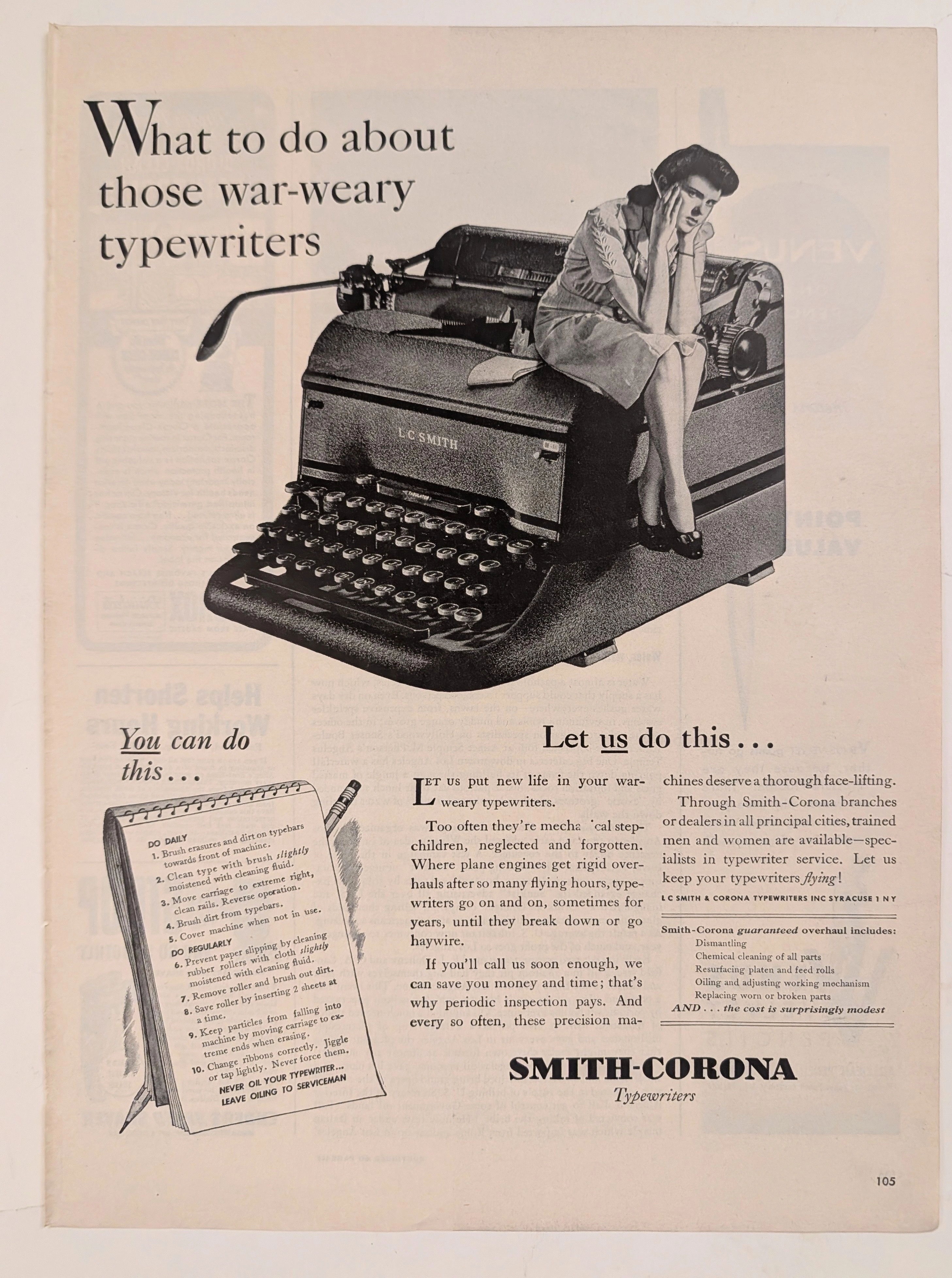
Before the era of glowing screens and silent digital strokes, commerce and bureaucracy were driven by the mechanical clatter of typebars and the sharp ring of the carriage return. The typewriter was not merely office equipment; it was the engine of the global economy. But when the world plunged into the total mobilization of the Second World War, the supply lines of civilian comfort were abruptly severed. Steel, brass, and aluminum were conscripted for munitions. Typewriter factories were retooled overnight to manufacture rifles, artillery fuzes, and cryptography machines. The artifact before us—a stark, surreal print advertisement for L.C. Smith & Corona Typewriters Inc.—captures a profound shift in the American capitalist mindset. It is an advertisement that explicitly does not try to sell you a new product. Instead, it is a manual for survival. It reflects an era where consumerism was forcibly suspended, replaced by a national culture of conservation, endurance, and mechanical triage. It uses powerful, dreamlike imagery to remind the American public that their machines were dying of exhaustion—and so were the women forced to operate them.
Category: Other
Brand: SMITH CORONA
The History
The Embargo on Office Consumerism To understand the necessity of this advertisement, one must understand the absolute rationing of the 1940s home front. In early 1942, the U.S. government’s War Production Board ordered a complete halt to the manufacturing of typewriters for civilian use. The Office of Price Administration (OPA) strictly rationed existing stocks. Smith-Corona, like its competitors Royal and Underwood, pivoted to producing weapons of war, famously manufacturing the M1903A3 Springfield rifle. Consequently, the millions of typewriters already sitting on office desks across America suddenly became irreplaceable assets. They were forced to work longer hours, handled by shifting rosters of workers, with no possibility of a shiny new replacement. The copy accurately identifies these machines as "mechanical step-children, neglected and forgotten." The Surreal Scale of Wartime Burden The most striking element of this artifact is its surreal manipulation of scale. A colossal, monolithic L.C. Smith typewriter dominates the composition. Slumped against its massive frame is a miniature woman, dressed in typical 1940s office attire, holding her head in her hands in a posture of absolute exhaustion. This visual metaphor is exceptionally powerful. The "machine" has grown to dominate the worker. The exhaustion of the woman mirrors the mechanical fatigue of the "war-weary" typewriter. It is also a poignant representation of the female wartime workforce. With millions of men deployed overseas, women absorbed the crushing administrative and bureaucratic weight of the war effort. The advertisement silently acknowledges their fatigue. The Typist’s Survival Guide The artifact cleverly divides its message into two distinct mandates: "You can do this..." and "Let us do this..." The spiral notepad features a highly specific, tactical checklist for daily and weekly maintenance. It instructs the typist to brush away erasures, clean the type, and keep particles out of the carriage. It is a democratization of mechanical responsibility. However, the most fascinating directive is printed in bold at the bottom of the notepad: "NEVER OIL YOUR TYPEWRITER... LEAVE OILING TO SERVICEMAN." This is a stark warning against civilian hubris. In an era where a broken typewriter could mean a complete halt in business operations, amateur repairs were a liability. The corporation establishes a hard boundary between daily hygiene and professional mechanics. The Shift from Product to Service In the lower half, the advertisement offers a "Smith-Corona guaranteed overhaul." This outlines the dismantling, chemical cleaning, platen resurfacing, and readjustment of the machine. This represents a fascinating pivot in corporate strategy. Unable to sell new machines, Smith-Corona monetized their expertise. They transitioned from a manufacturing business model to a service-and-maintenance model. They kept their brand relevant and their dealer network alive by ensuring that the existing, aging fleet of American typewriters did not break down before the war was won.
The Paper
The physical reality of this document is a testament to mid-century mass printing. Under macro magnification, the mechanics of the black-and-white halftone printing process are starkly visible. The smooth gradients of the typewriter's black metal chassis and the folds of the exhausted woman's skirt are rendered entirely through a regimented, microscopic grid of black ink dots of varying sizes. The paper is an uncoated, matte magazine stock. Decades of exposure to air and light have caused the acidic wood pulp to oxidize, turning the originally white page into a warm, aged beige. Despite the chemical yellowing of the paper, the black ink remains sharp and resolute. The bold serif typography of the "Smith-Corona" logo is crisp, reflecting the precision of the machines it advertises.
The Rarity
Classification: Class B (High Contextual & Social History Value) As an isolated magazine tear sheet, this item is not exceptionally rare in terms of market scarcity. However, its archival classification is elevated to Class B due to its pristine contextual value. It is a flawless primary source documenting the wartime pivot of American consumerism. For historians studying the WWII home front, the evolution of corporate advertising, or the sociology of office labor, this page provides a perfect, isolated data point demonstrating how corporations trained the public to conserve rather than consume.
Cite this article
- MLA
- Naodhinsuk, Ronin. “The Time Traveller's Dossier : Smith-Corona - The Mechanics of Endurance.” The Record Institute, 16 April 2026, https://therecord.institute/journal/the-time-travellers-dossier-smith-corona-the-mechanics-of-endurance.
- APA
- Naodhinsuk, R. (2026, April 16). The Time Traveller's Dossier : Smith-Corona - The Mechanics of Endurance. The Record Institute. https://therecord.institute/journal/the-time-travellers-dossier-smith-corona-the-mechanics-of-endurance
- CHICAGO
- Naodhinsuk, Ronin. 2026. “The Time Traveller's Dossier : Smith-Corona - The Mechanics of Endurance.” The Record Institute, April 16, 2026. https://therecord.institute/journal/the-time-travellers-dossier-smith-corona-the-mechanics-of-endurance.