The Time Traveller's Dossier : Space Camp - Civilian Orbit
For decades, the void of space was a closed ideological system. It was an arena reserved strictly for elite military test pilots and the apex of theoretical physics. To touch the edge of the atmosphere required a lifetime of rigorous physical perfection and government clearance. Then, the paradigm fractured. The Space Shuttle era reframed the cosmos. It was no longer a battlefield; it was a destination. The cosmos became a logistical frontier. This artifact represents the exact fulcrum of that shift. It is the moment the machinery of orbital mechanics was decoupled from national security and repackaged as experiential simulation. It documents the precise timeline when the civilian population was invited to strap into the very same multi-axis simulators that forged the Apollo crews. The threshold of the cosmos was opened to the public, not through actual flight, but through the profound psychological architecture of simulation.
Category: Technology
Brand: ์NASA
The History
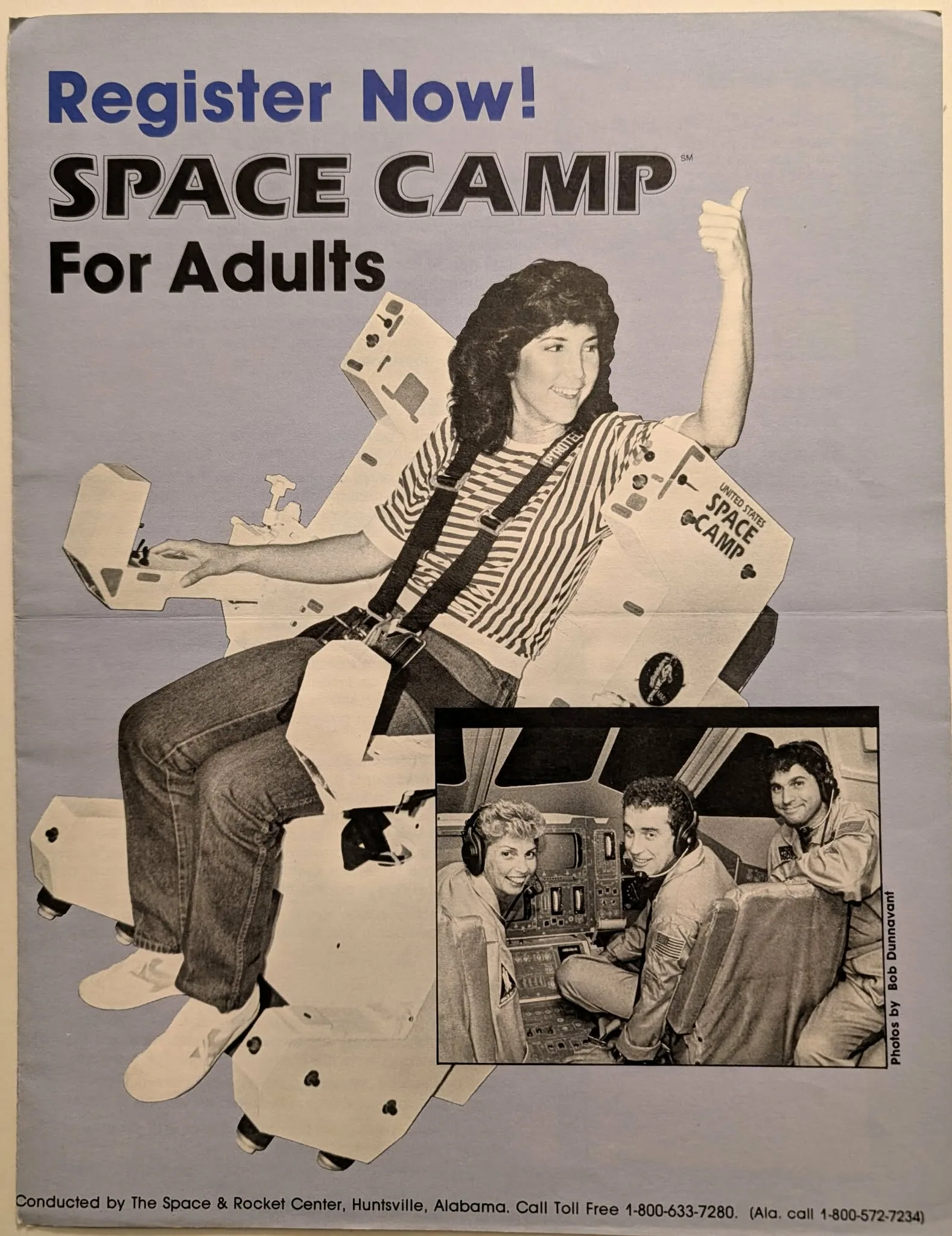
The Geopolitical Thaw and the Space Truck To understand this artifact, one must first isolate its temporal coordinates. The postmark stamped into the paper reads October 2, 1985. This date places the document at the absolute zenith of the Space Transportation System's (STS) operational optimism. The Space Shuttle was fully operational. NASA had successfully marketed the vehicle as the "space truck," a reliable, reusable workhorse that made low-Earth orbit a matter of routine logistics rather than exceptional exploration. During the Mercury and Apollo programs, astronaut training was a matter of intense national secrecy. It was a militarized process designed to weaponize human endurance against the unknown. By 1985, that doctrine had shifted. The Cold War was entering a state of technological détente. The cultural focus in the United States pivoted toward mass media, consumerism, and the commodification of elite experiences. This brochure is the physical manifestation of that cultural pivot. The text of the document explicitly states that the program brings a unique "astronaut experience" within the grasp of the "housewife and layman alike". This specific phrasing is a sociological marker. It dismantles the mythos of "The Right Stuff." It declares that the physiological and psychological conditioning required for spaceflight is no longer the exclusive domain of the hyper-masculine military test pilot. It is, instead, a set of protocols that can be learned, simulated, and consumed by the American middle class. The Architecture of Civilian Simulation The engineering of the camp, as outlined in the three-day itinerary, is an exercise in rigorous psychological architecture. The program does not merely offer a tour; it forces the civilian body into the biomechanical stresses of launch and orbit. Day One begins with an immediate immersion into the physics of propulsion. Participants are educated on the main engines, the orange external fuel tank, and the solid rocket boosters. However, the critical juncture of the first day is the physical conditioning. Trainees are strapped into the Five Degrees of Freedom (5DF) simulator, described as a rotating high chair. The cover of the artifact visually emphasizes this apparatus, showing an adult woman smiling while suspended in the white, mechanical rig. This machine removes the standard friction and resistance of terrestrial gravity. It introduces the civilian brain to microgravity maneuvering. Alongside the 5DF, they utilize the Manned Maneuvering Unit (MMU) jetpack. Activating the hydraulics base under the shuttle cockpit with a joystick transfers the illusion of control directly to the participant. The simulation creates a hyper-reality. The civilian is no longer a spectator of the space program; their vestibular system is actively being rewired by its machinery. The Physiology of Day Two If Day One is about the illusion of control, Day Two is about physiological submission to orbital forces. The itinerary dictates that trainees take turns inside the multi-axis simulator. This device is designed to induce extreme disorientation, mimicking a spacecraft tumbling out of control. It tests the human vestibulo-ocular reflex. Historically, this machine was an instrument of sheer endurance for Project Mercury. Here, it is repackaged as civilian recreation. Following this, the participants experience one-sixth gravity. The text explicitly connects this device to the exact equipment Apollo astronauts used to learn to walk on the Moon. This is the crux of the artifact's philosophical weight. The hardware that facilitated humanity's greatest exploratory achievement—lunar traversal—has been transitioned into a tool for civilian experiential education. The sacred relics of the Space Race have become instructional interactive exhibits. Furthermore, the integration of technology is evident in the use of the Plato computer system to sharpen their knowledge. The Plato system was a pioneering computer-assisted instruction architecture. Its inclusion signifies the 1980s transition toward digital literacy as a prerequisite for aerospace operations. The human operator is being conditioned to interface seamlessly with the digital mainframe. The Economic Commodification of the Void The transition of spaceflight from exploration to experience carries a distinct economic footprint. The brochure outlines a registration fee of $350.00 for the three-day program. In 1985, this was a calculated price point. It was accessible enough for middle-class professionals seeking novel vacations, yet high enough to filter for genuine dedication. The fee covered room, board, program equipment, and hand-outs. The commodification extends deeply into identity transformation. The document notes that flight suits in adult sizes can be purchased for $65.00 upon arrival. This is a critical detail. The flight suit is the supreme sartorial symbol of the aerospace elite. By placing a $65 price tag on it, the institution allows the civilian to purchase the visual identity of the astronaut. The group photograph on the rear fold illustrates this perfectly. A diverse group of adults—men with mustaches, women with permed hair, wearing glasses—are all unified by the identical NASA-patched jumpsuits and caps. They have successfully purchased and assimilated the aesthetic of the orbital pioneer. The Shadow of 1986 It is impossible to analyze this 1985 artifact without looking through the lens of subsequent history. The itinerary explicitly divides the adult campers into two mission teams: "Challenger" and "Discovery". Throughout the three days, the Challenger team and the Discovery team rotate through mission control, the shuttle simulator, and payload specialist tasks. This nomenclature carries a profound, retrospective gravity. Just months after this October 1985 postmark, the Space Shuttle Challenger would break apart 73 seconds into its flight on January 28, 1986. That disaster permanently shattered the illusion of routine, safe, civilian spaceflight. It abruptly ended the era of unchecked operational optimism. Therefore, this brochure exists in a delicate, frozen pocket of time. It represents the absolute peak of American innocence regarding the Space Transportation System. It documents the final moments when assigning a group of civilian campers the name "Challenger" was a symbol of aspirational adventure, rather than a solemn memorial. The artifact captures the precise atmosphere of a society entirely convinced that the dangers of space had been fully conquered by engineering. The Culmination and The Right Stuff Day Three revolves around the synthesis of teamwork and the final simulation rounds. The document stresses that swapping roles demonstrates how astronauts and scientists depend on each other for guidance. The paradigm of the lone, heroic test pilot is systematically deconstructed and replaced with the concept of the integrated, interdependent system. The experience culminates in a debriefing and the presentation of "The Right Stuff" awards, along with wings and certificates. The irony is palpable and intentional. The phrase "The Right Stuff," originally coined by Tom Wolfe to describe the unteachable, innate courage and instinct of the original Mercury Seven, has been systematized. It has been transformed into a certificate achievable over a three-day weekend in Huntsville, Alabama. This is the ultimate proof of the historical shift. The extraordinary had been quantified, packaged, and delivered to the public.
The Paper
The physical medium is a standard, lightweight uncoated offset paper, likely chosen for its cost-effectiveness in mass mailings. The substrate folds open into a multi-panel layout, a utilitarian design meant to present a dense volume of logistical information efficiently. The printing relies on a CMYK halftone process. This is most evident in the monochromatic photographs of the participants, where the structural grid of ink dots creates the illusion of depth and shadow. The background utilizes a flat, pale blue wash, providing a calm, clinical contrast to the dense text blocks. The most vital physical characteristic of this artifact is the red postal meter stamp. The mechanical pressure of the stamping machine has left a faint tactile impression on the fibers. The ink reads "UNITED STATES SPACE CAMP," "HUNTSVILLE ALA," and crucially, "OCT 2 '85". This is not merely a date; it is an unalterable timestamp anchoring the document to the final months of the pre-Challenger era. The slight fading of the red ink and the subtle yellowing of the paper's margins track the slow decay of the physical world, contrasting with the frozen, optimistic data it carries.
The Rarity
Classification: Class S. While brochures for Space Camp are relatively common, intact adult program materials from the 1985 season, specifically bearing a pre-Challenger 1985 postmark, possess immense contextual rarity. Its value is derived entirely from its historical positioning. It is a primary source document capturing the peak of civilian space optimism. It is a sociological record of how a nation attempted to democratize the mechanics of orbit just before tragedy fundamentally altered the trajectory of human spaceflight.
Cite this article
- MLA
- Naodhinsuk, Ronin. “The Time Traveller's Dossier : Space Camp - Civilian Orbit.” The Record Institute, 4 August 2026, https://therecord.institute/journal/the-time-travellers-dossier-space-camp-civilian-orbit.
- APA
- Naodhinsuk, R. (2026, August 4). The Time Traveller's Dossier : Space Camp - Civilian Orbit. The Record Institute. https://therecord.institute/journal/the-time-travellers-dossier-space-camp-civilian-orbit
- CHICAGO
- Naodhinsuk, Ronin. 2026. “The Time Traveller's Dossier : Space Camp - Civilian Orbit.” The Record Institute, August 4, 2026. https://therecord.institute/journal/the-time-travellers-dossier-space-camp-civilian-orbit.