The Time Traveller's Dossier : Space Shuttle - Engineering the Reusable Void
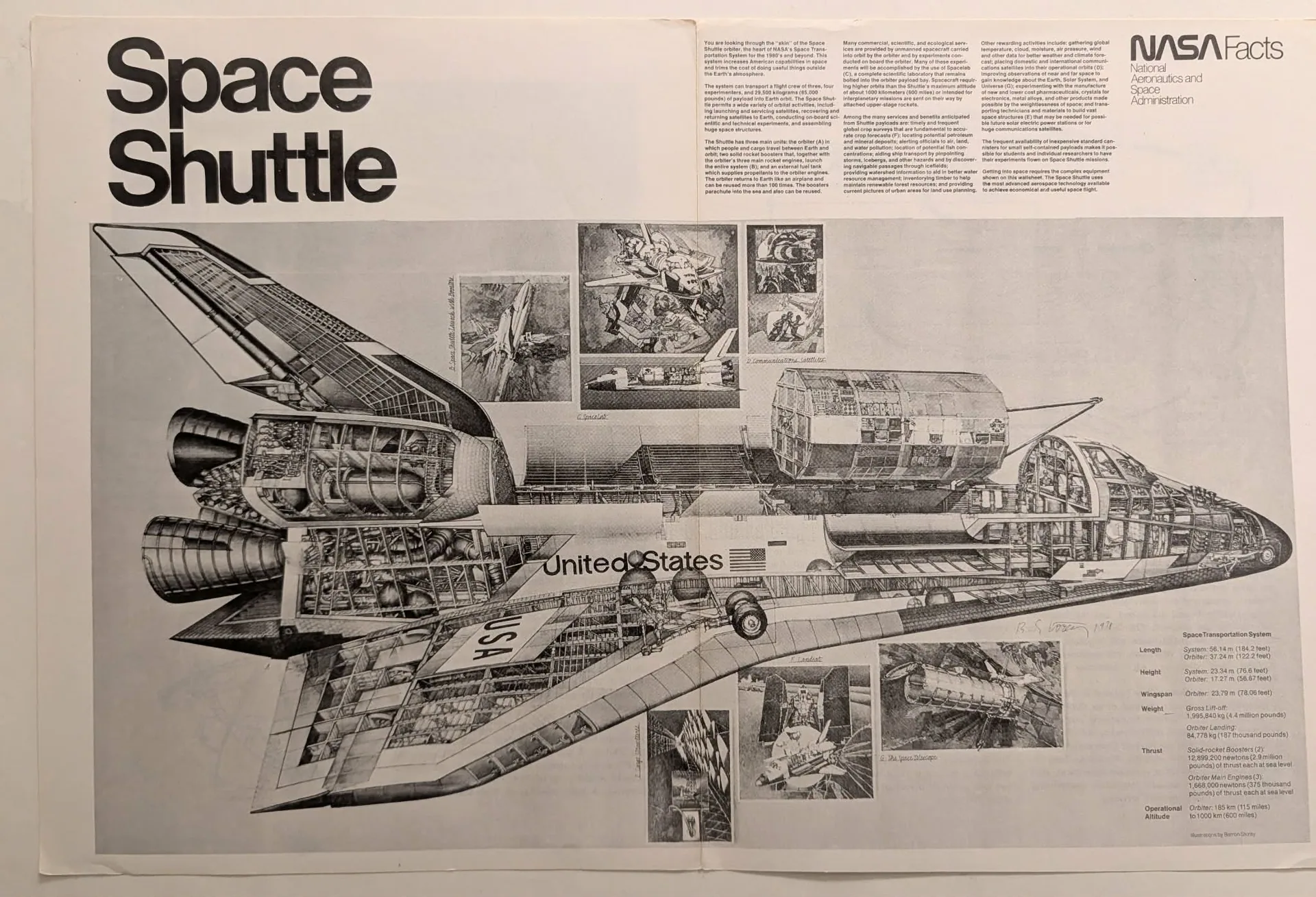
Before this ink dried, spaceflight was an entirely disposable endeavor. We built monolithic monuments of aluminum and fire, hurled them into the unforgiving abyss, and let them burn in the atmosphere or sink to the bottom of the ocean. The paradigm of the 1960s was magnificent, but it was fundamentally, economically unsustainable. Then came the shift. The concept of the orbital workhorse. The space truck. A vehicle designed to breach the atmosphere, deploy a payload into the vacuum, and glide back to Earth like a commercial airliner. This 1978 NASA Facts document is not merely a technical schematic. It is the architectural manifesto of a new era. It is the precise moment humanity decided that space was no longer a realm exclusively reserved for exceptional miracles, but a domain destined for routine, industrial logistics.
Category: Technology
Brand: NASA
The History
The Context of 1978: The Hangover of Apollo To understand the profound weight of this document, we must first isolate its temporal coordinates. The year is 1978. The echoing triumph of the Apollo moon landings has faded into a distant, complex memory. The American public is exhausted. The decade has been battered by the geopolitical hangover of the Vietnam War, crippling oil crises, and relentless economic stagflation. The blank-check era of the space race, fueled by pure Cold War ideological warfare, is definitively over. The National Aeronautics and Space Administration (NASA) faced an existential crisis. They needed a new narrative to survive. They needed a vehicle that could justify its own astronomical existence through sheer economic utility rather than purely ideological supremacy. The answer to this crisis was the Space Transportation System (STS), designed for the 1980s and beyond. This specific artifact documents the painful, ambitious transition from the bespoke, hand-crafted tailoring of the 1960s space program to the industrial, mass-production mindset required for the coming decades. It is a sales pitch to the American taxpayer, grounded in the promise of utilitarian return on investment. The Architecture of Routine: Anatomy of a Space Truck Let us dissect the machine as it is presented to the public. The document outlines a cohesive system comprised of three primary, interdependent units: the orbiter, two solid rocket boosters, and a massive external fuel tank. The physical scale detailed in these pages is staggering, yet it is presented with clinical, bureaucratic calmness. The total system length stretches to 56.14 meters (184.2 feet). The orbiter itself measures 37.24 meters (122.2 feet) in length. The mass required to accomplish this logistical dream is immense. The gross lift-off weight of the entire vehicle is documented at nearly two million kilograms, precisely 1,995,840 kg (4.4 million pounds). To tear this monolithic weight away from the Earth's gravity well demands violence quantified into raw thrust. The two solid-rocket boosters generate a combined fury, outputting 12,899,200 newtons (2.9 million pounds) of thrust each at sea level. The three orbiter main engines add to this, producing 1,668,000 newtons (375 thousand pounds) of thrust each at sea level. Yet, amidst these terrifying metrics of explosive power, the true revolution is printed in a single, quiet, paradigm-shattering sentence: The orbiter returns to Earth like an airplane and can be reused more than 100 times. This is the historical shift. True reusability. The philosophy of disposability is discarded. Furthermore, the solid rocket boosters are designed to parachute into the sea, allowing them to also be recovered and reused. Out of this towering architecture, only the external fuel tank is ultimately sacrificed to the atmosphere. The Mechanics of Industrial Time: The Turnaround To make space travel truly economical, it fundamentally had to become routine. The magic had to be stripped away, replaced by the rigid predictability of a factory floor. The document meticulously maps out this process in the "Ground Turnaround Operations" flowchart. The ambition outlined here is breathtaking in its arrogance over physics: a projected 14-day turnaround from the moment of landing to the moment of the next lift-off. The text ruthlessly calculates this operational dream into 160 working hours. This equates strictly to two shifts a day, five days a week, spanning exactly two weeks. This flowchart reduces the unfathomable complexities of orbital mechanics and thermal shielding to a mundane cyclical schedule. The stages are cyclical, forming a never-ending industrial loop: landing, preliminary safing, maintenance and checkout, vehicle assembly (where the orbiter is mated with the External Tank and Solid Rocket Boosters), payload installation on the pad, and finally, the prelaunch sequence. It is a choreography of efficiency. The Promise of Payload: Commercializing the Cosmos The sole purpose of this rigorous routine is utility. The orbiter was engineered to act as a delivery truck for the cosmos, capable of transporting a diverse flight crew ranging from three to seven people alongside a massive 29,500 kilograms (65,000 pounds) of payload directly into Earth orbit. The text actively envisions the commercialization of the void. It speaks of placing both domestic and international communications satellites precisely into their required operational orbits. It promotes the Spacelab, a complete scientific laboratory designed to remain bolted inside the orbiter's payload bay, allowing experiments to be conducted by on-board scientists. The vision expands to assembling huge space structures, hinting at the future construction of orbital stations. The societal benefits are laid out like a corporate prospectus. The system will gather vital data for global crop forecasts, pinpoint locations for potential petroleum and mineral deposits, and alert officials to both air and water pollution. It even suggests the system can aid shipping transport by discovering icebergs and navigating passages through icefields. This document was tasked with convincing a weary public that space was no longer just about planting a flag; it was about managing Earth's resources from an operational altitude ranging between 185 kilometers (115 miles) to 1000 kilometers (600 miles). Geopolitics and Orbital Mechanics: KSC versus VAFB The logistical web of this new era spanned the entirety of the North American continent. Flights were strategically planned to be launched from two distinct locations: Kennedy Space Center (KSC) in Florida, and Vandenberg Air Force Base (VAFB) in California. These geographical locations were not arbitrary; they strictly dictated the physics and capabilities of the launch. The document delves into orbital mechanics to explain this dual-site strategy. A launch directed due east from KSC utilizes the Earth's easterly rotation as a crucial assist, permitting the maximum payload weighing up to 29,484 kg (65,000 lbs) to be hurled into orbit. The orbits generated from KSC launches would feature inclinations ranging from 39 to 57 degrees with respect to the equator. Conversely, VAFB was designated specifically for polar orbits, catering heavily to Department of Defense (DOD) needs. These launches would achieve inclinations from 56 to a steep 104 degrees. However, physics demands a sacrifice. Because a westerly launch from VAFB must actively counter the Earth's natural rotation, the payload capacity drops significantly, allowing only up to 14,515 kg (32,000 lbs) to be transported into orbit. This level of unvarnished operational detail, presented transparently in a public document, proves that NASA was actively selling a functioning, complex utility to the world, rather than a distant, romanticized dream. It grounded the fantasy in the hard, unforgiving laws of physics.
The Paper
To touch this document is to touch the bureaucratic optimism of the late 1970s. The physical medium is a standard, uncoated offset paper, likely chosen for its cost-effectiveness in mass distribution. It lacks the glossy sheen of modern promotional materials, favoring a utilitarian matte finish. The printing relies on a monochromatic black ink process, utilizing halftone dot matrices to render the complex shading of the illustrations. Time has interacted chemically with this artifact. The distinct yellowing along the margins, known in archival terms as foxing, and the subtle softening of the paper fibers serve as secondary records of the intervening decades. It is a tactile carrier of history. The paper degrades slowly, but the data—the blueprints of humanity's attempt to conquer the void—holds fast against the entropy of time.
The Rarity
Classification: Class A. Millions of these NASA Facts sheets were likely printed and distributed to schools, press members, and aerospace contractors during the late 1970s. However, finding a surviving copy possessing this level of structural integrity—free from severe tearing or moisture damage—elevates its status. Its true rarity, however, lies in its immense contextual value. It acts as the definitive bridge between the experimental Apollo hangover and the STS operational era. It is a primary source document capturing the exact moment the United States redefined its relationship with the cosmos.
Cite this article
- MLA
- Naodhinsuk, Ronin. “The Time Traveller's Dossier : Space Shuttle - Engineering the Reusable Void.” The Record Institute, 4 August 2026, https://therecord.institute/journal/the-time-travellers-dossier-space-shuttle-engineering-the-reusable-void.
- APA
- Naodhinsuk, R. (2026, August 4). The Time Traveller's Dossier : Space Shuttle - Engineering the Reusable Void. The Record Institute. https://therecord.institute/journal/the-time-travellers-dossier-space-shuttle-engineering-the-reusable-void
- CHICAGO
- Naodhinsuk, Ronin. 2026. “The Time Traveller's Dossier : Space Shuttle - Engineering the Reusable Void.” The Record Institute, August 4, 2026. https://therecord.institute/journal/the-time-travellers-dossier-space-shuttle-engineering-the-reusable-void.