The Time Traveller's Dossier : Sundstrand Hydraulics - Engineering Comfort
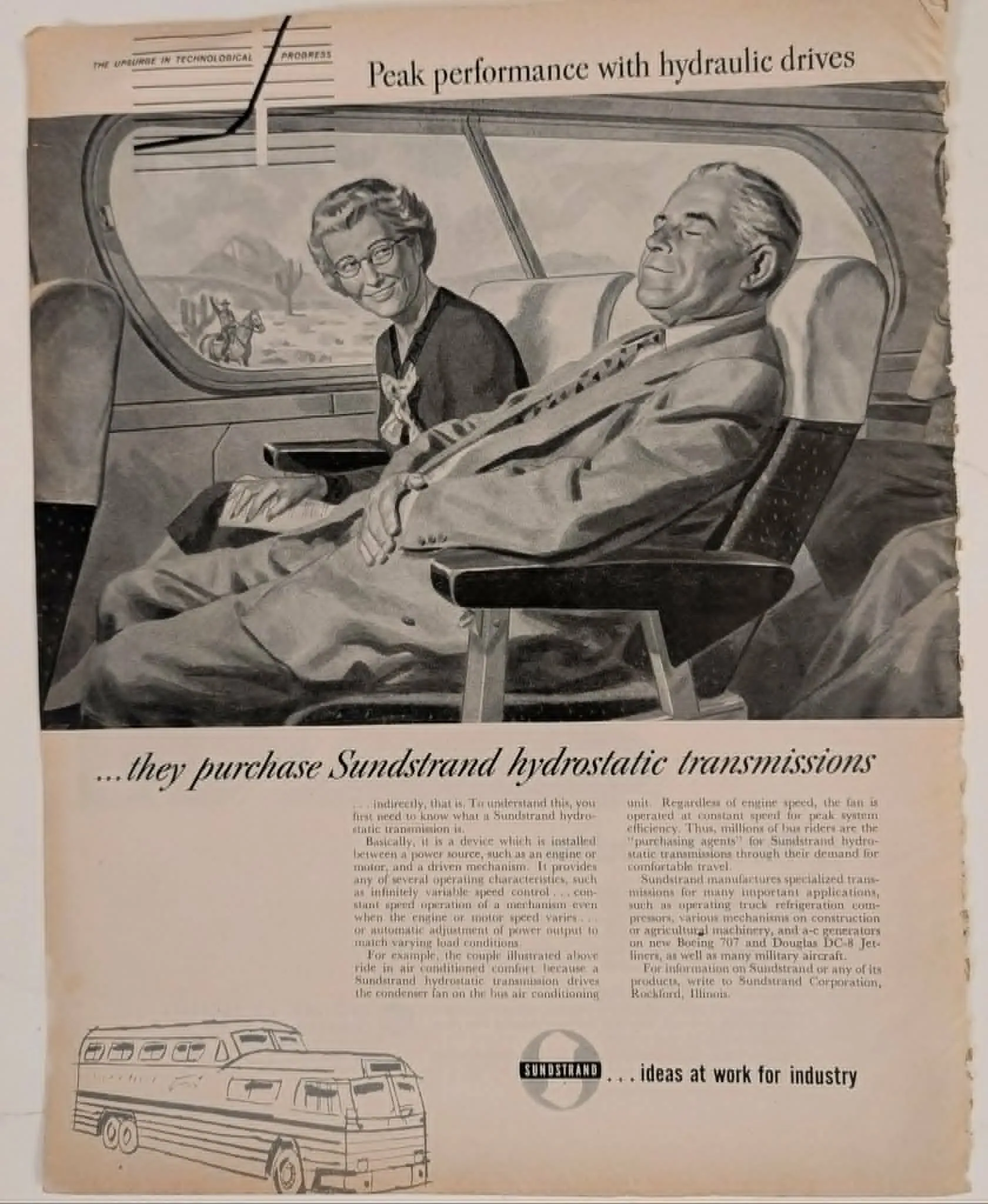
The world was once defined by its friction. To move was to endure. To travel was to submit to the brutal mechanics of the earth. The grinding of gears. The violent transfer of kinetic energy. The unforgiving reality of external thermodynamics. Then came the shift. This artifact, an archival imprint from the mid-twentieth century, documents the exact moment humanity decided to decouple itself from the environment. It is an advertisement for Sundstrand hydrostatic transmissions. On the surface, it is a pitch for a mechanical component. Beneath the ink, it is a manifesto of control. It highlights a problem: variable input creating variable output. A bus engine revs and idles; therefore, mechanical air conditioning fails when it is needed most. It provides the solution: fluid dynamics. By utilizing hydraulic drives, power could be transferred smoothly, infinitely, and independently of the source. The internal climate of the cabin was abruptly severed from the chaos of the engine and the hostility of the outside world. This is not just a commercial for industrial machinery. It is a chronicle of how we built moving fortresses of comfort, looking out at the harsh world from behind sealed glass.
Category: Technology
The History
The Era of Mechanical Brutality and the Post-War Surge To understand the artifact, we must first understand the landscape of motion before the widespread adoption of fluid power. In the first half of the twentieth century, power transmission was a violent affair. It relied on direct mechanical linkages. Belts snapped. Shafts vibrated. Gears stripped. If a mechanism required power from a primary engine, it was entirely at the mercy of that engine's revolutions per minute (RPM). Consider the artifact's primary example: a long-haul bus traversing a desert. Prior to advanced hydrostatic systems, the air conditioning compressor and condenser fans were often driven directly by the main engine via belts. When the bus accelerated down an open highway, the engine howled, the fans spun violently, and the cabin froze. But when the bus climbed a steep grade, or worse, idled in blistering heat, the engine RPM plummeted. The fans slowed down. The air conditioning ceased to function precisely when the passengers needed it most. The environment dictated the experience. Human comfort was a slave to mechanical limitation. The post-World War II era birthed a new philosophy. The upsurge in technological progress—literally graphed across the top left of this document—was not just about speed. It was about mastery. The creation of the Interstate Highway System in 1956 transformed the American continent. Travel was no longer an expedition; it was an expectation. And the expectation was absolute comfort. The Sundstrand Solution: The Architecture of Fluid Power Sundstrand Corporation, based in Rockford, Illinois, was not merely a parts manufacturer. They were architects of motion. Originally rooted in machine tools and milling, they recognized a fundamental truth: rigid connections break under variable stress. Their answer was the hydrostatic transmission. The engineering principle is elegantly simple, yet profoundly difficult to manufacture with precision. A hydrostatic transmission replaces physical gears and shafts with fluid. An engine drives a hydraulic pump. This pump forces pressurized hydraulic fluid through lines into a hydraulic motor, which then drives the secondary mechanism. The brilliance lies in the control mechanisms. By altering the displacement of the pump or the motor—changing how much fluid moves per revolution—the system can achieve infinitely variable speed control. Read the text of the artifact closely. "Regardless of engine speed, the fan is operated at constant speed for peak system efficiency." This is the historical shift. The Sundstrand drive acted as a mechanical translator. It absorbed the chaotic, fluctuating RPM of the bus engine and output a smooth, continuous, unchanging rotation for the cooling fan. It was a firewall against mechanical reality. Fluid power allowed the machine to think. It provided automatic adjustment of power output to match varying load conditions. It smoothed the harsh edges of physics. It made the internal environment immune to the external struggle of the vehicle. The Aerospace Connection: From the Stratosphere to the Asphalt The artifact does not limit its scope to terrestrial vehicles. It drops a crucial historical anchor in its copy: "a-c generators on new Boeing 707 and Douglas DC-8 Jetliners, as well as many military aircraft." This is where the technological gravity of the artifact truly rests. The late 1950s saw the dawn of the Jet Age. The Boeing 707 and the Douglas DC-8 revolutionized global transport. But jet engines presented a massive electrical problem. Jet engines operate across a massive range of speeds, from a slow idle on the tarmac to screaming maximum thrust during takeoff. Yet, the aircraft's critical instruments, lighting, and internal systems required alternating current (AC) electricity at a strict, unwavering frequency of exactly 400 Hertz. If the generator was attached directly to the jet engine, the frequency would fluctuate wildly, destroying the avionics. Sundstrand engineered the Constant Speed Drive (CSD). The CSD was essentially a highly advanced, ultra-precise hydrostatic transmission. It sat between the jet engine and the electrical generator. It took the wildly varying input speed of the jet turbine and, using hydraulic fluid and planetary gears, output a perfectly constant RPM to the generator. It was a miracle of mid-century engineering. The artifact is cross-pollinating this aerospace prestige with civilian infrastructure. By stating that the same fundamental fluid dynamics keeping a Boeing 707 aloft are keeping the bus passengers cool, Sundstrand elevates the mundane act of riding a bus into participation in the space-age technological vanguard. The passengers in the illustration are not just sitting in a bus; they are riding on the coattails of the military-industrial complex. The Societal Shift: The Window as a Cinema Screen Look at the illustration. An older, affluently dressed couple sits in deep, plush, reclining seats. They are the picture of mid-century American prosperity. The man rests with his eyes closed, hands folded peacefully over his stomach. The woman looks out the window with a serene, almost detached smile. Now, look at what she is observing. Framed in the ovular window—shaped intentionally like an airplane window or a television screen—is a rugged cowboy on horseback. He waves his hat against a backdrop of barren mountains, cracked earth, and towering saguaro cacti. This is the philosophical core of the artifact. The cowboy represents the past. He is exposed to the elements. He is hot, dusty, and subjected to the friction of the earth. His mode of transport is biological, unpredictable, and exhausting. The couple represents the future. They are encased in a mobile terrarium. The Sundstrand hydrostatic transmission driving the air conditioner has stripped the desert of its heat. The heavy glass has stripped the desert of its noise. The air ride suspension has stripped the desert of its roughness. To them, the desert is no longer a physical threat. It is a movie playing on a screen. It is entertainment. This marks a profound shift in human psychology. Technology had advanced to the point where the environment was commodified. Nature was conquered not by paving it over, but by moving through it in a hermetically sealed bubble. The harshness of the American West was reduced to scenery for the comfortable elite. The ad sells hydrostatic drives, but it promises invulnerability. The Graph of Limitless Optimism At the top left of the artifact, a bold black line cuts aggressively through horizontal rules. The text reads: "THE UPSURGE IN TECHNOLOGICAL PROGRESS". This graph has no axes. It has no numbers. It is purely symbolic. It represents the postwar American consciousness. Following the devastation of the 1940s, the 1950s and 1960s were defined by a belief in infinite upward trajectories. Technology would solve all ailments. Chemistry would conquer disease. Physics would conquer gravity. Hydraulics would conquer friction. The sharp, almost violent upward angle of the line—breaking the neat borders of the design—shows that progress cannot be contained. Sundstrand positions itself not as a follower of this line, but as the engine driving it upward. The line forces the viewer's eye directly into the headline: "Peak performance with hydraulic drives". It is a masterpiece of psychological alignment. Buying a Sundstrand product is not a mere procurement decision; it is an alignment with the inevitable upward march of human history.
The Paper
This artifact is a physical manifestation of the era it represents. Printed on mid-weight, machine-finished magazine stock, it carries a distinct GSM (Grams per Square Meter) typical of late-1950s industrial trade publications. The printing method is a classic web offset lithography. Upon close inspection, the halftone dot pattern is clearly visible, especially in the shading of the man's suit and the desert landscape. The halftone process deconstructs continuous tones into thousands of tiny black dots of varying sizes, relying on the human eye to blend them into a coherent image. It is an optical illusion, much like the illusion of stillness the bus passengers experience while hurtling down a highway. The aging process—the slow oxidation of the lignin within the wood pulp—has shifted the paper from its original bright white to a warm, mottled sepia. This chemical degradation serves as a silent clock, recording the passage of decades. The artifact is a physical vessel of time. The edges are frayed. The paper is brittle. The medium is decaying, even as the technological triumph it advertises has become permanently embedded in our modern infrastructure.
The Rarity
Classification: Class A This document is not unique. It was likely printed in tens of thousands of trade magazines—perhaps Aviation Week, Commercial Car Journal, or Fleet Owner. It was designed to be consumed by purchasing agents and then discarded. However, its rarity lies entirely in its contextual value. It is a perfect, unblemished fossil of a specific transitional moment in engineering history. Finding an advertisement that so seamlessly connects heavy truck refrigeration, military aerospace constant speed drives, and the sociological phenomenon of the comfortable American road trip is rare. It is a Class A artifact because it acts as a Rosetta Stone, translating complex mid-century fluid dynamics into accessible consumer desires. Its value is not monetary; it is deeply educational.
Cite this article
- MLA
- Naodhinsuk, Ronin. “The Time Traveller's Dossier : Sundstrand Hydraulics - Engineering Comfort.” The Record Institute, 7 June 2026, https://therecord.institute/journal/the-time-travellers-dossier-sundstrand-hydraulics-engineering-comfort.
- APA
- Naodhinsuk, R. (2026, June 7). The Time Traveller's Dossier : Sundstrand Hydraulics - Engineering Comfort. The Record Institute. https://therecord.institute/journal/the-time-travellers-dossier-sundstrand-hydraulics-engineering-comfort
- CHICAGO
- Naodhinsuk, Ronin. 2026. “The Time Traveller's Dossier : Sundstrand Hydraulics - Engineering Comfort.” The Record Institute, June 7, 2026. https://therecord.institute/journal/the-time-travellers-dossier-sundstrand-hydraulics-engineering-comfort.