The Time Traveller's Dossier : T Adams - Commodifying Belief
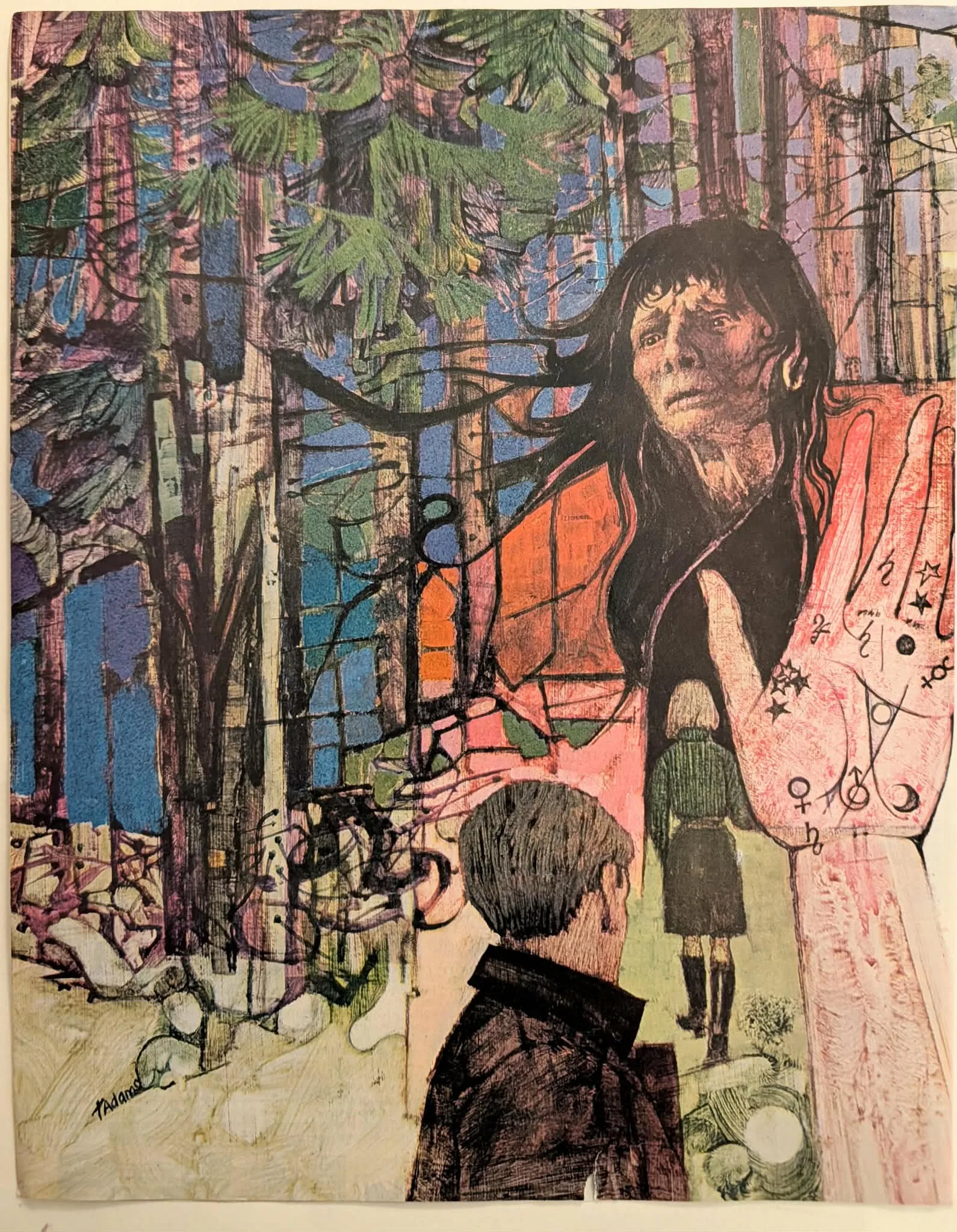
The artifact before us is a terminal point. It is a recording of a profound societal disorientation. A physical memory of the exact moment sacred knowledge became mass culture. Prior to this era, illustration served two masters. It was either the sanitized, hyper-real idealism of mid-century advertising. Or it was the sterile, academic abstraction of the modernists. This artifact rejects both. It embraces complexity. It demands interpretation. We are observing a scene of fracture. A massive, disembodied hand, tattooed with the ancient symbols of alchemy and astrology, dominates the frame. It is a heavy, ancient presence. Beside it, a crone representing weary tradition stares into the void. Yet, the modern world—a young woman in a green turtleneck—turns her back. She walks away toward a fragmented, geometric forest. She leaves the old magic behind. In the foreground, an observer watches. Passive. Disconnected. Consuming the scene without participating. He is the surrogate for the modern viewer. This is the Shift. The esoteric was no longer a hidden, lifelong pursuit. It was a flattened image on a page. A domesticated aesthetic for a counter-culture desperately seeking meaning in an industrialized world. It is the ultimate paradox. The mass production of the mystical.
Category: Other
The History
This illustration, etched onto a textured paper substrate that has absorbed decades of oxygen, operates as a highly sensitive cultural recording device. It captures the complex, roiling, and unstable landscape of its time. While specific publication metadata may be lost to the attrition of archiving, the artifact’s internal vectors—its stylistic clash, its symbolic weight, its composition, and its printing technology—all point to a critical inflection point in the chronological timeline. This is the boundary layer between the late 1960s and the early 1970s. To analyze this piece is to analyze a cultural earthquake. It is the visual documentation of a society losing its unified narrative. Engineering the Aesthetic: The Technical Clash The stylistic engineering of this piece is its first, most profound layer of historical data. The work is an aggressive masterclass in hybrid technique, forcing incompatible visual languages to occupy the same space. Observe the linework. We see extensive, punishingly detailed fine-line cross-hatching. This is a method traditionally reserved for centuries-old black-and-white etchings. It mimics the deep, laborious precision of Renaissance woodcuts or Victorian steel engravings. This methodical hand implies ancient authority. It builds deep, traumatic shadows into the face of the elder woman. It gives weight and biological reality to the skin of the massive hand. It is a slow, analog technique that requires immense discipline. Yet, this archaic, disciplined texture is violently layered over flat, vibrant fields of industrial color. This is where the technological and cultural clash is made visual. The primary background is not a naturalistic forest. It is a fragmented, cross-sectioned grid of synthetic color. We see vibrant cyan blues, deep purples, and jarring, flat fields of orange and pink. This background layout mimics the aesthetics of modern abstract painting, architectural blueprints, or early computer punch-cards. It takes the organic world—the trees, the sky—and imposes a rigid, technical structure upon them. The artists of the previous generation would have painted this forest with romantic realism. T Adams does not. They engineer a fractured environment. It is the natural world perceived through the overwhelming, fragmented lens of mass media and early information technology. Furthermore, the composition is strikingly modular. The rigid separation of the foreground figures, the dominant floating hand, and the geometric background grid do not blend organically. Instead, they exist as strictly defined, distinct visual strata. This heavily layered architecture behaves less like a traditional flat painting and more like the separate, suspended celluloid layers of 2D animation. It is a static image that practically demands to be pushed into kinetic space. The disparate elements are structurally primed to slide across each other. The artifact feels as though it is waiting to be digitized, separated by a modern hand, and set into motion—translating the static, printed anxiety of the 1970s into a fluid, animated sequence for a contemporary audience. The potential energy is entirely kinetic. The Lexicon of the Hand: Commodifying the Sacred The visual core of this artifact is not the humans. It is the massive, dominant, pink-red hand. It is not a natural appendage attached to a body. It is a graphic construct. It is an intrusion. It is overlaid with aggressive, black line-work symbols. These symbols are not decorative; they are specific data points pulled from planetary, zodiacal, and alchemical traditions. We can systematically decode this esoteric lexicon. There are stars, representing general illumination or cosmic destiny. There is the symbol for Sol, the central dark circle, representing vital force and consciousness. We see Luna, the crescent, representing the unconscious and intuition. The symbol of Venus, beauty and attraction, sits prominently on the wrist. Mars, the arrow of aggression and kinetic energy, points downward. The stylized crosses of Saturn and Jupiter denote time, restriction, and expansive sovereignty. The winged cross of Mercury sits near the top, governing communication and synthesis. This hand is a compact, highly engineered data packet. It represents deeply traditional, ritual-based belief systems: astrology, alchemy, chiromancy. Prior to this historical moment, these systems were largely occult. They were hidden. They were private. They required years of intense study within closed traditions. The Shift recorded by this artifact is the aggressive commercialization and simplification of that belief. During the counter-culture boom of this era, these ancient systems were dragged into the glaring light of mass media. They were popularized. Most importantly, they were domesticated. They ceased to be rigorous systems of philosophical belief and became accessible, aesthetic signs. They were stripped of their terrifying depths and printed on mass-market posters, clothing, and editorial illustration pages just like this one. T Adams’ image visualizes this transition with ruthless clarity. It takes the esoteric and violently forces it into a mundane, modern context. The hand is large not simply because it is powerful, but because it is demanding to be seen. This image makes the hidden visible. It records the new societal expectation that all knowledge, no matter how ancient or sacred, should be instantly accessible, easily consumable, and visually striking, even if it is completely stripped of its original context. The Societal Fracture: Disorientation and Departure The human figures in this tableau do not interact with one another. They exist in isolated psychological silos, recording the profound emotional impact of this cultural Shift. We are observing the visualization of societal fragmentation. The central figure is the wild-haired, deeply lined elder woman. She is directly adjacent to the esoteric hand, almost merging with it. Yet, she wears an expression of profound, distant worry. She looks entirely past the hand. She looks past the viewer. She represents the crushing weight of tradition, or perhaps the immense fatigue of carrying ancient burdens into a world that no longer understands them. Her identity is intentionally archetypal. She is the embodiment of weary, obsolete wisdom. In stark contrast, a second female figure walks directly away from the scene. She is dressed in a modern, utilitarian green ribbed turtleneck, a dark skirt, and heavy boots. She is the embodiment of the contemporary era. She is active. She is mobile. She is leaving the ancient symbols and the weary crone behind. She walks toward a distant, fragmented patch of green light. She represents a society turning its back on complex historical narratives in search of simple, immediate, and modern progress. The old ways remain large and imposing, but they have lost their gravitational pull on the youth. Finally, the third figure anchors the composition. It is a man in a heavy, modern brown jacket, positioned in the lower foreground. His back is partially turned to us. He is observing the elder woman and the floating hand. But his posture is entirely passive. He is disconnected. He is not a participant in the magic, nor is he fleeing like the young woman. He is simply consuming the scene as a detached observer. This composition is a flawless recording of disorientation. The old ways are prominent but exhausted. The future is actively walking away. The present is left to simply watch the collision. It is a perfect tableau of a society that has lost its unified center. It is experimenting with recycled ancient signs while marching blindly into a mechanized future, resulting in a deeply fractured psychological environment. The Economic Vector: Industrial Printing and Demand The very existence of this illustration on this specific paper stock implies a massive economic and technical Shift. This was an era where the mechanics of publication were rapidly converging with new cultural appetites. Improved offset lithography and massive, high-speed rotary presses made the distribution of high-quality, complex color printing economically viable for mainstream magazines. At the same time, editors and advertisers were facing existential threats from television. To compete, print media required denser, more complex, and more provocative visual content. The artist was a beneficiary of this specific economic vector. Publishers actively demanded complexity to capture the wandering attention of a fractured public. The time-intensive cross-hatching technique—which would have been deemed too expensive or too dark for the optimistic magazines of the 1950s—was now actively commissioned for industrial mass culture. This artifact marks the death of the illustrator as a mere decorator. It signals the rise of the illustrator as an intellectual commentator. This image argues a complex thesis: that the world is broken, and that ancient belief is now just another mass-culture commodity. This level of dense, symbolic discourse was only possible because the economic engines of printing demanded it.
The Paper
We must examine the physical substrate. It is the artifact's biological memory. The physical medium that recorded the friction of time. This specific page displays the undeniable texture of its era. It is an off-white, slightly warm-toned stock. Estimated mass: roughly 120 to 140 GSM (Grams per Square Meter). This density implies a deliberate substantiality. It was not cheap, disposable newspaper pulp intended for a single day's use. It was a high-quality, likely machine-glazed book paper or a premium editorial magazine stock, designed to hold ink with precision and endure handling. We observe the physical decay of the analog age. The minute paper fibers are visible. The surface is slightly rough, creating a micro-texture that interacts with the light. This is not a digital artifact; it is a physical body. The wood pulp has undergone slow, inevitable oxidation, resulting in the natural ambering—the slight yellowing—that visually maps the passage of decades. The printing methodology is clearly offset lithography. When we analyze the CMYK process visually, we see that the primary colors—the aggressive magenta in the hand and the synthetic cyan in the background grid—are not perfectly solid fields. They exhibit the characteristic offset dot matrix structure. However, the key black line-work—the meticulous cross-hatching—is sharply defined. It sits distinctly and aggressively atop the colored fields. This specific, semi-porous paper chemistry was critical to the final psychological effect. It allowed the wet, fine lines of the artist's ink to maintain their razor-sharp definition without bleeding outward into the fibers. Simultaneously, the rough texture of the paper broke up the flat fields of the colored ink, giving the massive red hand a distressed, raw, almost violently screen-printed appearance. This precise, microscopic interaction of wood pulp, chemical ink, and atmospheric oxidation is the unforgeable fingerprint of a bygone era.
The Rarity
Within the archives, rarity is never merely a function of auction house economics or market demand. It is strictly a measure of historical significance, preservation status, and unique contextual value. The image itself was likely reproduced in a run of thousands, perhaps tens of thousands, depending on the circulation of the host publication. However, a specific, physically well-preserved page that has survived the brutal entropy of fifty years—avoiding moisture, sunlight, and disposal—is exceptionally rare. Its Class S designation stems from its status as a 'perfect recording synthesis'. It represents a technical rarity, successfully merging the contradictory languages of fine-line etching and flat psychedelic color. It represents a thematic rarity, offering a multi-layered philosophical critique of the commodification of the occult, rather than simply exploiting it for shock value. Finally, its physical preservation allows us to read the original intent of the press registration and the texture of the historical substrate. It is an invaluable data point proving that an entire society was once deeply, beautifully lost.
Cite this article
- MLA
- Naodhinsuk, Ronin. “The Time Traveller's Dossier : T Adams - Commodifying Belief.” The Record Institute, 19 July 2026, https://therecord.institute/journal/the-time-travellers-dossier-t-adams-commodifying-belief.
- APA
- Naodhinsuk, R. (2026, July 19). The Time Traveller's Dossier : T Adams - Commodifying Belief. The Record Institute. https://therecord.institute/journal/the-time-travellers-dossier-t-adams-commodifying-belief
- CHICAGO
- Naodhinsuk, Ronin. 2026. “The Time Traveller's Dossier : T Adams - Commodifying Belief.” The Record Institute, July 19, 2026. https://therecord.institute/journal/the-time-travellers-dossier-t-adams-commodifying-belief.