The Time Traveller's Dossier : Thai Airways Fleet - Industrial Scale
Then, commercial aviation sold the destination. Advertisements depicted exotic beaches, ancient temples, and smiling stewardesses serving champagne. Flight was marketed as a romantic, leisurely endeavor. The airplane itself was merely a vessel. The focus was on the human experience of travel. Now, aviation operates on ruthless operational efficiency. We are sold algorithmic punctuality, automated check-ins, and carbon offset calculations. The romance has been systematically stripped away, replaced by the cold mathematics of route optimization and load factors. Between these two eras, a distinct and aggressive battle raged. This artifact documents that exact transition. It marks the precise historical moment an Asian carrier stopped asking for permission from the established Western monopolies. They ceased selling mere hospitality. Instead, they projected absolute, intimidating mechanical scale. This is the shift from "service provider" to "geopolitical heavyweight." They did not sell a holiday. They sold an industrial arsenal.
Category: Travel
The History
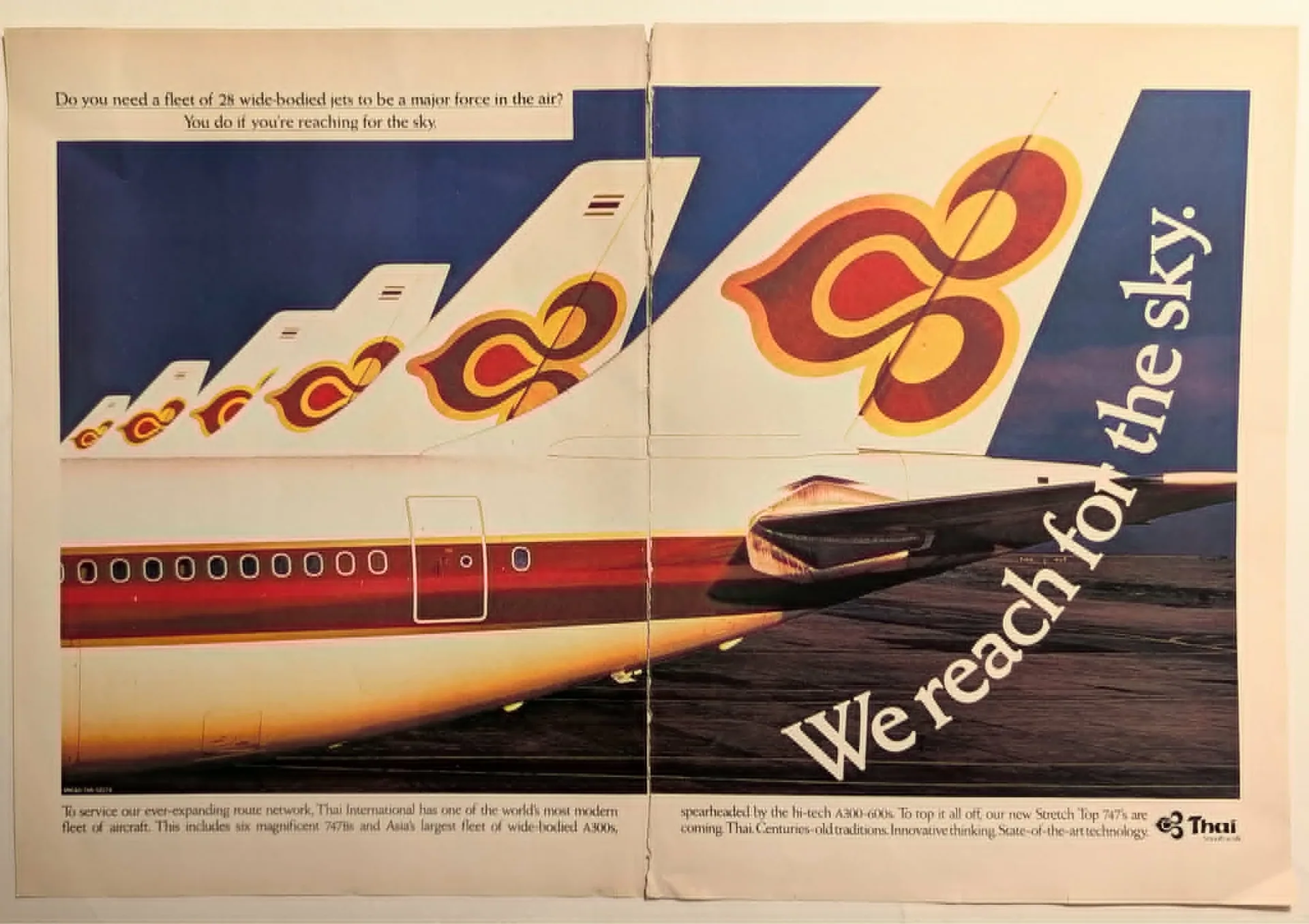
The End of Western Hegemony in the Sky To fully grasp the profound weight of this artifact, one must analyze the geopolitical landscape of the late twentieth century. For decades, the global skies were overwhelmingly dominated by Western legacy carriers. Airlines like Pan American World Airways, British Airways, and Air France dictated the rules of international transit. They possessed the capital. They controlled the primary hubs. They owned the narrative of global connectivity. Asian airlines, during their nascent stages, were often relegated to regional feeder status. When they did advertise internationally, they relied almost entirely on the cultural trope of subservient hospitality. They sold silk uniforms, ancient smiles, and graceful service. They competed on the softness of their culture because they could not yet compete on the hardness of their steel. This specific advertisement obliterates that paradigm. It is a declaration of industrial independence. By boldly questioning, "Do you need a fleet of 28 wide-bodied jets to be a major force in the air?", Thai Airways reframed the entire competitive landscape. The operative word is "force." They did not refer to themselves as a major "choice" or a major "option." They used military terminology. A "force" is something that exerts undeniable physical pressure. It demands recognition. The Arsenal of Heavy Metal The text explicitly highlights "six magnificent 747Bs and Asia's largest fleet of wide-bodied A300s, spearheaded by the hi-tech A300-600s." This is not a casual listing of inventory. It is a calculated display of vast economic leverage. In the late 1980s, acquiring a single wide-body aircraft was a massive capital expenditure, often requiring complex sovereign debt structuring. To possess twenty-eight of them was an astronomical flex of national wealth. It signaled the arrival of the Asian Economic Miracle. The economies of the East were exploding with newfound manufacturing and financial power. The Boeing 747 was the undisputed Queen of the Skies, a symbol of ultimate long-haul dominance. The Airbus A300-600 represented the bleeding edge of twin-engine, high-capacity efficiency. By boasting about owning Asia's largest fleet of the latter, Thai Airways was telling the corporate traveler that they were not just culturally refined, but technologically superior. They were stating that the axis of global commerce was physically shifting toward Bangkok. The copy concludes with a triad of promises: "Centuries-old traditions. Innovative thinking. State-of-the-art technology." This is the ultimate synthesis. They weaponized their heritage, packaging it alongside billions of dollars of high-grade aerospace aluminum and jet fuel. The Analog Illusion of Infinity We must address the visual engineering of the artifact itself. The image displays a perfect, infinite regression of Thai Airways tail fins lined up on a tarmac. In our current post-digital era, generating this image would take a moderately skilled artist mere minutes using cloning tools in Adobe Photoshop. The replication of pixels is computationally cheap. But in the era of this artifact's creation, digital image manipulation of this caliber for print resolution did not exist. This image is a masterclass in analog deception. It is a physical impossibility to line up that many wide-body jets in such perfect, mathematically precise geometric succession. Furthermore, committing that many revenue-generating assets to sit idle on a runway solely for a photoshoot would be an operational and financial disaster. Therefore, this image was constructed by human hands in a darkroom or on a drafting table. It required a master compositor to painstakingly cut, scale, and paste photographic elements. The subtle shift in atmospheric perspective—the way the furthest tails fade into the hazy blue—had to be manually airbrushed or manipulated through chemical exposure. The alignment of the iconic 'champa' flower logo on each tail fin required obsessive geometric precision. Every edge, every shadow, every reflection on the polished metal fuselage was a deliberate, irreversible physical action. It is a monument to the patience and absolute mastery of pre-digital commercial art. The Strategic Dissonance The artifact contains a fascinating psychological friction. Examine the typography at the very bottom right. Nestled beneath the bold corporate logo is the legendary tagline: "Smooth as silk." This phrase evokes softness, gentleness, and effortless grace. Yet, it is visually crushed beneath the overwhelming, heavy-metal mass of twenty-eight industrial jetliners. This is strategic dissonance. The airline understood that global business travelers required two conflicting assurances. First, they needed the absolute certainty that the machine carrying them across oceans was part of a massive, well-capitalized, technologically flawless operation. The image of the fleet provides this mechanical reassurance. Second, they needed the psychological comfort of high-touch human care once inside the metal tube. The tagline provides this emotional reassurance. The artifact successfully balances the terrifying scale of modern aviation with the comforting intimacy of human hospitality. It is a flawlessly executed psychological trap. It captures the mind with volume, and soothes the anxiety with silk.
The Paper
The physical artifact bears the unmistakable scars of its medium and its era. This is a two-page centerfold spread, brutally interrupted by the vertical staple crease running down its exact center. This physical division fundamentally shatters the illusion of the infinite sky, reminding us of its existence as a mass-produced magazine insert. The paper stock appears to be a medium-weight, lightly coated gloss. Under macro-inspection of the deep indigo sky and the vibrant magenta of the logo, the mechanical truth is revealed: the CMYK (Cyan, Magenta, Yellow, and Key/Black) halftone rosette pattern. The continuous tones of a sunset are actually an optical illusion, formed by thousands of microscopic, overlapping dots of ink pressed into paper fibers by industrial steel rollers. At the bottom left, the agency tracking code "MNC&H/THA/5227 B" is stamped. This string of alphanumeric characters is the artifact's DNA. It strips away the romance of the imagery and exposes it as a calculated, cataloged corporate asset. The edges show mild oxidation, a slow chemical burning of the paper's lignin reacting with decades of ambient light. It is a physical clock, quietly recording the passage of time.
The Rarity
Archival Classification: Class S (Historical Paradigm Shift & Analog Zenith) While vintage airline ephemera is heavily traded in antiquarian markets, two-page centerfold spreads from this specific era of aggressive Asian aviation expansion are increasingly scarce. They were designed to be consumed rapidly and discarded with the month's recycling. However, its true rarity is dictated entirely by its contextual value. It documents the exact pivot point where the marketing of commercial flight shifted from selling cultural hospitality to selling raw industrial scale and technological hegemony. It is a museum-grade specimen of late-twentieth-century corporate warfare, executed through masterful analog photo-compositing.
Cite this article
- MLA
- Naodhinsuk, Ronin. “The Time Traveller's Dossier : Thai Airways Fleet - Industrial Scale.” The Record Institute, 23 June 2026, https://therecord.institute/journal/the-time-travellers-dossier-thai-airways-fleet-industrial-scale.
- APA
- Naodhinsuk, R. (2026, June 23). The Time Traveller's Dossier : Thai Airways Fleet - Industrial Scale. The Record Institute. https://therecord.institute/journal/the-time-travellers-dossier-thai-airways-fleet-industrial-scale
- CHICAGO
- Naodhinsuk, Ronin. 2026. “The Time Traveller's Dossier : Thai Airways Fleet - Industrial Scale.” The Record Institute, June 23, 2026. https://therecord.institute/journal/the-time-travellers-dossier-thai-airways-fleet-industrial-scale.