The Time Traveller's Dossier : THE CLUB Whiskey Sour (1975) - The Birth of Portable Escapism
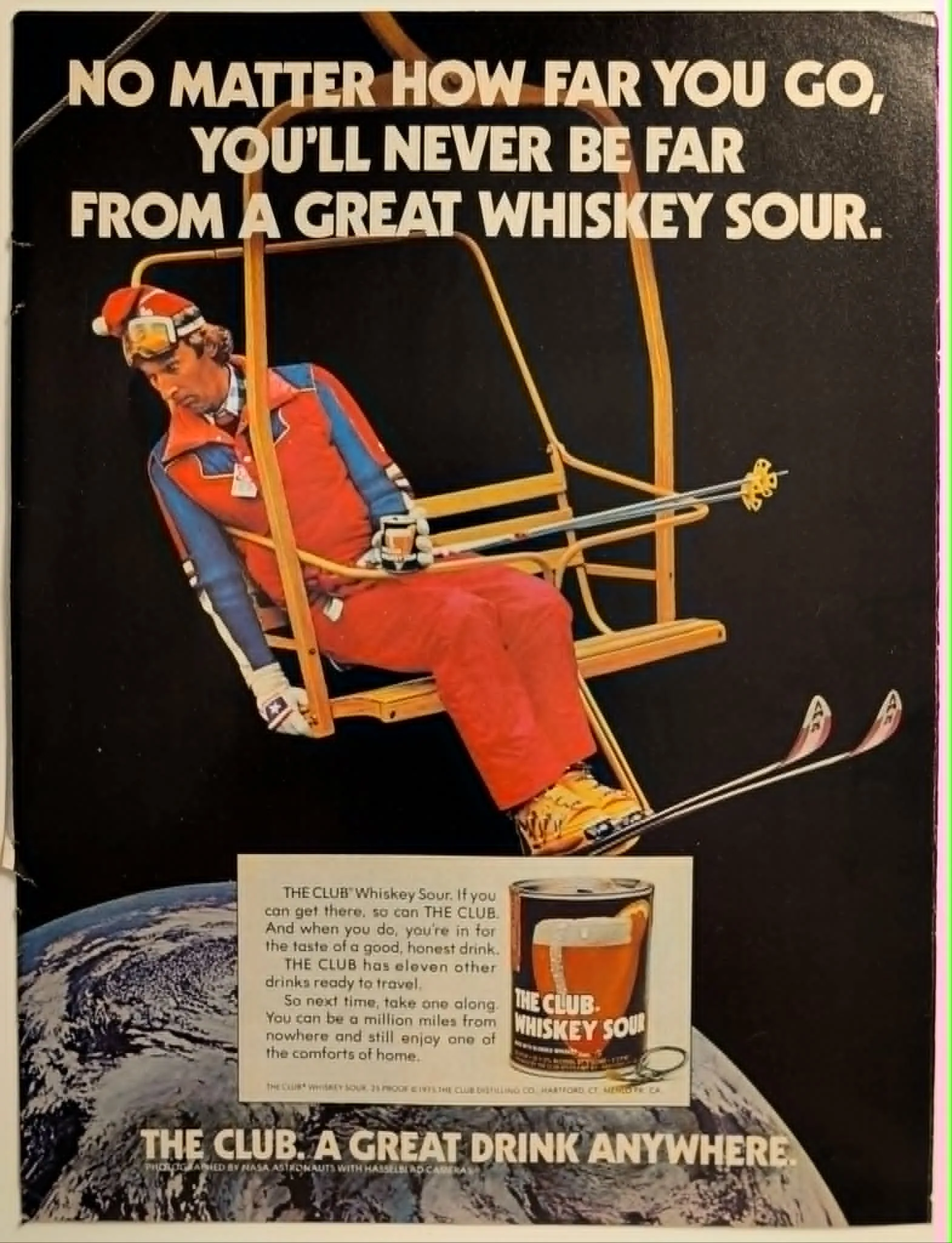
Then, the cocktail was a tether. It demanded geography. It required the architecture of a lounge, the alchemy of a mixologist, and the fragile vessel of glass. To consume a Whiskey Sour was to remain stationary. The world moved outside, but the drinker was anchored to the barstool. Now, convenience is an invisible architecture. We expect our indulgences to follow us seamlessly into the wild, into the air, into the void. We take the ready-to-drink (RTD) beverage for granted. We have forgotten the friction of the past. This artifact, born in 1975, is the visual documentation of a paradigm shift. It is the exact moment when the beverage industry looked at the limitations of terrestrial geography and chose to ignore them entirely. The ad does not sell alcohol; it sells extreme, unbothered autonomy. By placing a skier in the vacuum of space, dangling above the Earth's curvature with a canned cocktail in hand, the artifact solves the problem of "the tethered experience." It proposes a new human condition: You are no longer bound to the bar. The luxury travels with you. The universe is merely a backdrop for your leisure.
Category: Beverage
The History
The Commercialization of the Cosmos The year is 1975. The Apollo era is concluding with the Apollo-Soyuz Test Project, marking the end of the furious, politically charged Space Race. The cosmos, once a terrifying frontier of Cold War anxiety and existential dread, has been conquered, documented, and delivered to the living rooms of the American public. Space was no longer just for the astronaut; it was entering the public subconscious as a domain of eventual human habitation. Simultaneously, the United States was navigating a complex terrestrial reality. The post-Vietnam era was defined by economic stagflation, the energy crisis, and a profound cultural exhaustion. The population sought escapism. They did not want to solve the world's problems; they wanted to float above them. This advertisement taps directly into that psychological yearning. It utilizes actual photography captured by NASA astronauts using Hasselblad medium-format cameras. This is a critical detail. The awe-inspiring, paradigm-shifting image of the "Blue Marble"—a perspective that was meant to humble humanity by showing our fragile existence—is repurposed here as a literal billboard for a 25-proof canned beverage. It represents the ultimate triumph of 1970s American capitalism: the commodification of the sublime. The infinite void is reduced to a ski resort. The Engineering: Capturing Alchemy in Aluminum Before we analyze the cultural impact, we must analyze the technological triumph required to make this artifact possible. The concept of the "Ready-to-Drink" canned cocktail was an engineering nightmare in the mid-20th century. A true Whiskey Sour requires a delicate pH balance. The citric acid of the lemon, the aggressive ethanol of the blended whiskey, and the sugars must coexist. Placing this volatile, acidic mixture into a standard steel or early aluminum can would, historically, result in a catastrophic metallic degradation. The acid would eat the lining, tainting the flavor and compromising the vessel. THE CLUB Distilling Co., based in Hartford, Connecticut, had to utilize advanced epoxy-phenolic interior coatings for their aluminum cans. This microscopic barrier was the unsung hero of the era, a technological leap that prevented the drink from tasting like a battery. Furthermore, consider the delivery mechanism. The can features the classic, now-obsolete pull-tab (ring-pull) opening mechanism. Invented in the 1960s, it reached peak ubiquity in the 1970s. It was a mechanism of instant gratification. No churchkey. No opener. The user merely pulled the ring, breaking the scored aluminum with a sharp snap, releasing the pressurized aroma. This engineering allowed for the total democratization of the cocktail. You did not need a bartender to measure the 12-1/2% alcohol by volume. The science had already done the measuring. The Message: Absurdism and The Sovereign Consumer "NO MATTER HOW FAR YOU GO, YOU'LL NEVER BE FAR FROM A GREAT WHISKEY SOUR." The copy is an exercise in commanding brevity. It does not beg the consumer to buy the drink. It states a universal law. The visual narrative relies on deadpan absurdism. The skier is not in a spacesuit. He wears a standard 1970s quilted ski jacket—bold red and blue panels—complete with a pom-pom beanie, goggles, and leather gloves. He sits on a standard yellow chairlift. He is casually glancing down at the Earth, holding his canned drink with the profound boredom of a man commuting to work. This is the message: Absolute consumer sovereignty. The artifact communicates that extreme environments do not require extreme sacrifices. The skier represents the affluent, mobile, leisure-class consumer of the 1970s. Skiing was the ultimate status symbol of the era, an expensive sport requiring specialized gear and travel. By placing the skier in space, the advertisement elevates terrestrial leisure to a cosmic scale. "If you can get there, so can THE CLUB." The product promises that your lifestyle will never be compromised by your coordinates. The Competitors and The Economic Landscape In 1975, the liquor industry was dominated by heavy, glass-bound tradition. Giants like Smirnoff, Bacardi, and Jack Daniel's sold raw ingredients. You bought the bottle, but you had to build the drink. The RTD market was viewed with intense skepticism by the establishment. Canned cocktails were largely perceived as low-brow, a gimmick for the unrefined palate. THE CLUB faced the monumental task of shifting this perception. How do you convince the middle-class aspirational drinker that a canned Whiskey Sour is acceptable? You associate it with the highest technological achievements of mankind. You associate it with extreme sports. You associate it with NASA. While traditional whiskey brands were showing men in leather armchairs sitting by fireplaces, THE CLUB showed a man suspended in the stratosphere. They did not compete on flavor alone; they competed on context. They bypassed the traditional cocktail hour entirely and created a new consumption occasion: the remote wilderness, the ski slope, the boat, the void. The Historical Shift: The Untethered Experience This advertisement marks a definitive pivot in the anthropology of consumption. Prior to this era, the location dictated the experience. You went to a French restaurant to drink French wine. You went to a cocktail lounge to drink a Whiskey Sour. The geography held the power. This artifact documents the reversal of that power dynamic. The object now travels with the subject. The canned cocktail was a precursor to the Walkman, the smartphone, and the modern digital nomad lifestyle. It is the physical manifestation of the idea that comfort, luxury, and dopamine should be portable. The historical shift is profound: Humanity moved from adapting to their environment, to carrying their preferred environment with them in an 8-ounce aluminum can. The ad is a manifesto for the untethered life. The bar is dead. The world is the bar.
The Paper
This artifact exists on standard consumer magazine stock of the mid-1970s. It is likely a 70 to 80 GSM (Grams per Square Meter) lightweight coated web offset paper. The printing process is 4-color CMYK web offset lithography. Under macro-inspection, the imagery—particularly the stark contrast between the blackness of space and the Earth's atmosphere—is constructed of interlocking cyan, magenta, yellow, and black halftone rosettes. The black background is not a solid dye; it is a dense layering of ink meant to simulate the infinite void. The aging process tells a story of chemical degradation. The paper exhibits mild foxing and a distinct yellow shift, particularly noticeable in the white text block at the bottom. This is due to the lignin in the mechanical pulp oxidizing over five decades of exposure to ultraviolet light and atmospheric moisture. The ink, particularly the vibrant reds of the skier's jacket and the orange on the can, has maintained its saturation remarkably well, indicating a high petroleum-base in the 1970s ink formulation. The paper is no longer just a medium; it is a clock, recording the slow oxidation of the era it represents.
The Rarity
Classification: Class A (High Contextual Value) In terms of physical scarcity, magazine clippings from 1975 are not exceptionally rare. Millions of these pages were printed. However, the artifact is elevated to Class A based purely on its contextual and historical significance. Finding an advertisement that legitimately bridges NASA's lunar photography with mid-century liquor marketing is a bizarre anomaly in advertising history. It possesses immense value for archivists studying the commercialization of the Space Race, the history of RTD beverage engineering, and the psychological marketing tactics of the post-Apollo era. Its value is not measured in auction prices, but in its weight as a primary source of 1970s techno-optimism.
Cite this article
- MLA
- Naodhinsuk, Ronin. “The Time Traveller's Dossier : THE CLUB Whiskey Sour (1975) - The Birth of Portable Escapism.” The Record Institute, 11 June 2026, https://therecord.institute/journal/the-time-travellers-dossier-the-club-whiskey-sour-1975-the-birth-of-portable-escapism.
- APA
- Naodhinsuk, R. (2026, June 11). The Time Traveller's Dossier : THE CLUB Whiskey Sour (1975) - The Birth of Portable Escapism. The Record Institute. https://therecord.institute/journal/the-time-travellers-dossier-the-club-whiskey-sour-1975-the-birth-of-portable-escapism
- CHICAGO
- Naodhinsuk, Ronin. 2026. “The Time Traveller's Dossier : THE CLUB Whiskey Sour (1975) - The Birth of Portable Escapism.” The Record Institute, June 11, 2026. https://therecord.institute/journal/the-time-travellers-dossier-the-club-whiskey-sour-1975-the-birth-of-portable-escapism.