The Time Traveller's Dossier: The Color Revolution – The 1968 Zenith Handcrafted Golden Jubilee and the Generational Shift in Consumer Electronics
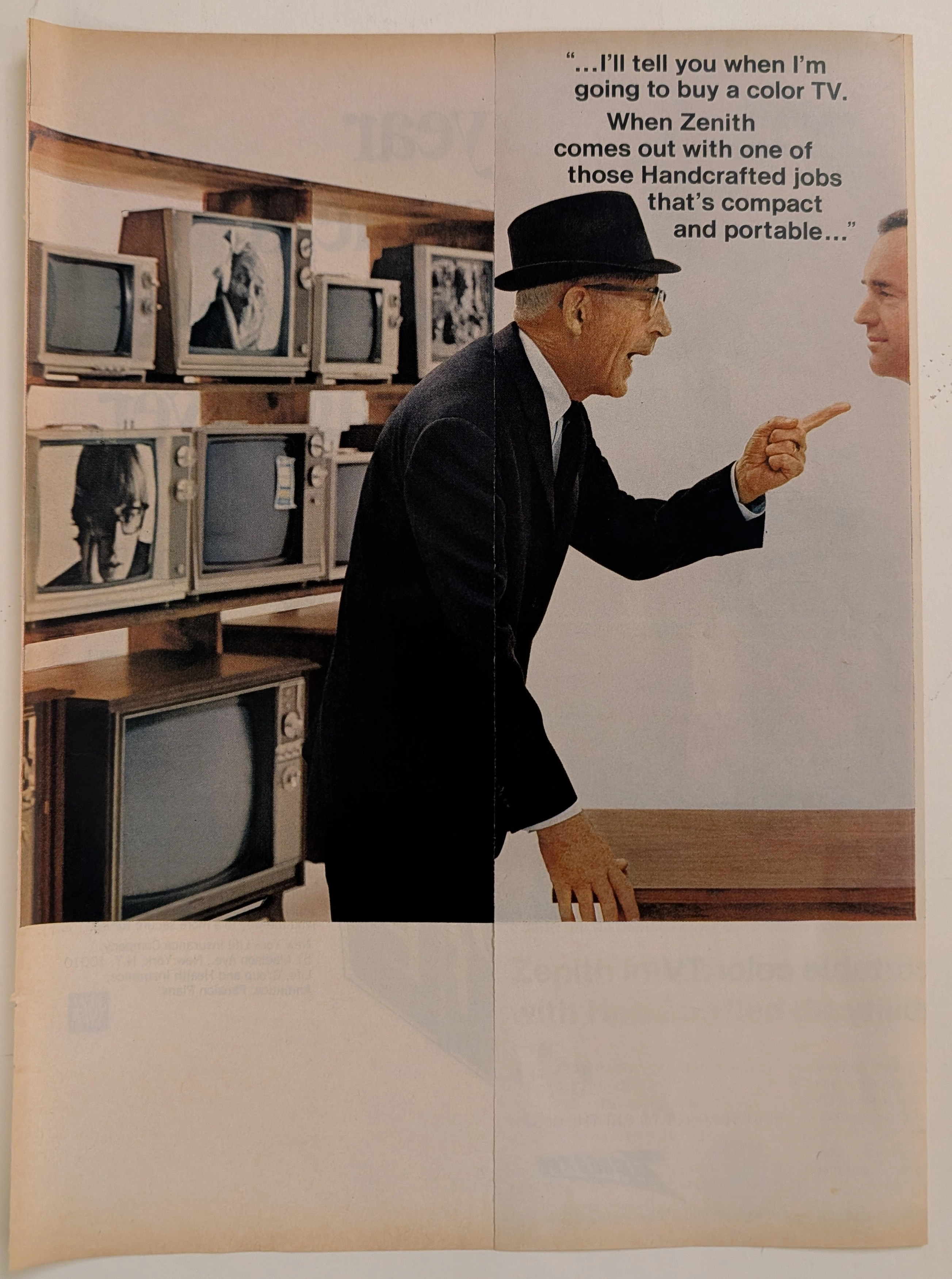
The evolution of the mid-twentieth-century American living room was fundamentally defined by the rapid, fiercely competitive technological arms race in consumer electronics. The historical artifact elegantly and securely positioned upon the analytical table of The Record Institute today is a striking, two-page centerfold print advertisement for the 1968 Zenith 14" Portable Color TV, originating from a highly transformative era in global broadcasting. This document completely transcends the standard, utilitarian boundaries of appliance marketing. It operates as a highly sophisticated, multi-layered cultural mirror, reflecting the precise era when American manufacturers had to psychologically persuade a cautious, older generation to adopt a radically new, expensive technology by anchoring it to traditional concepts of craftsmanship and reliability. This world-class, comprehensive dossier conducts a meticulous, unyielding, and exceptionally exhaustive examination of the artifact, operating under the absolute most rigorous parameters of historical, sociological, and material science evaluation. Dedicating the overwhelming majority of our analytical focus to its immense historical gravity, we will decode the brilliant marketing psychology embedded within the multi-page narrative of the "skeptical buyer," analyze the sociopolitical impact of Zenith's "Handcrafted" manufacturing philosophy during the rise of automation, and dissect the profound cultural semiotics of broadcasting the American pastime—baseball—in vivid color. Furthermore, as we venture deeply into the chemical and physical foundations of this analog printed ephemera, we will reveal the precise mechanical fingerprints of the CMYK halftone rosettes captured in the macro imagery of the television screen and corporate logos. Finally, we will assess its archival rarity, exploring how the graceful, natural oxidation of the paper substrate cultivates a serene wabi-sabi aesthetic—a natural, irreversible phenomenon that serves as the primary engine driving up its market value exponentially within the elite global spheres of Vintage Commercial Ephemera and Technology Archives.
Category: Technology
The History
To fully appreciate the immense historical gravity, cultural magnitude, and sociological importance of this artifact, one must meticulously contextualize the complex, highly competitive landscape of the American television manufacturing industry in 1968. By the late 1960s, the "Color Revolution" was reaching its critical tipping point. While color television technology had been introduced in the 1950s, early adoption was notoriously sluggish due to exorbitant retail costs, notorious mechanical unreliability, and a severe lack of color programming from the major networks. However, by 1968, the technological landscape had shifted dramatically. The major networks were broadcasting their primetime schedules in "Living Color," and consumer demand was skyrocketing. It was within this highly lucrative, yet highly skeptical market that the Zenith Radio Corporation launched this masterful advertising campaign. 1968 was a monumental year for Zenith, marking their "Golden Jubilee"—their 50th Anniversary (1918-1968), proudly displayed as a golden seal in the bottom right corner of the artifact. Zenith was a titan of American electronics, fiercely battling rivals like RCA and Motorola. Zenith’s primary competitive advantage—and the entire foundational ethos of this advertisement—was their unwavering commitment to "Handcrafted" reliability. During this era, competitors were rapidly adopting mass-produced "printed circuit boards" to cut costs. Zenith aggressively countered this trend in their marketing, boasting that their televisions featured "the complete Zenith Handcrafted chassis, driven by a full power transformer, for finer performance and unrivaled dependability". Zenith explicitly sold the narrative that automated, machine-printed circuits were prone to failure and difficult to repair, whereas their hand-wired, hand-soldered connections were the pinnacle of American industrial craftsmanship. The visual narrative of this two-page spread is a masterclass in psychological demographic targeting. The advertisement reads from left to right, functioning as a continuous narrative sequence. On the left page, we see an older gentleman—sartorially defined by his traditional fedora, conservative dark suit, and wire-rimmed glasses. He represents the archetype of the cautious, fiscally conservative, older generation. He is standing in front of a wall of older, monochrome (black and white) televisions, wagging his finger aggressively at a younger salesman off-page. His dialogue establishes the barrier to entry: "...I'll tell you when I'm going to buy a color TV. When Zenith comes out with one of those Handcrafted jobs that's compact and portable..." He is demanding the impossible: the modern luxury of color, the convenience of portability, but strictly anchored to old-world, handcrafted reliability. The psychological release occurs on the right page. The salesman, impeccably dressed and exuding the calm, confident authority of mid-century corporate America, doesn't argue. He simply hands the older man a receipt and asks, "Will that be cash or charge, sir?" The punchline is visual: resting on the table between them is the exact paradox the older man demanded—the "14" portable color TV with Handcrafted dependability." The model featured is "The Newell" (Model Z3508W), boasting a 102 sq. in. rectangular picture within a "Vinyl clad metal cabinet in grained Walnut color". This material description is deeply indicative of the era: utilizing modern, space-age materials like vinyl and metal, yet disguising them with a faux-walnut wood grain to ensure the high-tech appliance visually integrated into the traditional aesthetics of the mid-century American living room. Furthermore, the imagery displayed on the television screen itself carries profound cultural weight. It shows a baseball game in progress—specifically, a play at a base involving an umpire, a runner, and a fielder. The choice of baseball is highly strategic. Live sports, particularly baseball with its vibrant green outfield grass, pristine white uniforms, and stark dirt basepaths, were a primary catalyst driving middle-class fathers to finally upgrade to color television. The vivid, dynamic action of American pastime broadcast in color was the ultimate demonstration of the "Automatic Color Clarifier" and the "exclusive Solid-State, 3-stage I.F. Amplifier" touted in the ad copy. Zenith was not merely selling a box of wires and vacuum tubes; they were selling a front-row seat to the modern American cultural experience, packaged in a fortress of traditional reliability.
The Paper
As a physical entity, this printed artifact functions as a living, breathing, and profound record of mid-twentieth-century graphic reproduction and substrate chemistry. Under exceptional, high-magnification macro-lens examination, this document reveals the stunning complexity and mathematical precision of analog color printing. The extraordinary macro photographs of the television screen displaying the baseball game and the intricate details of the golden 50th Anniversary seal provide a textbook visualization of a CMYK halftone rosette pattern. The vibrant green of the stadium grass, the deep blues of the player's uniform, and the metallic gold of the anniversary emblem are not solid swatches of ink. Instead, they are meticulously constructed from a precise, mathematically rigorous galaxy of microscopic ink dots. Cyan, Magenta, Yellow, and Key (Black) inks are elegantly and systematically layered at highly specific angles to trick the human eye and the biological visual cortex into perceiving a continuous, vibrant, and dimensional photographic reality out of mere clusters of ink. The texture of the uncoated magazine paper stock further illustrates how the ink absorbed into the organic fibers, creating a soft, matte finish characteristic of 1960s high-volume offset printing. Yet, the most profound and impactfully beautiful factor elevating the immense value of this artifact in the contemporary global collector's market is the natural, organic, and entirely irreversible process of Material Degradation. Because this artifact is a two-page centerfold spread, it bears the distinct, vertical physical crease down its center. Along this crease, and extending across the expansive lower margins, the substrate exhibits a genuine, unavoidable "Toning." This gradual, chronological transition from the original bright, bleached manufactured paper to a warm, antique ivory and golden hue is caused by the slow, relentless chemical oxidation of Lignin—the complex organic polymer that naturally binds cellulose fibers together within the raw wood pulp of the paper. As the substrate is exposed to ambient oxygen and ultraviolet light over a span of nearly six decades, the molecular structure of the lignin gracefully breaks down. This naturally evolving patina represents the absolute core of the wabi-sabi aesthetic. It is precisely this authentic, unreplicable degradation that acts as the primary engine driving up its market value exponentially among elite curators and collectors, as it provides the ultimate, irrefutable scientific proof of the artifact's historical authenticity and its delicate journey through time.
The Rarity
RARITY CLASS: B (Very Good Archival Preservation with Natural Margin Toning and Centerfold Crease) Evaluated under the most exacting, rigorous, and uncompromising archival parameters established by The Record Institute, this artifact is definitively and securely designated as Class B. The remarkable and defining paradox of mid-century commercial ephemera is that these specific documents were produced by the millions as explicitly and intentionally "disposable media." Inserted into high-volume consumer publications of 1968, they were inherently destined by their very nature to be briefly observed, casually folded, and ultimately discarded into the recycling bins of history. This specific artifact possesses a distinct archival challenge: it is a two-page spread. In the realm of vintage ephemera, centerfolds are notoriously fragile. To survive as a single, connected piece without the staple holes completely tearing through the center, without catastrophic structural separation down the vertical seam, and without destructive moisture staining, constitutes a highly significant statistical archival anomaly. While the vertical fold line is clearly visible—as is standard and expected for a spread of this nature—the structural integrity of the paper remains exceptionally sound. The rich analog colors of the wood-grained televisions and the vivid baseball broadcast remain astonishingly vibrant against the aging paper. The beautiful, mathematically even natural lignin oxidation reflects its era, displaying a pronounced, warm ivory patina heavily along the lower text margin. This environmental interaction does not detract from its immense value; rather, it authentically validates the document's chronological journey. The sheer sociopolitical weight of the subject matter—the definitive documentation of Zenith bridging the generational gap through the promise of "Handcrafted" color technology—makes this a highly prized, museum-worthy piece of consumer electronics heritage, requiring acid-free, UV-protected conservation framing to ensure its historical permanence.
Cite this article
- MLA
- Naodhinsuk, Ronin. “The Time Traveller's Dossier: The Color Revolution – The 1968 Zenith Handcrafted Golden Jubilee and the Generational Shift in Consumer Electronics.” The Record Institute, 24 March 2026, https://therecord.institute/journal/the-time-travellers-dossier-the-color-revolution-the-1968-zenith-handcrafted-golden-jubilee-and-the-generational-shift-in-consumer-electronics.
- APA
- Naodhinsuk, R. (2026, March 24). The Time Traveller's Dossier: The Color Revolution – The 1968 Zenith Handcrafted Golden Jubilee and the Generational Shift in Consumer Electronics. The Record Institute. https://therecord.institute/journal/the-time-travellers-dossier-the-color-revolution-the-1968-zenith-handcrafted-golden-jubilee-and-the-generational-shift-in-consumer-electronics
- CHICAGO
- Naodhinsuk, Ronin. 2026. “The Time Traveller's Dossier: The Color Revolution – The 1968 Zenith Handcrafted Golden Jubilee and the Generational Shift in Consumer Electronics.” The Record Institute, March 24, 2026. https://therecord.institute/journal/the-time-travellers-dossier-the-color-revolution-the-1968-zenith-handcrafted-golden-jubilee-and-the-generational-shift-in-consumer-electronics.