The Time Traveller's Dossier: The Geopolitics of Supreme Power – Cartographic Origins of the 35 U.S. Presidents (Circa Mid-1960s) — The Record Institute Journal
\u2726 6 Photos
\u2726 Tap to view
March 18, 2026

The Time Traveller's Dossier: The Geopolitics of Supreme Power – Cartographic Origins of the 35 U.S. Presidents (Circa Mid-1960s)

Click any image to view in high resolution

Other

The History

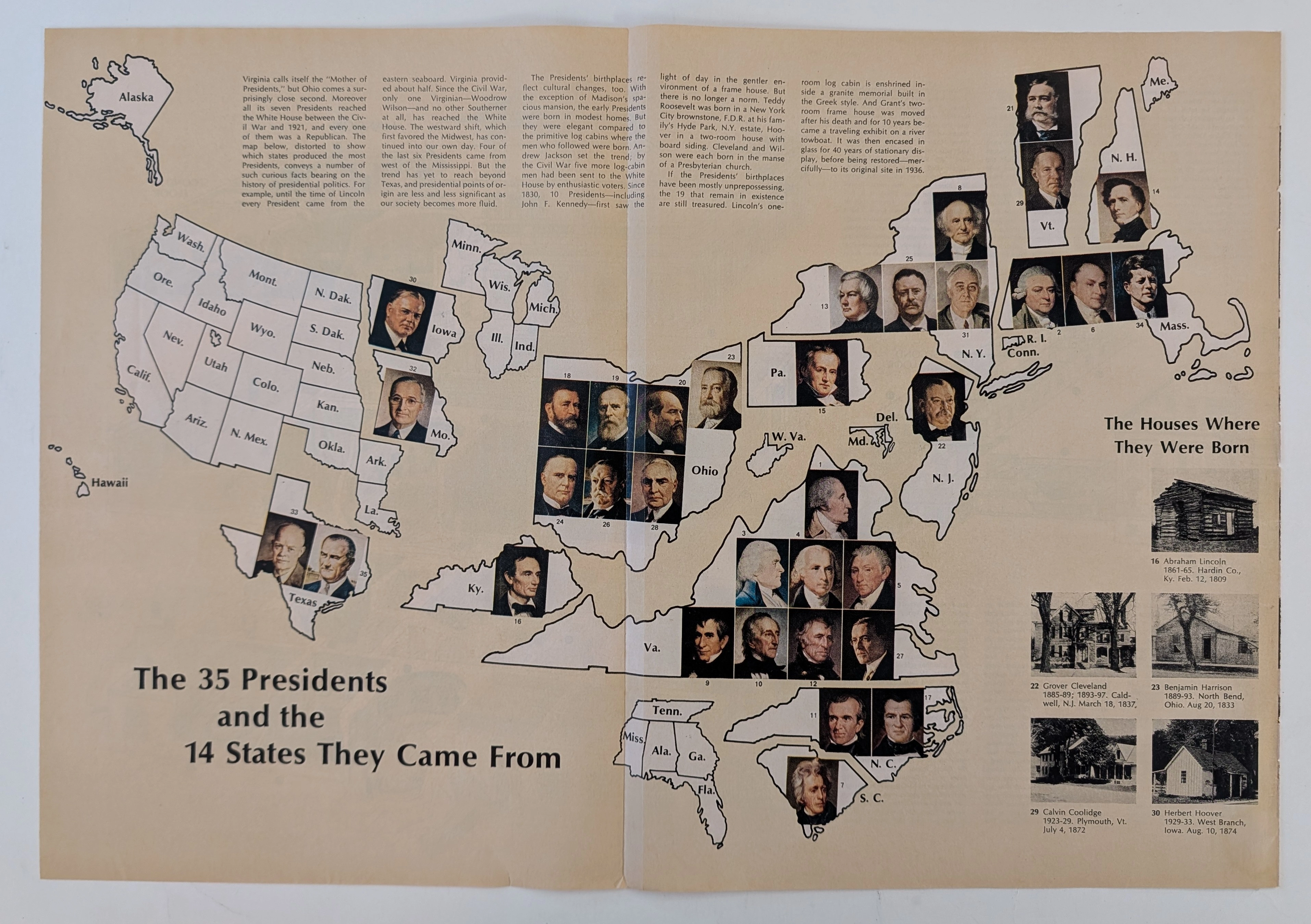
To fully decode the historical complexities encrypted within this page, one must consider the context of the geographical distribution of power in the United States. This map does not present information in a strict chronological order of administrations; instead, it utilizes the "Birth State" as its organizational anchor, effectively mirroring the social and political dynamics that evolved over generations.

The Chronological Anchor: The primary semiotic indicator used to date this artifact is the title itself: "The 35 Presidents." In official historical records, Grover Cleveland served as both the 22nd and 24th president, meaning the number of "administrations" differs from the number of "individuals." This specific map deliberately counts "individuals," designating Lyndon B. Johnson as the 35th President (though technically the 36th administration). This structural choice firmly anchors the artifact's production to the mid-1960s (between 1963 and 1969), an era defined by the Cold War, the Civil Rights Movement, and the escalating conflict in Vietnam.

The Rivalry of the Presidential Powers (Virginia vs. Ohio): The map visually narrates the geopolitical struggle for supremacy between Virginia, long heralded as the "Mother of Presidents," and the closely trailing state of Ohio. Virginia serves as the birthplace for eight presidents, representing the aristocratic and intellectual stronghold of the Founding Fathers. Meanwhile, Ohio claims seven presidents, illustrating the immense growth of Midwestern political influence from the post-Civil War era through the early 20th century.

The Westward Shift: The accompanying text explicitly addresses "The westward shift," demonstrating that political power was no longer a strict monopoly held by the original thirteen colonies. The emergence of presidents from Iowa, Missouri, and Texas serves as visual proof of the nation's expansion, mirroring the manifest destiny and the continuous broadening of the American political landscape.

History: Biographies of the Statesmen
In accordance with the highest standards of museum-grade historical curation, when the portraits and names of globally significant figures are presented, their roles in altering the trajectory of human history must be meticulously documented and explained. This artifact compiles the official portraits of numerous transformative statesmen:

George Washington (No. 1, Virginia): The first President of the United States and the Commander of the Continental Army during the American Revolutionary War. He is the foundational pillar of the republic, establishing the precedent of a two-term limit, which became a bedrock principle of American democratic tradition.

Thomas Jefferson (No. 3, Virginia): The third President and the principal author of the Declaration of Independence. An Enlightenment political philosopher who championed individual liberty, he also orchestrated the Louisiana Purchase, an act that effectively doubled the geographic size of the nation.

Abraham Lincoln (No. 16, Kentucky): The 16th President and arguably one of the most revered figures in American history. He successfully navigated the nation through its greatest moral, constitutional, and political crisis—the American Civil War—and issued the Emancipation Proclamation, fundamentally altering the moral and economic structure of the country forever.

Ulysses S. Grant (No. 18, Ohio): The 18th President and the former Commanding General of the Union Army who led the North to victory in the Civil War. As president, he led the Reconstruction era, working to protect the civil rights of newly freed African Americans and stabilize the post-war economy.

Theodore Roosevelt (No. 25, New York): The 26th President, known for his boundless energy and progressive policies. He was a champion of the "Progressive Era," initiating significant anti-trust legislation (trust-busting) and pioneering the conservation movement by establishing the national parks system.

Herbert Hoover (No. 30, Iowa): The 31st President (listed as the 30th individual on this map). Despite his prior reputation as a highly capable engineer and a master of international humanitarian relief, his presidency was tragically overshadowed by the onset of the Great Depression in 1929, an economic catastrophe his conservative fiscal philosophies struggled to contain.

Franklin D. Roosevelt (No. 31, New York): The 32nd President (listed as 31st here), and the only president to serve more than two terms (elected to four). He is the architect of the "New Deal" coalition that revolutionized the federal government's role in the economy during the Great Depression, and he served as the supreme Commander in Chief of the Allied forces through the vast majority of World War II.

Harry S. Truman (No. 32, Missouri): The 33rd President (listed as 32nd), who assumed office following FDR's sudden death. He made the profound and historically monumental decision to use atomic weapons on Hiroshima and Nagasaki to end World War II, and he subsequently established the Truman Doctrine, setting the foundational containment policy of the Cold War.

Dwight D. Eisenhower (No. 33, Texas): The 34th President (listed as 33rd) and the former Supreme Commander of the Allied Expeditionary Force in Europe during World War II. He presided over the economic boom of the 1950s, managed Cold War tensions with a steady hand, and initiated the creation of the Interstate Highway System.

John F. Kennedy (No. 34, Massachusetts): The 35th President (listed as 34th), who became a symbol of a new, youthful generation and the "New Frontier" vision. He navigated the Cuban Missile Crisis, avoiding nuclear conflict, and ignited the Apollo space program before his tragic assassination in 1963.

Lyndon B. Johnson (No. 35, Texas): The 36th President (listed as 35th), who took the oath of office upon JFK's death. He was a master of legislative maneuvering, designing the "Great Society" legislation that included the landmark Civil Rights Act and Voting Rights Act. However, his domestic achievements were deeply overshadowed by his escalation of American military involvement in the Vietnam War.

Part 1: The Architecture of the Log Cabin Myth
Beyond mere geographical pinpointing, this artifact presents a crucial sociological dimension through the section titled "The Houses Where They Were Born." This serves as a brilliant visual representation of political branding in early and modern America.

This specific area of the document deliberately contrasts the humble, rustic log cabin of Abraham Lincoln in Kentucky with the sprawling, opulent estate of Franklin D. Roosevelt in Hyde Park, New York. The juxtaposition of these structures reinforces the mythology of the "American Dream," which proved to be one of the most potent political marketing tools of the 19th and 20th centuries. Political candidates consistently emphasized their modest, working-class origins (the "log cabin" narrative) to forge a psychological connection with the common laborer and farmer, even if many presidents actually hailed from considerable wealth. The photographs and illustrations of these birthplaces serve as visual instruments to narrate the "rags-to-riches" trajectory, an identity deeply ingrained in the national ethos.

Part 2: Visual Semiotics: The Cartographic Representation of Power
In an era preceding the internet, the presentation of complex national data relied heavily on sophisticated graphic design. This map acts as an academically precise semiotic indicator:

Fragmentation and Composition: The cartographer chose not to render a complete, contiguous map of all 50 states. Instead, a technique of "fragmentation" is employed, isolating only the 14 specific states with presidential historical significance, allowing them to float prominently above the beige background. States such as Ohio, Virginia, New York, and Massachusetts are meticulously scaled and arranged to accommodate the portraits. This technique forces the viewer to focus entirely on the territories that generated historical power, deliberately omitting irrelevant geographical space.

Official Portraiture: The portraits utilized for each president are official paintings or photographs, uniformly projecting solemnity, authority, and stately elegance. Embedding these faces directly within the state borders inextricably binds the identity of the individual to the territorial identity of the land. It cultivates a profound sense of local pride for readers residing within those specific jurisdictions.

The Paper

As a physical entity, this two-page spread (centerfold) is a surviving historical record of mid-20th-century offset lithography. The medium-weight, uncoated paper stock was originally produced in massive quantities for distribution in educational magazines. However, its current physical state—displaying clear evidence of the passage of time—demands a profound evaluation through the lens of museum-grade archival preservation.

Microscopic Halftone Rosettes: Subjecting extreme macro photographs of this artifact to visual forensics reveals the mechanical heartbeat of the pre-digital printing press. Under high magnification, the smooth appearance of the presidential portraits shatters, dissolving into a precise, mathematically rigorous galaxy of CMYK (Cyan, Magenta, Yellow, Key/Black) halftone rosettes. The distinct, gritty grain of the mid-century offset printing process is clearly visible in the portraits of Herbert Hoover and Harry S. Truman. The typography and numerical indicators exhibit the slight ink spread characteristic of the era, acting as physical anchors that secure this piece firmly within its analog, historical reality.

The Oxidation of Lignin: The most crucial and valuable aspect of evaluating the condition of this specific artifact lies in the process of Material Degradation. Examining the unprinted margins and the beige background areas reveals authentic, undeniable "Toning." This is a gradual, irreversible yellowing and embrittlement effect. It is caused by the natural chemical oxidation of "Lignin"—a complex organic polymer responsible for binding cellulose fibers together within the wood pulp of the paper. As the paper is exposed to ambient oxygen and ultraviolet light over several decades, the lignin structure breaks down, absorbing more light and causing the warm, aged coloration that is the absolute hallmark of authentic vintage documents.

The Aesthetics of Decay: It is vital to understand the archival significance and value of this ephemeral nature. Analog two-page spreads from the mid-20th century represent an endangered species of historical documentation that is slowly decaying every single day. These educational fold-outs are inherently fragile by design; they were meant to be opened, folded repeatedly, and often ended up tearing along the center fold line. This organic, breathing physical degradation is a fingerprint of time that cannot be cloned or replicated by any digital scanning process. The evolving patina elevates the piece from a mass-produced industrial print to a singular artifact bearing historical scars. The wabi-sabi nature of this aging paper, combined with its historical significance, is precisely the mechanism driving up its market value exponentially among serious collectors.

The Rarity

Rarity Class: A (Advanced / Highly Desirable)

Under the parameters of international archival evaluation, this artifact is designated as Class A. The ultimate paradox of mid-20th-century educational ephemera lies in the stark contrast between its initial, widespread mass production and its extreme scarcity in intact condition today. These educational maps and diagrams were true "disposable media." They were destined to be torn from the spines of magazines, pinned to classroom chalkboards, handled by countless students, and ultimately discarded into wastebaskets at the end of the academic semester.

For this specific, large-format two-page map—brimming with valuable historical data and portraiture—to have miraculously survived for decades, resisting the ravages of unfolding, moisture, and avoiding severe tearing along its structural center fold, is a statistical archival anomaly. Furthermore, discovering a document that comprehensively encapsulates American political history from the era just prior to the culmination of the Civil Rights movement, wherein the printing pigments maintain their integrity while the paper exhibits authentic wabi-sabi aging, is a rare occurrence. Pristine remnants of this era of cartographic illustration attract the intense interest of American history curators, political archivists, and collectors of mid-century educational media. They seek to preserve such items with the intention of executing museum-grade, acid-free conservation framing, protecting the historical legacy of an era when complex national data was beautifully rendered through analog print.

Visual Impact

The aesthetic authority of this artifact lies in its absolute mastery of Information Design. Amidst the 35 portraits and dense historical text, the immediate focal point that captures the viewer's optic nerve is the heavy clustering of imagery on the Eastern seaboard.

A masterful visual weight is achieved through contrast. The left side of the map displays the vast expanses of the West and Midwest, populated sparsely by isolated portraits (such as Hoover in Iowa, Truman in Missouri). In stark contrast, the right side of the map is densely packed with the crowded portraits of Ohio and Virginia. This visual conflict between the "emptiness of the new frontiers" and the "congestion of the old power bases" acts as a silent historical narrator. It compels the viewer's brain to instantly comprehend the geopolitical evolution of the nation without needing to read a single line of text. This represents the pinnacle of visual infographic achievement in the analog age.

Exhibition Halls

Share This Archive

The Archive Continues

Continue the Exploration

Vintage PRAYBOY 1984 Cover: The Vanishing Analog Satire | The Record

Vintage PRAYBOY 1984 Cover: The Vanishing Analog Satire | The Record

An in-depth look at the 1984 PRAYBOY parody cover. A masterpiece of 1980s analog studio photography on degrading vintage paper, driving up the value of this magazine-sized original print.

THE TIME TRAVELER'S DOSSIER: ARROGANCE AND INNOVATION IN THE ABYSS OF THE DEPRESSION

THE TIME TRAVELER'S DOSSIER: ARROGANCE AND INNOVATION IN THE ABYSS OF THE DEPRESSION

The artifact under rigorous, museum-grade analysis is an exceptionally preserved Historical Relic originating from the darkest economic abyss of the 20th century: the American Great Depression. Sourced from a 1931 issue of The Saturday Evening Post, this Primary Art Document features a sweeping, full-page advertisement for the Sheaffer's "Balance" Lifetime Pen. This piece is a profound sociological and industrial marker. In 1931, as the global economy collapsed, W.A. Sheaffer defiantly marketed a revolutionary, streamlined luxury writing instrument priced at an astronomical $15. The ad explicitly highlights the "White Dot" lifetime guarantee and the 14-karat solid gold "Autograph" band engraved with the owner's signature ("John Adams"). It is a masterclass in aspirational marketing during an era of mass destitution. Physically, this nearly century-old wood-pulp document is a breathtaking testament to the Japanese aesthetic of wabi-sabi. It exhibits severe, dramatic edge trauma, profound edge loss, deep amber oxidation, and prominent moisture staining along the left margin. This extreme analog decay transforms the mass-produced commercial print into an irreplaceable, highly coveted Primary Art Document that physically embodies the scars of its 90-year journey through history.

The Time Traveller's Dossier: Engineering as High Art – 1981 Honda CBX Advertisement

HONDA · Automotive

The Time Traveller's Dossier: Engineering as High Art – 1981 Honda CBX Advertisement

History is not written; it is printed. Before digital algorithms dictated human behavior, societal engineering was executed through the calculated geometry of the four-color offset press. The historical artifact before us is not merely an advertisement; it is a weaponized blueprint of mechanical aspiration and a testament to the golden age of Japanese technological supremacy. This museum-grade archival dossier presents an academic deconstruction of a 1981 print advertisement for the legendary Honda CBX. Operating on a profound binary structure, it documents a calculated paradigm shift within the global motorcycle industry. It illustrates the precise historical fracture where the motorcycle was conceptually transitioned from a stigmatized symbol of counter-culture rebellion into a highly sophisticated, aerodynamic marvel tailored for the affluent connoisseur. Through the lens of late-analog commercial artistry and precise visual forensics, this document serves as a masterclass in psychological marketing, establishing the archetype of the high-tech superbike that unconditionally dominates modern automotive pop culture.

Published by

The Record Institute