The Time Traveller's Dossier : The Illustrated London News 1918 - The Mechanization of Human Conflict
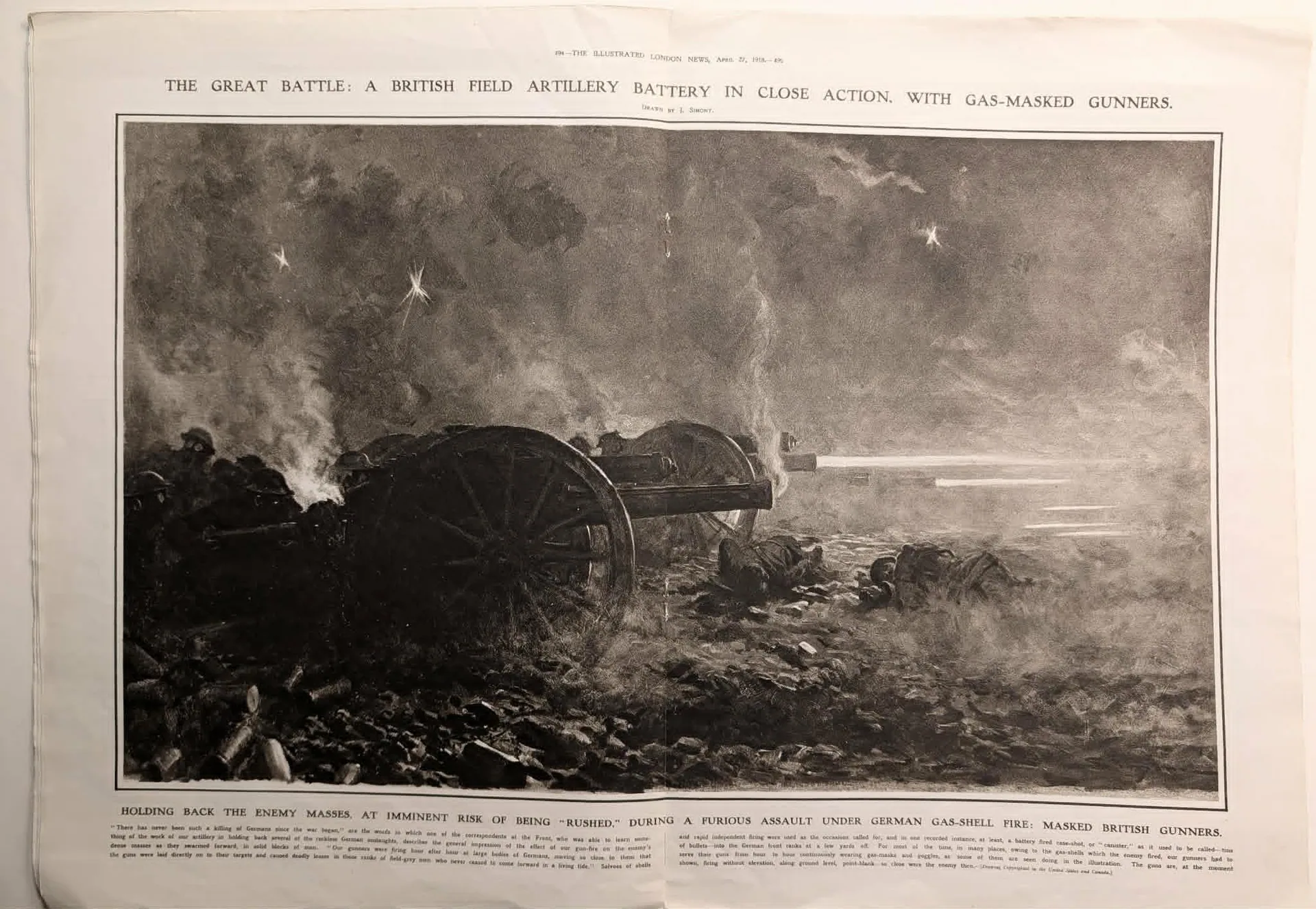
Before this era, combat was an exercise in individual agency. It was the cavalry charge. It was the infantryman's rifle. It was the face-to-face clash of opposing ideologies. Then, human conflict underwent a metallurgical and chemical transfiguration. The artifact before us is not merely an illustration. It is an autopsy of the romantic ideal of war. It captures the precise historical epoch when humanity realized it had engineered its own obsolescence on the battlefield. This centerfold from The Illustrated London News documents a profound shift in military doctrine: the transition from human-centric warfare to industrialized, mechanized slaughter, complicated by the weaponization of the very air the soldiers breathed. The problem was an overwhelming, massed infantry assault. The solution was point-blank, rapid-fire field artillery operated by men reduced to anonymous, insectoid operators within a toxic atmosphere. This is the architecture of extinction, captured in ink and paper.
Category: Other
The History
The Context of Calamity: April 1918 To comprehend the sheer gravity of the artifact cataloged as df6c7b58-0d4a-4ca5-ad52-de56ee69570b.jpg, we must first establish the geopolitical terror of April 1918. The date printed at the top of the page, "APRIL 27, 1918," places this illustration precisely within the timeline of the German Spring Offensive, known as the Kaiserschlacht. Imperial Germany, freed from a two-front war following the collapse of the Russian Empire, threw everything it possessed into a massive, desperate assault against the British and French lines on the Western Front. The text explicitly notes the British gunners are "HOLDING BACK THE ENEMY MASSES, AT IMMINENT RISK OF BEING 'RUSHED'". This was a war of movement after years of static trench deadlock. The British lines were buckling. Field artillery, usually situated safely behind the infantry, suddenly found itself in the absolute vanguard, firing at advancing German stormtroopers over open sights. This was not a calculated bombardment; it was a desperate, chaotic fight for survival. The illustration captures a moment of tactical collapse and mechanical desperation. The Mechanics of the 18-Pounder Field Gun The central protagonist of this image is not a human being. It is the Ordnance QF 18-pounder, the standard British field gun of the First World War. Look closely at the metallurgical anatomy depicted in 57316cfc-ffd8-4b6c-a782-f16fc5462109.jpg. The artist has painstakingly rendered the heavy spoked wooden wheels, the thick steel barrel, and the complex recuperator system housed above it. This gun was an engineering marvel of its time, designed for a singular purpose: rapid, sustained, and devastating kinetic output. In the scenario depicted, the gunners are firing point-blank. The caption notes the firing is happening "without elevation, along ground level". They are likely firing shrapnel shells—canisters packed with lead bullets timed to explode just in front of the advancing infantry, essentially transforming the heavy artillery piece into a massive, apocalyptic shotgun. The sheer physical labor required to operate this machine at such a pace was staggering. The gunners, operating in a frantic rhythm, had to open the breech, extract the spent casing, load a new 18-pound shell, close the breech, aim, and fire. The ground in the illustration is littered with discarded brass casings, a visual testament to the sheer volume of ammunition expended and the terrifying duration of the engagement. The machine consumes brass and spits out fire; the men are merely its biological support system. The Architecture of Poison: The Gas Mask The most philosophically haunting element of this artifact is the anonymity of the human figures. Every gunner is wearing a gas mask, explicitly noted as "GAS-MASKED GUNNERS" under "GERMAN GAS-SHELL FIRE". Prior to 1915, the battlefield was a place of explosive violence, but the atmosphere itself remained neutral. The introduction of chemical warfare—phosgene, diphosgene, and mustard gas—fundamentally altered the relationship between the soldier and his environment. To breathe the ambient air was to invite a horrific, suffocating death. The mask depicted is likely the Small Box Respirator, standard issue for British troops by 1918. Notice how the masks completely erase human individuality. There are no faces of courage, no expressions of fear, no grimaces of determination. The men have been reduced to faceless, bug-eyed automatons. They appear alien, insectoid, entirely dehumanized by the defensive technology required to keep them alive. The mask severes their connection to the natural world. They must breathe through a chemical filter, bite down on a rubber mouthpiece, and look at the carnage through fogged glass lenses. This represents a profound shift in the psychological experience of combat. The soldier is alienated not only from the enemy but from his own humanity and the very air he occupies. The Economics and Sociology of Mass Media The Illustrated London News holds a monumental place in the history of journalism. Founded in 1842, it was the world's first illustrated weekly news magazine. By 1918, it was a vital conduit of information bridging the gap between the unimaginable horrors of the Western Front and the breakfast tables of the British public. Consider the sociological impact of this specific spread, 7d446f40-720c-4f3c-af54-4b2a229d301e.jpg, being unfolded in a London drawing-room. The public was starved for visual confirmation of the war's progress. While photographs existed, early cameras were bulky, required long exposure times, and were virtually useless in the smoke-filled, chaotic darkness of close-quarters combat. Thus, the "Special Artist" was deployed. Illustrators like J. Simont were tasked with translating eyewitness accounts and sketches into visceral, comprehensible imagery. This image served a dual purpose. It was propaganda, yes—it depicted British resolve in the face of overwhelming odds, highlighting the heroism of "holding back the enemy masses". But it was also a grim mechanism of truth. It did not shy away from the terrifying reality of gas warfare or the overwhelming darkness of the battlefield. It educated the civilian population on the changing face of war, preparing them psychologically for the massive casualty lists that would follow the Spring Offensive. The Paradigm Shift: From Chivalry to Chemistry This artifact forces us to confront the death of chivalry. Before the industrial revolution, war was often romanticized. It was a narrative of individual heroism, of flags and cavalry and decisive sword strikes. This artifact proves that by 1918, those notions had been obliterated by the machine age. The men in this image are not heroes in the classical sense; they are technicians of death. They are tethered to a machine that dictates their movements. They are blinded by darkness, deafened by the relentless concussions of the 18-pounder, and suffocated by the rubber masks strapped to their faces. They are surviving in a toxic void, firing blindly into the abyss. The true victor in this image is not the British Empire nor the German Empire. The true victor is industry. The true victor is the chemical plant producing the gas, the steel mill casting the artillery barrel, and the factory turning out millions of brass shell casings. The shift is complete: war is no longer a human endeavor; it is an industrial process where human beings are the most expendable raw material.
The Paper
This artifact is printed on mechanical wood pulp paper, the standard substrate for mass-circulation periodicals of the early 20th century. Unlike the durable rag paper of antiquity, this newsprint was born of the industrial age—cheap, abundant, and inherently self-destructive. The high lignin content within the wood fibers reacts relentlessly with oxygen, causing the paper to become highly acidic over a century. The visible yellowing and localized spotting, known as foxing, is a physical clock, a chemical manifestation of time eroding the artifact. The printing method employed is likely an early form of rotogravure or a highly refined halftone relief process, capable of capturing the nuanced washes and charcoal strokes of J. Simont's original artwork. The monochromatic black ink is pressed deep into the porous, uncoated fibers. There is a profound philosophical friction here: the events depicted are heavy, apocalyptic, and forged in iron and poison, yet the record of these events is fragile, lightweight, and slowly disintegrating. The artifact is a transient vessel carrying a permanent historical trauma.
The Rarity
Classification: Class A (High Historical Resonance) While The Illustrated London News had a massive circulation, rendering individual pages relatively common in broad archival terms, this specific artifact transcends its physical scarcity through its immense contextual density. An intact, full two-page centerfold depicting the very nadir of the 1918 Spring Offensive, complete with the dual technological horrors of close-action artillery and chemical warfare, is highly significant. Its rarity is not determined by an auction house gavel, but by its capacity to serve as a primary sociological anchor. It is an indispensable visual text for historians analyzing the weaponization of mass media and the civilian comprehension of industrialized warfare.
Cite this article
- MLA
- Naodhinsuk, Ronin. “The Time Traveller's Dossier : The Illustrated London News 1918 - The Mechanization of Human Conflict.” The Record Institute, 3 July 2026, https://therecord.institute/journal/the-time-travellers-dossier-the-illustrated-london-news-1918-the-mechanization-of-human-conflict.
- APA
- Naodhinsuk, R. (2026, July 3). The Time Traveller's Dossier : The Illustrated London News 1918 - The Mechanization of Human Conflict. The Record Institute. https://therecord.institute/journal/the-time-travellers-dossier-the-illustrated-london-news-1918-the-mechanization-of-human-conflict
- CHICAGO
- Naodhinsuk, Ronin. 2026. “The Time Traveller's Dossier : The Illustrated London News 1918 - The Mechanization of Human Conflict.” The Record Institute, July 3, 2026. https://therecord.institute/journal/the-time-travellers-dossier-the-illustrated-london-news-1918-the-mechanization-of-human-conflict.