The Time Traveller's Dossier : Through Vincent's Eyes - The Mechanical Reproduction of Anguish
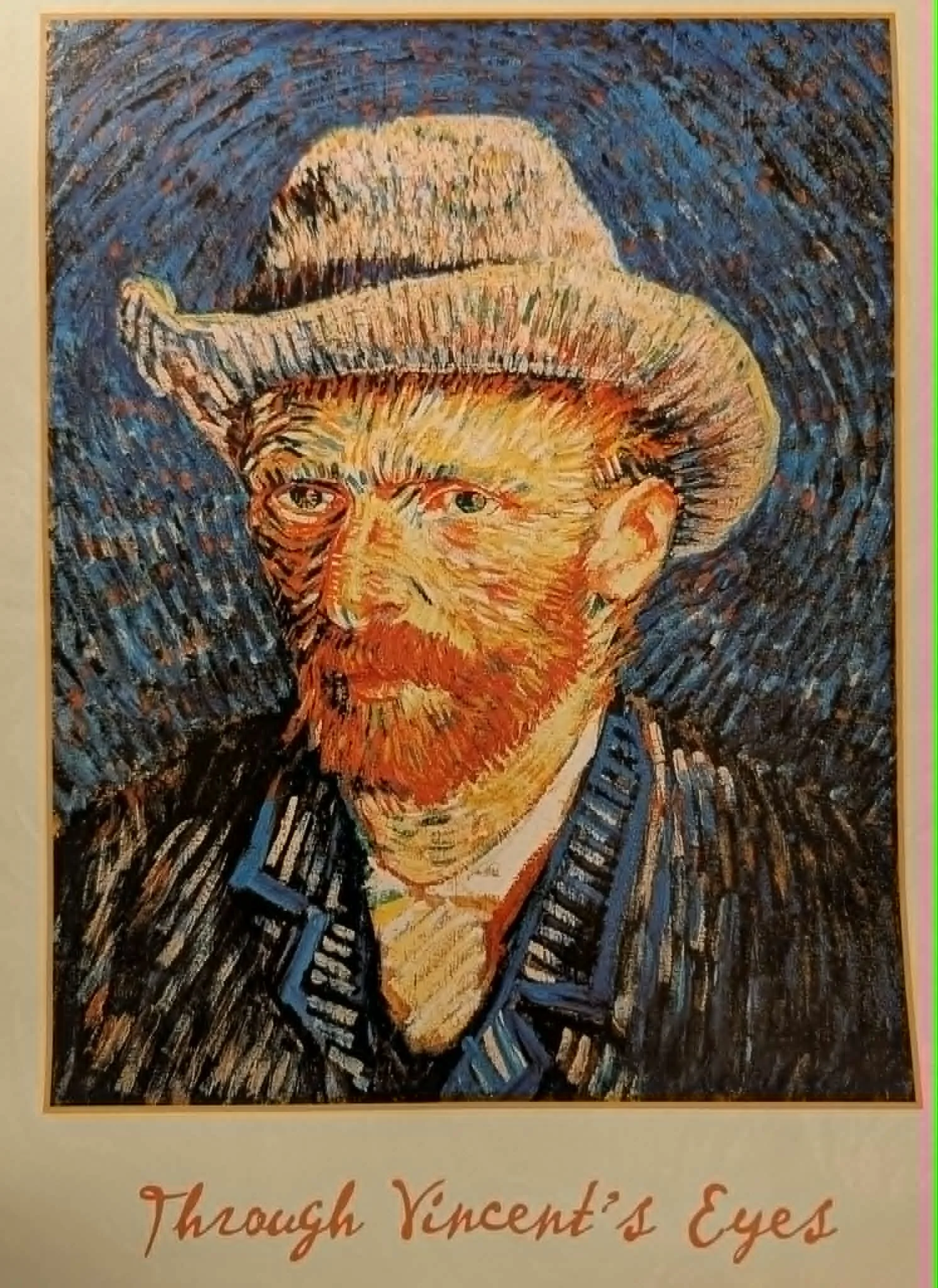
A canvas holds a singular truth. A poster distributes it. Before the advent of high-fidelity offset lithography, fine art was geographically locked. To look into the eyes of Vincent van Gogh, one had to stand on the hardwood floors of the Musée d'Orsay in Paris, or navigate the curated halls of the Van Gogh Museum in Amsterdam. The art demanded pilgrimage. The artifact demanded physical proximity. Then came the machinery of mass reproduction. This artifact—a commercial poster titled "Through Vincent's Eyes," designated as ARV 050 and distributed by Portal Publications Ltd. of Novato, California—represents a definitive shift in cultural consumption. It is the democratization of the masterpiece. It takes the deeply personal, tactile, and tragic self-examination of a nineteenth-century Dutch post-impressionist and flattens it into a reproducible commodity for the American domestic interior. The pilgrimage was canceled. The museum was delivered to the living room. This is not simply a picture of a painting. It is a calculated translation of medium. It represents the moment society decided that the image of the art was just as necessary as the art itself.
Category: Other
The History
The Genesis of the Image: The Architecture of the Self To understand the shift this lithograph represents, one must first dissect the original subjects it seeks to copy. The artifact curates three distinct self-portraits, painted during the most volatile and transformative years of the artist's life. The first is the Self-Portrait with Grey Felt Hat (1887), housed in Amsterdam. Created during his time in Paris, it reveals a man adopting the techniques of the Pointillists, yet weaponizing them. The brushstrokes are not scientific dots; they are frantic, radiating dashes. They form a halo of kinetic energy around a gaunt face. The second is the Self-Portrait as a Painter (1887–1888). Here, he holds the palette. The brushes are grasped tightly. It is a declaration of occupation. He is not merely a man; he is an instrument of creation. The dominant blues of his smock contrast violently with the orange of his beard—a masterclass in complementary color theory, executed with thick, unforgiving impasto. The third is the Self-Portrait from 1889, residing at the Musée d'Orsay. Painted in the asylum at Saint-Rémy-de-Provence. The background is no longer a static wall; it is a turbulent, hallucinatory ocean of swirling pale mint and deep azure. The face is tight. The eyes are uncompromising. It is the architecture of a mind actively fighting its own collapse. These original works were never meant for mass consumption. They were private interrogations in oil. They were thick, three-dimensional topographies of dried pigment. They were singular. The Mechanics of the Copy: The Offset Lithographic Shift The historical pivot occurs when these three-dimensional topographies encounter the American commercial printing press. This poster is an artifact of four-color offset lithography. The process strips the physical texture from the original work and replaces it with an optical illusion. The turbulent brushstrokes of 1889 are photographed, scanned, and separated into four distinct aluminum printing plates: Cyan, Magenta, Yellow, and Key (Black). When these plates are run through heavy industrial rollers, they deposit microscopic dots of ink onto mass-market paper. The violent, physical act of Van Gogh dragging a loaded hog-bristle brush across a rough canvas is mathematically translated into a halftone screen. This is a profound technological compromise. The lithograph cannot reproduce the shadow cast by a thick ridge of oil paint. It cannot reproduce the specular highlight of glossy varnish. It must simulate depth through color density alone. Yet, the engineering of ARV 050 is highly proficient. The color separations are calibrated to maintain the violent contrast of the orange and blue pigments. The mechanical process succeeds in capturing the ghost of the artwork, even if it leaves the physical body behind. This technological shift fundamentally altered human expectations. The public no longer expected art to possess texture. They expected it to possess accuracy. The flat image became the standard metric of visual truth. The Commodification of Anguish: Portal Publications and the American Market Look closely at the lower margin. "DISTRIBUTED BY [Heart Logo] PORTAL PUBLICATIONS LTD. NOVATO, CALIFORNIA www.portalpub.com" This single line of text anchors the artifact to a highly specific window in the timeline of human commerce. Portal Publications was a titan of the American poster industry in the late twentieth century. Operating out of Marin County, California, they specialized in translating fine art, pop culture, and photography into affordable, standardized formats. Their business model relied on the physical retail space. Before algorithms dictated taste, consumers walked into framing shops, university bookstores, and shopping mall retailers to flip through massive, swinging metal racks of posters. ARV 050 was designed for these racks. The inclusion of the URL "www.portalpub.com" is critical. It acts as a carbon-dating mechanism. It places the printing of this specific edition in the late 1990s or early 2000s—the precise twilight of the analog retail era. Portal Publications was attempting to bridge their physical distribution empire with the nascent digital frontier. Ultimately, the company would succumb to the changing landscape, ceasing operations as on-demand digital printing and e-commerce decimated the traditional poster market. Therefore, this artifact sits at a crossroads. It looks backward to the analog majesty of 1889, and it looks forward to the digital distribution networks of the twenty-first century. The Cultural Shift: From Gallery to Dormitory Why combine these three specific portraits under the title "Through Vincent's Eyes"? The curation is deliberate. It is an act of psychological marketing. By the late twentieth century, Van Gogh was no longer just an artist; he was a globally recognized archetype. He was the definitive "tortured genius." The commercial poster market understood that consumers were not merely buying a reproduction of a painting; they were purchasing a piece of that archetype. Hanging this poster in a university dormitory, a suburban living room, or a modest apartment was an act of personal signaling. It communicated a sensitivity to beauty, an alignment with the underdog, and an appreciation for emotional depth. The artifact allowed the everyday consumer to borrow the cultural weight of the Musée d'Orsay and the Van Gogh Museum for the price of a few dollars. This represents the ultimate democratization of the image. Walter Benjamin, the cultural critic, argued that mechanical reproduction strips an artwork of its "aura"—its unique presence in time and space. While true, ARV 050 proves that the loss of the original aura is replaced by a new kind of utility. The reproduced image becomes a ubiquitous cultural baseline. It ensures that the piercing gaze of an institutionalized man in 1889 can endure as a permanent fixture in the collective visual vocabulary of the modern world.
The Paper
The substrate of ARV 050 is a standard, machine-made commercial poster stock, likely weighing between 150 and 170 GSM (Grams per Square Meter). It is coated on one side. The surface treatment is engineered to hold the ink on the very top layer of the paper fibers, preventing absorption and subsequent dot gain. This ensures the sharpest possible resolution for the halftone lithographic screen. The reverse side remains uncoated, exhibiting the natural, slightly rough texture of the wood pulp. The designation "LITHO IN U.S.A." indicates domestic manufacturing, bypassing the slower, heavier import routes for European fine art prints of the era. The paper itself is inevitably mildly acidic. Unlike museum-grade archival cotton rag, this wood-pulp base is designed for temporary display, not permanence. Over decades, exposure to ultraviolet light and the internal chemical breakdown of the lignin will cause the white margins to shift toward a warm, brittle yellow. The artifact is designed to decay, mirroring the transient nature of the commercial retail market it was born from.
The Rarity
Classification: Class B. From a purely market-driven perspective, this artifact was produced in the tens of thousands. It is not rare in volume. However, its classification elevates when viewed through the lens of contextual value. Pristine, surviving copies from the exact era of the "www.portalpub.com" transition are becoming increasingly uncommon. Most copies of ARV 050 were subjected to the brutal environments of their intended use: pinned to plaster walls, taped to doors, bleached by sunlight, and ultimately discarded. Finding a well-preserved survivor with intact margins and un-faded cyan ink offers a pristine data point regarding the commercial printing standards of late-90s American pop-cultural distribution.
Cite this article
- MLA
- Naodhinsuk, Ronin. “The Time Traveller's Dossier : Through Vincent's Eyes - The Mechanical Reproduction of Anguish.” The Record Institute, 6 July 2026, https://therecord.institute/journal/the-time-travellers-dossier-through-vincents-eyes-the-mechanical-reproduction-of-anguish.
- APA
- Naodhinsuk, R. (2026, July 6). The Time Traveller's Dossier : Through Vincent's Eyes - The Mechanical Reproduction of Anguish. The Record Institute. https://therecord.institute/journal/the-time-travellers-dossier-through-vincents-eyes-the-mechanical-reproduction-of-anguish
- CHICAGO
- Naodhinsuk, Ronin. 2026. “The Time Traveller's Dossier : Through Vincent's Eyes - The Mechanical Reproduction of Anguish.” The Record Institute, July 6, 2026. https://therecord.institute/journal/the-time-travellers-dossier-through-vincents-eyes-the-mechanical-reproduction-of-anguish.