The Time Traveller's Dossier: Tools of the Void - Engineering Against Newton's Third Law
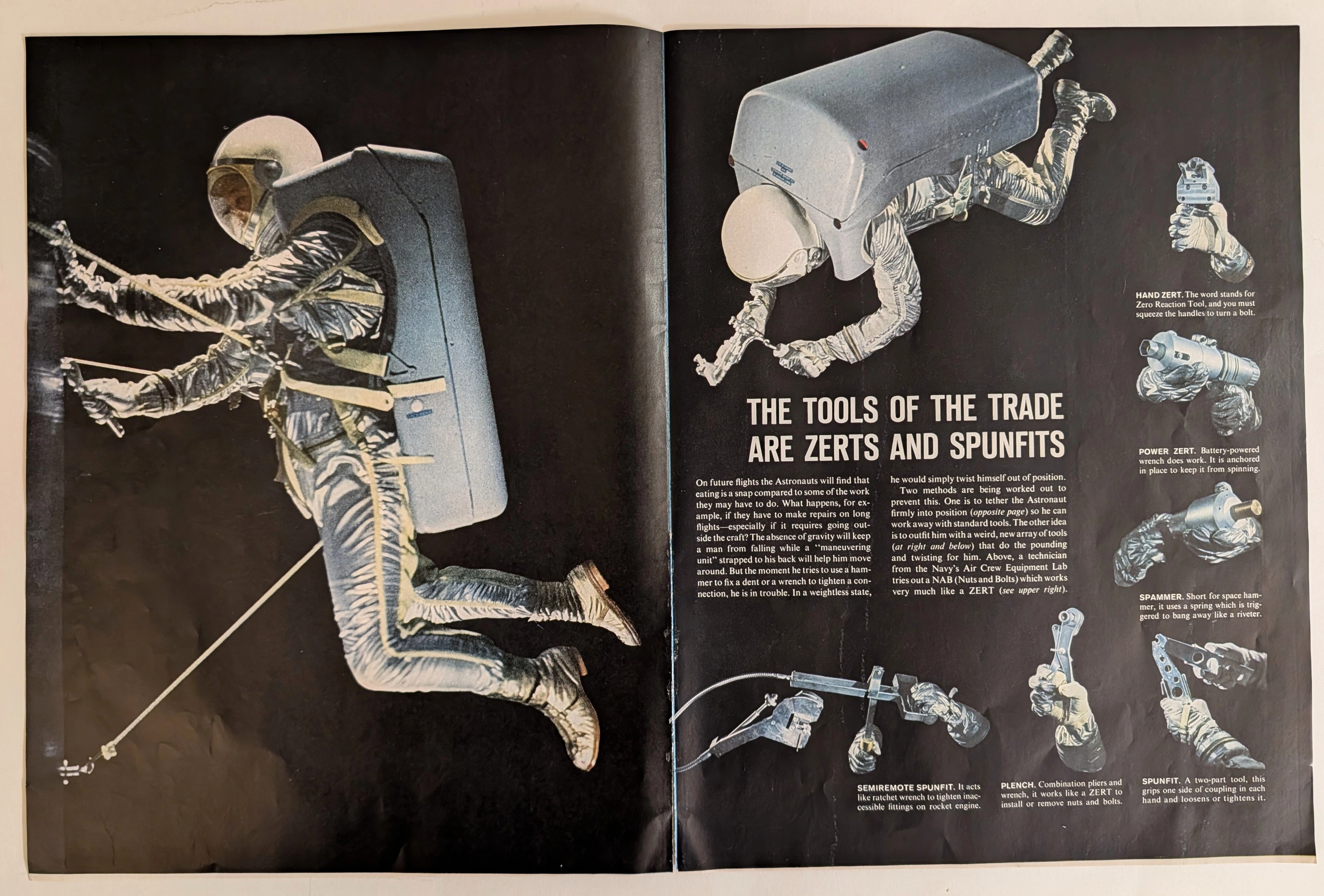
When we look back at the golden age of the Apollo and Gemini programs, we often fixate on the massive Saturn V rockets, the explosive launches, and the triumph of the lunar landings. We rarely think about the mundane act of turning a wrench. Yet, in the brutal, frictionless vacuum of space, the most basic acts of manual labor become lethal puzzles. This collection of highly specialized tool photographs is not just a catalogue of vintage hardware. It is a visual record of humanity realizing that the fundamental mechanics of Earth do not apply in orbit. In microgravity, without friction to anchor your boots to the floor, Sir Isaac Newton’s Third Law (F A =−F B , for every action, there is an equal and opposite reaction) transforms a simple mechanic's wrench into a centrifuge. This dossier dissects a fascinating, mid-1960s print artifact detailing the "Zero Reaction" toolset. These tools were engineered specifically to allow astronauts to build, repair, and survive in the void without spinning uncontrollably into the abyss. It is a masterclass in aerospace engineering, ergonomic survival design, and the aesthetics of the Space Race.
Category: Other
The History
The Crisis of the Void: Newton's Revenge To understand the profound necessity of the tools shown in these images, we must first understand the terrifying reality of early Extravehicular Activity (EVA), commonly known as spacewalks. During the Gemini program in the mid-1960s, NASA discovered a massive flaw in their operational theories. They assumed astronauts could simply float outside the spacecraft and perform maintenance using standard tools. They were dangerously wrong. During Gemini 9A, astronaut Eugene Cernan attempted to test an Astronaut Maneuvering Unit. As he tried to perform basic tasks, he found that applying torque to a valve or a bolt didn't turn the hardware; it turned him. Because he had no leverage and no gravity to hold him down, pushing on a wrench simply pushed his own body in the opposite direction. Cernan exhausted himself so severely fighting his own pressurized suit and the laws of physics that his visor fogged completely with sweat, and his heart rate spiked to dangerous levels. The mission was nearly a fatal disaster. NASA engineers quickly realized that standard rotational torque was the enemy of the spacewalker. They needed an entirely new class of hardware: tools that could perform violent kinetic actions (twisting, hammering, clamping) while keeping the net external force at absolute zero. They needed the "Zero Reaction" arsenal. The ZERT Protocol: Cheating Physics The artifact highlights the primary solution to this orbital nightmare: The ZERT, or Zero Reaction Tool. The first image displays the HAND ZERT. The accompanying text explicitly defines its purpose: "The word stands for Zero Reaction Tool, and you must squeeze the handles to turn a bolt". This is a stroke of mechanical genius. Instead of relying on the shoulder and wrist to create a swinging arc (which would transfer momentum to the astronaut's body), the tool utilizes a scissor-like grip. The astronaut squeezes two handles together. Because the forces of the astronaut's hand squeezing inward are equal, opposite, and contained entirely within the grip of the tool, the net external force is zero. The internal mechanism of the ZERT translates that linear squeezing motion into rotational torque applied directly to the bolt. The bolt turns, but the astronaut remains perfectly still. The second image introduces the heavy-duty counterpart: the POWER ZERT. The text identifies it as a "Battery-powered wrench". However, a power tool spinning at high RPMs creates massive gyroscopic forces and torque. If an astronaut pulled the trigger on a standard power drill in space, the drill bit would stall against the bolt, and the astronaut would begin spinning in the opposite direction. To solve this, the text notes a crucial engineering detail: "It is anchored in place to keep it from spinning". The tool had to be physically locked into a receptor on the spacecraft's hull before it could be activated, transferring the counter-rotational force safely into the mass of the spaceship rather than the astronaut's fragile body. Kinetic Impactors and Orbital Clamps The physical challenges of space construction went beyond just turning nuts and bolts; sometimes, brute force was required. But how do you swing a hammer in a vacuum? The third image reveals the SPAMMER. The text explains this is "Short for space hammer". Swinging a traditional hammer requires winding up your arm and delivering a kinetic strike. In space, winding up your arm throws your center of mass off, and the impact of the hammer striking the surface would cause a violent rebound, launching the astronaut backward. The SPAMMER eliminates the swing entirely. The text reveals its brilliant internal mechanics: "it uses a spring which is triggered to bang away like a riveter". By placing the tool directly against the surface and pulling a trigger, an internal spring releases a heavy mass that strikes the objective. A counter-mass inside the tool simultaneously moves in the opposite direction to absorb the recoil. It delivers the kinetic impact of a hammer blow without the deadly rebound. The final two images showcase specialized grappling and tightening mechanisms. The SPUNFIT is described as a "two-part tool, this grips one side of coupling in each hand and loosens or tightens it". By using both hands to push together or pull apart evenly, the astronaut once again cancels out the net forces, avoiding the dreaded spin. For harder-to-reach areas, the text presents the SEMIREMOTE SPUNFIT, which "acts like ratchet wrench to tighten inaccessible fittings on rocket engine". Finally, the PLENCH is introduced. A linguistic blend of pliers and wrench, the text notes it is a "Combination pliers and wrench, it works like a ZERT to install or remove nuts and bolts". The snippet also mentions trying out a "NAB (Nuts and Bolts) which works very much like a ZERT".
The Paper
Material Context and Demographic Placement: These images are macro-photographic crops taken from a mid-to-late 1960s mass-market periodical—most likely a science-focused issue of LIFE magazine, Popular Science, or Mechanix Illustrated. During the height of the Space Race, there was an insatiable public appetite for the granular, technical details of how NASA was conquering the cosmos. The American public didn't just want to see rockets; they wanted to see the ingenuity of American engineering down to the very wrenches used in orbit. The paper itself is a standard, medium-weight magazine stock. Unlike premium glossy fashion magazines, this paper has a slightly porous texture, designed for high-speed web offset printing. Printing Pathology (The Illusion of the Void): The most striking physical characteristic of this print artifact is the aggressive use of solid black ink. The graphic designer deliberately stripped away all background environments—no spacecraft hulls, no Earth in the distance. The tools and the hands holding them are completely isolated in a sea of rich, heavily saturated black ink. This is a brilliant visual metaphor. The black ink simulates the terrifying, infinite void of space. To achieve this depth of black on cheap magazine paper without the ink bleeding or tearing the page requires a high-quality "rich black" CMYK mix. When inspecting the lighter areas of the tools and the text, the distinctive, coarse halftone dot pattern of 1960s lithography becomes highly visible, particularly in the grey gradients of the spacesuit gloves.
The Rarity
Classification: Class A+ (Pinnacle Aerospace Engineering Documentation) Vintage magazine clippings are generally common. However, documentation explicitly detailing the "Zero Reaction" toolset is highly prized among aerospace historians and space-race archivists. While everyone remembers the Apollo lunar drill (famously built by Black & Decker), the Hand ZERT and the Spammer represent a highly specific, transitional era in spaceflight. They represent the exact moment NASA transitioned from "getting to space" to "learning how to actually work in space." These tools were the direct mechanical answer to the near-fatal physiological failures of early spacewalks. Owning a pristine visual record of these prototypes, complete with their contemporary mid-60s journalistic descriptions, is like owning a blueprint to survival in the vacuum.
Cite this article
- MLA
- Naodhinsuk, Ronin. “The Time Traveller's Dossier: Tools of the Void - Engineering Against Newton's Third Law.” The Record Institute, 13 April 2026, https://therecord.institute/journal/the-time-travellers-dossier-tools-of-the-void-engineering-against-newtons-third-law.
- APA
- Naodhinsuk, R. (2026, April 13). The Time Traveller's Dossier: Tools of the Void - Engineering Against Newton's Third Law. The Record Institute. https://therecord.institute/journal/the-time-travellers-dossier-tools-of-the-void-engineering-against-newtons-third-law
- CHICAGO
- Naodhinsuk, Ronin. 2026. “The Time Traveller's Dossier: Tools of the Void - Engineering Against Newton's Third Law.” The Record Institute, April 13, 2026. https://therecord.institute/journal/the-time-travellers-dossier-tools-of-the-void-engineering-against-newtons-third-law.