The Time Traveller's Dossier : Tootal Fabrics - The Mechanics of Applied Energy
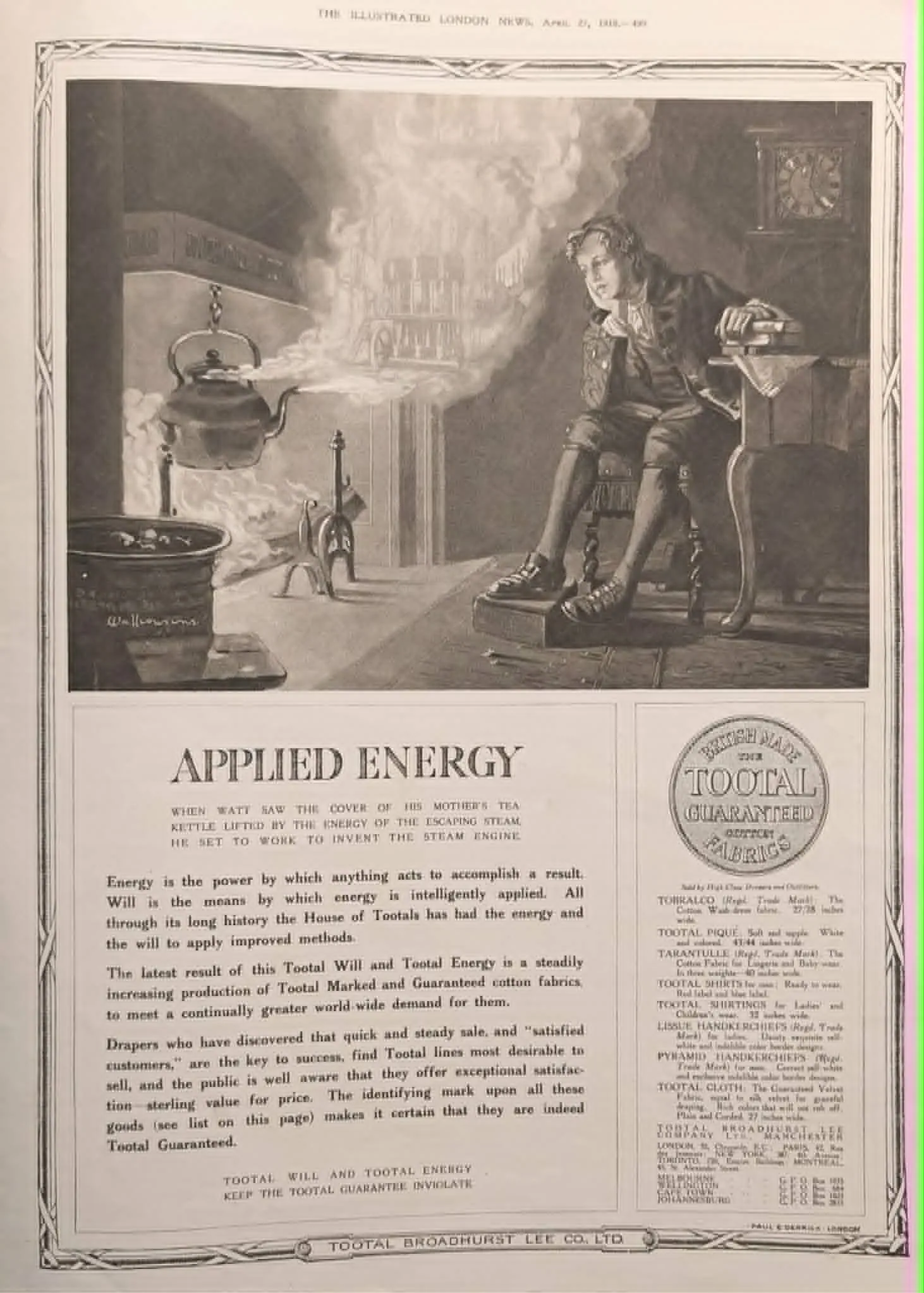
The year is 1918. The world is exhausted by global conflict. Resources are thin. Certainty is scarce. In this environment, an advertisement ceases to be a mere solicitation and becomes a manifesto of stability. This artifact does not sell cotton. It sells the inevitable triumph of human will over raw material. It draws a direct chronological line from James Watt’s observation of boiling water to the synchronized roar of Manchester’s automated looms. Before this era, textiles were regional, variable, and unbranded. After this era, textiles became globally standardized, chemically guaranteed, and fiercely branded. This document captures the exact moment a manufacturer claimed the philosophical high ground of the Industrial Revolution, promising that the same energy that lifted a kettle lid now guarantees the molecular integrity of a handkerchief.
Category: Technology
The History
1918. A World Running on Fumes. The artifact is dated April 27, 1918. This is a critical temporal coordinate. The First World War is in its final, grinding year. The Spring Offensive is tearing through Europe. The British Empire is functioning under immense logistical and psychological strain. Labor is diverted. Materials are rationed. In such a climate, consumer trust is fractured. People do not want novelty; they demand reliability. The Tootal Broadhurst Lee Company understood this atmospheric pressure. They did not release an advertisement about the softness of their cotton. That would be trivial. They released a thesis on thermodynamics, industrialization, and certainty. They positioned their product as the logical conclusion of British engineering. In a world falling apart, they offered a fabric that was guaranteed to hold together. The Genesis of Industrial Will. The illustration anchors the narrative on a young James Watt. He sits by a hearth, observing a kettle. Steam escapes. The lid rattles. It is a simple domestic scene, yet it represents the precise pivot point of modern human history. Before Watt, energy was biological. It came from muscle, from beasts of burden, from the passive capture of wind or flowing water. Steam was a chaotic, dissipating force. It vanished into the air. Watt did not invent the steam engine—Thomas Newcomen preceded him—but Watt optimized it. He introduced the separate condenser. He translated thermal chaos into calibrated, mechanical motion. He captured energy and gave it a vector. The text of the artifact mirrors this philosophical leap: "Energy is the power by which anything acts to accomplish a result. Will is the means by which energy is intelligently applied." This is not standard advertising copy. It is a doctrine of industrial capitalism. It argues that raw energy is useless without human intelligence to guide it. The Mechanics of Cottonopolis. To understand the shift this artifact represents, one must understand Manchester, England. In the 19th and early 20th centuries, it was "Cottonopolis." The damp climate prevented cotton threads from snapping during spinning. But it was the steam engine that transformed Manchester from a town of hand-loom weavers into the undisputed textile capital of the earth. Steam engines powered the spinning mules. Steam engines drove the power looms. The ghost-like vision emerging from the fireplace in the illustration is a beam engine. It is the skeletal structure of industrialization, rising directly from the domestic hearth. Tootal Broadhurst Lee Co. is drawing a direct lineage. They are stating that the mechanical perfection of Watt's engine has been synthesized into the warp and weft of their fabrics. The cotton is no longer just a plant; it is an engineered material, processed by the heirs of James Watt. The Psychology of the Guarantee. Look at the right side of the document. The seal. "BRITISH MADE - THE TOOTAL GUARANTEED COTTON FABRICS." This is the true historical shift. Prior to the late 19th century, a consumer bought fabric by the yard from a local draper. The quality was variable. The dyes would run in the wash. The cotton would shrink. The manufacturer was invisible. Tootal changed the architecture of commerce. They bypassed the anonymity of the supply chain. They branded the selvedge of the cloth. They branded the finished garments. They created subsidiary identities: Tobralco for wash-dresses, Tarantulle for lingerie, Lissue and Pyramid for handkerchiefs. By doing so, they assumed total liability. The guarantee was a technological flex. During the war, chemical dyes were scarce because Germany had previously dominated the synthetic dye market. For Tootal to promise "indelible color border designs" in 1918 meant they had mastered domestic chemical engineering. They were selling scientific certainty in an age of profound uncertainty. The Hierarchy of Products. The nomenclature of the product lines reveals the socioeconomic structure of the era. "Tobralco" is marketed as a wash-dress fabric. It implies utility, durability, the working woman's need for a garment that can withstand the harsh alkaline soaps of the early 20th century. "Tarantulle" is positioned for lingerie and baby-wear. It speaks to softness, woven in three specific weights, acknowledging a stratified consumer need. The handkerchiefs are gendered: "Lissue" for ladies (dainty, exquisite), "Pyramid" for men (correct, exclusive). Even the mundane handkerchief was elevated to an engineered artifact. Finally, "Tootal Cloth" is described as equal to silk velvet, targeting the aspirational middle class who desired the aesthetic of aristocratic silk but required the durability and economic accessibility of cotton. Every product is a solved problem. Every brand is an application of energy. The Global Footprint and Imperial Reach. At the bottom right corner, the artifact lists the coordinates of the Tootal empire. London. Paris. New York. Toronto. Montreal. Melbourne. Wellington. Cape Town. Johannesburg. This is not merely a list of offices; it is a map of global logistics. In 1918, maritime shipping was perilous. U-boats patrolled the Atlantic. Yet, this Manchester firm maintained an unbroken supply chain across continents. The artifact demonstrates the vast, invisible machinery of empire. The raw cotton was likely harvested in the American South, Egypt, or India, shipped to the dark, roaring mills of Lancashire, spun, dyed, woven, branded, and then exported back across the oceans to dress the citizens of Melbourne and Cape Town. The "Applied Energy" mentioned in the headline is not just mechanical. It is logistical. It is the sheer administrative and industrial force required to move a delicate, indelibly dyed "Pyramid" handkerchief from a Manchester loom to a Johannesburg outfitter. The Legacy of the Shift. This document captures the maturation of the consumer brand. It proves that a company could sell an abstract concept—"Will" and "Energy"—to move physical inventory. It educated the public to demand consistency. Once a populace is introduced to a guaranteed standard, they will never return to the variable quality of the past. Tootal engineered a shift in expectation. They turned a biological fiber into a reliable industrial component, and in doing so, they set the template for modern consumer branding.
The Paper
This artifact is printed on early 20th-century newsprint, extracted from The Illustrated London News. The base material is likely a wood pulp and rag hybrid, common for periodicals of the era aiming for a slight premium over daily broadsheets. The GSM (Grams per Square Meter) is relatively low, designed for mass distribution, yet thick enough to hold the dense ink saturation of the halftone illustration. The printing method is letterpress combined with halftone block reproduction. Notice the deep blacks in the fireplace grate and the subtle, fading grays of the steam cloud. This requires precise pressure calibration on the press to prevent ink bleed on porous paper. Over a century, the paper has oxidized. The lignin within the wood pulp has reacted with ambient light and air, causing the structural yellowing and brittleness inherent to the aging process. It is a physical ledger of time. The artifact is slowly burning itself up through slow oxidation, mirroring the very thermal decay the steam engine was built to control.
The Rarity
Classification: Class A The primary value of this artifact is not found in sheer scarcity—millions of copies of The Illustrated London News were printed. Its value lies entirely in its high contextual density. It is an apex example of wartime industrial advertising. Finding an intact page that perfectly encapsulates the philosophical bridge between the birth of the Industrial Revolution (Watt) and the zenith of mass-market branding (Tootal) elevates its historical significance. It is a primary source document for historians of economics, advertising, and thermodynamics. Its rarity is defined by its pristine conceptual execution rather than its physical uniqueness.
Cite this article
- MLA
- Naodhinsuk, Ronin. “The Time Traveller's Dossier : Tootal Fabrics - The Mechanics of Applied Energy.” The Record Institute, 7 July 2026, https://therecord.institute/journal/the-time-travellers-dossier-tootal-fabrics-the-mechanics-of-applied-energy.
- APA
- Naodhinsuk, R. (2026, July 7). The Time Traveller's Dossier : Tootal Fabrics - The Mechanics of Applied Energy. The Record Institute. https://therecord.institute/journal/the-time-travellers-dossier-tootal-fabrics-the-mechanics-of-applied-energy
- CHICAGO
- Naodhinsuk, Ronin. 2026. “The Time Traveller's Dossier : Tootal Fabrics - The Mechanics of Applied Energy.” The Record Institute, July 7, 2026. https://therecord.institute/journal/the-time-travellers-dossier-tootal-fabrics-the-mechanics-of-applied-energy.