The Time Traveller's Dossier : Trump Grande - The Branded Skyline Shift
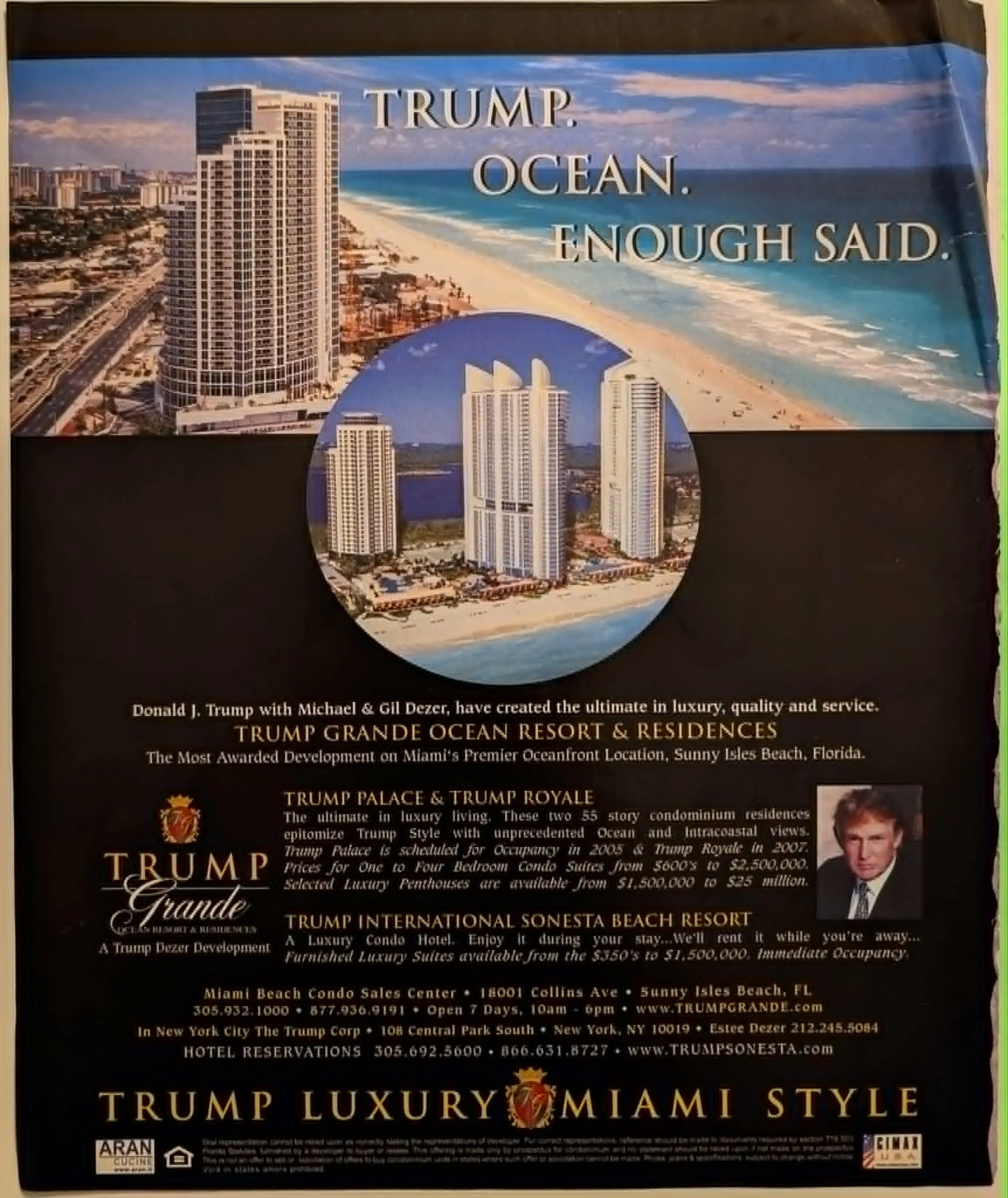
Before the turn of the millennium, a building was defined by its location. Its geometry. Its concrete utility. Then came the era of the licensed monolith. The artifact before us is not merely a vintage advertisement for a luxury residence. It is a historical blueprint of a profound economic and psychological shift. The transformation of human shelter into a branded, speculative commodity. Here, the developer is no longer just a local builder. The developer is an international celebrity. The building is a global product line. This dossier examines the absolute peak of the pre-2008 real estate frenzy. It is a moment captured in high-gloss ink, unapologetic typography, and the endless promise of the Atlantic ocean. A time when a name on a facade held more weight than the steel within the walls.
Category: Other
The History
The Epoch of Speculative Architecture We observe the years leading up to 2007. A period defined by frictionless capital, hyper-leverage, and boundless economic optimism. The global financial engine was accelerating toward an unseen, devastating precipice. In the United States, the concept of real estate had fundamentally transcended its traditional role. It was no longer just a place to reside, raise a family, or anchor a community. It had become the ultimate vehicle for rapid wealth generation. The artifact we are analyzing belongs precisely to this volatile, exuberant window in human history. The advertisement for the Trump Grande Ocean Resort & Residences—comprising Trump Palace, Trump Royale, and the Trump International Sonesta Beach Resort—is a definitive, physical marker of this epoch. The document proudly lists scheduled occupancy dates of 2005 and 2007. This places its creation at the very precipice of the 2008 subprime mortgage crisis. But in the glossy reality of this print advertisement, the impending crisis does not exist. Only the ascent exists. Only the limitless, tax-favorable sky of the Florida coast. Sunny Isles Beach: The Eradication of Motel Row To understand the true weight of this artifact, we must first understand the geography it altered. Sunny Isles Beach, Florida. For decades throughout the mid-to-late twentieth century, this specific stretch of barrier island coastline was known affectionately as "Motel Row." It was a quaint, low-rise collection of mid-century modern, themed motels catering to middle-class tourists from the Northeast and Midwest. It was democratic. It was architecturally accessible. By the early 2000s, the land beneath these two-story motels became simply too valuable to sustain their existence. A systemic, aggressive eradication of the old paradigm began. Developers, notably Michael and Gil Dezer—prominently named in this artifact—acquired massive, contiguous parcels of this oceanfront property. They did not build new motels. They built soaring fortresses of glass, steel, and concrete. The skyline was violently and rapidly rewritten. This advertisement captures the sheer, unapologetic scale of that coastal terraforming. Three towering structures dominating the horizon, entirely replacing the architectural modesty of the past. This was not merely urban gentrification. It was the complete, irrevocable overwrite of a city’s structural DNA. The Mechanics of Architectural Licensing The most critical historical shift documented in this artifact is the elevation of the "brand" over the brick. Historically, a luxury building relied on the prestige of its physical address. "Fifth Avenue." "Park Avenue." "Beverly Hills." In this new era, the address became subservient to the licensed name bolted to the facade. Donald J. Trump did not pour the concrete for these towers. The Dezer family were the primary developers who executed the construction. Trump provided the brand identity. This represents a profound evolution in late-stage real estate capitalism. It is the licensing of a human persona to convey an immediate, globally understood standard of ultimate luxury. The artifact prominently features Donald Trump’s face. His portrait acts as a visual anchor in the lower right quadrant of the composition. He is positioned not as an architect, and not merely as a partner, but as a guarantor of prestige. The text explicitly mentions "Trump Style." It sells a lifestyle, an attitude, and a perception of ultimate, unassailable success. The shift is entirely clear: buyers were no longer just purchasing square footage on a beach. They were purchasing proximity to a perceived aura of billionaire status. The Condo-Hotel Paradigm Examine the fine text detailing the Trump International Sonesta Beach Resort. "A Luxury Condo Hotel. Enjoy it during your stay... We'll rent it while you're away..." This simple sentence introduces another vital, complex mechanism of the era's economic machinery. The condo-hotel. This concept bridged the psychological gap between a vacation home and a liquid investment vehicle. It promised a frictionless, affluent existence. Ownership without the tedious burden of property management. Revenue generation without active labor. This financial paradigm fueled the speculative fires of the mid-2000s Miami market. It acted as a magnet for international capital. Buyers from Latin America, Europe, and Eastern Europe viewed these specific units as safe-haven assets, shielded by an American brand name. The artifact, therefore, does not just advertise a domestic home; it advertises a globally integrated financial mechanism. It is a self-sustaining asset class wrapped in the glittering veneer of a beachfront vacation. The Price of Illusion The figures printed on this page serve as a stark ledger of the era’s rampant asset inflation. "Prices for One to Four Bedroom Condo Suites from $600's to $2,500,000." "Selected Luxury Penthouses are available from
The Paper
We examine the physical substrate of the artifact. It is constructed of a high-gloss, high-GSM (Grams per Square Meter) magazine stock. This specific material is commonly found in inflight luxury magazines, high-end lifestyle periodicals, or elite real estate portfolios of the mid-2000s. The glossy coating is a crucial, intentional element of the medium. It is designed to reflect light, perfectly mirroring the superficial, "glossy" lifestyle the ink promotes. Under microscopic analysis, the CMYK dot pattern reveals a tightly clustered arrangement, heavily prioritizing the saturation of the cyan ink to render the vast, appealing ocean, and the magenta/yellow mix to render the golden typography and the skin tones of the portrait. Over time, this specific chemical composition of glossy paper is prone to marginal yellowing and slight delamination at the edges, especially if exposed to the humidity of the very coastal environment it advertises. This specific artifact shows remarkable preservation, suggesting it was kept in a controlled, dark environment. It is a physical ledger that has successfully outlasted the economic boom it was printed to herald.
The Rarity
Classification: Class A (High Contextual Significance) While hundreds of thousands, perhaps millions, of these specific magazine inserts were printed and globally distributed in the mid-2000s, the survival rates of ephemeral, date-stamped advertising are notoriously, aggressively low. They are consumed. They are discarded. They are recycled into new media. The rarity of this dossier does not stem from a theoretical monetary value on a modern auction block. Its rarity is purely contextual and historical. It is a pristine survivor from the absolute zenith of a specific, devastating financial bubble. Finding an unblemished, fully legible copy that so perfectly articulates the condo-hotel model, the architectural terraforming of Sunny Isles, and the licensing era of Trump real estate before the 2008 crash makes it a highly significant document for urban historians, economists, and sociologists alike.
Cite this article
- MLA
- Naodhinsuk, Ronin. “The Time Traveller's Dossier : Trump Grande - The Branded Skyline Shift.” The Record Institute, 20 June 2026, https://therecord.institute/journal/the-time-travellers-dossier-trump-grande-the-branded-skyline-shift.
- APA
- Naodhinsuk, R. (2026, June 20). The Time Traveller's Dossier : Trump Grande - The Branded Skyline Shift. The Record Institute. https://therecord.institute/journal/the-time-travellers-dossier-trump-grande-the-branded-skyline-shift
- CHICAGO
- Naodhinsuk, Ronin. 2026. “The Time Traveller's Dossier : Trump Grande - The Branded Skyline Shift.” The Record Institute, June 20, 2026. https://therecord.institute/journal/the-time-travellers-dossier-trump-grande-the-branded-skyline-shift.