The Time Traveller's Dossier : Twentieth Century Outlaws - The Genesis of Decentralized Civic Surveillance
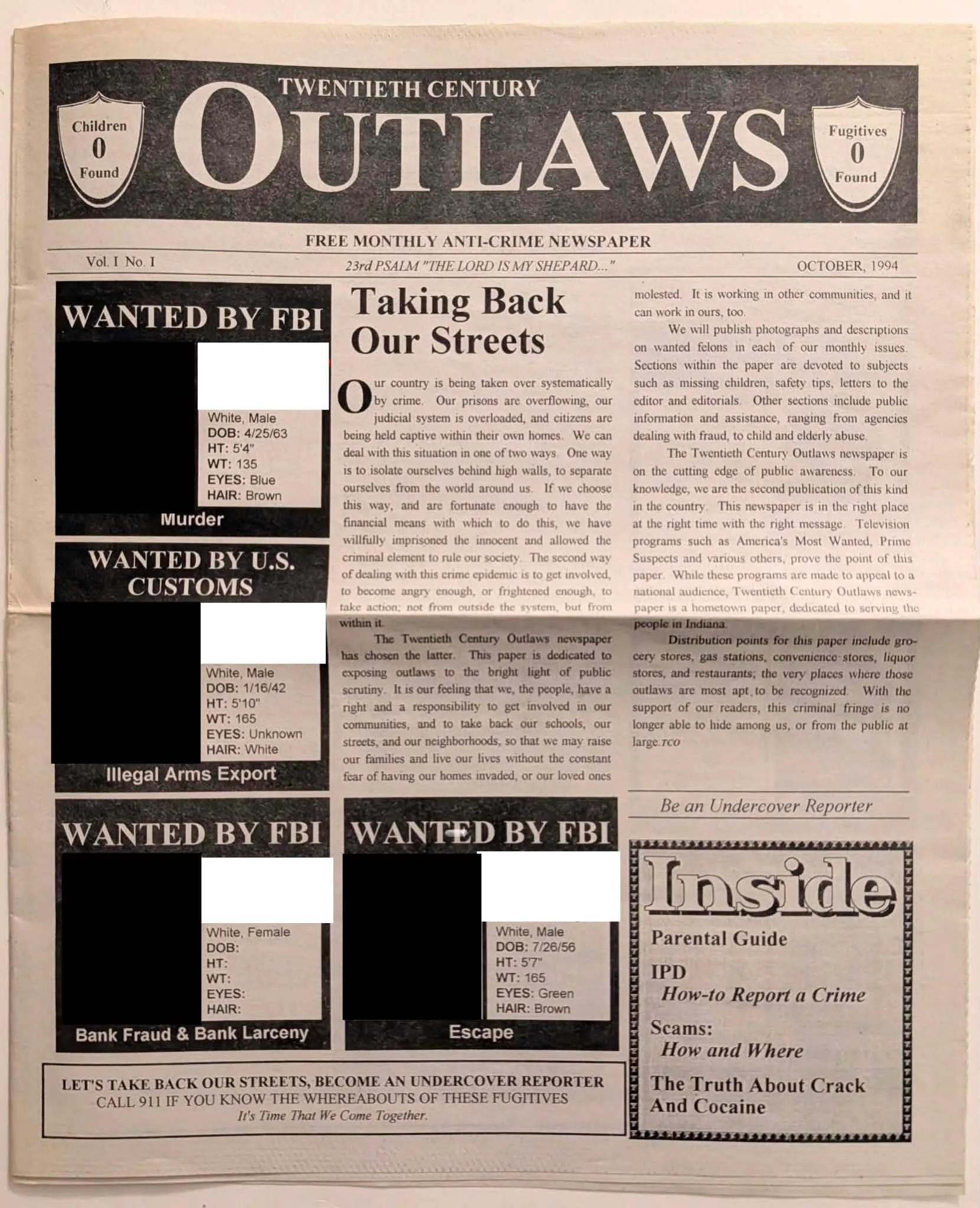
Then, the state held the monopoly on pursuit. Information regarding fugitives and systemic threats was locked behind the closed doors of precincts or relegated to the austere bulletin boards of federal post offices. The public was a passive observer. Now, we exist in an era of open-source intelligence, digital vigilantism, and real-time community reporting. The artifact before us bridges that exact transition. It is October 1994. The problem is an overwhelming societal fear of crime, articulated through a medium of profound physical locality. The solution presented is the deputization of the everyday citizen. This publication does not merely report the news; it demands participation. It is the precursor to the digital neighborhood watch, printed on cheap pulp, distributed at the corner store, and fueled by raw civic anxiety.
Category: Other
The History
The Epoch of Systemic Anxiety The year is 1994. The month is October. To understand this artifact, one must understand the atmospheric pressure of the era. The United States was navigating the apex of a decades-long escalation in violent crime. The societal narrative was dominated by the crack cocaine epidemic, urban decay, and a pervasive sense that institutional control was slipping. Just one month prior, the Violent Crime Control and Law Enforcement Act of 1994 had been signed into law, representing the largest crime bill in the history of the country. The front page of this publication operates as a localized manifesto of that exact national trauma. The lead editorial, boldly titled "Taking Back Our Streets," wastes no time on diplomatic rhetoric. It states, with absolute finality: "Our country is being taken over systematically by crime. Our prisons are overflowing, our judicial system is overloaded, and citizens are being held captive within their own homes". This is not journalism in the traditional sense; it is a declaration of a state of emergency. It captures a specific historical moment where the middle class felt entirely unprotected by the state apparatus. The Architecture of Vigilance and the Media Landscape Before the internet democratized data, information distribution required physical infrastructure. The mainstream competitors of the time were heavily funded, editorially sanitized metropolitan newspapers and national television broadcasts. The text itself acknowledges its media lineage, citing television programs like Prime Suspects and America's Most Wanted as proof that public awareness aids law enforcement. However, this artifact represents a vital, structural deviation. It critiques those national programs for appealing to a broad audience, positioning itself instead as a "hometown paper, dedicated to serving the people in Indiana". This is the hyper-localization of the crime panic. The engineering of its distribution was strategic. It bypassed traditional newsstands. Instead, it targeted the mundane intersections of daily life: "grocery stores, gas stations, convenience stores, liquor stores, and restaurants". By placing the faces of accused murderers, illegal arms exporters, and bank fraudsters next to the milk and gasoline, the publisher engineered a reality where the threat of violent crime was woven seamlessly into domestic routine. The Economics of Paranoia and Ephemeral Print Volume I, Number I. The inaugural issue of a "FREE MONTHLY ANTI-CRIME NEWSPAPER". The economic model of free press requires high volume and specific advertiser targeting. To sustain a free paper, the content must guarantee engagement. Fear is the ultimate guarantor of attention. The economic landscape of the mid-90s allowed for independent desktop publishing to flourish, meaning a small group of highly motivated citizens could bypass media gatekeepers entirely. The publication addresses the economic divide of safety explicitly. It argues that those with "financial means" choose to "isolate ourselves behind high walls," thereby willfully abandoning society to the "criminal element". This text frames the consumption of this paper—and the active participation in its directives—as the only viable alternative for the everyday citizen who cannot afford a gated community. It is a profound socio-economic commentary hidden beneath the guise of a neighborhood bulletin. The Weaponization of the Ordinary Citizen Here lies the core historical shift. The artifact does not merely inform; it commands. The imperative phrase "Be an Undercover Reporter" marks a stark transition in the social contract. The state is no longer the sole investigator. The citizen is tasked with surveillance. The paper instructs its readers to expose outlaws to the "bright light of public scrutiny". This is the analog precursor to modern doxing and internet sleuthing. The publication provides the tools for this decentralized pursuit. The "Inside" section promises practical, tactical knowledge: "How-to Report a Crime," identifying "Scams," and "The Truth About Crack And Cocaine". It is a survival manual for the modern urban and suburban landscape. By providing physical descriptions—height, weight, eye color, and date of birth—the paper transforms every reader waiting in line at a gas station into an active node in a law enforcement dragnet. The Theological and Ideological Undercurrents Beneath the masthead, printed in stark italics, sits a singular line of scripture: "23rd PSALM 'THE LORD IS MY SHEPARD...'". The typographical error—misspelling "shepherd" as "shepard"—speaks volumes about the raw, unpolished urgency of the publication. More importantly, the inclusion of this specific psalm ("Yea, though I walk through the valley of the shadow of death, I will fear no evil") elevates the project from mere community watch to a righteous crusade. It frames the American Midwest of 1994 not as a geographic location, but as a moral battlefield. The criminals are not just lawbreakers; they are the darkness. The readers are not just citizens; they are the flock requiring protection, but also deputies in a divine mandate to cleanse their communities. It is a potent mixing of American civic duty, vigilantism, and religious justification. The Baseline of Failure and the Promise of Progress Flanking the title are two distinct crests. One reads "Children 0 Found". The other reads "Fugitives 0 Found". On Volume I, Number I, these zeros are not decorative. They represent the baseline. They are a stark visual representation of a system that is currently failing. The implicit promise of the publication is that through the collective action of its readership, these numbers will rise in subsequent issues. It gamifies the concept of justice, providing a scoreboard for the community's vigilance. This paper fundamentally shifted the expectation of the citizen. It argued that passive reliance on the police was obsolete. To survive the end of the 20th century, one had to become part of the apparatus of pursuit. This specific, fragile piece of newsprint is the fossilized record of the exact moment suburban America decided to fight back.
The Paper
The artifact is printed on standard, low-grade mechanical newsprint. This material was never engineered for longevity; it was designed for immediate consumption and disposal. The significant yellowing and oxidation of the paper stock indicate a high lignin content, an acidic reaction to three decades of atmospheric exposure. The texture is undeniably coarse and fibrous. The printing method utilizes standard web offset lithography, evidenced by the sharp contrast of the bold serif typography against the fading paper. The mugshots rely on a low-line-screen halftone pattern, a necessity for fast-drying ink on highly absorbent, cheap paper. This physical degradation is essential to its identity. It is an artifact recording time through its own slow decay, a physical manifestation of a fleeting, localized panic that has long since evaporated, leaving only the brittle paper behind.
The Rarity
While millions of newspapers were printed in 1994, this artifact achieves Class B status due to its inherent ephemerality. Free, hyper-local, independent publications distributed at gas stations possessed a lifespan of mere days before being discarded or used as packing material. Surviving copies of Volume I, Number I of independent fringe media are exceedingly rare. Its value is not derived from auction house metrics, but from its immense historical gravity as a primary source document of mid-90s socio-political anxiety and the evolution of citizen journalism.
Cite this article
- MLA
- Naodhinsuk, Ronin. “The Time Traveller's Dossier : Twentieth Century Outlaws - The Genesis of Decentralized Civic Surveillance.” The Record Institute, 21 July 2026, https://therecord.institute/journal/the-time-travellers-dossier-twentieth-century-outlaws-the-genesis-of-decentralized-civic-surveillance.
- APA
- Naodhinsuk, R. (2026, July 21). The Time Traveller's Dossier : Twentieth Century Outlaws - The Genesis of Decentralized Civic Surveillance. The Record Institute. https://therecord.institute/journal/the-time-travellers-dossier-twentieth-century-outlaws-the-genesis-of-decentralized-civic-surveillance
- CHICAGO
- Naodhinsuk, Ronin. 2026. “The Time Traveller's Dossier : Twentieth Century Outlaws - The Genesis of Decentralized Civic Surveillance.” The Record Institute, July 21, 2026. https://therecord.institute/journal/the-time-travellers-dossier-twentieth-century-outlaws-the-genesis-of-decentralized-civic-surveillance.