The Time Traveller's Dossier : U.S. Bongs - The Capitalist Hijacking of Counterculture
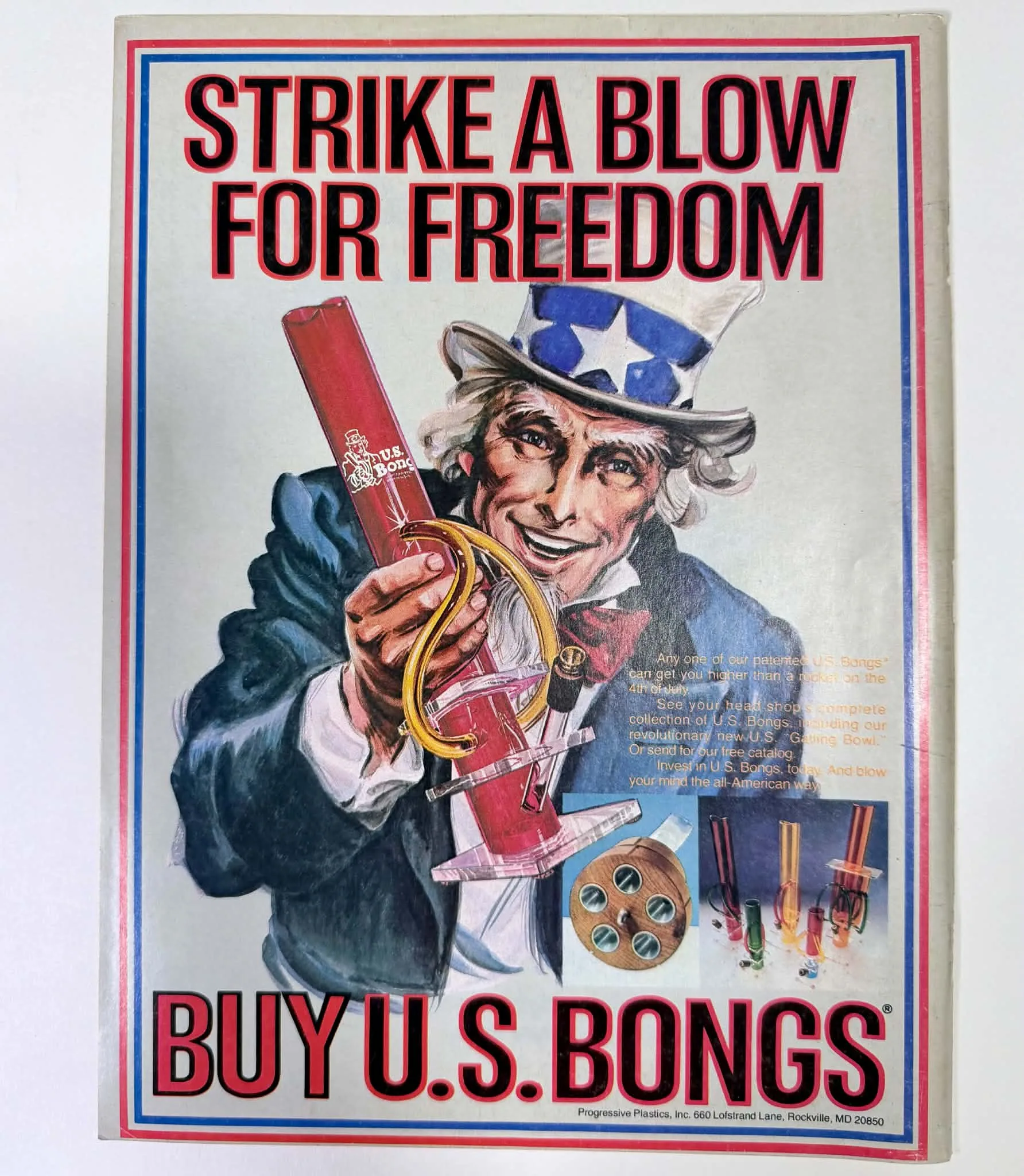
The past is not a static place. It is a repository of shifting paradigms. Rebellion was once a dangerous endeavor. It existed in the shadows, hunted by authority. Yet, this artifact stands as a monument to the collapse of that dichotomy. It is not merely a printed advertisement. It is the exact moment capitalism swallowed the counterculture whole. Uncle Sam, the ultimate avatar of state power, was once a figure of dread for draft-age youth. He pointed his finger. He demanded blood for foreign wars. But here, his purpose has been entirely inverted. He offers a bright red acrylic cylinder. His smile does not ask for sacrifice. It invites consumption. The problem of the era was the terrifying weight of government authority. The solution presented on this page is the commodification of that very authority. It is the ultimate ideological judo. If you cannot dismantle the machine, you mock it. And then, you sell the mockery back to the masses at a premium.
Category: Tobacco
The History
The Context of Subversion The era was defined by inescapable friction. The late 1960s bleeding into the 1970s created a fractured American psyche. The Vietnam War raged on televisions. The youth actively rejected the sterile, compliant capitalism of their parents. Psychoactive substances were not merely recreational; they were highly political tools. To consume was to rebel. To alter one's consciousness was a deliberate rejection of the military-industrial complex. In this atmosphere, paraphernalia was inherently primitive. It was hand-blown glass. It was carved wood. It was fiercely and intentionally anti-corporate. This artifact utterly obliterates that boundary. It takes the most recognizable tool of the American establishment and ruthlessly repurposes it. The massive headline "STRIKE A BLOW FOR FREEDOM" appropriates the sacred language of civil rights and anti-war movements. It strips the phrase of its political danger. It reassigns the profound concept of "freedom" to the mundane act of purchasing a consumer good. This is precisely how a subculture dies and a lucrative demographic is born. The Desacralization of National Icons Look closely at the rendering of Uncle Sam. Historically, he is a stern, commanding patriarch. He requires absolute obedience. In this advertisement, his visage undergoes a radical desacralization. Desacralization is the psychological process of stripping a symbol of its sacred or terrifying aura. By placing a red acrylic water pipe in his hands, the designers essentially castrated the visual symbol of the state. His eyes are wide, almost manic in their intensity. His grin is deeply complicit. The ad text explicitly states, "Any one of our patented U.S. Bongs can get you higher than a rocket on the 4th of July.". The 4th of July is the high holy day of American civic religion. Rockets represent military might, historical triumph, and explosive power. Here, they are reduced to a simple metric for intoxication. The closing phrase "blow your mind the all-American way" completes the inversion. It suggests that true patriotism is no longer found in a muddy trench, but in a state of chemically altered euphoria. Progressive Plastics and the Industrialization of Paraphernalia The physical reality of the object being sold is equally important to the narrative. The bottom right of the artifact reads: "Progressive Plastics, Inc. 660 Lofstrand Lane, Rockville, MD 20850". This is not a utopian commune in San Francisco. This is a sterile industrial park in suburban Maryland. This marks the absolute industrialization of paraphernalia. The bongs depicted are not fragile, unique art pieces. They are standardized, extruded acrylic cylinders. They feature uniform, bright yellow surgical tubing. The use of plastics represents a massive technological shift for the underground market. It means mass production. It means economies of scale. The word "patented" appears in the text, proudly claiming "patented U.S. Bongs". A patent requires the protection and endorsement of the federal government. The very government that violently criminalized the substance intended for the device was now protecting the intellectual property of the device itself. This is the supreme, defining contradiction of the American legal system during the 1970s. The Gatling Bowl and the Irony of Weaponized Peace The most fascinating engineering detail resides in the "U.S. 'Gatling Bowl'". Displayed in a circular inset, it features a wooden block machined with five distinct metal-rimmed chambers. The Gatling gun is a historic weapon of mass casualty. It represents the dawn of mechanized, industrial slaughter. To appropriate the name and function of a machine gun for a device strictly meant to induce peaceful euphoria is a masterstroke of dark irony. It reflects the deeply conflicted psychological state of a generation raised entirely in the shadow of war. They took the brutal mechanics of death and twisted them into the mechanics of extreme leisure. The multiple chambers allowed for sustained consumption without reloading, directly mimicking the rapid-fire destruction of its namesake. It is an engineering marvel born entirely from gallows humor. Navigating the Grey Market Economy The business model embedded in the text reveals the legal ambiguity of the era. The ad directs consumers to "See your head shops complete collection" or "send for our free catalog". The head shop was a uniquely liminal space. It operated in the twilight of legality, constantly threatened by local law enforcement. By offering a mail-order catalog, Progressive Plastics strategically bypassed local ordinances. They brazenly utilized the federal postal service to distribute tools of cultural subversion. The layout shows multiple color options: red, yellow, green, and purple. This provides the comforting illusion of choice inherent in advanced consumer capitalism. The revolution was not televised, but it was certainly color-coordinated for visual appeal. The final branding "BUY U.S. BONGS" is displayed in massive, block lettering at the footer. It mimics the aggressive, commanding layout of a World War II war bond drive. It is aggressive. It is unapologetic. The Psychological Containment of Rebellion Why does an advertisement like this work so effectively? It functions entirely through the exploitation of cognitive dissonance. The American viewer is conditioned from birth to respect the imagery of Uncle Sam. When that imagery is aggressively subverted, the brain experiences a fleeting moment of shock, immediately followed by amusement. This amusement is the psychological hook. Once the viewer laughs at the sheer audacity of the image, their defensive barriers drop. They are no longer analyzing a piece of controversial drug paraphernalia; they are enjoying an inside joke. Progressive Plastics understood this dynamic implicitly. They were not merely selling plastic tubes; they were selling participation in a shared joke against the establishment. The audacity to print this in a magazine, to send it through the mail, was a form of soft terrorism against the conservative sensibilities of the Nixon era. Furthermore, the socioeconomic implications are profoundly revealing. In the early 1970s, the counterculture was largely composed of white, middle-class youth who could actually afford the luxury of "dropping out" of society. By manufacturing these devices out of durable acrylic, Progressive Plastics was catering directly to this specific demographic. They recognized that the hippie movement possessed disposable income. They recognized that rebellion had a quantifiable market cap. This transition—from a grassroots political movement to a targeted consumer demographic—is the fundamental trajectory of all successful American subcultures. What begins as a protest inevitably ends up as a product line. The U.S. Bongs advertisement serves as the Rosetta Stone for this societal phenomenon. It translates the raw, dangerous anger of the 1960s into the cynical, detached consumerism of the 1970s. Consider the broader implications of the word "Freedom" utilized in this context. The United States was founded on the concept of negative liberty—the freedom from external restraint. The anti-war movement fought for freedom from the military draft. The civil rights movement fought for freedom from systemic racial oppression. But the "freedom" being sold on this page is entirely different. "STRIKE A BLOW FOR FREEDOM" is a direct call to consumer action. It redefines liberty as the unrestricted right to purchase and consume illicit-adjacent goods. The product itself, the bong, becomes a physical vessel for this manufactured liberty. It creates a closed-loop system of rebellion. You buy the bong, you consume the substance, you feel a temporary sense of liberation, and then the cycle repeats endlessly. Capitalism has successfully contained the subversive energy, redirecting it away from the protest lines and safely into the living room. The state is no longer threatened, because the revolutionaries are far too busy investing in U.S. Bongs, "the all-American way". This is the ultimate, quiet triumph of the system. It does not destroy its enemies; it monetizes them.
The Paper
The medium is never just the message; it is the physical timeline. This artifact is a tangible manifestation of mechanical reproduction. Look closely at the ruddy cheeks of Uncle Sam and the vivid red of the acrylic cylinder. You will see the intricate, overlapping architecture of halftone dots. This is the unmistakable signature of CMYK offset printing. It is a technology that predates the sterile perfection of digital rendering. It relies on microscopic rosettes of cyan, magenta, yellow, and black ink physically colliding on paper. The text "STRIKE A BLOW" features a black drop shadow that bleeds slightly into the red. This imperfect registration is a ghost of the mechanical printing press in motion. The paper itself is a canvas currently in decay. It possesses the slight, reflective gloss of mid-century magazine stock. However, the once-pristine white margins are slowly yielding to time. Acid decay, an inevitable chemical reaction within the raw wood pulp, is turning the borders a faint, nicotine yellow. The surface shows subtle ripples and hairline stress marks. It has been handled, folded, stored, and forgotten. This decay is essential to its identity. It proves the artifact has traveled through the hostile, degrading environment of linear time to reach us.
The Rarity
Financial market value is a trivial metric for an object of this specific nature. Its true worth lies entirely in its contextual anomaly. This artifact represents a remarkably narrow, fragile window in American history. It exists perfectly in the brief plateau of legal tolerance before the cultural backlash. By the 1980s, the Reagan administration’s aggressive "War on Drugs" would obliterate this grey market entirely. Advertisements of this brazen, colorful nature were driven strictly to extinction. Paraphernalia laws became incredibly draconian. The very existence of this page—a full-color, unapologetic integration of nationalistic pride and drug culture—became legally and socially impossible to replicate. It achieves Class S status because it is a pristine fossil of a defunct reality. It proves that, for a fleeting moment, the American establishment and the underground shook hands to turn a profit.
Cite this article
- MLA
- Naodhinsuk, Ronin. “The Time Traveller's Dossier : U.S. Bongs - The Capitalist Hijacking of Counterculture.” The Record Institute, 26 September 2026, https://therecord.institute/journal/the-time-travellers-dossier-us-bongs-the-capitalist-hijacking-of-counterculture.
- APA
- Naodhinsuk, R. (2026, September 26). The Time Traveller's Dossier : U.S. Bongs - The Capitalist Hijacking of Counterculture. The Record Institute. https://therecord.institute/journal/the-time-travellers-dossier-us-bongs-the-capitalist-hijacking-of-counterculture
- CHICAGO
- Naodhinsuk, Ronin. 2026. “The Time Traveller's Dossier : U.S. Bongs - The Capitalist Hijacking of Counterculture.” The Record Institute, September 26, 2026. https://therecord.institute/journal/the-time-travellers-dossier-us-bongs-the-capitalist-hijacking-of-counterculture.