The Time Traveller's Dossier: Van Gogh Print - The Offset Illusion
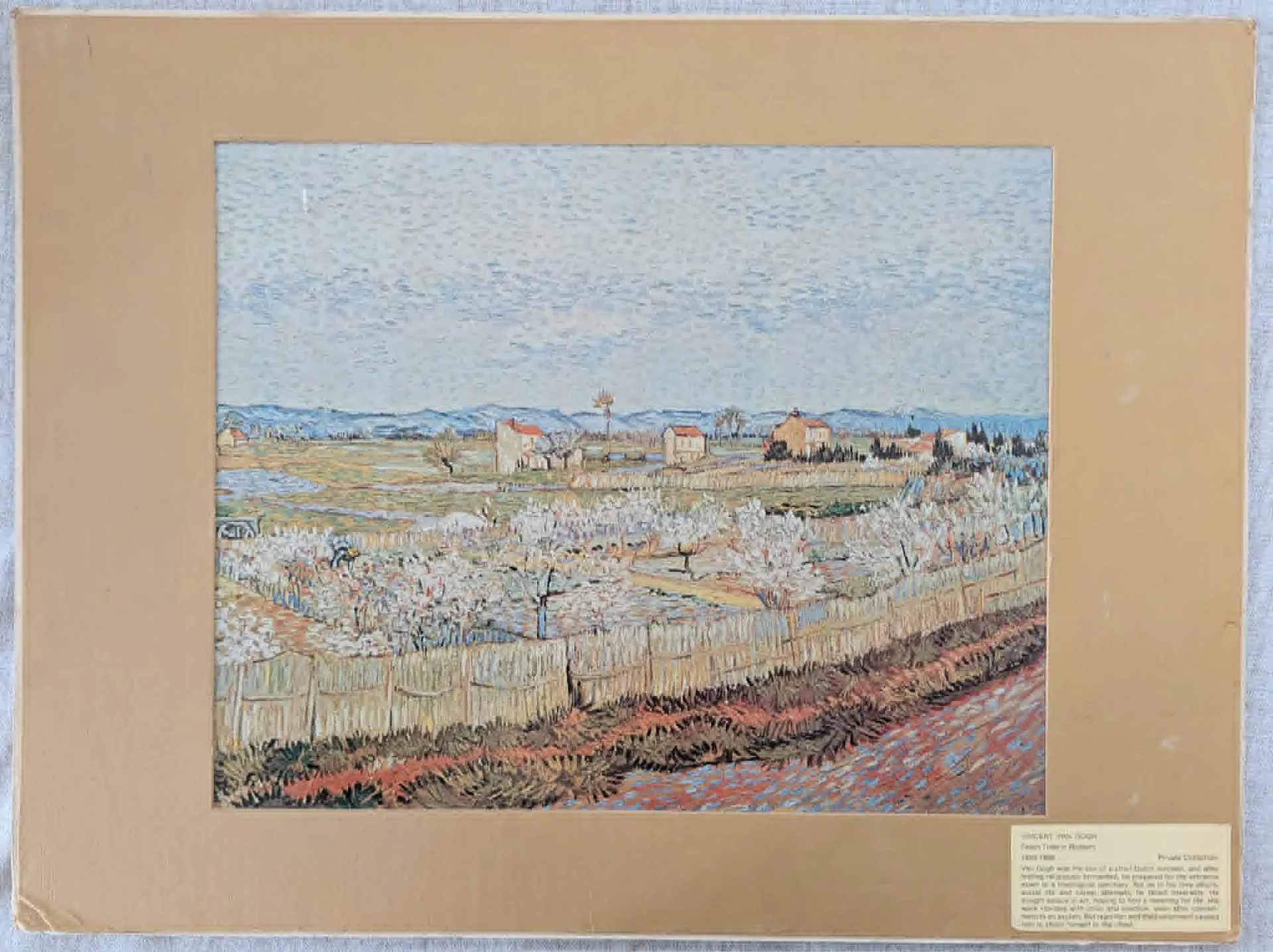
The object before us presents a profound paradox of replication. It is a mid-20th-century offset lithographic reproduction of Vincent van Gogh’s 1889 masterpiece, Peach Trees in Blossom. To the untrained modern eye, it is merely an old print mounted on cardboard. To the archivist, it represents a crucial sociopolitical shift in human history. Then, art was an exclusive, localized experience. To witness Van Gogh’s texture, one had to stand before the canvas in Arles or a private gallery. Now, industrial printing technology democratizes the avant-garde. This artifact captures the exact moment high culture collided with mass production. It is an engine of simulation designed to deliver the aura of genius to the domestic living room.
Category: Other
The History
The Post-War Cultural Explosion In the mid-20th century, Western society underwent a radical transformation. The trauma of global conflict gave way to an era of economic expansion and educational democratization. A rising middle class emerged, hungry for cultural capital. Possessing art was no longer solely the domain of industrialists and aristocrats. However, authentic oil paintings remained scarce and prohibitively expensive. The solution lay in the advancement of high-fidelity printing techniques. Publishers and educational institutions sought to bridge the gap between museums and the masses. They began producing large-format portfolios of Western masterpieces. These were not mere postcards; they were intended to be framed, contemplated, and respected. The artifact under analysis—Vincent van Gogh's Peach Trees in Blossom—is a product of this specific educational and commercial push. The Technical Battle: Replicating Impasto Van Gogh’s artistic language relies heavily on impasto. His brushstrokes are not flat applications of color; they are three-dimensional sculptures of oil paint. They catch light and cast minute shadows across the surface of the canvas. For early 20th-century printers, reproducing this depth was an insurmountable obstacle. Traditional woodcuts, steel engravings, and basic letterpress operations reduced his expressive, violent marks to flat, muddy tones. By the 1950s and 1960s, commercial offset lithography reached its zenith. Printers utilized multi-color photographic separation techniques to isolate the subtle shifts in tone, hue, and shadow. Look closely at the detail of the house in the background. The printer did not merely attempt to copy the color of the paint. They attempted to map the shadows cast by the ridges of Van Gogh’s original brushwork. This created an illusion of texture on a completely flat sheet of paper. It was an engineering feat that transformed the printing press into a translator of human psychological expression. Competitors of the Era and the Curatorial Frame During this period, various reproduction methodologies competed for market dominance. On the high end, fine-art publishers utilized collotype printing. Collotype offered continuous tones without a visible dot screen, but it was slow, expensive, and limited in production volume. On the lower end, cheap rotogravure prints flooded newspapers and magazines, sacrificing color accuracy for speed. The offset lithograph on heavy cardstock found the perfect equilibrium. It allowed for mass distribution while maintaining enough visual integrity to satisfy academic scrutiny. This particular artifact includes an institutional curatorial label printed directly on the mat board. The text provides a biographical narrative of Van Gogh’s torment, his religious struggles, and his ultimate suicide. This choice is highly deliberate. It shows that the object was not marketed merely as decoration. It was sold as an educational tool—a museum experience packaged for the home or classroom. The Philosophical Shift: Walter Benjamin Realized In his seminal essay, The Work of Art in the Age of Mechanical Reproduction, philosopher Walter Benjamin posited that mass reproduction strips an artwork of its "aura"—its unique existence in time and space. This artifact proves Benjamin both right and wrong. While the print lacks the physical presence of the canvas painted in Arles, it constructs a new kind of secondary aura. For millions of individuals who would never cross the Atlantic or visit a metropolitan museum, this print was Van Gogh. It shaped the collective cultural consciousness of a generation. The shift it represents is total: art moved from being a singular sacred object to a distributed, omnipresent intellectual concept.
The Paper
The physical manifestation of this artifact tells a story of industrial intent and natural decay. The print is executed on a heavy, substantial cardstock, likely between 250 and 300 GSM. This thickness was chosen to prevent warping when mounted or framed, ensuring the long-term durability required for educational environments. The printing method is high-grade offset lithography. Under magnification, the image dissolves into a precise CMYK rosette halftone pattern. Unlike modern digital printing which relies on erratic inkjet droplets, this mid-century process utilized solid, chemically etched metal plates. The ink density is remarkably high, allowing the rich blues of the distant mountains and the deep ochres of the foreground to retain their presence despite decades of environmental exposure. Aging is visible primarily along the perimeter of the mat board. The distinctive browning and yellowing indicate a high concentration of lignin within the wood pulp fibers used to manufacture the board. Over time, exposure to atmospheric oxygen and ultraviolet light has triggered an oxidation process, darkening the borders while leaving the central printed image relatively shielded. The reverse side reveals mounting strips, minor abrasions, and a handwritten signature reading "Lindgren", signaling past ownership and a life lived within an active human environment rather than a climate-controlled vault.
The Rarity
This artifact does not possess immense monetary wealth on the contemporary art market; it is not a rare hand-signed lithograph by the artist. However, within the taxonomy of 'The Record Institute', it is classified as Class A. The rarity lies in its contextual value and state of preservation. Most educational prints from this era were destroyed, worn down by handling in schools, or discarded during the transition to digital media. Finding a complete specimen that retains its original printed mat board, detailed curatorial label, and historical patina is increasingly uncommon. It stands as a pristine physical monument to the mid-century project of mass-producing enlightenment.
Cite this article
- MLA
- Naodhinsuk, Ronin. “The Time Traveller's Dossier: Van Gogh Print - The Offset Illusion.” The Record Institute, 4 July 2026, https://therecord.institute/journal/the-time-travellers-dossier-van-gogh-print-the-offset-illusion.
- APA
- Naodhinsuk, R. (2026, July 4). The Time Traveller's Dossier: Van Gogh Print - The Offset Illusion. The Record Institute. https://therecord.institute/journal/the-time-travellers-dossier-van-gogh-print-the-offset-illusion
- CHICAGO
- Naodhinsuk, Ronin. 2026. “The Time Traveller's Dossier: Van Gogh Print - The Offset Illusion.” The Record Institute, July 4, 2026. https://therecord.institute/journal/the-time-travellers-dossier-van-gogh-print-the-offset-illusion.